A Yuamigi Lets Strangers Share One Bath
· 8 min read
A yuamigi is the thin bathing garment worn in the water at a growing number of mixed onsen in Japan, and it is quietly changing who feels able to share the bath.
The water is not what stops most people at a mixed onsen. The temperature is fine, the setting is often superb, and the shared pool is usually the oldest and grandest bath the inn owns. What stops people is the short walk from the changing room to the water, and the feeling of being looked at along the way. A yuamigi exists to shorten that walk. It is a thin bathing garment, worn in the water itself, and at a growing number of mixed baths it is the difference between trying the famous pool and quietly choosing the smaller separated one instead.
The garment itself is unremarkable, and that is rather the point. A yuamigi is a sleeveless wrap dress or a loose tunic of thin cotton or quick drying synthetic cloth, put on over a washed body and kept on while you soak. Inns rent them at the front desk or sell them in the shop, and where a yuamigi is offered at all, it is offered precisely so that strangers can share one bath without anyone having to be brave about it.
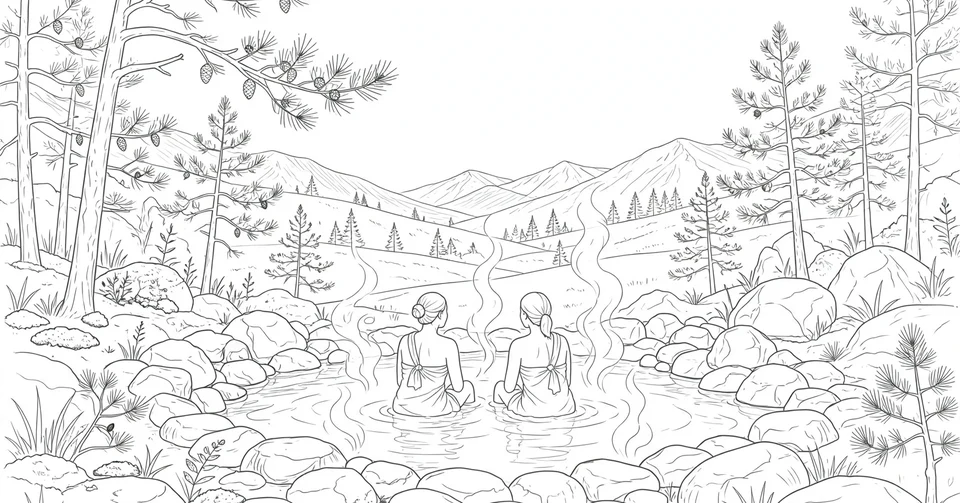
A piece of cloth sounds like a small thing to argue about. In the world of the Japanese bath, though, it touches almost everything at once: hygiene, tradition, who feels welcome in the water, and who quietly stopped coming years ago.
What a yuamigi is, and what it is not
The name is plain descriptive Japanese: a garment for wearing in the hot water. In practice a yuamigi takes a few forms, most often a wrap front dress tied at the side or a simple pull over tunic, cut long enough to stay modest when the cloth is wet. The colours are nearly always dark, navy, brown or deep green, for a practical reason. Pale fabric turns transparent in the water, and a garment that fails at its one job is worse than none.
A yuamigi is not a swimsuit, and the distinction matters to the inns. A swimsuit arrives from outside, worn at beaches and pools and who knows where else, and most traditional baths ban swimsuits outright. A house yuamigi is different: it is owned and laundered by the inn, worn only in that inn's water, and put on only after the bather has washed. That is why places that allow the garment so often insist on their own. At Sukayu in Aomori, where the best known experiment with the garment took place, bringing your own was not accepted even during the trial days; only the inn's yuamigi, or one bought in its shop, could go in the water.
The garment also turns up beyond mixed bathing. Some separated baths now accept a yuamigi for bathers who have surgical scars, who are recovering from illness, or who simply prefer some cover, and travel guides note that the number of such facilities is growing. The mixed bath made the yuamigi visible, but the need it answers was never only about men and women in the same pool.
The problem the yuamigi is answering
Mixed bathing was the Japanese default for centuries, and the surviving konyoku pools are remote, old and run on strict house rules, as I found when writing about how konyoku is still out there, past the last train station. But survival has a weak point, and it is not the water quality or the buildings. It is behaviour. A small number of male bathers, nicknamed wani or crocodiles by exasperated regulars, took to settling into mixed pools for hours, motionless, waiting for women to arrive. One guide to mixed bathing describes the pattern bluntly, and the outcome was predictable: women stopped coming, the pools filled with men waiting for women who no longer came, and some inns partitioned or closed their mixed baths altogether.
Read that history and the yuamigi stops looking like a concession to shyness. The women who stayed away were not, for the most part, objecting to shared water. They were objecting to being watched in it. A garment that covers the body from shoulder to knee answers the actual complaint, which is why inns and officials began to treat the yuamigi as a tool for saving mixed bathing rather than diluting it.
Five days at Sukayu when nobody bathed without one
The most serious test came at Sukayu Onsen, a toji inn in the Hakkoda mountains of Aomori whose great cypress bath, the Hiba Sennin Buro, is one of the most famous mixed pools in Japan. In November 2021 the Ministry of the Environment ran a demonstration there as part of a project on the future of mixed bathing in Towada Hachimantai National Park. On five days that month, the 19th, 21st, 23rd, 25th and 27th, everyone entering the big bath between 10 in the morning and 3 in the afternoon had to wear a yuamigi, men included. The garment was lent free, the normal day bathing fee of 1,000 yen was all anyone paid, and bathing without one was simply not allowed during those hours. The ministry's announcement of the Sukayu yuamigi days framed the aim widely: a mixed bath that women, younger bathers, foreign visitors and sexual minorities could all use without strain, so that the culture could be handed on.
The reported result was modest and telling. During the trial, the share of women among the bathers in the big pool went up. Nothing about the water had changed, and nothing about the room had changed. Only the terms of being seen in it had changed, and that was enough to bring back bathers the inn had been losing.
Today Sukayu has settled into the middle position. Wearing a yuamigi in the Hiba Sennin Buro is optional, the inn rents them for a small fee, and the big bath also keeps women only hours in the morning and evening for those who prefer them. The garment sits alongside the older arrangements rather than replacing them.
The honest argument against it
It would be tidy to present the yuamigi as pure progress, but the case against it is not foolish. Part of the pleasure of an onsen is the direct contact of mineral water with skin, and a layer of cloth genuinely changes that sensation. Bathers who grew up with mixed pools as they were can feel that a dressed bath is a different and lesser thing, closer to a swimming pool than to the tradition they know. I have some sympathy with this. A compromise that satisfies everyone usually satisfies no one completely, and the yuamigi is a compromise all the way down.
Hygiene cuts both ways, too. Critics of clothing in the water argue that fabric carries soap residue and dirt into the pool. Defenders answer that a thoroughly washed body inside a freshly laundered house garment is no dirtier than a body alone, and that the inns control the laundry precisely to keep it that way. Meanwhile a good number of inns ban every kind of clothing in the water, for cleanliness and for tradition, and they are not villains in this story. They are keeping a stricter version of the same culture.
The result is that there is no national rule for the yuamigi, only house rules. Depending on the inn, the garment is compulsory, optional, or forbidden, and a traveller who assumes one inn's policy applies at the next will eventually be corrected at a changing room door. The only safe habit is to check the specific bath before you go.
Where the yuamigi stands now
The strictest version has its own successes. Takaragawa Onsen in Gunma, whose huge terraced pools along a mountain river are among the most photographed in Japan, made the yuamigi compulsory for everyone in 2019, and the arrangement is now simply how that bath works. At Kusatsu, the open air Sainokawara bath runs a mixed session on Friday evenings where women rent a gown and men are lent one free and asked to wear it. Dressing everybody, it turns out, is easier to police and easier to relax in than dressing only the people who feel exposed.
Elsewhere the water itself does the covering. At Nyuto Onsen in Akita, the famous mixed pools are filled with opaque milky water that hides everything a few centimetres below the surface, and those baths stayed popular with women long before anyone discussed garments. The yuamigi matters most where the water runs clear and the room is bright, which is to say at exactly the grand old baths that have the most to lose.
My own feeling, after reading around the subject, is that the garment asks very little of the tradition and gives it a great deal. Nobody is required to like wearing one, and the inns that ban clothing entirely should be free to go on doing so. But a custom that only the unbothered can still enjoy will shrink with every generation, and the mixed bath has already shrunk enough.
A tradition survives by being entered, not by being admired from outside. For centuries the shared bath at places like Sukayu asked nothing of its bathers but soap, hot water and decent behaviour. The yuamigi is how a more self conscious century meets those same terms: washed, covered, and in the water together, which is where the custom was always meant to happen.
More in Life & Style
Latest posts
- Shimekasu Was Herring You Never Ate
- A Hana Donko Wears Its Cracks Like Flowers
- Hashigo-Nori Is Riding a Ladder Someone Else Holds
- At a Goma, Prayers Are Written to Be Burned
- The Sekaa Teruna Builds the Monsters
- A Lembaga Perkreditan Desa Is a Bank the Village Owns
- Every Melasti Goes to Fetch Tirta Amerta
- Kuki Is the Spring the Sea Turned White
- When the Kulkul Stops Sounding for You
- A Caru Is an Offering for the Ones You Fear
- Tatsuko Wished for Beauty and Became a Statue
- Warangan Is the Wash That Reveals the Pattern
- Every Village Writes Its Own Awig-Awig
- Umaji Refused to Disappear
- Rwa Bhineda Keeps Opposites From Going to War