The Kunimasu Came Back From Extinction
· 9 min read
The kunimasu, a deep water trout found only in Lake Tazawa, was written off as extinct after acid river water poisoned its lake in 1940, then turned up alive 70 years later in a lake 500 kilometres away.
In 2010, researchers working in Lake Saiko, one of the Fuji Five Lakes in Yamanashi Prefecture, pulled nine small, dark trout out of the deep water. The fish were kunimasu, a landlocked trout that had been declared extinct 70 years earlier, after its only home lake was poisoned. Nothing about the catch was supposed to be possible.
The stranger part is that nobody had saved the kunimasu on purpose and then forgotten. A shipment of its eggs had been sent to other lakes in 1935, written off as a failure, and erased from the plan. The species survived for three quarters of a century by being mistaken for a different, commoner fish, in a lake at the foot of Mount Fuji, while the world filed it under gone forever.
To understand how unlikely the return was, it helps to start with the lake that lost the fish, because the kunimasu was never a widespread species waiting for a second chance. It was a one lake fish, and the lake changed faster than it could.
A fish that lived in exactly one lake
The kunimasu was endemic to Lake Tazawa in Akita Prefecture, and to nowhere else on Earth. Tazawa is the deepest lake in Japan, dropping 423 metres, with no natural inflow or outflow and cold, clear depths that once measured 31 metres of transparency. I wrote about that remarkable lake in a piece on Lake Tazawa, the deepest lake in Japan, and the kunimasu was its signature fish, the creature the lake was known for.
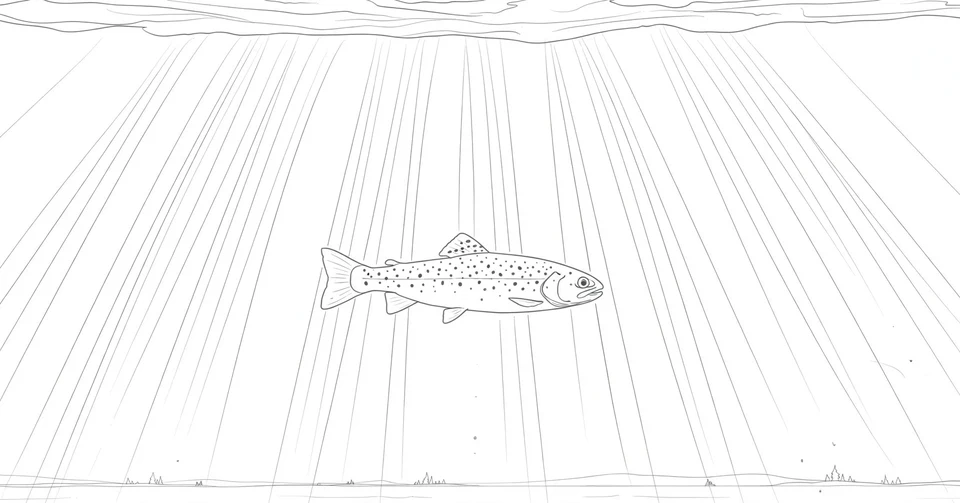
It is a modest looking animal. An adult kunimasu grows to about 30 centimetres, dark olive along the back with black spots, long and slim in the body. It is a close relative of the sockeye salmon, landlocked and freshwater bound, and it was formally described in 1925 by the ichthyologists David Starr Jordan and Ernest McGregor. Its Japanese name is sometimes translated as national trout, which gives a sense of how proudly it was regarded at home.
Everything about its life happened in the cold and the dark. Kunimasu live benthopelagic lives, hovering just above the lake bottom and feeding on zooplankton, sieving the water through as many as 43 gill rakers. They spawn at depths of 30 to 40 metres in winter and spring, with the females sweeping out spawning beds with their tails. It was a fish built for one very deep, very stable lake, and for most of its known history that was enough.
Even its plainness was seasonal. Outside the breeding months both sexes are long, slim and silvery dark, but as spawning approaches the kunimasu changes shape. The body deepens into a dark olive green, the males grow a slight hump behind the head and a longer, pointed snout, and the females develop a noticeably larger mouth. For a few weeks a year the modest little trout puts on the full salmon family costume, humps, jaws and all, then fades back into the anonymous dark fish that nobody would look at twice. That talent for looking ordinary would matter enormously later.
How the kunimasu was lost
The end came quickly, and it came from a power station. In 1940, water from the Tama River was diverted into Lake Tazawa to increase hydroelectric generation at a local dam. The river water was strongly acidic, and salmon are exquisitely sensitive to pH. The lake that had been famous for its clarity turned into something closer to vinegar.
By the late 1940s the water of Tazawa sat at pH 4.3, and its transparency had collapsed from 31 metres to less than 4. The record of Lake Tazawa and its slow acidification is blunt about what followed. Before 1940 the lake held kunimasu, sockeye salmon, Japanese trout, char, carp, catfish and eel. After the acid came, only one fish survived, the Japanese dace. Everything else, including the kunimasu, was gone.
There was no dramatic last sighting and no final specimen ceremony. The kunimasu simply stopped being caught, and then stopped being looked for, and its name settled into the past tense. For 70 years it existed in Japan as a preserved specimen, a scientific name, and a local memory in Akita, a fish your grandfather might have eaten and you never would.
The eggs nobody remembered
What almost nobody remembered was the insurance policy. In 1935, five years before the poisoning, eyed eggs of kunimasu, fertilised eggs at the stage where the eyes of the embryo show through the shell, had been shipped from Tazawa to several other lakes in Japan in an attempt to establish the species elsewhere. One of those lakes was Saiko, about 500 kilometres south of Tazawa.
The translocation was judged a failure, and on the surface that judgement looked correct. Lake Saiko already held himemasu, the landlocked form of sockeye often called kokanee, which had been stocked there repeatedly. Himemasu and kunimasu are close cousins and look very much alike, both small, dark, deep water trout. Any kunimasu that did hatch in Saiko grew up hidden inside the himemasu population, uncounted and unrecognised, generation after generation.
I find something quietly instructive in that. The kunimasu was not saved by a breeding programme, a protected reserve or a famous campaign. It was saved by redundancy, by a spare copy of the species posted to another lake and then forgotten, and by being ordinary looking enough to hide. Conservation usually fails for want of exactly this kind of unglamorous backup.
Nine fish in Lake Saiko
The hiding ended in 2010, when a research team that included Kyoto University ichthyologist Tetsuji Nakabo and the television fish expert known as Sakana-kun examined trout caught in Lake Saiko and realised some of them did not fit. Nine specimens were identified as kunimasu, descendants, in all likelihood, of those 1935 eggs. The details and citations sit in the scientific account of the kunimasu and its rediscovery, which reads in places like a detective story.
The identification was not a matter of a lucky glance. Kunimasu keep a different breeding season from himemasu, carry fewer pyloric caeca, the small digestive pouches along the gut, and more gill rakers. The two fish turned out to be reproductively isolated in the same lake, spawning apart and not mixing. Later DNA work, published in 2013, confirmed what the anatomy had said. The extinct fish was real, alive, and breeding.
The find was formally published in 2011 in the journal Ichthyological Research, in a paper whose title carries the whole drama in one line: a deepwater trout discovered in Lake Saiko, 70 years after extinction in its original habitat. In the same journal, the ichthyologist Kazumi Hosoya wrote a cooler headed companion piece about the problems the rediscovery created. A fish that everyone had agreed was gone now had to be protected in a living lake, alongside an established himemasu fishery and all the ordinary pressures of a popular body of water. Being extinct, administratively speaking, had been simple. Being alive again was complicated.
Japan, a country that reads omens into a washed up doomsday fish, got a fish story with the opposite moral, and it became national news. Even so, there is a wrinkle that keeps the story honest. Conservation lists still classify the kunimasu as extinct in the wild, because the wild it belongs to, the deep water of Lake Tazawa, no longer has a single one of them. A species can be back from extinction and still be homeless. Both things are true at once.
Can the kunimasu go home?
The obvious ending, the fish returning in triumph to Tazawa, has not happened, and it may not happen soon. Japan has been trying to neutralise its deepest lake since 1972, piping in lime to fight the acid, with a dedicated facility completed in 1991. The surface has improved, but measurements in the year 2000 still found pH values around 4.9 to 5.1 in the deep water, far from the neutral lake the kunimasu evolved in. The poison is leaving at geological patience, not at human speed.
Meanwhile the Saiko population is being studied and guarded, and young kunimasu have been raised in captivity in Yamanashi, the first step of the long, careful argument about whether a fish can be handed back to a lake that killed it. The depth problem alone is sobering. Kunimasu do not live near the surface and they do not spawn in the shallows. They need the water 30 to 40 metres down to be clean, in winter and spring, in a lake where the depths are exactly where the old acid lingers longest. A clear surface over a sour deep would be a home with the bedroom still on fire. Whether the deep water of Tazawa will ever be clean enough, and whether the Saiko fish should be risked on the attempt, are questions with no settled answer yet. This chapter of the story is still being written, and anyone who promises you a happy ending is ahead of the evidence.
That, to me, is the right way to hold this story. The kunimasu came back from extinction not because anyone performed a miracle, but because somebody in 1935 made a spare copy and the copy quietly endured. Extinction is usually described as a door that only swings one way. Once in a while, it turns out the door was never quite shut, just unmarked, in a cold lake under a famous mountain, waiting 70 years for somebody to look closely at a fish everyone thought they already knew.
More in Culture & Society
Latest posts
- Shimekasu Was Herring You Never Ate
- A Hana Donko Wears Its Cracks Like Flowers
- A Lembaga Perkreditan Desa Is a Bank the Village Owns
- Kaburiyu Is How You Talk Your Body Into the Bath
- Kuki Is the Spring the Sea Turned White
- Tatsuko Wished for Beauty and Became a Statue
- Warangan Is the Wash That Reveals the Pattern
- Ganbanyoku Is Bathing Without Water
- The Obuki Throws Out Nine Thousand Litres a Minute
- Every Village Writes Its Own Awig-Awig
- Sainokawara Is a Bath You Share With a Hundred Strangers
- Umaji Refused to Disappear
- Rwa Bhineda Keeps Opposites From Going to War
- Kasepekang Is Exile Without Leaving Home
- Jamasan Washes a Blade Thinner Every Year