Lake Tazawa, the Deepest Lake in Japan, Hides Below Nyuto
· 10 min read
Lake Tazawa in Akita is the deepest lake in Japan at 423 metres, a round blue caldera lake that never freezes. It holds the legend of Tatsuko, a golden statue on its shore, and the true story of the kunimasu, a fish that came back from the dead.
There is a lake in the mountains of Akita where you can stand on the shore in the middle of winter, in some of the heaviest snow country in Japan, and watch open water move against the stones. Lake Tazawa never freezes. It is simply too deep to freeze, 423 metres of dark blue water folded into a volcanic caldera, and that single fact shapes everything about the place, from the goddess said to guard it to the fish that was lost and then found again.
Most visitors meet Lake Tazawa from the road that climbs past it toward the hot springs. In the hills above the lake sit the seven old inns of Nyuto Onsen, and below their steam the lake spreads out almost perfectly round, ringed by forested slopes, its colour sliding between cobalt and ink as the light changes. From the shore road it looks calm and uncomplicated. It is neither.
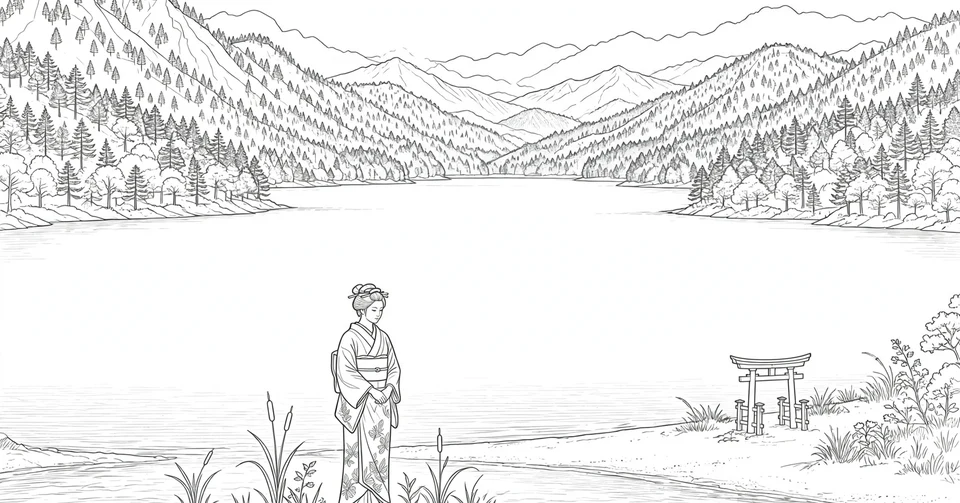
On the western shore, standing in the shallows, is a golden statue of a young woman. She is Tatsuko, and her story is the story of Lake Tazawa in miniature: beautiful, a little vain, and shadowed by a wish that came true in the wrong way. This is a lake that rewards anyone willing to look below the surface, in every sense of the phrase.
How deep Lake Tazawa really is
The measured maximum depth of Lake Tazawa is 423.4 metres, with an average depth of 280 metres, which makes it the deepest lake in Japan by a comfortable margin. The runner up, Lake Shikotsu in Hokkaido, reaches 363 metres. The surface of Lake Tazawa sits 249 metres above sea level, so its bottom, at 174 metres below sea level, is lower than the floor of many coastal bays. There is a pleasing symmetry in the fact that Japan pairs this lake with Suruga Bay, the deepest bay in the country, far to the south off Shizuoka. The islands keep their deepest water at both ends.
People have been dropping lines into Lake Tazawa for a long time, and the numbers kept growing. In 1909 the geologist Tanaka Akamaro measured 397 metres with a hemp rope. A wire rope survey in 1926 found 413 metres. A three year survey ending in 1940 reached 425 metres and found two small volcanic cones resting on the bottom, evidence for the theory that the lake fills the scar of an explosive volcanic eruption roughly 1.4 million years ago. The almost perfectly circular shape once made a meteorite crater seem possible, but the cones on the floor argue for fire rather than impact.
The depth explains the open winter water. A shallow lake can chill through and skin over with ice, but Lake Tazawa holds so much water, 7.2 cubic kilometres of it, that summer warmth stored in the depths never fully leaves. As the surface cools it sinks and is replaced, and the lake keeps turning over instead of freezing. Standing on that shore in February, with snow piled head high along the road and waves still moving on Lake Tazawa, feels like a small violation of the rules of winter. It is just physics, but it does not feel like physics.
The lake is also a sealed bowl. Lake Tazawa has no natural river flowing in and no natural river flowing out, which once made its water legendary for clarity. In 1931 its transparency was measured at 31 metres, a figure compared with the famously clear Lake Mashu in Hokkaido, and the water was full of life. That sealed stillness was the lake's glory. It later became the lake's vulnerability, because whatever enters Lake Tazawa has nowhere else to go.
Tatsuko, the maiden in the shallows
The golden figure on the western shore belongs to the most famous legend of Lake Tazawa. Tatsuko was a maiden celebrated for her beauty, and she prayed to keep her youth and beauty forever. In the version most often told, she was directed to drink from a hidden spring. She drank, and her thirst grew instead of fading, and she drank again until the water changed her. Tatsuko became a dragon, slipped into the depths of Lake Tazawa, and remains there as its guardian goddess. In one strand of the tale, her mother came searching with a burning torch and, in grief, threw it into the lake, where it turned into a school of fish. Those fish, the story says, were the kunimasu. Remember them. They come back into this story in a way nobody expected.
The statue itself is a golden bronze work by the sculptor Yasutake Funakoshi, unveiled on May 12, 1968, at Katajiri on the western shore. She stands with her back to the blue water, serene and slightly sorrowful, and she has become the postcard image of Lake Tazawa. I find her more moving than most landmark statues, because the legend underneath her is not really about vanity. It is about wanting time to stop, which is the most human wish there is, and the lake answering honestly: time does not stop, it only deepens.
Pilgrims and tourists have their photograph taken beside her and drive on, which is a shame, because the western shore is the right place to slow down. The water in front of the statue is the same water that hides a 423 metre drop a short distance out. Tatsuko guards a lake you cannot see the bottom of, and on a still day, with the mountains doubled in the surface, it is easy to understand why people decided someone must be down there.
The year the water changed
In 1940, engineers changed the chemistry of Lake Tazawa in the name of progress. Water from the Tama River, the Tamagawa, was channelled into the lake to raise the output of a hydroelectric dam and to supply new farmland. The Tamagawa drains a volcanic valley of steaming, sulphurous springs, the same valley where Tamagawa Onsen still draws the sick to some of the most acidic hot spring water in Japan. River water that acidic did to the lake exactly what chemistry said it would.
By the late 1940s the pH of Lake Tazawa had fallen to 4.3, roughly the acidity of tomato juice, in a lake that had once been measured clear to 31 metres. Transparency collapsed to less than 4 metres. The fish community that had included sockeye salmon, trout, char, carp, catfish and eel died back until only the hardy Japanese dace remained. The water grew so sour that it could no longer be used to irrigate rice fields, the very purpose for which some of it had been brought in. Lake Tazawa had been injured by the one thing a sealed lake cannot survive: something foreign poured in, with no exit.
The repair has been slow, deliberate and incomplete. Since 1972 the Japanese government has been introducing lime to neutralise the acid, with a new treatment facility completed in 1991. The surface layers have improved, but measurements in the year 2000 still found pH 5.14 at 200 metres down and 4.91 at 400 metres. The depths of Lake Tazawa remember 1940 even now. Recovery, if it fully arrives, will be measured in generations rather than electoral cycles, and there is something instructive in that. A lake this deep keeps its history the way it keeps its cold: at the bottom, for a very long time.
The fish that came back from the dead
Before 1940, the signature creature of Lake Tazawa was the kunimasu, a landlocked trout related to the sockeye salmon, dark olive with black spots, about 30 centimetres long, spawning in deep water in winter and spring. It lived in Lake Tazawa and nowhere else on Earth. When the acid came, the kunimasu died with the rest, and for seventy years the species was treated as extinct, surviving only in jars, in scientific papers and in the legend of Tatsuko's mother and her torch.
What saved it was an old insurance policy. In 1935, fisheries officials shipped eyed eggs of the kunimasu to several other lakes, including Lake Saiko in Yamanashi Prefecture, one of the Fuji Five Lakes, in an attempt to establish the fish elsewhere. The attempt was written off as a failure, and then the war and the acid closed over Lake Tazawa, and everyone forgot about the eggs.
In 2010, a research team working in Lake Saiko, a group that included the Kyoto University ichthyologist Tetsuji Nakabo and the television biologist Sakana-kun, caught nine dark trout and suspected what they were holding. The fish in Lake Saiko had long been assumed to be himemasu, a close kokanee relative introduced to many lakes, but these nine had the kunimasu's distinct breeding season and its particular counts of gill rakers. DNA sequencing settled it. The specimens were pure kunimasu, descendants of the eggs sent south in 1935, alive some 500 kilometres from home, seventy years after their species had been declared gone. The full record of the fish and its return is kept in its species account, and it reads like a detective story with a happy ending.
Lake Saiko is now the only wild home of the kunimasu, and the story has one more turn. A small museum beside Lake Tazawa, opened in 2017, keeps live kunimasu on display, fish brought back up the country from Lake Saiko to swim within sight of the water their kind came from. Whether kunimasu will ever live wild in Lake Tazawa again depends on the slow chemistry of those deep, still acidic layers. I hope they manage it. Few homecomings would be better earned.
Going down to the water
For travellers, Lake Tazawa is usually one half of a day whose other half is steam. Trains run to Tazawako Station, buses circle down to the shore, and the inns of Nyuto Onsen and Tamagawa Onsen wait in the hills above, so the classic pattern is a morning by the lake and an afternoon in water hot enough to erase the cold. The shore road runs about 20 kilometres around the water, close to the lake's full circumference, and cycling it on a clear autumn day, with the beech woods turning and the surface shifting colour, is the way most likely to make you fall for the place. Sightseeing boats cross Lake Tazawa in the warmer months and pass the Tatsuko statue, giving you the one view the shore cannot: the goddess small against the whole round bowl of the lake, with the ski slopes of the Tazawako Ski Area standing over the far side.
Go in winter if you can. The crowds vanish, the road is a white corridor, and Lake Tazawa sits open and dark blue in the middle of all that snow, steaming faintly in the cold air, refusing to freeze like something that has made up its mind. It is one of the great quiet sights of Tohoku.
What stays with me about Lake Tazawa is how completely its beauty and its wound are the same fact. The sealed depth that kept it clear, that keeps it open in winter, that gave the kunimasu its cold dark refuge, is also the depth that trapped the acid and still holds the memory of 1940 near the bottom. The lake does not hide any of this. It just goes on being deep, in the middle of the mountains, under the eyes of a golden maiden who wished for forever and got something stranger. Some places impress you. Lake Tazawa, if you give it a quiet hour, does something better. It sobers you, gently, and sends you back up the hill to the steam feeling that the world is larger and longer than your plans for it.
More in Food & Travel
Latest posts
- Hashigo-Nori Is Riding a Ladder Someone Else Holds
- At a Goma, Prayers Are Written to Be Burned
- The Sekaa Teruna Builds the Monsters
- A Lembaga Perkreditan Desa Is a Bank the Village Owns
- Every Melasti Goes to Fetch Tirta Amerta
- Kaburiyu Is How You Talk Your Body Into the Bath
- When the Kulkul Stops Sounding for You
- A Caru Is an Offering for the Ones You Fear
- Tatsuko Wished for Beauty and Became a Statue
- Warangan Is the Wash That Reveals the Pattern
- Ganbanyoku Is Bathing Without Water
- The Obuki Throws Out Nine Thousand Litres a Minute
- Every Village Writes Its Own Awig-Awig
- Sainokawara Is a Bath You Share With a Hundred Strangers
- Rwa Bhineda Keeps Opposites From Going to War