Bonsai and the Thousand-Year Art of Tiny Trees
· 10 min read
Bonsai turns ordinary trees into living sculptures, and the oldest bonsai in training today survived a war, an ocean crossing, and four centuries of care.
A Japanese white pine that was planted in 1625 now stands about a metre tall in a museum in Washington, DC. It survived the atomic bombing of Hiroshima, crossed the Pacific as a gift of peace, and in 2025 it marked 400 years in training. That tree is a bonsai, and it is the best argument for taking this small art seriously.
Bonsai is not a species of tree and it is not a houseplant category. It is a technique for growing an ordinary tree in a shallow container and shaping it, over years, so that it looks like a mature tree in nature. Any woody tree can become a bonsai, from a pine to a maple to an apple tree. The tree stays alive, grows, changes with the seasons, and slowly takes on the shape its keeper imagines for it.
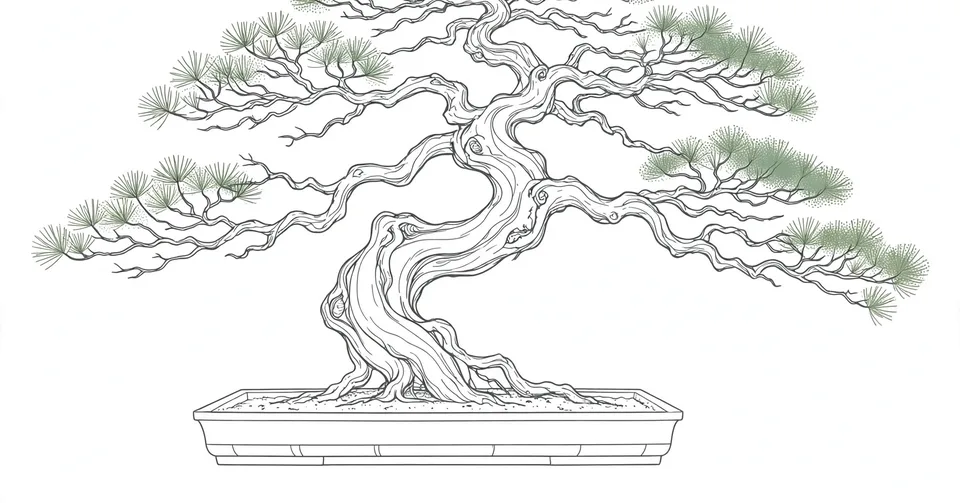
The word itself explains the idea. Bonsai combines bon, a tray or shallow container, and sai, planting. A bonsai is a tree planted in a tray, kept small on purpose, and trained to look old. The small size is not the point. The point is the illusion of age, balance, and a believable relationship between trunk, branches, foliage, roots, and container.
Bonsai did not start in Japan
The art began in China, where it was called penjing, landscape in a tray. As early as 706 AD, a mural in the tomb of Crown Prince Zhang Huai shows miniature landscapes in trays, and Chinese monks and scholars grew small trees as meditation and as an expression of harmony with nature. The practice reached Japan in the 12th century, carried by Buddhist monks, and Japanese growers shaped it into something of their own, guided by Zen ideas about simplicity and the beauty of imperfection.
Early Japanese references used the name hachi-no-ki, tree in a bowl. The word bonsai only became established in the early 19th century, when the practice had grown into a deliberate, design-focused art with its own rules and schools. By then the art was no longer a temple curiosity. Wealthy families kept trees, exhibitions drew crowds, and nurseries passed techniques from one generation to the next. The art arrived in the West only after the Second World War, when American soldiers brought small trees home, and the 1970 World Exposition in Osaka, which presented around 2,000 trees gathered from across Japan, set off a global boom in the art.
That long history is part of the appeal. When you work on one of these trees, you join a conversation that started more than a thousand years ago, and the tree you shape today could outlive you by centuries. I find that quietly humbling, and it is the reason I think the art deserves more respect than the novelty gift it is often sold as. It is closer to the slow patience of ikigai, a reason to keep showing up, than to a weekend hobby.
What makes a tree a bonsai
A small tree in a pot is not automatically a bonsai. The composition has to give the impression of age. That means a trunk that tapers as it rises, branches placed with intention, roots that grip the soil visibly at the base, and a container that suits the tree rather than fighting it. It is judged the way a painting is judged, except the painting keeps growing.
The tools are simple and slow. Pruning shapes the silhouette and directs energy to the parts of the tree that need development. Wiring, usually with aluminium or copper wire, bends branches into place over months. Repotting every two to three years for young trees, and every three to five years for mature ones, keeps the roots healthy and the tree compact. The soil matters too. A standard mix uses akadama, a hard-baked Japanese clay that holds moisture and releases it slowly, mixed with pumice and lava rock so the roots can breathe.
None of this works on a fixed calendar. Watering is the skill that kills most beginner trees, and the rule is to check, not to schedule. Push a finger one or two centimetres into the soil. If it is still moist, do not water. If it is dry, water thoroughly until it runs out of the drainage holes, preferably in the morning so the tree has all day to absorb it. Overwatering, not neglect, causes most bonsai deaths. A tree is a living thing with its own seasons, and the keeper's job is to read it.
The styles a beginner should know
The styles are not decoration. Each one copies a shape that trees take in the wild, after wind, snow, cliffs, and poor soil have had their say. A beginner does well to learn five of them before buying a first tree.
| Style | Shape | What it copies |
|---|---|---|
| Formal upright | Straight trunk, symmetrical branches | A tree growing in open ground |
| Informal upright | Curved trunk, branches in all directions | A tree shaped by gentle wind |
| Slanting | Trunk leaning to one side | A tree reaching for light |
| Cascade | Trunk flowing down below the pot | A tree on a cliff edge |
| Windswept | Branches all bent one way | A tree on an exposed coast |
The formal upright is the hardest to do well, because a straight trunk leaves no room to hide a mistake. The informal upright is the most forgiving place to start, and the cascade is the most dramatic, though it needs a tall pot and a sturdy bench. Knowing the styles matters when you choose a tree, because a nursery pine with a natural lean is already halfway to a slanting tree, while a straight young maple wants to be an upright. The tree tells you what it wants to become, and the best growers listen first.
Species choice matters more than any label. Japanese black pine, Japanese maple, juniper, satsuki azalea, and ginkgo are all classic choices, but a ficus or a Chinese elm is often kinder to a beginner, especially indoors. The useful rule is simple: treat the plant as its species requires, not as a decorative object requires. An outdoor pine kept in a living room will weaken and die, no matter how carefully it is watered, because it needs winter cold for dormancy. That is the most common beginner mistake, and it is entirely avoidable.
The Yamaki pine and the tree that survived Hiroshima
Few trees carry a heavier story than the Yamaki pine. The tree is a Japanese white pine that was planted in 1625, on the island of Miyajima, and cared for by five generations of the Yamaki family in Hiroshima. On the morning of 6 August 1945, the atomic bomb exploded less than two miles from the family nursery. A wall around the garden shielded the tree, and it survived.
The Yamaki family kept the tree for another three decades. In 1976, Masaru Yamaki offered it as part of Japan's gift of 53 bonsai to the United States for its bicentennial, saying only that it was a gift of peace. The museum in Washington did not learn the tree's true history until 2001, when members of the family explained that it had survived the bombing. The tree is a hibakujumoku, a tree that survived the atomic bomb, and in 2025 it marked its 400th year in training. You can read the full story on the National Bonsai Foundation site.
I keep coming back to that tree because it settles the question of whether this is a serious art. A practice that can keep one tree alive and beautiful for four hundred years, through war and across an ocean, is not a fad. It is a discipline, and the Yamaki pine is its quiet proof. It also shares something with kintsugi, the art of repairing broken pottery with gold. Both arts treat damage and age not as flaws to hide but as part of the object's story.
How to keep a bonsai alive
Starting is simpler than people expect, and the best first step is not a seed. Growing a bonsai from seed, called misho, gives full control from the start but demands years before the seedling is ready to shape. Nursery stock is the forgiving choice. It already has a trunk, established roots, and enough vigour that a beginner can learn pruning, wiring, and seasonal care without waiting years for a seedling to thicken.
Choose a tree that fits where you live. If you have a balcony or a garden, an outdoor species such as a pine, maple, or juniper will be happy. If you only have indoor space, pick a tropical species such as a ficus, which tolerates warm rooms year round. Buy from a nursery, not a supermarket shelf, and ask what species it is and where it should live. That one question prevents most early failures.
Then do less than you think. In the first year, water correctly, give the tree the light its species needs, and resist the urge to prune, wire, repot, and fertilise all at once. A weak tree should be left alone until it is strong. Feed weekly in spring and autumn while the tree is growing, ease off in winter, and repot just before bud break in spring, when the tree has maximum power to recover. The work is small, regular, and mostly waiting. That is the whole secret, and it is why bonsai suits people who like slow progress they can see.
Where to see bonsai in Japan
The best place to see bonsai in Japan is Omiya Bonsai Village in Saitama, about 30 kilometres north of Tokyo. After the Great Kanto Earthquake of 1923 destroyed their Tokyo nurseries, a group of professional growers moved to Omiya and founded the village in 1925. The district was officially named Bonsaicho, Bonsai Town, and today the village holds several historic nurseries within a few minutes' walk of each other, plus the Omiya Bonsai Art Museum, the world's first public museum dedicated to bonsai, which opened in 2010. Every year from 3 to 5 May the village holds the Great Bonsai Festival, when growers from across Japan gather to show and sell their trees.
If you cannot make the festival, the museum alone is worth the trip. It shows masterpieces from the village's nurseries, historic pots, viewing stones, and woodblock prints that feature bonsai, and its garden holds around sixty trees on display. Walking the quiet streets of the village, past hedges and nursery gates, gives a sense of what this culture looks like when it is a neighbourhood, not a shop. It pairs well with a visit to a Japanese rock garden, where the same ideas about age, balance, and restraint are expressed in stone instead of wood.
A small tree, a long view
Bonsai asks for something rare in a fast world: attention spread over decades. You cannot rush a trunk to thicken, you cannot hurry a branch to set, and you cannot buy the look of a tree that has been cared for by five generations. What you can do is start, learn the species in front of you, and accept that the tree will teach you patience whether you want the lesson or not.
That is why the art has lasted a thousand years, from a Chinese tomb mural to a village in Saitama to a museum in Washington. A bonsai is a tree, a sculpture, and a calendar all at once, and the people who keep them are not collecting plants. They are keeping time.
More in Culture & Society
Latest posts
- Hakama Turn a Kimono Into Ceremony
- A Haori Is the Jacket That Turns a Kimono Formal
- The Taiko Musubi Turned a Kimono Sash Into a Drum
- Hiroshige Walked the Tokaido and Japan Followed
- Hokusai Spent a Lifetime Chasing One Mountain
- Tabi Are the Split Toe Socks Japan Wears Under Everything
- Ukiyo-e Turned Everyday Edo Into Art Anyone Could Own
- Zori Are the Quiet Sandals Japan Wears to Every Formal Occasion
- An Obi Is the Knot That Holds a Kimono Together
- Joya no Kane Rings Out the Old Year One Hundred Eight Times
- Base Genep Seasons Every Balinese Feast From the Mortar Up
- Geta Still Clatter Through Japanese Summer
- Shakyo Copies the Sutra One Stroke at a Time
- Yukata Is the Robe Japan Reaches for After the Bath
- Bonsho Is the Bell That Wakes a Japanese Temple