The Shinai Is a Bamboo Sword That Teaches Before It Strikes
· 19 min read
A shinai is a bamboo practice sword made of four slats, and its design explains why kendo can be fought at full speed without serious injury.
Pick up a shinai for the first time and two things surprise you at once. It is lighter than it looks, and it is louder than you expect. Four thin slats of bamboo, bound in leather and tied with cord, make a cracking sound when they meet that carries across a whole dojo. It looks like a toy sword and feels like a serious one, and that tension is the whole point. The shinai is a weapon designed not to hurt, yet it demands to be treated as if it could.
The name gives away the secret of how it works. Shinai is written with the characters for bamboo and sword, but the word itself comes from the verb shinau, to bend or to flex. A shinai is a sword that bends. When it lands, the slats flex along their length and spread apart slightly, and the force of the blow is scattered instead of concentrated. That single property is what makes kendo possible. Without it, two people could never strike each other at full speed, day after day, and walk away unhurt.
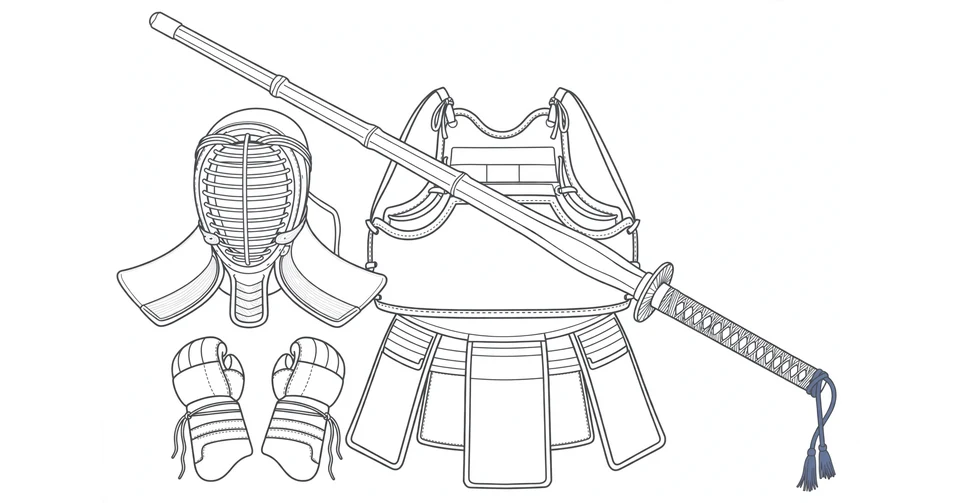
This article looks closely at the object itself, because the shinai deserves more than a passing mention. In the story of the way of the sword lives on in kendo, practitioners "strike each other with a bamboo sword called a shinai", and the piece moves on. Here the passing mention becomes the subject: the four slats, the leather fittings, the sizes and the rules, the history of what it replaced, and the lesson it quietly teaches about restraint.
What a shinai actually is
A shinai is a Japanese practice sword made of bamboo, used in kendo and in some older schools of swordsmanship. It is not a replica of a katana. It is straight where a katana curves, it has no edge, and it weighs far less than a steel blade. Its job is different. A katana was made to cut. A shinai is made to let two people practise cutting each other, at full speed, without cutting anything at all.
The distinction matters because kendo is a contact art. Practitioners wear protective armour called bogu and strike at the head, the wrists, the body and the throat, and a point only counts when the strike is delivered with spirit, correct posture and a clear shout. None of that would be possible with a wooden sword, which is too rigid, or with a steel sword, which is unthinkable. The shinai sits in the middle. It is hard enough to sting and to reward good timing, and soft enough to forgive a mistake. A student who gets the distance wrong learns from a bruise, not from a wound, and that difference is what lets a beginner keep coming back.
The word itself carries a small warning about reading Japanese too literally. The characters say bamboo sword, but that reading is irregular, applied to the characters after the fact. The true root is the verb for bending. To understand the weapon, start with the bend, not with the bamboo. Bamboo is the material. Flexibility is the idea.
Four slats of bamboo
The modern shinai is made of four slats of bamboo, known as take, held together by leather fittings and a cord. The slats are usually cut from dried bamboo, and some are treated by smoking or soaking in resin. A small number of modern practice swords use carbon fibre or reinforced resin instead, but bamboo remains the standard, and for good reason. Bamboo is light, springy and strong along its grain, and when it finally fails it tends to splinter along the grain rather than snap into a sharp point.
Making a shinai starts with choosing the bamboo. The prized local variety in Japan is madake, a bamboo with dense, fine fibres that makes a resilient and beautiful practice sword. Madake is in limited supply, so much of the bamboo used in mass produced swords today is keichiku from Taiwan, whose grain and density are close to madake and which splits more easily. Either way, the raw material is cut and split into slats, which are heated, bent into shape and sanded smooth before assembly. Four slats with matching joints are chosen for a single sword, and the fit has to be close. The slats must sit tight against each other down the whole length, with no open gaps between them, because a gap is where a slat can catch, splinter or break.
The number four is not an accident. Fewer slats would make the sword too stiff, closer to a wooden sword. More slats would make it too soft and too fragile. Four slats give the shinai its characteristic behaviour on impact: the bundle flexes, the slats spread slightly, and the energy of the strike is shared across a wider area. The result is a weapon that can be swung fast and hit hard without doing the kind of damage a solid piece of wood would do. It still stings, and a well placed strike leaves a mark, but the injury stays at the level of a bruise rather than a cut.
The parts, from handle to tip
A shinai looks simple from a distance, a pale stick with a leather handle and a leather tip. Up close it is a small assembly of named parts, each with a job, and learning the names is the first step toward owning one properly.
The handle is the tsuka, wrapped in a leather sheath called the tsuka-gawa. Under that wrapping, at the base of the handle, sits a small square of metal called the chigiri, which holds the four slats in place. The tsuka is where the hands go, and its shape matters more than a beginner expects. Adult handles commonly measure between 25 and 30 millimetres across, and the diameter is chosen by feel. Some handles are round, some are oval in a style called koban, and some are octagonal, called hakkaku. The oval and octagonal shapes give feedback through the gloves about the angle of the blade, which helps the practitioner keep the cutting edge, real or imagined, in the right line.
Just above the handle sits the tsuba, a round hand guard of leather or synthetic material, held in place by a rubber ring called the tsuba-dome. The guard is small, no more than 9 centimetres across under competition rules, and it does more than protect the hands. It also helps hold the bamboo together at the point where the handle ends and the bare slats begin.
A cord called the tsuru runs the length of the shinai, securing all the leather fittings. The cord must be tight and it must sit on top, along the back of the sword, and referees in competition will check it. A loose cord lets the fittings slip, and a slipped fitting is a safety problem, so the cord is inspected as carefully as the bamboo.
About a third of the way down the exposed bamboo from the tip, a leather band called the nakayui binds the four slats together. The nakayui does two jobs at once. It holds the middle of the sword together, and it marks the start of the striking portion, the datotsu-bu, which runs from the nakayui to the tip. Only strikes made with that part of the sword can score. A strike with the wrong part does not count, however hard it lands.
At the tip, a small plastic plug called the saki-gomu is inserted between the ends of the slats to stop them from being squeezed inward. Over it goes the saki-gawa, a leather cap that holds the four slats and the plug in place and forms the tip used for thrusting techniques. The tip is the most regulated part of the whole weapon. Under federation rules the saki-gawa must be at least 50 millimetres long, and its minimum diameter is measured and checked, because a tip that is too thin can break and become dangerous, especially in a thrust.
From fukuro shinai to the four slat shinai
The shinai was not born in its present form. The earliest use of a bamboo training weapon is credited to Kamiizumi Nobutsuna, a sixteenth century swordsman and founder of the Shinkage school, who lived through the civil wars of the fifteen hundreds. The first version was the fukuro shinai, the bag sword. It was a length of bamboo split several times at one end, sometimes eight times, and covered with a leather sleeve. The name fukuro means bag or sack, and the sleeve is the bag. That early design was soft enough to allow direct contact, and it was used to imitate cutting motions rather than thrusts. It is still used today in some old schools of swordsmanship, and in the Shinkage tradition the sleeve is lacquered a deep red and tied off at the unsplit end.
The step from the bag sword to the modern four slat design came in the Edo period, as protective armour became common and practice grew harder and faster. The four slat shinai, called yotsu-wari, was stronger and harder than the bag sword, more elastic and more durable, and it suited a style of training in which partners struck each other at full force. The modern form is generally credited to Nakanishi Chuzo Tsugutate, who died in 1801, of the Nakanishi school of Itto-ryu. The brief history published by the International Kendo Federation records the same turning point: in the Shotoku era, from 1711 to 1715, Naganuma Shirozaemon Kunisato developed protective equipment and a training method using the shinai, and the federation calls this the direct origin of present day kendo. Later in the Edo period, the federation notes, the new four slat design replaced the bag sword because it was more elastic and durable.
For a long time there was no standard size at all, and practitioners often made their own. One famous swordsman of the eighteen hundreds, Oishi Tanetsugu, is said to have used a practice sword 160 centimetres long, far beyond anything allowed today. That freedom ended as kendo became organised, and the rules that now govern the weapon are a direct response to that history. The shinai had to be standardised because the practice it made possible had become a sport, and a sport needs a fair and safe weapon.
Sizes, weights and the rules
A shinai is not one size. It comes in sizes numbered roughly by length, from small swords for children up to the full adult size, and the numbers follow the old Japanese measure of shaku and sun, where one shaku is about 30 centimetres. A size 39 shinai, the standard adult length, measures 120 centimetres. A size 38 measures 117 centimetres, a size 37 measures 114 centimetres, and the scale runs down through size 36 at 112 centimetres to size 28 at 92 centimetres for young children.
Competition rules set a maximum length and a minimum weight for each age group, and the numbers show how seriously the sport takes safety. Under the International Kendo Federation rules, an adult man using a single shinai may use one no longer than 120 centimetres, weighing at least 510 grams, with a tip diameter of at least 26 millimetres. An adult woman uses the same maximum length, with a minimum weight of 440 grams and a tip diameter of at least 25 millimetres. Junior high school students are limited to 114 centimetres, with minimum weights of 440 grams for boys and 400 grams for girls, while senior high school students are limited to 117 centimetres. The sword is weighed complete with its leather fittings but without the guard, and the full length is measured. These figures come from the regulations for the shinai, which set out the federation tables in full.
The rules also cover the two sword style, nito, in which a practitioner holds a long sword in one hand and a short sword in the other. The long sword, the daito, may be up to 114 centimetres, while the short sword, the shoto, may be up to 62 centimetres, and each has its own weight range. That style is rare, and it has its roots in the two sword schools of old swordsmanship, but the fact that the rules make room for it says something about how kendo remembers its past even while it standardises its present.
There is also room for personal choice inside the rules. The standard shape is balanced and resilient and is the best starting point, and it is also the most produced and the most affordable. Two other shapes are common. Dobari, which means an expanded middle, bulges just ahead of the handle and then tapers to a thin tip, which makes the tip lighter and faster and suits competition, though the thinner tip is more prone to splitting. Koto, also called chokuto or straight sword, keeps a more even diameter along its length, which puts more weight toward the front and makes a robust sword that lasts longer and is less likely to fracture. Choosing between them is a matter of style and temperament, and most practitioners try several before they settle.
Why bamboo and not wood or steel
The question that follows any close look at the shinai is simple. Why bamboo? The answer is in the physics of the material, and it is the reason the whole art exists.
A wooden sword, a bokuto, is made from a single piece of hard wood. It is rigid, and when it hits, all of its energy arrives at once, in a small area. That is why the old schools spent most of their time on forms, rehearsing movements without a partner who fought back. A real sword makes every mistake final, and a wooden sword is not much kinder. Steel is worse, for obvious reasons. Bamboo is different because it is not solid. It is a bundle of fibres with a hollow structure, and it bends before it breaks. When a shinai strikes, the slats flex along their length and spread apart slightly, and the force of the blow is spread across a wider area and a longer moment. The physics is simple and the effect is profound. A strike that would cut with steel and bruise badly with wood becomes a loud crack and a sting.
Weight matters too. A shinai is lighter than a wooden sword of the same length, and much lighter than a steel one, so it can be swung faster and recovered faster. That speed is what lets kendo be a contest of timing rather than strength. A heavier weapon would favour the stronger arm. A lighter weapon favours the quicker eye, and the art is built around that trade.
There is also a practical matter of supply. Bamboo grows fast, splits cleanly along its grain, and can be replaced. A steel sword is a crafted object that lasts a lifetime and costs accordingly. A shinai is a consumable, and it is meant to be. It is used hard, it wears out, it splinters, and it is replaced. That disposability is part of its honesty. Nothing about it pretends to be permanent, and the practitioner learns, almost without noticing, that the tool is not the treasure. The practice is.
I find that last point worth sitting with. We tend to value the things that last, the polished object on the shelf, the sword in the glass case. The shinai goes the other way. It is valuable precisely because it does not last, because it is used up in the service of learning. A culture that made its training sword from the fastest growing plant it had, rather than from the hardest metal, was making a choice about what mattered. The sword was not the point. The person holding it was.
Care and maintenance
A shinai that is not looked after becomes dangerous, and every dojo teaches inspection as part of the practice rather than as an afterthought. Before and after use, the practitioner examines the striking portion on all sides, looking for splinters and cracks. Bamboo splinters are thin and sharp, and a splintered slat can cut a partner or break during a strike, so the check is not a courtesy. It is a duty to the other person in the room.
The tip gets special attention. The saki-gawa should be intact, the cord should be tight so the tip cannot slip off during use, and the nakayui should be tight enough that it does not rotate easily. If any of those fittings is loose, the sword is not used until it is fixed. When the sword is not in use, it is laid on the floor or leaned upright against a wall, often with the base of the handle on the floor and the tip against the wall. It is considered poor etiquette to step over a shinai lying on the floor, and the rule is usually explained to beginners on their first day, because it teaches the central habit of the art at once. The practice sword is treated like a real sword, and a real sword is never treated carelessly.
There is some disagreement about oiling and sanding. Many practitioners oil and sand a new shinai before its first use, and then periodically during its life, and they say it greatly extends the life of the bamboo. Others follow the guidance of their own school or teacher and do less, or nothing at all. The honest position is that there is no single rule, and a beginner should follow the practice of their own dojo rather than a general claim found online. What is not in doubt is the inspection. Whatever else you do to the sword, you look at it before you swing it, every time.
The fittings wear out before the bamboo does, and a well kept shinai can be repaired rather than replaced. A worn leather tip can be changed, a frayed cord can be replaced, and a loose guard can be refitted. Some practitioners keep old slats and rebuild a sword from parts that still have life in them. That habit fits the object. A shinai is an assembly, not a single thing, and each part can be judged on its own. Learning to maintain it is a small education in itself, in patience, in attention to detail, and in the idea that care is part of use rather than something that comes after it.
What the shinai teaches about restraint
All of this brings us back to the question the title asks. What does a bamboo sword teach before it strikes? The answer is restraint, and the teaching begins before the first blow is thrown.
A shinai is a weapon that has been deliberately weakened. Its makers could have made it harder, heavier and more dangerous, and for centuries swordsmen did exactly that. Instead, at a certain point in Japanese history, they chose to make a sword that bends, that spreads its force, that stings without cutting. That choice made a new kind of practice possible, one in which two people could test each other honestly, at full speed, without fear. The restraint is built into the object. You do not have to decide to hold back. The sword holds back for you, and in doing so it frees you to commit fully.
That is a strange and generous piece of design. Most tools are built to increase power. The shinai is built to limit it, and the limit is what makes the art possible. Without the limit there is no full speed practice, and without full speed practice there is no honest test of timing, distance and nerve. The student learns more from a hundred honest strikes with a bamboo sword than from a lifetime of careful forms with a wooden one, because the bamboo sword lets the other person answer back.
There is a wider lesson here, and it is one I keep returning to. Restraint is often described as the absence of action, as holding back or doing less. The shinai suggests the opposite. Restraint, properly understood, is what makes action possible. A road with no speed limit is not freedom, it is a place where nobody can drive safely. A practice with no safety is not honest, it is a place where nobody can commit. The bamboo sword sets the limit, and inside that limit the practitioner is free to give everything. That is a pattern worth noticing outside the dojo, in any work where people need to test each other without harming each other, from a debate to a negotiation to a disagreement between friends. The strongest container is the one that lets people be fully honest inside it.
Kendo itself says this in its formal language. The All Japan Kendo Federation stated in 1975 that the concept of kendo is to discipline the human character through the application of the principles of the katana, and that the purpose of practice is to mould the mind and body, to cultivate a vigorous spirit, and to hold in esteem human courtesy and honour. The shinai is the instrument of that discipline, and it works by removing the fear that would otherwise dominate the practice. A student who is afraid of being hurt cannot learn timing. A student who is afraid of hurting someone cannot learn commitment. The bamboo sword takes both fears away, and what is left is the work itself.
The uniform carries the same message in a different form. Practitioners train in a heavy cotton jacket and a hakama, the wide pleated trousers that turn a kimono into formal dress, and the story of the hakama shows how a garment can carry ceremony into a place of sweat and effort. The sword and the clothing agree with each other. Both say that this is a formal occasion, and that you are expected to behave accordingly, even while you are striking at full speed.
So the shinai is not a lesser sword. It is a different kind of sword, designed for a different purpose, and its purpose is teaching. It teaches that power without control is useless, that safety is not the opposite of seriousness, and that the best way to learn a dangerous skill is to make it safe enough to practise honestly. It has been teaching that lesson for centuries, one cracked bamboo slat at a time, and the lesson has not worn out. The swords wear out. The lesson does not.
More in Culture & Society
Latest posts
- Hakama Turn a Kimono Into Ceremony
- A Haori Is the Jacket That Turns a Kimono Formal
- The Taiko Musubi Turned a Kimono Sash Into a Drum
- Hiroshige Walked the Tokaido and Japan Followed
- Hokusai Spent a Lifetime Chasing One Mountain
- Tabi Are the Split Toe Socks Japan Wears Under Everything
- Ukiyo-e Turned Everyday Edo Into Art Anyone Could Own
- Zori Are the Quiet Sandals Japan Wears to Every Formal Occasion
- An Obi Is the Knot That Holds a Kimono Together
- Joya no Kane Rings Out the Old Year One Hundred Eight Times
- Base Genep Seasons Every Balinese Feast From the Mortar Up
- Geta Still Clatter Through Japanese Summer
- Shakyo Copies the Sutra One Stroke at a Time
- Yukata Is the Robe Japan Reaches for After the Bath
- Bonsho Is the Bell That Wakes a Japanese Temple