Omikuji Tells Your Fortune on a Slip of Paper
· 18 min read
An omikuji is a paper fortune drawn at a Japanese shrine or temple, and this guide explains the ranks, the ritual, and what to do with a bad result.
For the price of a coin, a Japanese shrine will tell you your fortune. You shake a small wooden box, a numbered stick slips out, and a strip of paper tells you whether the year ahead looks kind. That strip of paper is an omikuji, and it is one of the most approachable rituals in Japan. Anyone can draw one, no belief is required, and the whole thing takes about a minute.
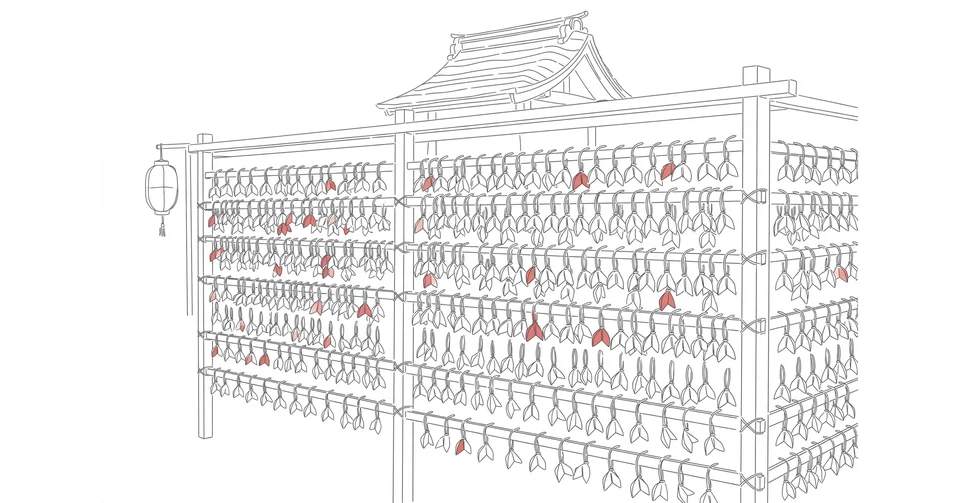
An omikuji is not a horoscope column and not a magic trick. It is a short piece of advice, written as if the kami, the spirits honored at the shrine, were speaking directly to you. The grade at the top matters less than the lines underneath, and even a bad result comes with a gentle way out. That mix of chance, advice, and a second chance is why the custom has lasted so long, and why visitors keep drawing a slip even when they do not believe a word of it.
The idea for this article came from a passing line in the article on Japan meets the New Year at hatsumode, which notes that if you draw a bad omikuji, you tie it to the rack provided. That one sentence hides a whole small world of ritual, and it is worth a closer look.
What an omikuji is
An omikuji is a paper fortune slip drawn at random at a Shinto shrine or a Buddhist temple. The word is usually written with the characters for honorable, divine, and lot, which is a fair summary of what it is: a sacred lottery, drawn by hand, in a place built for prayer. Most slips are plain white paper, folded or rolled, sometimes with a small illustration. You never know what yours will say until you open it, and that moment of not knowing is half the pleasure.
You can draw an omikuji at almost any staffed shrine or temple in Japan, from the great sites in Tokyo and Kyoto to the small neighborhood shrine at the end of a quiet street. The offering is usually around 100 to 200 yen, though some places charge a little more and novelty versions can cost extra, so bring coins. Many of the boxes are self service and coin only, and a 100 yen coin is the safest thing to carry. Prices differ from place to place, so treat any figure as a guide rather than a fixed rule.
An omikuji is not only a New Year custom, although early January is when the queues are longest. People draw one on ordinary visits too, before an exam, before a journey, at the start of a new job, or simply because they happened to pass a shrine on a fine day. The custom belongs to the whole year, and the shrine does not ask why you came.
What surprises first timers is how seriously, and how lightly, the whole thing is taken at the same time. People read their slip carefully, fold it into a wallet or tie it to a rack, and then walk on to lunch as if nothing had happened. The fortune is treated as advice from the kami, not as a verdict. I find that balance admirable. A culture that can take a piece of paper seriously for five minutes and then let it go has understood something about worry that the rest of us are still learning.
How to draw an omikuji
There is no single national procedure, and the method changes from place to place, but the shape of it is always the same. First, visit the main hall and pay your respects. The fortune comes after the prayer, not before it, and that order matters. You ask for guidance first, and only then do you draw the slip.
After praying, look for the omikuji desk or box, usually near the counter where charms are sold. The most common setup is the numbered stick. You pick up a long hexagonal box, called a mikuji bako, shake it gently until one thin numbered stick slides out of the small hole, read its number, and exchange it for the matching printed slip. An attendant may hand it to you, or you pull it yourself from the small numbered drawer that matches your stick. A detailed guide to the custom describes all three common setups, the stick box, the folded slip, and the self service machine, in the Hidden Japan guide to omikuji in Japan.
The second setup is simpler. You drop your coins into a box and take a folded omikuji directly, with no stick involved. The third is the novelty version. Some shrines use vending style dispensers, and a few have a mechanical lion that hands over your slip when you drop in a coin. In recent years, omikuji have also appeared as small ornaments, called okimono, shaped like crows, pigeons, foxes, or daruma dolls, especially at shrines around Kyoto. The form changes, but the idea does not. You pay a small offering, chance chooses a slip, and the slip speaks.
One piece of etiquette is worth knowing before you start. Treat one draw as enough. Drawing again and again until you get a good result turns the ritual into a game, and the shrine staff will notice. If the first slip is bad, the custom has a proper answer for that, and it does not involve a second coin.
How to read your fortune
Two things sit on an omikuji: the overall luck grade at the top, and short lines of advice for different parts of life below it. The grade is usually the biggest writing on the paper, so it is the first thing your eye finds. The advice underneath is the part worth reading slowly, and the Association of Shinto Shrines, known as Jinja Honcho, frames the written guidance as more important than the grade itself.
There is no official national ladder of grades, and this is the detail most guides get wrong. Jinja Honcho says plainly that the types of fortune and their order vary from shrine to shrine. One example order it gives, from best down, is the table below, and you should read it as one shrine's example, not as the rule.
| Grade | Reading | Rough meaning |
|---|---|---|
| Great blessing | dai-kichi | great luck |
| Blessing | kichi | good luck |
| Middle blessing | chu-kichi | middle luck |
| Small blessing | sho-kichi | small luck |
| Future blessing | sue-kichi | modest luck, good things to come |
| Bad luck | kyo | bad luck, take care |
Some shrines add more grades. A very bad result may be marked dai-kyo, great misfortune, and some lists include half grades such as han-kichi, half blessing, or sho-kyo, a little bad luck. Japan's national tourism body lists just five grades and stops at kyo, leaving out sue-kichi and dai-kyo entirely. Even the order of the middle grades is disputed: some shrines rank plain kichi above chu-kichi, and others rank it the other way around. A few shrines go their own way entirely. Fushimi Inari Taisha in Kyoto is often said to use an unusually wide range of grades, including rare labels such as dai-dai-kichi. The lesson is simple. Read your own slip rather than assuming a universal ranking, because there is not one.
Two kanji carry most of the meaning. The character for good fortune, read kichi, and the character for bad, read kyo, sit at the heart of every grade. Everything else is a shade in between, a matter of how much luck, and how soon.
A bad grade is not a curse, and this is the point first timers most need to hear. The slip is written as a warning to guide you, not as a sentence. Many Japanese people treat a kyo result on an omikuji as a different form of luck, since bad fortunes are relatively rare at many shrines, and some shrines leave them out of the set altogether. A kyo with sensible advice can be more useful than a dai-kichi you glance at and pocket. That is not a comforting slogan. It is the official view of the shrine association, and it is how the custom is meant to work.
The small print on the slip
Below the grade, the omikuji comments on specific parts of your life. The sections vary from shrine to shrine, and your slip may include only some of them, but Jinja Honcho names the typical ones as money and fortune, love and romance, health, travel, the person you are waiting for, and a lost item, with a note on whether it will turn up.
Many omikuji add more: wishes, business, studies, marriage prospects, disputes, moving house, and childbirth. Some carry a short waka poem, a note on how to live, written in old fashioned language that even native speakers can find hard to follow. Not all omikuji are translated into English, so a translation app helps, although older or poetic wording can translate roughly.
Read the lines on your omikuji as practical advice rather than prophecy. A line about travel may tell you to postpone a journey, a line about money may warn against lending, and a line about health may tell you to rest. The advice is specific enough to act on and vague enough to fit a life, which is exactly what good advice looks like. I keep thinking about how different this is from the fortune telling I grew up hearing about, where the point was to know the future. Here the point is to live the present a little more carefully, and that seems like the wiser use of a piece of paper.
What to do with a bad fortune
This is the question every first time visitor asks, and the answer is calmer than the internet suggests. You have two good choices, and both are fine. You may take the omikuji home, or you may tie it at the shrine. Jinja Honcho makes no distinction between good and bad fortune here. You may take any omikuji home, and you may leave any at the shrine.
The custom most visitors follow with an omikuji leans toward taking good luck home and tying bad luck at the shrine, as a way of leaving the bad fortune behind. The designated place is a rack or a frame of strings set up for exactly this, called a musubidokoro. You fold the slip, loop it around the string, and walk away. The bad luck stays there instead of following you home, and the shrine later burns the tied slips with respect. An introduction to the custom explains that the tied slips are left for the kami to take care of and are ritually burned and offered for cleansing, as described in the Go Go Nihon introduction to omikuji in Japan.
The one real rule is to use the rack the shrine provides, not the trees. Tying a slip to a random branch damages the tree and ignores the place the shrine set aside for the purpose. Where a site gives its own instruction, follow that. Some shrines ask visitors to take every slip home, and some have no rack at all.
There is also nothing wrong with taking a kyo omikuji home to reread. Reflecting on its advice is a perfectly proper thing to do, and some people keep a bad slip as a bookmark, a reminder to be careful for a while. What matters is not where the paper ends up but whether you read it. A fortune tied to a rack without being read is only litter with good intentions.
I like the psychology of the rack. Tying a bad fortune to a string is a small physical act, and small physical acts are often what the mind needs to let go of a worry. You do something with your hands, you leave the paper behind, and your feet carry you out of the shrine grounds a little lighter. The ritual does not promise that nothing bad will happen. It gives you a way to stop carrying the fear of it, and that is a more honest gift.
Omikuji, ema, and omamori
Three things at a shrine get mixed up constantly, so here is the clean split. You draw an omikuji, you write and leave an ema, and you buy and carry an omamori. The hatsumode article describes all three side by side, and the difference is worth keeping straight.
| Item | What it is | What you do with it |
|---|---|---|
| Omikuji | a paper fortune you draw by chance | read it, take it home or tie it |
| Ema | a small wooden plaque | write a wish on it and hang it up as an offering |
| Omamori | a protective amulet or charm | buy it and carry it in a bag, purse, or car |
An ema is a wooden plaque on which you write a wish and hang it up for the kami to receive. The word literally means picture horse, and the plaques stand in for the real horses once offered to shrines. An omamori is a small cloth amulet, believed to carry a little divine protection, made for health, safe travel, success at school, love, and childbirth. An omamori is said to last about a year, and the custom is to bring last year's charm back to the shrine and have it burned with respect, then buy a new one.
The three objects work as a set, and the omikuji is the only one of the three that is drawn by chance. Together they show how a shrine visit is structured. The omikuji tells you where you stand, the ema lets you say what you want, and the omamori goes home with you as a reminder. None of them is expensive, and none of them is required. They are souvenirs of a state of mind, and their real value is the few minutes of attention they ask of you.
Where to draw one
You can draw an omikuji almost anywhere with a shrine or temple, so let the place you are already visiting decide. A few are worth knowing about specifically, because each one shows a different face of the custom.
Meiji Jingu in Tokyo is the gentlest first choice. Its omikuji are unusual. Called omikokoro, they carry no luck grade at all. Instead you receive one of thirty waka poems composed by Emperor Meiji and Empress Shoken, with an English translation, for 100 yen. If you would rather avoid a blunt bad luck result, this is the shrine to choose, and the poem you receive is often the kind of line you keep for years.
Senso-ji in Asakusa keeps the older, traditional fortune format, which is why it genuinely hands out more kyo omikuji than many places that have softened their odds. When one Japanese news team drew 100 slips there, 26 came back kyo, higher than average, but far from the idea that everyone gets bad luck. If you draw a bad one there, follow the temple's own guidance and tie it at the designated place. The temple is also the setting for the bell ceremony that closes the old year, the 108 strikes of joya no kane, and the full story of that bell is told in the article on joya no kane, the bell that rings out the old year.
Kifune Shrine in northern Kyoto offers a variation called mizu-mikuji, the water fortune. The omikuji looks blank until you float it on the sacred spring water, and the writing slowly appears. It costs a little more than a standard slip, and it is one of those small experiences that feels like a trick until you remember that the shrine has been doing it far longer than you have been alive.
Fushimi Inari Taisha in Kyoto, famous for its thousands of vermilion torii gates, is the place for the widest range of grades, including the rare dai-dai-kichi that collectors of good luck talk about. Do not go there expecting a particular result. Go for the walk through the gates, and let the slip be a footnote to the morning.
Beyond these famous sites, the best place to draw an omikuji is often the small shrine near where you are staying. The queue is short, the attendant has time to explain the steps, and the slip means more when it comes from a place you walked to yourself.
A short history of the fortune slip
The practice is old, often described as going back the best part of a thousand years, although no single founding date is settled. The hundred verse temple fortunes are attributed by legend to the Heian period Tendai monk Ryogen, remembered as Ganzan Daishi, who lived in the tenth century. Scholars, meanwhile, think the Japanese system was modelled on older Chinese lot drawing oracles, in which a seeker drew a numbered stick and received a verse in return.
That Chinese connection is worth pausing on. Japan borrowed the mechanism, the stick, the number, the verse, and made it its own by placing it inside the shrine, beside the offering box and the charm counter. What began as a way for aristocrats and monks to seek guidance became, over the centuries, the omikuji anyone could draw for a coin. The democratizing of the custom is part of its charm. A ritual that once belonged to the court now belongs to whoever is standing in the queue.
Today a large share of Japan's omikuji is said to be printed by a single company, Joshidosha, tied to Nissho Yamada Shrine in Yamaguchi Prefecture, although its exact national share is not publicly confirmed. The detail is a useful reminder that even the most traditional customs run on ordinary logistics. Somewhere in Yamaguchi, a printing press keeps the shrines of Japan supplied with fortunes, and the verses it prints are the same ones monks were drawing a thousand years ago.
What an omikuji says about luck
An omikuji reveals a view of luck that is very different from the one most visitors bring with them. In much of the world, luck is something you either have or you do not, a fixed quantity handed out at birth. An omikuji treats luck as something closer to weather: it changes, it can be read, and a sensible person dresses for it. A bad grade does not mean the year is ruined. It means take care on the road, go slowly with money, rest when you are tired. That is not superstition. That is a sensible way to live, printed on a piece of paper.
There is also a quiet humility in the way the custom refuses to be sure of itself. The grades vary from shrine to shrine, the order is disputed, and the shrine association itself says the advice matters more than the grade. A tradition that admits its own uncertainty is rarer than it should be, and I trust it more for that honesty. The slip does not claim to know your future. It claims to have something worth thinking about, and it leaves the thinking to you.
The tying of a bad omikuji is the part I return to most. Most cultures have a ritual for good luck, a toast, a charm, a wish. Fewer have a ritual for bad luck that is this kind. Tying the paper to a rack does not deny the bad news. It acknowledges it, gives it a place, and leaves it there. There is a wisdom in that sequence, face it, place it, walk on, that a lot of modern advice about worry never quite reaches.
A slip of paper, kept or left behind
An omikuji costs a coin and takes a minute, and it gives back a small story about the year ahead. Draw your omikuji after you pray, read the grade without fearing it, read the advice underneath with more care, and then decide what to do with the paper. Keep a good one in your wallet, tie a bad one to the rack, or take either home and read it again in a quiet moment.
If the slip is good, enjoy it without leaning on it. If it is bad, take the warning seriously and leave the worry at the shrine. Either way, the fortune has done its work the moment you stop to think about the year ahead. That is all a slip of paper can do, and it is enough.
More in Culture & Society
Latest posts
- Hakama Turn a Kimono Into Ceremony
- A Haori Is the Jacket That Turns a Kimono Formal
- The Taiko Musubi Turned a Kimono Sash Into a Drum
- Hiroshige Walked the Tokaido and Japan Followed
- Hokusai Spent a Lifetime Chasing One Mountain
- Tabi Are the Split Toe Socks Japan Wears Under Everything
- Ukiyo-e Turned Everyday Edo Into Art Anyone Could Own
- Zori Are the Quiet Sandals Japan Wears to Every Formal Occasion
- An Obi Is the Knot That Holds a Kimono Together
- Joya no Kane Rings Out the Old Year One Hundred Eight Times
- Base Genep Seasons Every Balinese Feast From the Mortar Up
- Geta Still Clatter Through Japanese Summer
- Shakyo Copies the Sutra One Stroke at a Time
- Yukata Is the Robe Japan Reaches for After the Bath
- Bonsho Is the Bell That Wakes a Japanese Temple