Toro Stone Lanterns Light the Way Through Japan's Sacred Places
· 21 min read
A toro is a Japanese stone lantern that has marked sacred ground for more than a thousand years, and learning to read one changes how you walk through a shrine, a temple, or a garden.
Walk the stone path of an old shrine in Japan after dusk and you will notice them before you notice anything else. Small flames glow inside stone boxes, one after another, marking the way forward. Those quiet lights are toro, the stone lanterns that have stood along the sacred paths of Japan for more than a thousand years.
First, a word to clear up a possible confusion. Toro is also the Japanese name for the fatty belly of tuna, the prized cut you meet on a sushi menu. This article is not about that fish. The toro here is written with different characters and means a lantern, a basket of light made from stone, and it belongs to shrines, temples, gardens, and cemeteries. If you came here hungry, you have my sympathy, but the only thing this lantern will feed is your curiosity.
A toro began as an offering of light. Long before it became a garden ornament, it was a gift placed before a Buddha or a kami, a small flame kept burning in a dark hall or along a dark path. The light was never meant to be bright. It was meant to be steady, a sign that someone remembered, someone cared, and someone had walked this way before you. That is still the best way to understand a toro today, not as a lamp and not as a decoration, but as a small act of attention carved in stone.
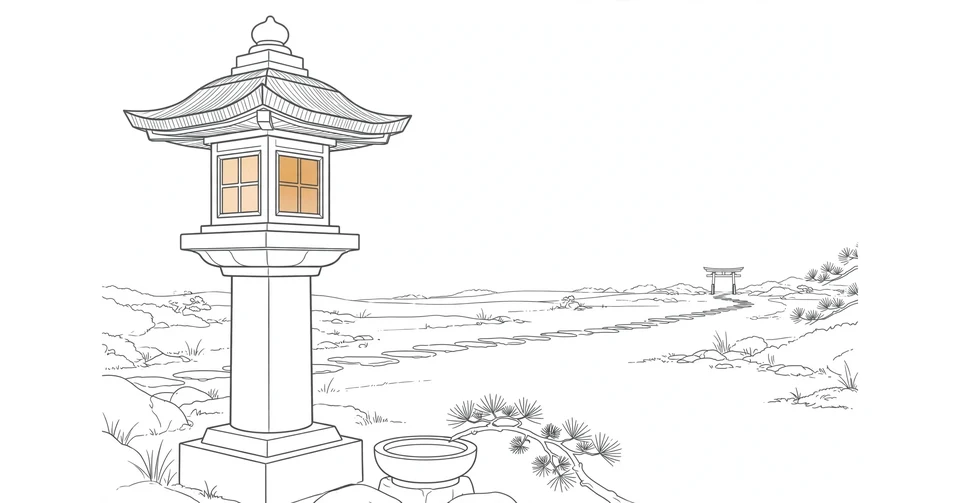
Once you start noticing them, you will see them everywhere in Japan. They line the approach to shrines in Nara, they stand in pairs beside temple gates, they crouch low beside ponds in Kyoto gardens, and they keep watch over the graves in mountain cemeteries. Some are taller than a person. Some are small enough to sit beside a stone basin. Some are polished and new, and some are so old and moss covered that the carving has softened into the stone itself. Each one is a little different, and each one repays a closer look.
What a toro actually is
The word toro is written with characters that mean light and basket, and that is a fair description of the object. It is a container for light, a small chamber with openings that lets a flame shine out while sheltering it from the wind. The earliest toro in Japan were made of bronze and stood inside Buddhist temples, where they framed and lit the paths and were regarded as offerings to the Buddha. Stone came later, and stone is what lasted. A bronze lantern can be melted down or carried away, but a stone lantern stays where it was put, and many have stayed for centuries.
Today the word toro covers a whole family of lanterns made of stone, metal, or wood. The stone ones are the most familiar, and they are the ones this article follows. In Japanese they are often called ishi-doro, which simply means stone lantern, and they are the same lanterns you meet in gardens and sacred places. A toro is not a street light, and it was never designed to be one. A tea master once observed that lanterns are not street lights, and the remark captures the whole spirit of the object. It gives a little light, but its real work is symbolic. It marks a place as set apart, it guides the eye along a path, and it reminds the walker to slow down.
I think that is why toro are so easy to love and so easy to overlook at the same time. They do not demand attention the way a great gate or a pagoda does. They stand quietly at the edge of the path, doing their work without fuss, and a hurried visitor can walk past a hundred of them without really seeing one. The reward for slowing down is a small one, but it is real. Once you have really looked at a single lantern, you will never walk past one unseeingly again.
How toro came to Japan
Toro came to Japan from China, where lanterns could already be admired in gardens and Buddhist temples, and the form arrived together with Buddhism. The oldest bronze and stone lanterns in Japan can be found in Nara, the city that served as the capital during the Nara period from 710 to 794. Taima-dera, a Buddhist temple in Katsuragi in Nara prefecture, possesses a very primitive stone lantern built during the Nara period. Kasuga-taisha, the great Shinto shrine in Nara, owns a lantern from the following Heian period, which ran from 794 to 1185.
At first, toro belonged only to Buddhist temples. They lined and lit the paths, and a lit lantern was considered an offering to the Buddha. During the Heian period, however, they began to be used in Shinto shrines as well, and then around private homes. That spread matters, because it shows how quickly a Buddhist object became a Japanese object, at home in both of the country's great religious traditions. The shrine at Kasuga in Nara still holds more than a thousand hanging lanterns donated by worshippers, a forest of bronze and light that is one of the most moving sights in the country when the lanterns are lit for festivals.
The next great change came much later, during the Azuchi-Momoyama period from 1568 to 1600, when tea masters began to use stone lanterns as ornaments in their gardens. A tea garden, the roji, is a small, quiet space that prepares the guest for the ceremony, and the lantern became part of that preparation. Tea masters designed new types to suit the needs of their gardens, and the lantern moved from the temple into the world of tea, and from there into the Japanese garden as we know it today. By the Edo period, which ran from 1603 to 1867, the stone lantern had become a familiar sight in gardens of all kinds, from the grand gardens of villas to the small courtyard of a town house.
There is a lesson in that long journey, and it is a hopeful one. A toro began as a temple object, then became a shrine object, then a tea garden object, and then a garden object. At every step it kept its meaning and gained a new one. Few objects survive that many changes of setting without losing themselves, and the lantern did it by being simple enough to fit anywhere and meaningful enough to be worth keeping.
Reading a toro from base to finial
A traditional toro is not a single lump of carved stone. It is a small piece of architecture, built up from separate parts that fit together, and each part has a name and a meaning. Learning the parts is the quickest way to read one, and it turns a stone object into a story you can follow with your eyes.
At the bottom is the base, called the kiso, which is usually rounded or hexagonal. Sometimes a shaped piece of rock called the kidan sits underneath the base, directly on the ground. The post or shaft rising from the base is the sao, circular or square in cross section, often with a kind of belt near its middle. Above the post sits the middle platform, the chudai, and above that the fire box, the hibukuro, which literally means fire sack. This is the chamber that holds the light. A conical or pyramidal roof called the kasa, meaning umbrella, sits on top of the fire box, and its upward curled corners are called warabite. On top of the roof sits a lotus shaped part called the ukebana, the receiving flower, and the onion shaped finial crowning the whole lantern is called the hoju, the jewel.
In their original form, stone and bronze lanterns embody the five elements of Buddhist cosmology. The part closest to the ground represents earth, chi. The next part on top of it represents water, sui. The portion holding the light represents fire, ka. The air, fu, and the spirit, ku, are symbolized by the two upper sections that are close to the sky. The lantern is therefore a small model of the universe, stacked in stone from earth to spirit, with a flame burning at its heart. The same five elements appear in the stone pagodas of Japanese cemeteries, and the lantern and the grave marker are cousins in that sense. It is also a metaphor for the ephemerality of life. After death, our physical bodies return to their elemental and original form, and the lantern stands as a quiet reminder of that return.
Not every toro has all five parts. Excluding the fire section, any elements may be added or removed, and different types of toro drop different pieces. A small movable lantern may rest directly on the ground, sometimes without any umbrella at all. That variation is part of the pleasure of looking. Once you know the grammar, you can spot which parts a particular lantern has kept and which it has let go, and you can guess why. A lantern beside a pond does not need to be tall. A lantern marking a shrine approach needs to be seen from far away, so it grows a long post and a high fire box.
I find this the most satisfying part of the whole subject. A toro rewards knowledge the way a good building does. The first time you see one, it is a pretty stone object. The tenth time, after you have learned the parts, it is a sentence you can read. That is a small kind of literacy, and it costs nothing but attention.
The main types of toro
Stone lanterns can be sorted into a few large families, and each family has many variations. The sorting is practical rather than poetic. It is mostly about how the lantern stands on the ground, and that in turn decides where it belongs.
The most widespread family is the pedestal lantern, the tachidoro. These always have a base, and the fire section is often decorated with carved deer or peonies. More than twenty subtypes exist, but the best known is the kasuga-doro, named after the Kasuga-taisha shrine in Nara. A kasuga toro is a garden lantern found at shrines and temples, tall and thin, with a small umbrella that has six or eight sides and upward curled corners. Its fire section is hexagonal or square and is adorned with carved patterns showing deer, the moon, or the sun. You will often find a kasuga toro near the second torii gate of a Shinto shrine, standing like a quiet usher at the threshold. The second oldest stone lantern in Japan is also at Kasuga shrine, a yunoki-doro, or citron tree lantern, from the Heian period. Its name is said to come from a citrus tree that was planted close to it, and its post is carved with rings at the bottom, middle, and top, while its hexagonal base and middle platform are adorned with lotuses.
The second family is the buried lantern, the ikekomi-doro. Its post does not stand on a base but goes directly into the ground, which gives the lantern a lower, more modest presence. These lanterns are usually placed along pathways or close to stone basins in Japanese gardens, where a tall lantern would feel out of place. The most famous buried type is the oribe-doro, named after Furuta Shigenari, a nobleman widely known as Oribe, who designed it to be placed in gardens. The oribe toro has a small four sided umbrella, and its fire section is a cube with a window on each side. The front and back windows are square, and the right and left apertures are shaped as a crescent moon and a full moon. It is a small masterpiece of design, a lantern that carries the moon in its walls.
The third family is the movable lantern, the oki-doro. These are small lanterns that are not fixed on the ground at all, and they often resemble hanging lanterns set down to rest. You will meet them along pathways and close to house entrances, where they can be moved to suit the season or the occasion. A close cousin is the sanko-doro, the three lights lantern, whose low roof has windows shaped as the sun in the front, the moon in the back, and a star on the other sides. It is usually placed near water, and an example can be seen in the garden of the Katsura Imperial Villa in Kyoto.
The fourth family is the one most visitors remember best, the snow viewing lantern, the yukimi-doro. These have one to six curved legs and a very large umbrella, and they are traditionally placed near water, with a three legged lantern often standing with two legs in the water and one on the earth. The wide roof catches the snow in winter, which is where the name comes from, though the lantern is beautiful in every season, when its broad roof mirrors itself in the pond. The oldest examples can be viewed in Kyoto at the Katsura Imperial Villa and date from the seventeenth century. A yukimi toro is the lantern of postcards and garden calendars, and it earns the fame. It is the toro that looks most like a small house for light, solid and sheltering, and it is often the first toro a visitor learns to name.
There are other kinds as well, including hanging lanterns, the tsuri-doro, which hang from roof cornices at shrines and temples, and the tall gilt bronze lanterns called kondo-doro, beautiful antique examples of which can be seen at Todai-ji temple in Nara and at Tosho-gu shrine in Nikko. But for the visitor on foot, the four families above cover most of what you will meet, and naming them is enough to turn a walk into a small treasure hunt.
Where toro stand, and why the place matters
A toro is never placed at random. Its position is part of its meaning, and the place tells you what the lantern is doing there. Once you know the places, you can read the landscape the way a gardener reads it.
At a shrine or a temple, toro line the approach, the sando, and stand in pairs beside gates. Their job there is to mark the way and to light it, both literally and symbolically. A path lined with toro is a path that has been walked by many people before you, and the lanterns are the signs of that long use. Some shrines keep hundreds of them, and the effect at a festival, when every lantern is lit, is unforgettable. The light does not flood the path. It dots it, one small flame at a time, and your eye follows the dots forward. That is a gentle way to be guided, and it suits a sacred place far better than a floodlight would.
In a Japanese garden, a toro does a different job. It lights the path, it stands near a pond or a stone basin, and it gives the eye a place to rest. Garden designers place a toro where the composition needs a vertical note, a small tower among low shrubs and flat water. The lantern is both a light and a sculpture, and in daylight, when it is not lit at all, it still does its work as a piece of the garden's design. Tea masters valued the toro not for its lighting but for its presence, and that attitude still governs the Japanese garden today. The lantern contributes to an atmosphere of quiet reflection rather than to visibility.
In a cemetery, a toro keeps watch over the dead. The forest cemetery of Okunoin on Mount Koya is one of the most moving examples, a vast woodland of graves where visitors walk past thousands of stone lanterns on their way to the mausoleum of Kobo Daishi. There the lanterns are not decoration at all. They are offerings, each one a small light kept for someone who is gone, and the sheer number of them turns a walk into a meditation on how many lives have passed through one mountain. If you go there, walk slowly and look at the variety. No two lanterns are quite alike, and that variety is the point. Each toro was given by someone, for someone, and the forest remembers them all.
The same toro can also stand in an ordinary place, beside the entrance of a house or on a small balcony, and there its job is simpler. It brings a little of the sacred into daily life, a reminder that light and quiet are worth keeping close. That is the most recent chapter in the lantern's long life, and it is still being written. A toro on a balcony is not a lesser toro. It is the same object, doing the same work, at a smaller scale.
What the light of a toro means
It is worth asking what a small flame inside a stone box is actually for, because the answer is not as obvious as it seems. A toro gives very little light. A candle inside a stone chamber cannot compete with an electric lamp, and in the old days the lanterns of a temple were not the main source of light at all. Torches and paper lamps did the practical work. The toro did something else.
In Buddhism, light is a symbol of wisdom and of the path to enlightenment. A lit lantern is an offering, a small gift of brightness made to the Buddha, and the flame stands for the wisdom that dispels ignorance. In Shinto, the lantern marks a place where kami are present, and the light is a sign of respect and of welcome. In both traditions, the light is not there to help you see the path. It is there to tell you that the path matters.
That is why a toro is so often found at a boundary, at a gate, at the edge of a pond, at the start of a cemetery path. The lantern marks a crossing, a place where one kind of ground gives way to another. The shimenawa rope marks a similar boundary at shrines, and the toro does the same work in stone and light. Both say, quietly, that you are entering a different kind of space, and that you should walk accordingly.
There is also a humbler meaning, and I think it is the one that has kept the toro alive for so long. A lantern is a promise that someone will come back to tend it. A flame needs oil or a candle, a wick needs trimming, and a stone lantern needs to be kept clear of leaves and moss. Every toro that is still lit, or still standing clean and upright, is evidence that someone cared enough to keep it. In a world that moves fast and forgets quickly, that small continuity is worth more than it looks.
How to look at a toro when you visit
You do not need any special knowledge to enjoy a toro, but a few habits will make your looking richer. The first habit is the simplest one. Stop. A toro is designed to be seen at walking pace, not at a run, and it repays the visitor who pauses for ten seconds. Look at the whole lantern first, from base to finial, and then look at the details. Are there deer carved on the fire box, or peonies, or the moon? Is the stone polished or rough? Is there moss on the roof, and does the moss suit the lantern or hide it?
The second habit is to count the parts. Does this toro have a base, or does its post go straight into the ground? Does it have an umbrella, and how many sides does the umbrella have? Is the finial a jewel, or is it low or missing, as on a snow viewing lantern? Counting the parts will usually tell you which family the toro belongs to, and naming the family makes the lantern feel less anonymous. A kasuga toro by a torii gate and an oribe toro beside a stone basin are doing different jobs, and you can see the difference once you know what to look for.
The third habit is to notice the placement. Is the toro beside water, and does its reflection matter? Is it one of a pair flanking a gate, or one of a long row along a path? Is it alone in a corner of a garden, where it is the only vertical thing in sight? The placement is the gardener's or the priest's signature, and it tells you what the lantern is for. A toro that stands alone is a focal point. A toro in a row is a guide. A toro beside a basin is a companion to the water.
The fourth habit is to come back at a different time of day. A toro in morning light is a piece of sculpture, and its carvings show clearly. A toro at dusk, if it is lit, is a different object entirely, a small warm room in the dark. Many temples and shrines light their lanterns only for festivals, so a festival visit is worth planning if you can manage it. The lantern festivals of Nara, when thousands of lanterns burn at once, are among the most beautiful nights in Japan, and they are the closest you can come to seeing the toro as its makers saw it.
Finally, remember that you are allowed to enjoy a toro without understanding it completely. The lanterns were made for ordinary people walking ordinary paths, not only for scholars of garden design. Your own response is part of the experience. If a particular toro pleases you and you do not know why, that is fine. Stay with the pleasure for a moment, and let the knowledge catch up later. The lantern is patient. It has been standing there for a long time, and it will still be there when you come back.
Why toro still matter
Japan changes quickly. Cities rebuild themselves, fashions come and go, and even temples adopt electric light. Yet the toro remains, and it remains for a reason that has little to do with nostalgia. A toro is a small, durable answer to a question every generation asks, which is how to mark a place as worth caring about. A stone lantern does that work with almost nothing, a little stone, a little light, and a lot of patience.
The toro also carries a quiet argument about how to live with old things. A lantern that has stood for centuries is not preserved behind glass. It stands outside, in the rain and the snow, growing moss, losing a little of its carving each decade, and being tended by the people who live near it. That is a different idea of preservation from the museum, and I think it is a wiser one. The toro is allowed to age, and its aging is part of its beauty. The moss is not damage. It is a record of the years the lantern has kept its post.
If you visit Japan, give the toro a little of your attention. Walk the cemetery paths of Okunoin, where the lanterns stand in their thousands, and let the scale of that forest of stone settle on you. Stand before a shrine gate at dusk and watch the first lanterns being lit. Sit beside a pond in a Kyoto garden and look at a snow viewing lantern with its broad roof reflected in the water. You will not need a guidebook to tell you what you are feeling. The lanterns have been saying it for more than a thousand years, in a language of stone and light that anyone can understand. Walk slowly, look closely, and let the small lights show you the way.
More in Culture & Society
- Kiai Is the Shout That Turns a Strike Into a Commitment
- An Ofuda Brings the Kami Home on a Slip of Paper
- Kagura Suzu Are the Bells That Let the Kami Hear the Dance
- Japanese Knives From Samurai Swords to Kitchen Counters
- Goshuin Collects Your Shrine Visits One Red Stamp at a Time
- Hamaya Is the Arrow That Breaks Demons at New Year
Latest posts
- Tenkasu Turns Tempura Scraps Into Japan's Favorite Crunch
- Saisen Is the Small Coin You Offer Before You Pray
- Japanese Gardens and the Quiet Art of Borrowed Scenery
- Tanuki Udon Is the Bowl Named After a Raccoon Dog
- A Himorogi Is the Shrine Before Shrines Had Walls
- Wagyu Beef and Why One Small Steak Costs More Than Dinner
- Inari Sushi Turns Fried Tofu Into a Portable Feast
- Sakaki Is the Sacred Tree Shinto Cannot Do Without
- Aburaage Is the Fried Tofu Japan Simmers Sweet
- Tamagushi Is the Sakaki Branch You Offer to the Kami
- The Miko Who Dance Between People and Kami
- Kotodama and the Spirit That Lives Inside Japanese Words
- Japanese Cheesecake and the Fluffy Cake That Jiggles
- Kagura Is the Sacred Dance Shinto Still Performs
- Norito Give a Shinto Ceremony Its Voice