Kagura Suzu Are the Bells That Let the Kami Hear the Dance
· 23 min read
Kagura suzu are the small tiered bells a miko shakes during the sacred kagura dance, and their bright sound is understood as the call that lets the kami hear the offering.
Stand in a shrine hall while a sacred dance is being performed and you will hear the kagura suzu before you see them clearly. A bright cluster of small bells rings with every turn of the dancer's hand, light and sharp, cutting through the low drum and the thin voice of the flute. Those bells are not decoration. Kagura suzu are the instrument that turns a dance into an offering, a small tree of bells held in one hand that speaks to the kami in sound.
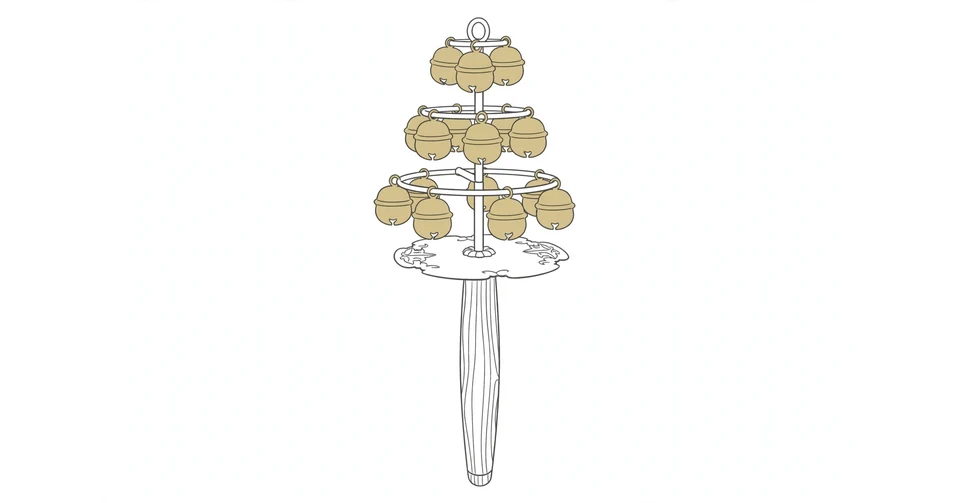
A set of kagura suzu looks simple at first glance, a short handle with rings of little bells hanging from it. Look closer and the simplicity disappears. The bells hang in three tiers on coiled wires, they move like leaves on a branch when the dancer turns, and they ring with a sound that is somehow both delicate and impossible to ignore. The dance would still be beautiful without them, but it would be missing its voice.
That voice is the whole point. In Shinto, the sacred dance called kagura is an offering made to the kami, the spirits and deities of the tradition, and the kagura suzu are the part of the offering that can be heard. The dancer moves, the bells ring, and the sound is understood to call the kami, to purify the space, and to let the gods know that something is being offered to them. The bells are small. The job they do is not.
Most visitors to Japan meet bells at a shrine long before they meet kagura suzu. They pull a rope and ring the big bell that hangs at the front of the hall, clap twice, and bow. That bell is loud, public, and meant for the worshipper. The kagura suzu are its quiet counterpart, held in the hand of a dancer, rung not by a visitor asking for attention but by a performer offering a dance. Once you know the difference, you start hearing shrines differently, and a festival dance stops being a pretty performance and becomes a conversation.
What kagura suzu are
Kagura suzu, written in Japanese as 神楽鈴, are a set of small bells on a short staff, used in kagura dance. The word kagura means entertainment for the kami, and the word suzu means small bell, so the name itself says what the object is for. These are bells for entertaining the gods, not bells for marking time or calling a congregation. Everything about their shape follows from that purpose.
The most striking feature of kagura suzu is their shape. They are built like a small tree. A central handle rises from a hand guard, and from the handle, coiled brass wires spread out in three tiers, each wire carrying small bells. The bells are crotal bells, round and hollow, with a small pellet inside that sounds when the bell is shaken, and a slit cut into the side. When the dancer moves her hand, the whole cluster sways and rings, and the sound comes from many small voices at once rather than from a single strike.
How many bells hang on a set of kagura suzu? Here the sources disagree, and the disagreement is worth stating plainly rather than smoothing over. One widely used reference describes twelve to fifteen bells in tiers of two, four, and six. Another detailed guide to the instrument insists that every set has fifteen bells, arranged in tiers of three, five, and seven. The Metropolitan Museum of Art holds a rare seventeenth century set with twelve barrel shaped bells. The honest answer is that the number varies, from twelve to fifteen, and that the fifteen bell form, in tiers of three, five, and seven, is the pattern most often described for modern sets. The numbers three, five, and seven are auspicious odd numbers in East Asian numerology, the same sequence that gives the Shichigosan festival for children its name, and that may be one reason the fifteen bell form has become the standard that makers and dancers describe most often.
The bells themselves are thought to have been inspired by the fruits of the ogatama tree, a small evergreen known in Latin as Michelia compressa. Look at a cluster of ogatama fruit and the resemblance is clear enough, small round forms hanging together from a branch. That detail matters because it connects the bells to the older object they replaced. According to tradition, the goddess Ame no Uzume danced holding a branch of the sakaki tree, and that branch is described as the ancient form of the bells now used in kagura. The bells, in other words, are a branch that learned to sing. The shape remembers the tree even after the tree itself has been replaced by metal.
A set of kagura suzu is held in one hand, usually the right hand, and the dancer holds the handle firmly while the wires and bells move freely above it. The handle is often red, and the bells are often gold coloured, and the whole object is light enough to be shaken in rhythm for the length of a dance without tiring the arm. That lightness is part of the design. A dancer who must also move slowly, turn in circles, and hold her posture cannot carry anything heavy, and the kagura suzu are made to be an extension of the hand rather than a burden on it.
It helps to compare the kagura suzu with the other ritual objects a dancer may hold. A miko performing the shrine maiden dance may hold a fan, a branch of sakaki, a sprig of dwarf bamboo, or the bells, and she may exchange one for another as the dance progresses. The fan opens and closes like a held breath. The branch is silent and green. The kagura suzu are the only one of these objects that makes a sound of its own, and that is why they are given the most important moments of the dance. When the bells ring, the dance is speaking at its loudest, even though the sound itself is small.
The instrument is also older than it looks. Kagura as a formal tradition was established in the palace repertoire as early as 773, and the bells belong to that long history of music and dance offered to the kami. A description of the instrument can be found in the entry on kagura suzu, which gathers the basic facts about the tiers, the ogatama fruit, and the connection to the myth of Ame no Uzume. The object has changed very little across the centuries, which is itself a kind of evidence. When something works as a ritual tool, people keep making it the same way.
The sound and what it is for
The first thing to understand about kagura suzu is that their sound is not music in the ordinary sense. The flute carries the melody in a kagura performance, and the drum carries the pulse, and the bells sit on top of both like light on water. They do not keep the beat. They mark the movement. Every turn of the wrist, every slow circle of the dance, is answered by a bright shake of the bells, and the effect is that the dancer seems to be ringing the air itself as she moves through it.
That sound has a job to do. In Shinto tradition, bells have a long history as instruments that call to the kami. The large bell at the front of a shrine is rung by a worshipper before clapping, and the ringing is understood to call the kami and to announce that a prayer is about to be offered. The kagura suzu do the same work from the other side of the relationship. The worshipper rings a bell to say that a human is present and listening. The dancer shakes the kagura suzu to say that the kami are present and being honoured. The two sounds face each other across the same idea, that a bell can open a channel between people and gods.
The sound is also understood to purify. Before a dance begins, the space must be made clean in a ritual sense, and the ringing of the kagura suzu is part of that cleansing. The old accounts describe the dancer moving first to cleanse her own body, whirling in one direction and then the reverse, until the movement itself had done the work of purification. The modern dance keeps the whirling and the cleansing and lets the older intensity go, but the bells still carry the meaning. Their sound says that this place, for the length of this dance, is set apart from ordinary life.
There is a third meaning, quieter than the first two, and it is the one I find most moving. The bells are an offering of sound itself. A dance is something the eye can follow, and a prayer is something the mind can hold, but sound fills a room in a way that neither can. When the kagura suzu ring, the offering is not only visible, it is audible, and everyone present can hear that something is being given. The kami are understood to hear it too. That is the promise in the title of this article, that the bells let the kami hear the dance, and it is also the reason the bells are shaken rather than struck. A struck bell rings once and fades. Shaken bells keep ringing as long as the dancer keeps moving, and the offering lasts as long as the dance does.
Kagura suzu in the dance
The kagura suzu belong to the dancer, and the dancer who holds them most often is the miko, the shrine maiden. During mikomai, the shrine maiden dance, she moves in slow, circling patterns to flute, drum, and cymbals, holding the sacred objects of the rite. The cluster of small bells called kagura suzu is one of those objects, held alongside the fan and the sakaki branch, and it is shaken in rhythm as she turns. The story of the miko herself, from oracle to attendant, is told in the portrait of the miko who dances between people and kami, and the bells are the part of her work that a visitor is most likely to remember, because they are the part that can be heard from the back of the hall.
The dance that carries the kagura suzu is kagura itself, the sacred music and dance of Shinto, and its story is inseparable from the myth of the sun goddess Amaterasu. When Amaterasu hid herself in a cave and the world went dark, the goddess Ame no Uzume danced on an overturned tub, holding a branch of the sakaki tree, until the watching gods laughed and the sun was drawn back out. That dance is claimed as the origin of kagura, and the branch in Uzume's hand is described as the original, ancient form of the bells. Every time a miko shakes the kagura suzu today, she is holding a descendant of that branch, and the dance is still doing, in a quieter register, what Uzume's dance did, which is to coax light and attention back into the world. The full story of that dance is told in the account of kagura as the sacred dance Shinto still performs, and it is worth reading alongside this article, because the bells only make sense inside the dance they serve.
In performance, the kagura suzu are not shaken constantly. The dancer raises them, shakes them in a deliberate pattern, and then lowers them again, letting the silence between the shakes become part of the rhythm. The movements are slow and controlled, and the bells answer each gesture with a short burst of sound. The effect is closer to punctuation than to melody. The dance speaks in sentences, and the kagura suzu provide the commas and the full stops, marking where one movement ends and the next begins.
The dancers often perform in pairs or in groups of four, and when several sets of kagura suzu ring together, the sound thickens without becoming loud. Each dancer shakes her own bells in time with her own movements, and the small differences between them create a shimmer rather than a unison. It is a gentle sound, and it suits a dance that is meant to entertain the kami rather than to impress a crowd. Kagura is sometimes called god entertainment, and the word entertainment here means something closer to hospitality than to show business. The dancer is a host, the kami are guests, and the kagura suzu are the sound of the welcome.
There are different kinds of kagura, from the formal court kagura performed for the Imperial Household to the folk kagura performed at shrine festivals in the countryside, and the bells appear across them. The formal dances are slow, restrained, and precise, and the bells are shaken with great deliberation. The folk dances are livelier, with masks, costumes, and stories acted out, and the bells may be grouped in bundles for a louder, more festive sound. The instrument is flexible enough to serve both, which is one reason it has lasted. A ritual object that can only be used in one register is fragile. The kagura suzu can whisper and can celebrate, and so it is welcome everywhere.
How kagura suzu differ from the big shrine bell
Many visitors confuse kagura suzu with the large bell that hangs at the front of a shrine, and the confusion is understandable, because both are called suzu and both are rung to call the kami. But they are different instruments with different jobs, and the difference is worth learning, because it explains a great deal about how Shinto sound works.
The large suzu is a single crotal bell, similar in shape to a sleigh bell, with a slit on one side, and it hangs from a rafter in front of the shrine hall. A worshipper reaches up, takes hold of the rope or the ribbons that hang from it, and shakes or pulls it so that the bell rings. The sound is deep, round, and public, and it is meant to be heard by everyone in the courtyard. Its purpose, as the tradition describes it, is to call the kami, to allow the worshipper to acquire positive power, and to repel evil. It is the bell of the visitor, and it opens the prayer.
The kagura suzu are the opposite in almost every respect. They are many small bells rather than one large one. They are held in the hand rather than hung from a beam. They are rung by a dancer during a ritual performance rather than by a visitor before a prayer. Their sound is high, bright, and delicate rather than deep and public. And where the large bell announces a human prayer, the kagura suzu accompany a divine entertainment, a dance offered to the kami as a gift.
The word suzu itself covers both, and it covers more besides. Small suzu appear on good luck charms, on omamori, where a tiny bell is understood to carry the same calling and protective power in miniature. The tradition, in other words, thinks of the bell as a scale of sound, from the smallest charm to the largest hall bell, with the kagura suzu sitting in the middle, large enough to be heard across a hall and small enough to be danced with. Once you see the family resemblance, the shrine starts to make sense as a place full of bells, each one doing the same work at a different volume.
There is also a difference in who is allowed to ring which bell. Anyone may ring the large bell at the front of a shrine. It is there for the public, and ringing it is part of the ordinary act of prayer. The kagura suzu, by contrast, are a ritual tool, and they are not used in home worship or at the small household altar called the kamidana. They belong to the shrine and to the ceremony, and they are handled by a priest during certain rites and by a miko during the kagura dance. That restriction is not about secrecy. It is about fitness. A bell that is meant to carry a dance cannot be rung casually, and a bell that is meant to be rung casually cannot carry a dance. Each bell keeps to its work, and the work is what gives it meaning.
Materials, colour, and craft
A set of kagura suzu is a small piece of craft, and every part of it carries a meaning. The bells are metal, usually brass, and they are made as crotal bells, round and hollow, with a pellet inside that sounds when the bell is shaken. The wires that hold them are coiled brass, wound in a spiral from the central handle so that the bells hang in their three tiers and can swing freely. The handle itself is often wood, painted or lacquered red, and it ends in a hand guard that protects the dancer's fingers and gives the object its balance. The whole thing is modest in size. The Metropolitan Museum of Art gives the dimensions of its seventeenth century example as about 34 centimetres tall and 19 centimetres across, small enough to hold in one hand and large enough to be seen from the back of a hall.
The colours are not decoration either. Gold is the colour of the bells, and gold has long been understood as a precious material, suitable for an important or beautiful object. Red is the colour of the handle, and red in Shinto is a colour that brings good health and wards off illness and other negative energy, giving an image of vibrancy and life. White and red together are the colours of the miko's own costume, white for purity and red for vitality, so the bells match the dancer who holds them, and the pair of them together reads, at a glance, as a Shinto object.
Behind the bells, streaming from the handle, there are silk ribbons in five colours, purple, white, red, yellow, and green. These are the five sacred colours of Shinto, and they are said to represent the five aspects of the soul and the five directions. Purple stands for the north and for the rough, forceful aspect of the soul. White stands for the west and for the kind, gentle aspect. Red stands for the south and for one of the two aspects that give blessings. Yellow stands for the centre, the origin of life, and the core of the soul itself. Green stands for the east and for the other blessing aspect. The ribbons are always made from silk, a precious material, and they trail behind the bells as the dancer moves, so that the sound has a visible counterpart, a stream of colour following the ring through the air. A detailed guide to these details, including the ribbons and the crests, is given in the sacred items guide to kagura suzu, which walks through the anatomy of the instrument part by part.
At the base of many sets, there is a crest, and the crest most often found is a combination of the chrysanthemum, the kiku, and the diamond shaped hanabishi, the flower lozenge. Both are associated with the Imperial line and with Amaterasu, the sun goddess, and with her main shrine at Ise. The reason, as the guide explains, is practical as much as symbolic. Every shrine has its own crest, tied to the kami it enshrines or the family that founded it, but it would be difficult to custom order kagura suzu with a specific shrine's crest, and all shrines in the Jinja Shinto tradition are connected to Amaterasu and to Ise. So modern sets carry the two crests of Amaterasu and Ise, which makes them usable across all shrines and ceremonies. The crest is a small compromise that lets a single object serve a whole religion.
The oldest surviving sets show how little the design has changed. The Metropolitan Museum of Art holds a seventeenth century set of kagura suzu from Miwa in Nara Prefecture, a place with one of the oldest shrine traditions in Japan. Its twelve barrel shaped bells have slits that end in a heart shaped cutout, and its five lobed metal hand guard, decorated with flower motifs and openwork hearts, bears a hidden inscription on its underside. The inscription reveals that the instrument was used by a priestess named Kuriyama Kamiko for the worship of the Miwa Miyojin deity at Miwa, and it also bears a date of 1699. A bell tree made more than three centuries ago, held by a named priestess, for a named deity, in a named town, and still ringing in a museum collection today, is a reminder that these are not folk curiosities. They are working ritual tools with a documented history, and they were precious enough to be inscribed, kept, and remembered.
Where to see and hear kagura suzu
The best place to meet kagura suzu is where they are used, at a shrine during a kagura performance or a festival. The bells are not museum pieces first, though museums hold fine examples, and they are not shop goods either. They are living tools, and they are at their most meaningful when a dancer is holding them in a hall full of people, with drums and flutes around her and the smell of incense and wood in the air.
Shrine festivals are the most reliable occasion. Through the year, shrines across Japan hold festivals, matsuri, in which kagura is performed as an offering, and the miko dance is often part of the programme. The New Year season is busy, with shrines full of visitors making their first prayers, and the spring and autumn festivals bring longer performances, sometimes lasting into the evening. At a small shrine, the dance may be performed by four young women in a hall barely larger than a living room, and the kagura suzu will ring clearly in the small space, close enough for a visitor to hear each separate shake. At a large shrine, the dance may be performed on a raised stage, and the bells will carry across the courtyard like a thin bright thread through the sound of the drums.
If you go to see them, a little etiquette helps. Kagura is a ritual before it is a performance, and the audience is present as witnesses rather than as customers. Stand or sit where you are directed, keep your voice low, and do not use a flash when taking photographs, since many shrines restrict photography during the dance. Applauding at the end is usually welcome, but the quietest response is often the most fitting, a bow of the head and a moment of stillness while the last ring of the kagura suzu fades. The dance is an offering, and the audience honours it best by receiving it quietly.
Listening is a skill in itself. The first time you hear kagura suzu, you may find yourself listening for the drums and the flute, because those are the sounds that fill the room. Try instead to follow the bells. They are the highest sound in the ensemble, and they mark the dancer's movements, so if you watch her hand and listen for the ring that answers it, the dance will start to make sense as a conversation between movement and sound. The bells ring when she turns, fall silent when she holds still, and ring again when she moves on. Once you hear that pattern, you will never watch a kagura dance the same way again.
There are also places where the bells can be seen outside a performance. Museums with Japanese collections hold historic sets, and the Metropolitan Museum of Art example from Miwa is one of the finest, with its 1699 inscription and its heart shaped cutouts. Shrine treasure halls sometimes display the kagura suzu used by their own miko, alongside costumes and other ritual tools. These displays are worth seeking out, because they let you look closely at the tiers, the wires, the guard, and the ribbons, all of which are hard to see from a seat in the hall. But a display case is only half the story. The bells were made to be shaken, and their full meaning is only present when they ring.
Why small bells carry such a large meaning
It is a strange fact that one of the most important sounds in Shinto comes from one of its smallest objects. The great hall bell is loud enough to be heard across a courtyard. The drum is deep enough to be felt in the chest. The kagura suzu are small enough to hold in one hand, and their ring is thin enough to be missed if you are not listening for it. Yet they carry the part of the rite that nothing else can carry, the sound of the offering itself, made at the exact moment the dance is given to the kami.
I think there is a lesson in that disproportion, and it is not only a religious one. We tend to assume that importance scales with size, that a bigger bell means a bigger meaning, and that a quieter voice matters less than a louder one. The kagura suzu argue the opposite. They argue that a small sound, made at the right moment, by the right person, in the right place, can carry more meaning than a loud sound made anywhere. The dancer does not need to shout to be heard by the kami. She needs to ring clearly, in time, with attention, and the clarity does the work that volume cannot.
The bells also carry a history that is larger than they are. In their shape is the branch that Ame no Uzume held, in their number is an old numerology of auspicious odds, in their ribbons are the five directions and the five aspects of the soul, and in their crest is the connection to Amaterasu and to Ise. A visitor who knows none of this can still enjoy the sound. A visitor who knows a little of it will hear the dance differently, as a small object carrying a very long story, and will understand why the miko holds the bells so carefully, and why the hall goes quiet when they ring.
That care is, in the end, what the kagura suzu are for. They are a reminder that an offering does not need to be large to be real, and that attention, expressed in sound, is itself a form of prayer. The dancer offers her movement, the bells offer their ringing, and the two together say something that neither could say alone, that the kami are present, that they are being honoured, and that the dance is for them. It is a small sound, and it is enough. It has been enough for centuries, and if you stand quietly in a shrine hall and listen for it, you may find that it is enough for you too.
More in Culture & Society
- Kiai Is the Shout That Turns a Strike Into a Commitment
- Toro Stone Lanterns Light the Way Through Japan's Sacred Places
- An Ofuda Brings the Kami Home on a Slip of Paper
- Japanese Knives From Samurai Swords to Kitchen Counters
- Goshuin Collects Your Shrine Visits One Red Stamp at a Time
- Hamaya Is the Arrow That Breaks Demons at New Year
Latest posts
- Tenkasu Turns Tempura Scraps Into Japan's Favorite Crunch
- Saisen Is the Small Coin You Offer Before You Pray
- Japanese Gardens and the Quiet Art of Borrowed Scenery
- Tanuki Udon Is the Bowl Named After a Raccoon Dog
- A Himorogi Is the Shrine Before Shrines Had Walls
- Wagyu Beef and Why One Small Steak Costs More Than Dinner
- Inari Sushi Turns Fried Tofu Into a Portable Feast
- Sakaki Is the Sacred Tree Shinto Cannot Do Without
- Aburaage Is the Fried Tofu Japan Simmers Sweet
- Tamagushi Is the Sakaki Branch You Offer to the Kami
- The Miko Who Dance Between People and Kami
- Kotodama and the Spirit That Lives Inside Japanese Words
- Japanese Cheesecake and the Fluffy Cake That Jiggles
- Kagura Is the Sacred Dance Shinto Still Performs
- Norito Give a Shinto Ceremony Its Voice