An Ofuda Brings the Kami Home on a Slip of Paper
· 19 min read
An ofuda is a paper or wooden tablet from a Shinto shrine that carries the presence of a kami into the home, where it is honoured on a kamidana for one year.
An ofuda is a slip of paper or a thin tablet of wood, inscribed with the name of a kami or a shrine, that brings the kami home. It is received at a Shinto shrine, carried home with both hands, and set on a small shelf called a kamidana, where it is honoured for a year. That is the whole custom in one sentence, and it is worth slowing down for, because this small object carries one of the oldest ideas in Japanese religious life: the sacred does not stay at the shrine, it can live with you, quietly, in an ordinary room.
Most visitors to Japan never notice one. They see the grand torii gates, the ema boards crowded with wishes, and the bright pouches of omamori for sale at the shrine office. The ofuda is quieter than all of these. It is usually out of sight inside the home, standing behind the little doors of a kamidana, and it is never carried around or shown off. Yet for many Japanese households it is the most important sacred object they own, the one thing on the shelf that actually matters.
This article explains what an ofuda is, how a household receives one, how it is placed and cared for at home, and how it is returned at the end of the year. The custom belongs to Shinto, and it is described here as culture, not as instruction for belief. What makes it worth knowing is not only the ritual but the attitude behind it, an attitude of gratitude, tidiness, and letting go on schedule.
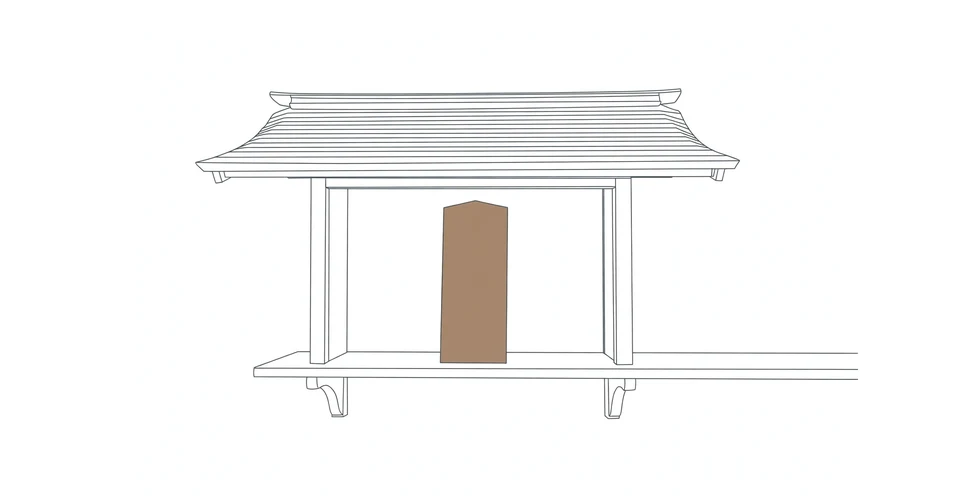
The word itself is plain. It means a slip of paper or wood, and that plainness is part of the point. Nothing about the object is grand. Its power, as believers understand it, comes not from size or cost but from the shrine that consecrated it and the care with which it is kept. A household that keeps an ofuda is making a small daily promise: to keep a clean high place in the home, to pause there each morning, and to remember that protection is something you tend, not something you buy once and forget.
What an ofuda actually is
An ofuda is a paper or wooden talisman received at a Shinto shrine, believed to hold the power of a deity. Its formal name is shinsatsu, and it is understood as a wakemitama, a divided portion of the kami, enshrined on the household altar as a yorishiro, a vessel that houses the divine presence. In plainer language, the ofuda is the kami's address in your home. The shrine does not sell you a souvenir. It entrusts you with a share of the kami's presence, and you agree to honour it.
The tablet usually bears the name of a kami or the name of the shrine that issued it, written in bold calligraphy. Some are simple strips of white paper, called kamifuda. Others are thin boards of wood, called kifuda, or wood wrapped in paper. Some are inscribed only with words, known as moji fuda, while others carry an image, known as efuda. The form varies from shrine to shrine, and there are slender forms like the kensaki-fuda and thicker ones like the kaku-harai, but the idea is the same in every case: a named presence, made portable, that can be kept at home.
What matters most is the distinction between receiving and buying. An ofuda is received, not purchased. You make an offering at the shrine office, the juyosho, and the shrine gives you the tablet in return. The money has a name, hatsuho-ryo, and it covers more than one thing. As our earlier article on tamagushi explains, hatsuho-ryo also covers money paid in exchange for ofuda paper charms and omamori amulets. The offering is not a price tag. It is the first step of the relationship, and the shrine office staff will usually explain what each ofuda is for and how to care for it.
I find this distinction quietly radical. In a world where almost everything sacred can be ordered online and delivered in a box, the tablet insists on a visit, a face, and an exchange. You go to the shrine, you stand in front of the kami, you make an offering, and you carry the ofuda home yourself. The object remembers the journey, and so do you. That is why guides on the kamidana are blunt about it: without an ofuda, a kamidana is furniture. The shelf is housing. The tablet is the guest.
The three ofuda most homes keep
Most households that keep the custom do not keep just one. They keep up to three, and the three have a clear order of honour. The first is the Jingu Taima, the ofuda of Ise Jingu, the Grand Shrine of Ise, revered as the general protecting kami of Japan. The second is the ofuda of the local guardian shrine, the ujigami jinja, the shrine that protects the land where the household lives. The third is the tablet of a shrine to which the family feels a special connection, a sukei shrine, perhaps the shrine of a hometown, a shrine visited on a memorable trip, or a shrine whose kami is connected to the family's work.
The custom, as the shrine of Okuni Jinja explains on its guide to home veneration, is to enshrine the Jingu Taima first, then the ujigami tablet, then any other tablet the household holds dear. A local shrine can usually provide the Jingu Taima as well as its own ofuda, so a household does not need to travel to Ise to begin. The Jingu Taima is distributed through shrines across Japan, which is why it is the most widely kept ofuda in the country.
The order of the three is not decoration, it is a small map of belonging. The centre belongs to the whole country, the right to the neighbourhood, the left to personal attachment. A home that keeps all three is saying, in the arrangement of a few slips of paper, that it belongs to a nation, a place, and a story of its own. I think that is a lovely piece of thinking, and it is done without a single word of explanation on the shelf itself. The arrangement is the explanation.
Some ofuda serve a specific purpose as well. Shrines issue ofuda for protection from misfortune, known as yakuyoke, and for protection from fire, known as hibuse, among others. A household might keep a fire protection tablet near the kitchen, for example. These purpose-specific tablets sit alongside the three main ones, and the shrine office can advise which fits a household's situation. The variety is wide, but the rule stays simple: one home, a small number of tablets, each with a clear place.
How to receive an ofuda at a shrine
Receiving an ofuda is straightforward, and shrines welcome visitors who come for one, regardless of nationality. Shinto has no conversion process and no membership, and shrines distribute ofuda to whoever comes to receive them. The usual route is to visit a shrine, pray at the main hall, and then go to the shrine office, the juyosho, where tablets and omamori are given out. There you state which tablet you would like, make the offering, and receive the tablet, often wrapped in plain paper for the journey home.
The offering has no fixed price in the way a shop has prices, and the amount varies by shrine and by the kind of ofuda. The shrine will indicate the customary amount, and the visitor offers it with thanks. It is worth remembering that this is hatsuho-ryo, an offering, not a purchase, and treating it that way changes the tone of the whole exchange. You are not a customer. You are a guest asking the kami to come home with you, and the offering is the first act of hospitality.
One honest difficulty deserves mention. The Association of Shinto Shrines, Jinja Honcho, discourages postal distribution, because an ofuda is meant to be received in person at a shrine you have visited. There is no official mail order system, and that is deliberate. Some shrines, such as Okuni Jinja, do send ofuda to people living overseas who cannot visit in person, and they explain the offering by email first. Practices differ from shrine to shrine, so the surest course is to follow the guidance of the shrine where you received the ofuda, and to receive it in person whenever you can. For a visitor to Japan, that is easy: the intended way is simply to go to a shrine, and the shrine will take care of the rest.
For someone living outside Japan, the yearly cycle afterwards is the real difficulty, not the first visit. The tablet is renewed every year, and the old one must be returned to a shrine. That means the custom asks for an ongoing relationship with a shrine, not a single transaction on a holiday. It is worth thinking about before you begin rather than after, and it is worth being honest about whether you can keep the rhythm. A shrine in Hawaii, such as Hawaii Kotohira Jinsha or the Daijingu Temple of Hawaii, can serve people in that region, and that is the realistic route for many outside Japan.
Placing the ofuda on the kamidana
The ofuda is enshrined on the kamidana, the kami shelf, a small wooden shrine that holds the tablets at the highest clean place in the home. The kamidana should stand in a bright, clean spot that everyone in the home can easily visit, a little above eye level, and ideally facing south or east so that it looks toward the midday sun or the sunrise. In practice that means mounting it on a north or west wall. Nothing should be above the kamidana except the ceiling, because it would be disrespectful to put anything higher than the kami.
The arrangement of the tablets follows the order of honour described above. In a kamidana with three doors, the Jingu Taima goes in the centre, the ujigami ofuda to the right as you look at it, and the sukei ofuda to the left. In a kamidana with a single door, the tablets are layered front to back: the Jingu Taima at the front, the ujigami tablet behind it, and the sukei ofuda behind that. The order of honour runs centre first, then right, then left. The ofuda should stand upright, supported by a slot or a small wooden stand, so that it leans safely and can be seen.
Modern homes have made this simpler and also more complicated. Traditional kamidana are substantial pieces of joinery, and most Japanese apartments no longer have room for one. Modern kamidana are often shallow wall mounted panels of unfinished hinoki, Japanese cypress, reduced to a board, a ledge, and sometimes a miniature torii gate. The abbreviation is accepted practice, not a compromise sold to tourists. What the modern designs keep is the part that is fixed: a clean, high, undisturbed place to keep one.
A few placement rules are worth knowing because they show how seriously the custom takes the shelf. The kamidana should not sit above a doorway, where constant traffic and vibration make it an unsettled place. It should not back onto a lavatory wall. It should not directly face a Buddhist family altar, since facing each other means turning your back on one while addressing the other, though side by side in the same room is fine. In an apartment with neighbours overhead, some households fix a piece of paper bearing the character for cloud, kumo, to the ceiling above the shelf, declaring symbolically that only sky lies above the kami. Printed sheets are sold for this purpose, and writing the character yourself is equally normal. I find the cloud character the most charming detail in the whole custom. A building regulation becomes a poem, and one character solves it.
Daily care: rice, salt, and water
An ofuda is not installed and forgotten. It is cared for, daily, with a small ritual that takes less than a minute and asks for attention rather than effort. The standard daily offering is three things: white short grain rice, washed but uncooked, water, and salt, placed in small vessels in front of the ofuda. Rice goes on a plate in the centre, nearest to the tablet, with salt to the right and water to the left. Sake is often added on special days, in two small jars, one on either side of the rice.
The greeting itself follows the same pattern as worship at a shrine. You bow slightly, place the offerings before the kami, bow deeply twice, clap twice, bow deeply once, and bow slightly again before removing the offerings. The ideal is to do this twice a day, morning and evening, but it is also common to do it once a day, or on the first and fifteenth of the month. Fresh water each morning is the core habit. Rice and salt are changed less often, commonly on the first and fifteenth. Sakaki, the evergreen branches placed in vases on either side of the ofuda, are normally changed every two weeks, at the beginning and middle of the month.
Offerings to the kami should be eaten afterwards rather than thrown away, so the easiest rhythm is to place them just before paying respects and take them down as soon as you finish. Seasonal foods, gifts, or unusual foods may be offered as well, in a lower position than the standard offerings. The vessels themselves should be used for nothing else, and dedicated sets are available. None of this is elaborate. The whole point is regularity, a small act of attention repeated until it becomes part of the morning, like opening the curtains.
There is a quiet honesty in this routine that I admire. The custom does not ask for grand gestures or long prayers. It asks for a clean shelf, fresh water, and a minute of standing still before the day starts. A household that keeps an ofuda is not performing piety for an audience. There is no audience. There is only a shelf, a slip of paper, and the person who stands before it. That privacy is, I think, why the custom has survived into apartment life. It fits in a small room because it was never about the room.
The yearly return and the burning
An ofuda has a term of one year. A tablet that has seen the year through is returned, with thanks for a year of protection, to the shrine that gave it, and a fresh ofuda is welcomed in its place. The old tablet is never thrown away with household waste. It is taken to the shrine's collection point, the kosatsu osamesho, or sent back by mail with a note of thanks if a visit is impossible. It is appropriate to make an offering when returning an ofuda, though there is no fixed amount.
At many shrines, the returned tablets are committed to a sacred fire in ceremonies held around the new year, from New Year's Eve through mid January, in fire festivals called sagicho or dondo-yaki. The ritual burning has a formal name, otakiage, and it applies to old ofuda and old omamori alike. The fire is not disposal. It is a respectful farewell, a way of returning the kami's divided presence to the shrine with gratitude rather than discarding it like rubbish. A new tablet is then received, and the year begins again with a clean shelf and a fresh tablet.
The custom is best kept with the shrine that gave the ofuda, but the Association of Shinto Shrines notes that a charm from a far away place may be returned to a shrine near you, and Meiji Jingu's own sign at its return box asks visitors to use it only for old charms and talismans, not for trash. Practices differ in detail by shrine and region, so when in doubt it is surest to follow the guidance of the shrine where you received it. The principle underneath the variation is constant: the ofuda is returned, it is burned with respect, and the household begins again.
There is something bracing about a sacred object with an expiry date. Most things we value we try to keep forever, and we are surprised when they fade. The tablet is designed to fade on schedule. It is received in gratitude, kept for a year, and released in gratitude, and the release is part of the practice, not a failure of it. I think many of us could use a custom like that, a yearly moment when we thank something for its service and let it go, instead of keeping it until it becomes clutter. The ofuda does not ask to be eternal. It asks to be honoured while it lasts, and then to be returned.
Ofuda and omamori: the simple difference
Visitors often confuse an ofuda with an omamori, and the confusion is understandable, since both are sacred objects received at shrines, both are renewed yearly, and both are returned to be burned. The difference is practical, and one short sentence holds it: the omamori is worn, the ofuda is enshrined. An omamori is a small pouch, sewn shut, containing a slip of wood or paper inscribed with the kami's name, carried in a bag or pocket or hung in a car. An ofuda is a tablet that stays in one place, on the kamidana, guarding the home and everyone in it.
The omamori protects the person who carries it, and it is often tied to a specific wish, such as safe travel, good health, success in exams, or safe childbirth. The ofuda protects the household as a whole, and it is tied to the home rather than to any single wish. The omamori hides its sacred contents inside a decorated cloth pouch that should never be opened, since opening it is understood to release the power within. The tablet shows its writing openly, since it is meant to be seen and honoured on the shelf. If you want the fuller story of the little pouch, our article on omamori, the pocket sized amulets of protection explains how to choose one, carry one, and return one.
It is fine to keep both, and fine to keep more than one ofuda on a kamidana. A common worry among visitors is that keeping several sacred objects will cause the kami to quarrel, but shrines are clear that this is not so. The three ofuda on a kamidana are the normal arrangement, not an exception, and an ofuda from a Buddhist temple may stand alongside a Shinto one. What matters is not the number but the respect with which each is kept. A shelf crowded with tablets that are dusted and honoured is a healthy shelf. A single tablet left dirty and forgotten is not.
Etiquette for visitors who want one
A visitor to Japan who would like one should start by visiting a shrine, not by shopping. Go to the main hall, bow, clap, and pray as others do, and then go to the shrine office and ask. The staff will explain which ofuda the shrine offers and what offering is customary. There is no need for Japanese language fluency, and there is no test of belief. Shrines distribute ofuda to whoever comes to receive them, and a respectful visitor is welcome.
A few points of etiquette are worth carrying with you. Receive the ofuda with both hands, and carry it home carefully, keeping it in its paper wrapping until it is enshrined. Do not place it on the floor, on a low shelf, or anywhere it would sit below eye level. Do not put it in a bathroom or a kitchen, and do not hang it over a doorway where people pass beneath it all day. If you have no kamidana, a clean high place will do, and a tablet kept respectfully in such a place is complete practice even without a shelf. If you keep it for a year, plan how you will return it, either on a later visit to Japan or by sending it back to the shrine with a note of thanks. Never put an old ofuda in household waste, and if returning it is impossible for a time, keep it respectfully until you can, and ask a shrine what it advises.
It is also worth deciding honestly what you are doing. Buying a beautiful kamidana as a piece of hinoki joinery is entirely reasonable, and it is a beautiful object. Keeping an ofuda as a sacred presence is a different thing, and it asks for a year of daily attention and a yearly return. Both are fine. Confusing the two is the thing to avoid, and the confusion usually shows up later, when the shelf is dusty and the tablet is forgotten. If you are not ready for the rhythm, it is better to admire the custom and leave the tablet at the shrine than to take one home and neglect it. The kami, one suspects, would prefer the honest visitor to the careless keeper.
A small slip of paper, a whole year of attention
An ofuda is a small thing, and that is its strength. It does not demand a temple in the house or an hour of prayer. It asks for a clean high shelf, fresh water in the morning, and a moment of standing still. It asks to be received in person, honoured for a year, and returned with thanks to be burned. In return it gives the household a centre, a place where the day begins with gratitude and where the year ends with a deliberate letting go.
The custom survives because it fits real life. It fits apartments and busy mornings and people who are not sure what they believe. It does not require certainty, only attention, and attention is something anyone can offer. The ofuda hangs on the wall and says nothing, and the household answers by keeping the shelf clean and the water fresh. That quiet exchange, repeated daily for a year and then released, is the whole of it. A slip of paper brings the kami home, and the home, for a year, remembers to pay attention.
More in Culture & Society
- Kiai Is the Shout That Turns a Strike Into a Commitment
- Toro Stone Lanterns Light the Way Through Japan's Sacred Places
- Kagura Suzu Are the Bells That Let the Kami Hear the Dance
- Japanese Knives From Samurai Swords to Kitchen Counters
- Goshuin Collects Your Shrine Visits One Red Stamp at a Time
- Hamaya Is the Arrow That Breaks Demons at New Year
Latest posts
- Tenkasu Turns Tempura Scraps Into Japan's Favorite Crunch
- Saisen Is the Small Coin You Offer Before You Pray
- Japanese Gardens and the Quiet Art of Borrowed Scenery
- Tanuki Udon Is the Bowl Named After a Raccoon Dog
- A Himorogi Is the Shrine Before Shrines Had Walls
- Wagyu Beef and Why One Small Steak Costs More Than Dinner
- Inari Sushi Turns Fried Tofu Into a Portable Feast
- Sakaki Is the Sacred Tree Shinto Cannot Do Without
- Aburaage Is the Fried Tofu Japan Simmers Sweet
- Tamagushi Is the Sakaki Branch You Offer to the Kami
- The Miko Who Dance Between People and Kami
- Kotodama and the Spirit That Lives Inside Japanese Words
- Japanese Cheesecake and the Fluffy Cake That Jiggles
- Kagura Is the Sacred Dance Shinto Still Performs
- Norito Give a Shinto Ceremony Its Voice