Japanese Knives From Samurai Swords to Kitchen Counters
· 12 min read
Japanese knives are the sharpest souvenirs in Japan, and the story behind them runs from samurai swords to the small workshops of Sakai. Here is how they are made, what to buy, and how to keep one sharp for decades.
A Japanese knife does not feel like a kitchen tool the first time you hold one. It feels too light, too thin, almost fragile, until it slides through a tomato under its own weight and you understand why chefs fly across the world to buy one.
Japanese knives are now among the most sought after souvenirs in Japan. In 2021, exports of kitchen knives hit a record 12 billion yen, a rise of 30 percent from the year before, and the city of Sakai in Osaka, where 90 percent of Japan's professional chefs buy their blades, has become a pilgrimage site for cooks. The secret is not one trick. It is centuries of craft, harder steel, and a stubborn idea that one knife should do one job perfectly.
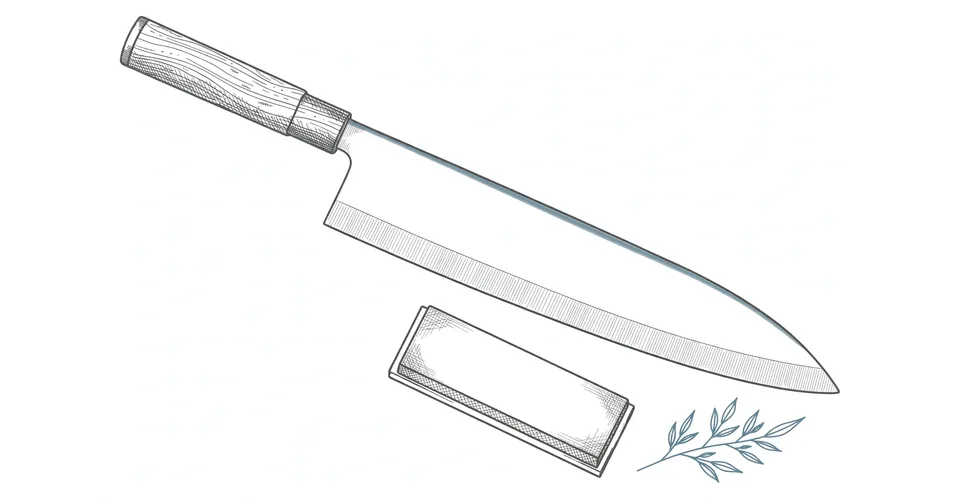
This article follows the blade from its beginnings in sword making to the workshops of Sakai, explains what makes Japanese knives cut differently from Western ones, and ends with practical advice on buying one and keeping it sharp for 15 to 20 years.
How a sword became a kitchen knife
The story of Japanese knives begins in the fifth century, when blacksmiths arrived in Sakai to make tools for the construction of the Nintoku-tenno-ryo Kofun, one of the largest burial mounds in the world. Edged tools found around the tombs suggest they were made in Sakai itself. By the 12th century, the same blacksmiths had moved from tools to forging swords for the samurai.
Sakai sat on Osaka Bay with a major port, and that position turned a local craft into a national one. When Portuguese traders arrived in the 16th century, Sakai's blacksmiths made them sharp knives for cutting tobacco. The workmanship was so good that the Tokugawa shogunate awarded the city's knife makers a seal of approval, a mark of quality that still echoes in the pride of Sakai workshops today.
The decisive turn came in 1876, when the Meiji government banned the wearing of swords in public. Swordsmiths across Japan suddenly lost their main market, and many turned their skills to kitchen blades. The steel, the forging, and the sharpening stayed the same. Only the purpose changed. Sakai is now one of Japan's six major cutlery regions, alongside Seki in Gifu, and its name has become a guarantee in professional kitchens.
That history matters because it explains the shape of the craft. Japanese knives were not designed in a factory to be all rounders. They grew out of a sword culture where a blade had one purpose and had to do it flawlessly, and that attitude survived the move from battlefield to kitchen.
Why Japanese knives cut differently
Pick up a Japanese knife and a Western chef knife side by side and the difference is obvious before either touches food. Japanese knives are thinner, lighter, and harder. Many Japanese blades reach hardness above 60 on the Rockwell scale, while Western kitchen knives often sit in the mid to high 50s. Harder steel holds a finer edge for longer, and that is why a Japanese blade can glide through a tomato instead of crushing it.
The second difference is the bevel, the angled face that forms the edge. Many traditional Japanese knives are single bevel, sharpened on one side only. A single bevel edge is finer and more precise, which is exactly what a sushi chef needs when slicing raw fish into clean, translucent sheets. Western knives are almost always double bevel, sharpened on both sides, which makes them tougher and more forgiving but never quite as sharp.
The third difference is specialization. Where a Western cook might own one big chef knife for everything, Japanese knives are built around clearly defined tasks. Most Japanese knives are made for a single task, and the cook is expected to learn each blade. A sushi chef will cut raw fish and some vegetables, so he will own just three or four knives, each made for its own job. A European chef, who must cook everything from meat to fruit, tends to own many more. The Japanese approach says a tool should fit its task like a key fits a lock, and the cook should learn the tool rather than force one blade to do everything.
There is a price for that sharpness. Harder steel is less forgiving when misused. Cutting bones, frozen food, or twisting the blade in hard ingredients can chip the edge. Japanese knives are designed for clean cutting motions and proper technique rather than rough, forceful use. I think that trade is worth it. Japanese knives reward a lighter touch, and after a week with a good Japanese blade, the heavy Western knife in my drawer started to feel like a hammer where I had wanted a scalpel.
Four pairs of hands, one blade
The making of Japanese knives in Sakai has barely changed for over 600 years, and the most surprising part is that no single person makes a knife. Each blade passes through four different companies, and each stage gets expert attention.
A blacksmith forges the knife from iron and carbon steel. Then it goes to a company of sharpeners who refine the blade on a rotating stone. A third company makes a bespoke handle, perhaps from magnolia wood, water buffalo horn, or ebony. A fourth company, the wholesaler, attaches the handle and engraves the brand on the blade before selling it. Sakai is home to around 75 knife making companies, including makers and wholesalers, all working in this chain.
The sharpening stage is where the craft turns almost meditative. Etsuro Ikegami, a fifth generation sharpener, wakes each morning and goes to his workshop in Sakai, as he has done since the age of 15. He has sharpened knives for over 70 years, working by touch on a wet stone, and the craft has clearly become his ikigai, the Japanese idea of a reason to live. He says it takes ten years to reach competency. He knows how to sharpen over 50 different styles of knife to perfection.
The apprenticeship behind that skill is famously slow. Eric Chevallier, a Frenchman who came to Sakai in 2012 to study the fifth century tomb and stayed to learn the craft, spent five years as an apprentice to a famed blacksmith. During a traditional apprenticeship, the student is not allowed to finish a knife, because the blacksmith only forges and does not sharpen, so the apprentice has no right to pass his product to the next craftsman. It was eight years before Chevallier produced a knife good enough to hand over to the next artisan. That patience is the real product of Sakai, and the blade is only its evidence. It is the same patience behind kintsugi, the Japanese art of repairing broken things, where care itself is part of the beauty.
This division of labour also explains why the craft is fragile. The Friday newspaper reported in June 2026 that the industry is booming, with sales of 38 knife makers reaching 16.733 billion yen, yet workshops face a severe shortage of artisans, including some in their 80s still working. When one link in a four company chain breaks, the whole tradition wobbles. That is part of why a handmade Japanese knife costs what it does, and why buying one is, in a small way, a vote for keeping the chain alive. This is also why genuine Japanese knives are rarely cheap, and why a suspiciously low price is often the first warning sign.
A knife for every task
If you walk into a knife shop in Sakai, the wall of blades can be overwhelming. The table below covers the Japanese knives a home cook is most likely to meet, and what each one is for.
| Knife | Best for | Shape |
|---|---|---|
| Yanagiba | Slicing raw fish for sashimi and sushi | Long, narrow, single bevel |
| Deba | Filleting fish and cutting through small bones | Short, thick, heavy spine |
| Usuba | Vegetables and fine, precise cuts | Thin, straight edge, single bevel |
| Nakiri | Vegetables, everyday chopping | Rectangular, double bevel |
| Santoku | General purpose, the all rounder | Shorter blade with a sheepfoot tip |
| Gyuto | The Japanese chef knife | Like a Western chef knife, thinner and lighter |
| Kiritsuke | Slicing and detail work | Long blade with a pointed, angled tip |
For most home cooks choosing among Japanese knives, the choice is simple. A santoku or a gyuto covers nearly everything, and a small petty knife handles fruit and detail work. The single bevel specialists, the yanagiba and the usuba, are wonderful, but they are sharpened for right handed use by default, and left handed cooks should ask for a left handed version before buying. The extremes are fun to know about: the menkiri, a rectangular knife designed to cut a strip of noodles in one stroke, and the fuguhiki, a thin blade made to slice fugu, the toxin filled pufferfish.
The same logic of specialization shows up in the kitchen that surrounds these knives. The long yanagiba exists because sushi, the dish that conquered the world, demands a single clean pull through raw fish, not a sawing motion. If you want to understand why the blade looks the way it does, watch a sushi chef work for five minutes. The knife and the cuisine grew up together, and neither makes full sense without the other.
Where to buy one in Japan
The best place to buy Japanese knives is Sakai itself. The Sakai Knife Museum CUT, which opened in 2022, shows some of the 200 types of knives created through the city's history, from samurai swords to oversize maguro bocho tuna knives that need two people to hold. The shop underneath the museum passed 100 million yen in sales in 2023, and it expects more each year as visitors arrive.
A few minutes' walk from the museum sits Wada Shouten, the wholesaler where Ikegami sharpens blades and visitors can try a whetstone themselves. The shop will let you choose a handle, magnolia wood, oak, sandalwood, even water buffalo horn, and engrave your name into the blade. A santoku from such a shop is a general purpose tool you can use to chop, slice, dice, and mince, and it will arrive home as a working souvenir rather than a decoration.
If Sakai is too far, two shopping streets cover most needs. Doguyasuji in Osaka is a 500 foot lane filled with specialized catering shops, and it is where many young chefs buy their first knife. Kappabashi in Tokyo, the kitchenware district between Ueno and Asakusa, has knife shops where foreign visitors now crowd in to hold blades and test their cutting performance before buying. Knives priced around 20,000 to 30,000 yen are especially popular among foreign tourists, and many shops offer tax free shopping for visitors.
A few practical notes before you pay. Hold the knife first. Weight and balance matter more than brand, and the best Japanese knives feel balanced the moment you pick them up. A blade that feels heavy in the shop will feel heavier after an hour of cooking. Ask whether the blade is single or double bevel, and whether it is carbon steel or stainless. Carbon steel takes a sharper edge but can rust if left wet, while stainless is easier to live with. Finally, pack the knife in checked luggage. A kitchen knife is forbidden in cabin baggage on every airline, and a beautiful blade confiscated at security is a sad end to the story.
Keeping the edge for decades
A Japanese knife is not a buy and forget tool. It is a relationship, and the maintenance is part of the pleasure. The core ritual is the whetstone. At the start of each week, many chefs take a water stone and sharpen their knives, holding the blade at an angle only two or three coins high and moving it half an inch at a time. Three stones of different coarseness are the usual set: rough to repair, medium to sharpen, fine to polish. Ikegami, who has done this for over 70 years, spends the most time on the tip of the blade, because it does most of the work.
Daily care is simpler and matters more. Most damage to Japanese knives comes not from cooking but from washing and storage, so wash the knife by hand after use and dry it immediately. Never put it in a dishwasher, where heat and rattling dull and chip the edge. Never use it on bones, frozen food, or hard shells. Store it in a saya, a wooden sheath, or on a magnetic strip, never loose in a drawer where it bangs against other tools. A knife treated this way should last 15 to 20 years, and many last longer, growing a soft golden patina on a magnolia handle as the years pass.
If sharpening on a stone feels daunting, most knife shops in Japan offer a sharpening service, and the wholesalers in Sakai will resharpen a blade for a small fee. Many owners of Japanese knives never learn to use a stone, and that is fine. There is no shame in paying a professional. The point is that the edge is maintained, not who maintains it. What matters is that a blade bought in Sakai in 2026 can still be slicing cleanly in 2046, and that is a rare promise for anything you can buy on a holiday.
That longevity is, for me, the real argument for Japanese knives. In a kitchen full of gadgets that break, rust, or go out of fashion, a well made blade is one of the few tools that gets better with attention and outlives trends. The craft behind it is old, slow, and a little stubborn, and the knife on your counter carries all of that in a few hundred grams of steel. Buying one of these Japanese knives is not about owning a sharper object. It is about choosing a slower, more careful way to cook, and letting a centuries old craft into your daily routine.
More in Culture & Society
- Kiai Is the Shout That Turns a Strike Into a Commitment
- Toro Stone Lanterns Light the Way Through Japan's Sacred Places
- An Ofuda Brings the Kami Home on a Slip of Paper
- Kagura Suzu Are the Bells That Let the Kami Hear the Dance
- Goshuin Collects Your Shrine Visits One Red Stamp at a Time
- Hamaya Is the Arrow That Breaks Demons at New Year
Latest posts
- Tenkasu Turns Tempura Scraps Into Japan's Favorite Crunch
- Saisen Is the Small Coin You Offer Before You Pray
- Japanese Gardens and the Quiet Art of Borrowed Scenery
- Tanuki Udon Is the Bowl Named After a Raccoon Dog
- A Himorogi Is the Shrine Before Shrines Had Walls
- Wagyu Beef and Why One Small Steak Costs More Than Dinner
- Inari Sushi Turns Fried Tofu Into a Portable Feast
- Sakaki Is the Sacred Tree Shinto Cannot Do Without
- Aburaage Is the Fried Tofu Japan Simmers Sweet
- Tamagushi Is the Sakaki Branch You Offer to the Kami
- The Miko Who Dance Between People and Kami
- Kotodama and the Spirit That Lives Inside Japanese Words
- Japanese Cheesecake and the Fluffy Cake That Jiggles
- Kagura Is the Sacred Dance Shinto Still Performs
- Norito Give a Shinto Ceremony Its Voice