Kurikinton Is the Golden Mash That Wishes You Wealth
· 20 min read
Kurikinton is the golden mash of chestnut and sweet potato served in osechi, and its colour carries a wish for wealth in the year ahead.
Kurikinton is the golden mash of chestnut and sweet potato that sits in the top tier of the osechi box at New Year, and it is there for one reason: its colour looks like gold, and gold looks like wealth. The dish is sweet, smooth, and studded with whole candied chestnuts, and it is eaten in small spoonfuls at the start of the year, when every dish on the table is also a wish.
The name itself says the wish out loud. Kuri means chestnut, kin means gold, and the whole word is often translated as chestnut gold mash. Nothing about the dish hides its meaning. The cook mashes sweet potato into a soft golden paste, folds in glossy chestnuts, and serves a small mound that shines like a pile of coins. You eat it, and you eat the hope that the year will be a prosperous one.
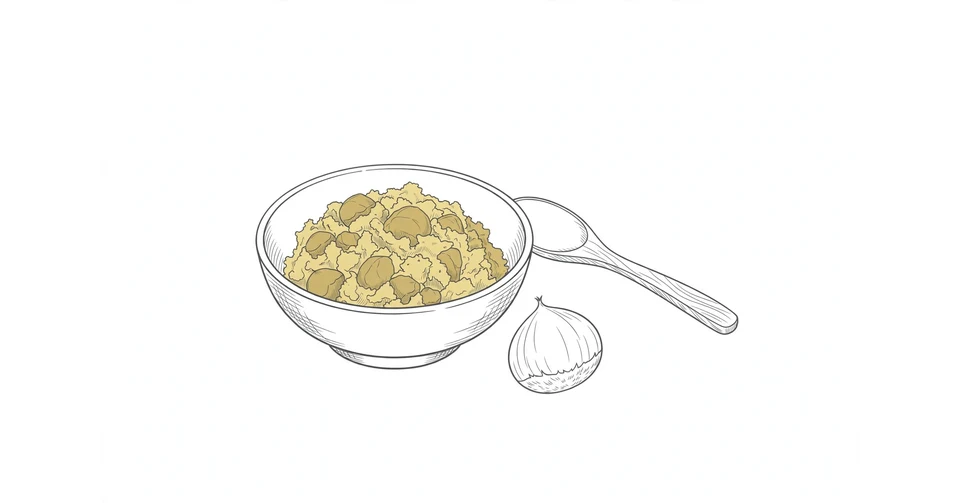
That directness is part of the charm. Japanese New Year food is full of puns, shapes, and colours that stand in for wishes, and kurikinton is one of the plainest examples. Black beans wish you health because the word for bean also means diligent. Herring roe wishes you many children because one sac holds so many eggs. Kurikinton wishes you wealth because it is the colour of money. Once you know that, you cannot look at the dish without smiling at how honest it is. A wish you can eat is a wish you can taste, and this one tastes of chestnut, sweet potato, and syrup.
What kurikinton actually is
Kurikinton is a sweet mash made from Japanese sweet potato and candied chestnuts, cooked together in syrup until soft and golden. The sweet potato is boiled, pushed through a fine sieve until it turns into a smooth paste, and then warmed gently with sugar, a pinch of salt, mirin, and syrup from the chestnut jar. Whole chestnuts go in last, so they stay whole and glossy while the mash around them turns soft and pale gold. The result is served at room temperature, never hot, and it keeps in the refrigerator for three to four days.
It is important to know that kurikinton is sweet but it is not a dessert. In the osechi box it belongs with the sweet appetizers, the kuchitori, and it is eaten as part of the meal, not after it. That surprises many first timers, and it is a good reminder that the New Year table does not follow the rules of an ordinary dinner. Many osechi dishes are seasoned more heavily with sugar, salt, and vinegar than everyday cooking, because the food was traditionally made in advance and had to keep well for several days while the household rested. Kurikinton keeps its sweetness for the same practical reason that the black beans keep theirs: the sugar helps the dish last through the holiday.
The texture is the thing to notice first. A good kurikinton is smooth without being runny, sweet without being sticky, and soft enough to scoop with a spoon yet firm enough to hold its shape in a small mound. The chestnuts give it contrast. They are tender and glossy, and they break the softness of the mash with something to bite into. When the dish is made well, the two textures sit side by side instead of blending into one, and each spoonful has both the silk of the potato and the gentle resistance of the chestnut.
Why gold means wealth in kurikinton
The link between kurikinton and wealth is carried by colour. The mash is a warm, bright yellow, and in a culture where gold has long stood for money and good fortune, a golden dish on the New Year table reads as a wish for a rich year. The Food in Japan guide to osechi puts it plainly: the name uses characters associated with a golden mass or treasure, and its bright yellow colour reinforces the link with wealth. The dish does not need a speech or a ceremony. Its colour does the talking, and everyone at the table understands it.
That colour comes from the ingredients themselves, and cooks have long helped it along. The Japanese sweet potato gives the mash its natural yellow, and traditionally cooks simmer the potato with dried gardenia pods, called kuchinashi no mi, which add a brighter golden tint. The pods are cracked in half, wrapped in cheesecloth, and dropped into the pot with the potato, then lifted out before mashing. The same pods are used to colour pickled daikon and noodles, so their golden touch is a familiar one in Japanese cooking. If you cannot find them, the sweet potato alone still gives a soft yellow, and many home cooks today skip the pods or use a pinch of turmeric instead. The wish survives either way, because the gold is in the idea as much as in the shade.
There is something gentle about a wealth wish that takes the form of food. Money is usually counted in private and worried over in silence, but kurikinton puts the wish on the table where everyone can see it and share it. Nobody at a New Year meal pretends the dish is about anything else, and that openness is refreshing. The family eats a golden mash together and hopes, together, for a better year. I find that more honest than most of the talk about money I hear the rest of the year, because it admits that wanting a comfortable life is a normal human wish, and it dresses that wish in something sweet enough to share.
The two ingredients that do the work
Kurikinton needs only two main ingredients, and both of them are winter harvests. The first is the Japanese sweet potato, called satsumaimo. The second is the chestnut, usually bought ready candied in syrup. Both are at their best in the cold months, and both have fed Japanese families through winter for a very long time. That is part of why the dish belongs to New Year: it is made from what the season gives, at the moment the year turns.
Satsumaimo is not the same as the sweet potatoes most of the world knows. It has a pale, almost white flesh under a reddish skin, a starchy texture, and an intensely sweet flavour when cooked. For kurikinton, cooks use only satsumaimo, because other sweet potatoes are too wet or too mild and the mash would turn loose and dull. The potato is peeled thickly, because the layer just under the skin can be bitter, then sliced into even pieces so it cooks at the same pace. After slicing, the pieces are soaked in water for about fifteen minutes to wash away excess starch, which helps the finished mash stay smooth and clear in colour.
The chestnuts usually come from a jar. They are sold as kuri kanroni, chestnuts preserved in heavy syrup, and a standard jar holds about two hundred grams, or roughly ten chestnuts. Making candied chestnuts from scratch is possible, and some cooks still do it, but peeling chestnuts alone takes hours, and then they must be cooked until tender and preserved in syrup. For most households, the jar is the sensible choice, and there is no shame in it. Kuri kanroni is also used in Japanese sweets such as yokan and manju, so the jar is a familiar pantry item rather than a shortcut. What matters is the chestnut itself: glossy, tender, and sweet enough to stand out against the mild potato.
Together, the two ingredients make a dish that is greater than either one alone. The sweet potato gives body, softness, and a gentle sweetness. The chestnut gives richness, a nutty depth, and a shape that the eye can rest on. The syrup ties them together and gives the mash its shine. It is a simple pairing, and like many simple pairings it works because each side covers what the other lacks. The potato would be plain without the chestnut, and the chestnut would be too rich without the potato.
How kurikinton is made, step by step
Making kurikinton is not difficult, but it rewards patience, and the best versions are the ones where the cook does not rush the mashing. The whole process takes about an hour, and most of that time is waiting for the potato to soften. Just One Cookbook, whose recipe is a reliable guide for home cooks, gives a preparation time of thirty minutes and a cooking time of thirty minutes for six servings, and suggests cooking the dish two days before serving if it is part of an osechi spread. That timing matters, because kurikinton tastes better after a day or two in the refrigerator, when the flavours have settled and the mash has firmed up.
The work begins with the sweet potato. Peel about half a kilogram of satsumaimo thickly, slice it into pieces about a centimetre thick, and soak the slices in water for fifteen minutes. Then drain the potato, put it in a pot with just enough water to cover it, and add the gardenia pods in cheesecloth if you are using them. Bring the water to a boil, lower the heat, and cook for fifteen to twenty minutes, until a skewer slides through a piece without resistance. Reserve a little of the cooking water, then drain the potato completely.
Next comes the step that decides the texture. While the potato is still warm, push it through a fine mesh strainer with a wooden spatula, or use a food processor with a splash of the reserved cooking water if the mash feels stiff. This is the slow part, and it is the part that separates a silky kurikinton from a lumpy one. A fork will not do the same job, and a careless mash will show in every spoonful. The cooks who love this dish treat the sieve as the heart of the recipe, not as a chore, and they are right. Smoothness is the whole point of a mash that is meant to look like gold.
Then the mash goes back into the pot with sugar, salt, mirin, and syrup from the chestnut jar. A typical batch uses half a cup of sugar, half a teaspoon of salt, a tablespoon of mirin, and three tablespoons of chestnut syrup, but the exact sweetness is a matter of taste, and cooks adjust it as they stir. The pot stays on low heat, and the cook stirs constantly until the sugar has dissolved and the paste turns glossy. If the mash feels too stiff, a little of the reserved cooking water loosens it. Finally, the chestnuts go in, and the pot stays on the heat for three to five more minutes, just long enough to warm them through without breaking them. Then the pot comes off the heat, the mash is moved to a bowl or a container, and it cools completely before serving.
The finished dish should be stored in an airtight container in the refrigerator, where it keeps for three to four days. It is served at room temperature, scooped in small amounts onto a plate or into a small lacquer bowl. One serving carries roughly 189 calories, with about 44 grams of carbohydrate and 31 grams of sugar, according to the nutrition estimate on the recipe page, so a little goes a long way. That is fitting for a dish about wealth: a small amount, enjoyed slowly, is worth more than a large amount eaten without thinking.
Where kurikinton sits in the osechi tiers
Kurikinton belongs in the first tier of the jubako, the stacked lacquer boxes that hold the New Year meal. The first tier holds the celebratory dishes and the sweets: black beans, herring roe, candied sardines, rolled omelet, fish cake, and kurikinton among them. That placement matters, because the first tier is the one opened first and seen first, and the golden mash is one of the first things the family tastes in the new year. The second tier holds grilled and vinegared foods such as prawns, sea bream, and pickled daikon and carrot. The third tier holds simmered foods such as lotus root, taro, carrot, shiitake, and burdock. Each tier has its own character, and kurikinton sits with the dishes that carry the clearest wishes.
| Tier | What it holds | Where kurikinton sits |
|---|---|---|
| First tier | Celebratory dishes and sweets | Kurikinton sits here, with kuromame, kazunoko, tazukuri, datemaki, and kamaboko |
| Second tier | Grilled and vinegared foods | No kurikinton here, this tier holds prawns, sea bream, and kohaku namasu |
| Third tier | Simmered foods | No kurikinton here, this tier holds lotus root, taro, and burdock |
The number of tiers is not fixed. Formal explanations describe four or five tiers, and one version leaves the fifth box empty so that it can receive future blessings, a quiet and lovely idea. Today, however, many households and shops use two or three tiers, and the arrangement changes with the family and the seller. The Food in Japan guide notes that the boxed form spread gradually from the late Edo period into the Meiji era, so the stacked boxes are newer than the custom of New Year food itself. The layers are said to express a wish to pile up good fortune, which is exactly the kind of wish kurikinton carries in miniature: a small golden pile, hoping for a larger one.
For a fuller picture of the whole box and the wishes packed into it, see osechi, the New Year feast that packs a whole year of luck into stacked boxes. The boxes themselves have their own story too, and jubako, the stacked boxes that layer a family's luck one box at a time explains how the layers work and why the stacking matters. Kurikinton makes more sense once you see the box it lives in, because the dish is not meant to be eaten alone. It is one wish among many, and its gold shines brighter beside the black beans, the red and white fish cake, and the orange of the rolled omelet.
Two kinds of kurikinton, and why they share a name
The name kurikinton covers more than one dish, and the other version is worth knowing, because it shows how a word can travel from the New Year table to the sweet shop. In Nakatsugawa, a town in Gifu prefecture, a different kurikinton is the local pride: a chestnut paste made from chestnuts alone, with no sweet potato at all. The chestnuts are steamed or boiled for about forty minutes, cut in half, scooped out, and pushed through a sieve into a smooth paste. Sugar and a pinch of salt are mixed in, the paste is warmed gently, and then small portions are shaped by wrapping them in cloth and twisting, a method called chakin shibori. The result is a small, smooth chestnut sweet that tastes of nothing but chestnut and sugar.
That version is said to have originated in Nakatsugawa, and it is sold in sweet shops through the autumn, when chestnuts are in season. It is closer to wagashi, the world of Japanese sweets, than to the osechi table, and it is eaten as a sweet in its own right, with tea. The osechi kurikinton, by contrast, is a dish of the meal, eaten with chopsticks and a spoon from the box. The two share a name and a love of chestnuts, but they belong to different moments: one to the autumn sweet shop, the other to the New Year table.
The confusion is understandable, and it is a useful reminder to check which kurikinton a menu or a recipe means before you order or cook. If the dish comes with sweet potato, it is the osechi kind. If it is chestnut paste shaped in cloth and served with tea, it is the Nakatsugawa kind. Both are good, and neither is a wrong version of the other. They are two answers to the same question, which is how to make the most of a chestnut, and the fact that the name stretches across both of them says something about how much Japan loves this nut.
How to eat and serve kurikinton
Eating kurikinton is a quiet affair, and the manners around it are simple. The osechi tiers are unstacked and laid side by side on the table, and each person takes small portions onto their own plate. Serving chopsticks are used when the host provides them, and many households set out iwai-bashi, festive chopsticks tapered at both ends. You take a little of everything, try the sweet dishes beside the vinegared ones, and return to the ones you like best. Kurikinton is best taken in small spoonfuls, because its sweetness is rich and its meaning is best savoured slowly.
It is served at room temperature, straight from the refrigerator after a short rest on the counter. There is no need to warm it, and warming it would only soften the mash and dull the shine of the chestnuts. If you are eating it outside the osechi box, a small lacquer bowl suits it well, and a wooden spoon feels right in the hand, though chopsticks work too. The dish is often one of the first things eaten from the box, because it sits in the top tier and because its sweetness wakes up the palate for the savoury dishes that follow.
For travellers, kurikinton is one of the easiest osechi dishes to try. Department store food halls and large supermarkets sell single packs of individual osechi dishes in late December, and a small pack of kurikinton fits a hotel refrigerator far better than a full box. If you are in Japan over New Year, that is the practical way in: buy a few single dishes, take them back to your room, and taste them slowly with a bowl of hot zoni soup beside them. The guide to osechi from Food in Japan notes that one person boxes have become common, and that buying four to six single dishes is usually easier than ordering a full tiered box, which often needs a reservation months ahead.
Storage is simple but worth respecting. Homemade kurikinton keeps in the refrigerator for three to four days, and it should be kept cold until shortly before serving. Once it has been out on the table, the leftovers should go back into the refrigerator rather than sitting out, because the dish is perishable and the holiday table is often warm. Frozen osechi boxes follow their own thawing instructions, so a shop bought pack should be read before it is opened. None of this is complicated, but it is the kind of care that keeps a celebratory meal safe as well as joyful.
Regional touches and the modern box
Osechi changes from region to region, and kurikinton changes with it. The standard dishes are broadly the same across Japan, but families add local specialties, and the celebratory trio itself differs by area. In Kanto, the trio is usually described as herring roe, black beans, and candied sardines. In Kansai, pounded burdock often takes the place of the sardines. Kurikinton, though, appears nearly everywhere, because its wish is a universal one. Wealth is wanted in every region, and gold looks the same in every dialect.
Some households make their kurikinton sweeter, some make it softer, and some leave the chestnuts whole while others cut them into pieces. The gardenia pods are used more faithfully in some homes and skipped in others. A few cooks add a little more mirin for shine, and a few add a touch of honey. None of these choices changes the dish into something else. They are the small marks a family leaves on a shared recipe, the same way a handwriting changes a copied letter. That is how a national dish stays alive: it is the same everywhere and slightly different everywhere, and the differences are where the love shows.
The modern box has changed kurikinton too, though gently. Many sellers now offer osechi with roast beef, ham, or Western dishes beside the classics, and one person boxes have made the feast available to people living alone. The classic dishes remain, and kurikinton is almost always among them, because a box without its golden mash would feel like a wish left out. Some makers sell it on its own in late December, in small clear packs, for people who want the taste of New Year without the whole box. That is a sensible way to meet the dish, and it is how many young people in Japan taste kurikinton for the first time: not from a family box, but from a supermarket shelf, eaten at home with a spoon.
I think that is a healthy change rather than a loss. Traditions survive when they bend enough to meet people where they live, and a dish that can only be eaten from a formal five tier box would slowly become a museum piece. Kurikinton in a small supermarket pack is still golden, still sweet, and still a wish, and the person eating it alone in a small apartment is making the same wish as the family around a full table. The scale changes, but the meaning holds, and that is the test of any tradition worth keeping.
The quiet lesson in the golden mash
There is a lesson in kurikinton that has nothing to do with cooking and everything to do with how to want things. The dish wishes for wealth, but it wishes for it in the form of a small golden mound that is shared, eaten slowly, and gone in a few spoonfuls. It does not promise riches, and it does not pretend that money will solve everything. It simply puts a hopeful colour on the table and lets the family taste it together. That is a modest way to talk about money, and modesty suits the subject better than most of the noise around it.
I have come to think that the best wishes are the ones you can hold in your hand. A resolution written in a notebook is easy to forget. A golden mash eaten on the first morning of the year is harder to forget, because your body remembers it even when your mind moves on. The sweetness stays with you, and so does the hope, and when the year gets difficult, as years do, the memory of that small bright dish is a reminder that you began the year by wishing yourself well. That is not superstition. It is a ritual that works because it is felt, not because it is believed in the way a contract is believed.
If you ever find yourself in Japan at New Year, try kurikinton before you judge it. Take a small spoonful, notice the smoothness, and let the chestnut break the sweetness. Then look at the box it came from, with its layers and its colours and its many small wishes, and notice how much care went into packing hope into food. You do not have to believe that a golden mash brings wealth to enjoy it. You only have to like the idea that a meal can begin with a wish, and that the wish can be shared. That is enough, and it is why this small dish has lasted so long on the New Year table.
More in Food & Travel
- Ebi Bends Like an Old Back and Wishes You a Long Life
- Kobumaki Rolls Joy Into a Strip of Kelp
- Japanese Beer and the Dry Wars That Changed How Japan Drinks
- Kamaboko Paints the New Year Red and White
- Datemaki Rolls Sweet Eggs Into a Spiral of Good Luck
- Japanese Bento and the Lunch Box That Became an Art Form
Latest posts
- Yokozuna Is the Rank Sumo Never Takes Back
- Tazukuri Turns Tiny Sardines Into a Wish for a Good Harvest
- Kazunoko Is the Herring Roe That Promises Children and Plenty
- Kuromame Turns Black Beans Into a Wish for Health
- Gyoji Are Sumo's Referees in Silk and Calligraphy
- Japanese Baseball and the Game Japan Made Its Own
- Jubako Layers a Family's Luck One Box at a Time
- The Banzuke Remembers Every Basho in Calligraphy
- Osechi Packs a Whole Year of Luck Into Stacked Boxes
- Fifteen Days of Basho Decide Who Sumo Remembers
- Kojiri Is the End Cap That Takes Every Knock for a Katana
- Kurikata Is the Chestnut Knob That Holds a Katana at the Hip
- Koshirae Is the Formal Mounting That Turns a Blade Into a Katana
- Shirasaya Is the Plain White Scabbard Where a Katana Rests
- The Togishi Polishes a Katana for Weeks Before It Ever Cuts