Kobumaki Rolls Joy Into a Strip of Kelp
· 15 min read
Kobumaki is a kelp roll tied with dried gourd and simmered in sweet soy sauce, and its name carries a wish for joy. This is the story of the kelp, the fish, the knot, and the place it holds in the New Year feast.
Kobumaki is a small roll with a large job. A strip of kelp wraps around a piece of fish, a thin ribbon of dried gourd ties it shut, and the whole thing simmers in a sweet soy sauce until it turns glossy and tender. It sits quietly in the New Year box, yet it carries one of the warmest wishes in the whole feast: joy.
The wish hides in the name. Kobu, the kelp, sounds like the tail end of yorokobu, the Japanese word for feeling happy, so every kobumaki on the plate is a little pun you can eat. That is the charm of the dish, and the reason a humble strip of seaweed earned a place at the most important meal of the year.
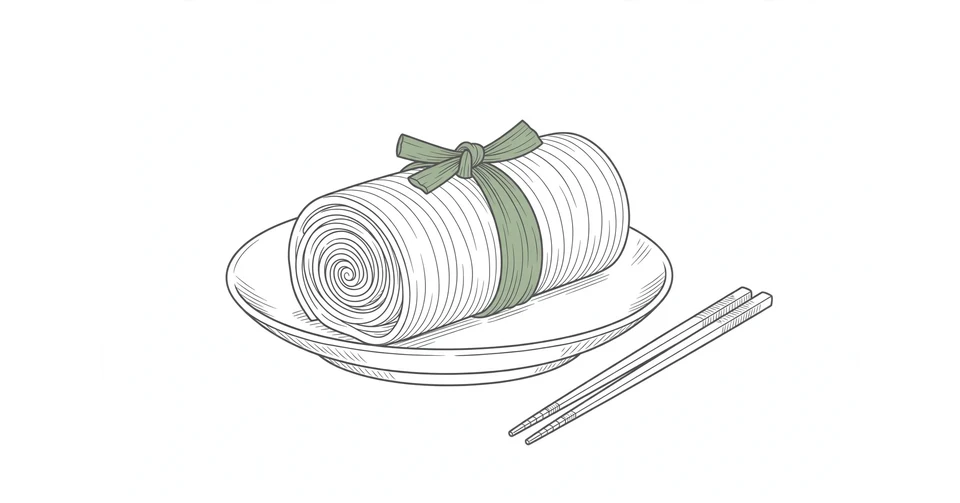
This article unwraps kobumaki piece by piece: the kelp, the fish, the tie, the simmering sauce, and the seat it takes in the stacked osechi box. Along the way, the story touches on herring, family, and the quiet skill of food that is made days ahead and still tastes like care.
What kobumaki actually is
At its simplest, kobumaki is kelp rolled around a filling and tied with kanpyo, then simmered until soft in a seasoned broth. The classic filling is rehydrated dried herring, though salmon and other fish are common today. Cut across the roll, each slice shows a dark green spiral with a pale center, and the little bow of gourd on top gives it away at a glance.
The dish belongs to osechi ryori, the New Year feast packed into stacked lacquer boxes called jubako. Each dish in the box carries a wish, and kobumaki carries joy. It is not the loudest dish in the box, and it does not need to be. Its job is to sit there, neat and dark green, and remind everyone at the table that the year ahead should hold something to smile about.
I like that the wish is so modest. The box also holds wishes for wealth, long life, and many children, all large and grand. Kobumaki asks for something smaller and, to my mind, harder to arrange: that the people eating it feel glad, here and now, with the food in front of them. Joy sounds simple until you try to cook it into a meal, and this roll does it with three ingredients and a knot.
The kelp that does the wrapping
Konbu, the kelp at the heart of kobumaki, is one of the foundation foods of Japanese cooking. Dried sheets of it steep into dashi, the clear broth that seasons so much of the cuisine, and the same sheets, once softened in water, become supple enough to roll. A good sheet is dark, leathery when dry, and surprisingly strong once wet, which is exactly what a wrapper needs to be.
Not all konbu behaves the same way. Hidaka konbu, a variety often used for rolls, is thinner than some other kinds and often comes in strips about 20 centimeters long, which suits the size of a roll. Thicker sheets need longer soaking and a gentler hand, and a sheet that is too stiff will crack instead of curling. Cooks who make the dish every year learn their kelp the way a baker learns flour, by feel rather than by the label.
The soaking water is not thrown away. It becomes konbu dashi, the base of the simmering sauce, so the kelp flavors the dish twice, once as a wrapper and once as a broth. That is one reason kobumaki tastes so layered for such a simple roll. Nothing is wasted, and that thrift feels right for a New Year dish. The year begins with a meal made from what the pantry already holds, and the kelp does double duty without complaint.
Eaten on its own, simmered konbu is savory, slightly chewy, and deeply oceanic, with the sweetness of the sauce rounding off its edges. It is not a flavor that shouts. It sits in the mouth the way a low note sits in a song, steady and grounding, and it makes the fish inside taste more like itself.
The fish inside, from herring to salmon
Tradition puts dried herring inside the roll. The fish is soaked, often in rice water overnight, until it softens enough to roll, and then it simmers inside the kelp until the two become one texture. Herring was the classic choice because it keeps well and because its name carries its own wordplay: nishin, herring, is heard as a word for parents, so the fish quietly wishes for the family that raised you.
Herring brings a second gift with it. The same fish gives us kazunoko, the salted herring roe that sits elsewhere in the osechi box as a wish for many children, so the herring family covers the whole story of generations in a single box. That is why kobumaki and kazunoko are often spoken of together, even though they sit in different corners of the box.
Today the filling is a matter of household habit. Salmon is probably the most common modern choice, since it is easy to find, easy to cut into neat sticks, and gentle in flavor. Tuna, kingfish, and even sliced pork appear in some homes, and cooks who want a vegetarian roll use carrot and burdock instead. The dish bends without breaking, which is part of its charm. A roll made with salmon is still kobumaki, because the kelp and the knot are what define it, not the fish.
The choice of fish also changes how kobumaki eats. Herring gives a firmer, more savory bite, while salmon is softer and milder, and a vegetable filling turns the roll into something lighter altogether. None of these is wrong. Each one is a different answer to the same question, and the kelp holds all of them.
My own preference leans toward herring when I can find good dried fish, because the stronger flavor stands up to the sweet sauce and the tradition tastes more complete. But I would not turn down a salmon version, and I think the dish is better for the flexibility. A recipe that survives by changing a little each generation is a recipe that will still be on the table in fifty years.
The little tie that holds kobumaki together
Kanpyo is the quiet hero of kobumaki. It is made from shavings of bottle gourd, the fruit of Lagenaria siceraria, dried into long pale ribbons. Soaked in water until soft, a ribbon becomes a string strong enough to hold a kelp roll shut through a long simmer, and it is edible, so the tie stays on the plate and gets eaten with the roll.
Tying is a small craft in itself. The roll is wrapped tightly around the fish, placed seam side down, and tied in two or three places depending on the width of the kelp, roughly one knot for every four centimeters of roll. The cook trims the ends of each string so the knot sits like a little bow on top. It is a modest decoration, but it is the detail that makes the roll look finished rather than merely wrapped.
The bow is the signature of kobumaki. Without it, the roll would still taste the same, but it would look like any other simmered food. With it, the dish announces itself, and a guest who knows the box can spot it from across the table. I have always liked food that wears its making on its surface, and this bow does exactly that. It shows the hand of the cook, and it shows that someone took the time.
If kanpyo is hard to find, thin strips of konbu or long dried daikon ribbons can stand in as edible string, and some cooks use banana leaf string or kitchen twine, which must be removed before eating. The original is better when you can get it, because the pale ribbon against the dark kelp is part of the look, and the soft chew of the gourd belongs to the bite.
How kobumaki is made
Making kobumaki is patient work rather than difficult work. The kelp and the kanpyo soak in separate bowls for about half an hour, the fish is cut into sticks, and then each sheet of kelp is rolled tightly around a stick, moving away from the cook, with the seam pressed down. Nothing in the process needs speed. It needs a steady hand and a willingness to let the soaking do its job.
The method is forgiving, and that is part of why kobumaki has lasted. The rolls go into a shallow pan in a single layer, knot side up, and the cook pours in the soaking water turned into konbu dashi, with sake and a spoonful of vinegar. The vinegar matters more than it looks: it helps the kelp turn tender, the way it softens fish bones in other dishes. A drop lid goes on top, and the rolls simmer gently for about half an hour.
Then the rest of the sauce joins the pan, sugar, mirin, and soy sauce, and the cooking continues until the liquid has reduced to almost nothing, usually another ten to fifteen minutes. The cook shakes the pan from time to time so every roll gets an even coat. When the sauce is nearly gone, the rolls come out glossy, dark, and sweet smelling, and they are left to cool before being cut between the knots into two or three neat pieces.
The strong, sweet, and salty sauce is also what makes the dish practical. A batch keeps for about a week in the refrigerator, which matters for a feast that stretches over the first three days of January. The cook makes the rolls before the holiday, and the holiday itself is free for eating rather than cooking. That is the whole logic of osechi in one small roll: cook once, rest well, and eat slowly.
The full method, with quantities and timings, is laid out clearly in this kobumaki recipe from RecipeTin Japan, which uses salmon and explains the knotting and the simmering sauce step by step.
I admire the way the method refuses to rush. Half an hour of soaking, half an hour of simmering, and then a slow reduction is a lot of time for a dish that is eaten in two bites. But that is the point. The dish is a small argument that slowness is not wasted time, and that a meal made ahead can still taste like it was made with attention.
Where kobumaki sits in the osechi box
Osechi is not a single recipe but a collection of small dishes packed into jubako, lacquered boxes that stack into a tower of two, three, four, or even five layers. The tower is said to represent layers of happiness piled up for the year ahead, and each compartment holds a dish with a wish attached. Kobumaki usually sits with the celebratory dishes in the upper tiers, among the black beans, the herring roe, and the rolled omelet, though the exact placement changes from house to house.
The box as a whole is a story about the year to come, and osechi packs that story into stacked boxes where every dish means something. Kobumaki plays its part by carrying joy, and it sits comfortably beside wishes for health, wealth, and learning, as if to say that none of the other wishes matter much without a little happiness to go with them.
The roll also carries a second meaning in its shape. Rolled up like a makimono, the traditional scroll, it is read as a wish for progress in learning and for knowledge to grow, the same reading given to the rolled omelet datemaki. One shape, two wishes, and neither of them costs anything extra. The dish is efficient that way, and I find that efficiency charming rather than cheap. A cook who can pack two blessings into one roll is a cook who understands value.
For a wider view of the feast, the osechi guide from Food in Japan explains the tiers, the dishes, and the meanings in detail, and notes that the contents vary by region, household, and seller, so no two boxes are ever quite the same.
Regional touches, from Fukui kitchens to home cooks
Like many Japanese dishes, kobumaki changes a little as it travels. In Fukui prefecture, the agriculture ministry records a local version called kobumaki or boumaki, made with dried red herring and long lengths of kelp, four strips of about 100 centimeters for six servings. The herring soaks in rice water overnight to remove its sharpness, the kelp is wrapped around a pair of chopsticks and rolled while shifting half its width, and lengths of daikon are laid at the bottom of the pot before the rolls go in. Sugar, soy sauce, and mirin, half a cup of each, season the simmer.
The ministry itself adds that recipes vary by region and by home, and that is the honest truth of the dish. Some families roll the kelp around a whole piece of fish, others around a stick. Some tie two knots, some tie three. Some simmer with daikon underneath, others do not. The version in any given house is the right version for that house, because it is the one the family remembers.
That variety is also why kobumaki has survived the move from handmade to shop bought. Department stores and supermarkets sell the rolls ready made in the last days of December, and a traveler who does not cook can buy a few pieces and taste the tradition without making a pot of it. The bought version is never quite the same as the homemade one, but it keeps the dish in circulation, and circulation is what keeps a food tradition alive.
How to eat and serve kobumaki
Kobumaki is eaten cold or at room temperature, straight from the box. Take a piece with chopsticks, eat it in one or two bites, and let the sweet sauce and the chew of the kelp settle before reaching for the next dish. It is a small dish, and it works best as part of a slow meal rather than as a snack on its own.
Presentation is simple. The pieces can be laid on their sides in a row, showing the spiral cut, or stood upright like little logs, which suits a packed box. A few pieces on a small plate, with a sprig of something green beside them if you like, is enough. The roll is dark and glossy, and it looks best with space around it, not crowded against brighter dishes.
Beyond the New Year, the rolls make a fine side dish for a bento box, and they freeze well, so a batch made for the holiday can stretch into January lunches. That second life is part of the appeal. A dish that begins as a once a year celebration and ends as an ordinary lunch is a dish that has earned its place in the kitchen.
A small practical note: a single piece is light, with one recipe putting it at about 41 calories, so the dish adds flavor and meaning to the meal without adding weight. The sweetness is real, though, and the sauce is the point, so a piece or two of kobumaki is enough for most people. The box is a tasting menu, not a main course, and kobumaki plays its part best in small portions.
Why a strip of kelp still matters
There are easier ways to wish someone a happy year. A card will do, or a toast, or a text message sent at midnight. Kobumaki insists on something slower: dried kelp soaked and rolled, fish simmered until tender, a gourd ribbon tied by hand, and a sauce reduced until it shines. The wish is not spoken. It is cooked, and then it is eaten, which makes it harder to forget.
That is why I think the dish deserves its small corner of the box. It is not the richest dish, nor the prettiest, nor the one that guests reach for first. It is the one that carries the simplest wish, and it carries it in the humblest materials: seaweed, fish, and a strip of dried gourd. A meal that can hold that much meaning in so little is a meal worth keeping.
If you ever find a piece on your plate at New Year, take a moment before you eat it. Look at the spiral, the knot, and the shine of the sauce, and remember that someone rolled joy into a strip of kelp and tied it shut so it would not come undone. Then eat it, and let the year begin with something sweet, salty, and quietly hopeful.
More in Food & Travel
- Ebi Bends Like an Old Back and Wishes You a Long Life
- Kurikinton Is the Golden Mash That Wishes You Wealth
- Japanese Beer and the Dry Wars That Changed How Japan Drinks
- Kamaboko Paints the New Year Red and White
- Datemaki Rolls Sweet Eggs Into a Spiral of Good Luck
- Japanese Bento and the Lunch Box That Became an Art Form
Latest posts
- Yokozuna Is the Rank Sumo Never Takes Back
- Tazukuri Turns Tiny Sardines Into a Wish for a Good Harvest
- Kazunoko Is the Herring Roe That Promises Children and Plenty
- Kuromame Turns Black Beans Into a Wish for Health
- Gyoji Are Sumo's Referees in Silk and Calligraphy
- Japanese Baseball and the Game Japan Made Its Own
- Jubako Layers a Family's Luck One Box at a Time
- The Banzuke Remembers Every Basho in Calligraphy
- Osechi Packs a Whole Year of Luck Into Stacked Boxes
- Fifteen Days of Basho Decide Who Sumo Remembers
- Kojiri Is the End Cap That Takes Every Knock for a Katana
- Kurikata Is the Chestnut Knob That Holds a Katana at the Hip
- Koshirae Is the Formal Mounting That Turns a Blade Into a Katana
- Shirasaya Is the Plain White Scabbard Where a Katana Rests
- The Togishi Polishes a Katana for Weeks Before It Ever Cuts