Ebi Bends Like an Old Back and Wishes You a Long Life
· 19 min read
Ebi, the simmered prawn of osechi, curves like the bent back of an old person and carries a wish for a long life into the Japanese New Year.
A cooked prawn does not lie straight. It curls into a neat comma, head and tail nearly meeting, as if it were bowing to the year ahead. In the Japanese New Year feast called osechi, that curl is the whole point. The prawn, ebi, is simmered gently in a light seasoned broth, served with its head and shell still on, and placed in the box as a wish for a long life. It is one of the smallest dishes on the table, and one of the easiest to understand.
The wish carried by ebi comes from the shape. A cooked prawn curves like the bent back of an old person, so it wishes the eater a life long enough to bend the same way. That is the reading given in our article on osechi, the feast that packs a whole year of luck into stacked boxes, and it is the reading every guide to the New Year table agrees on. There is no wordplay to decode and no hidden history to dig up. You look at the prawn, you see an old back, and you wish to live long enough to earn one.
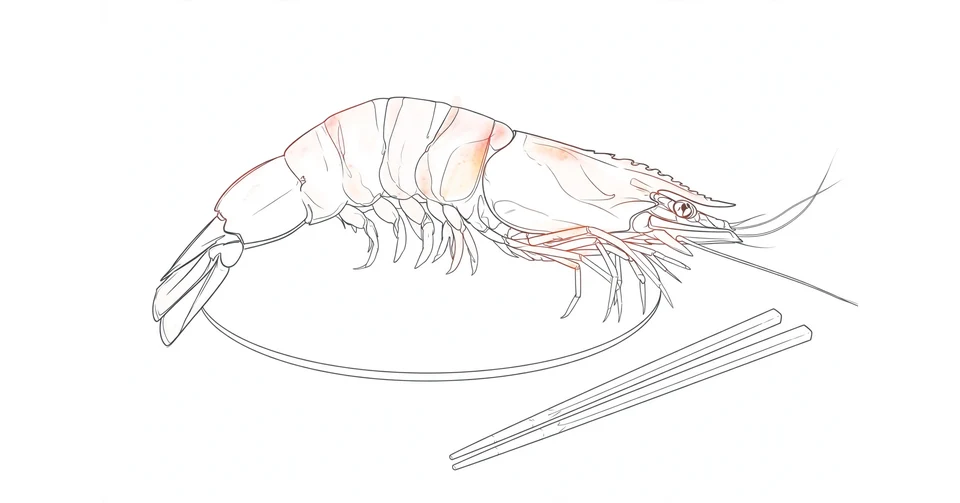
I first noticed the ebi properly at a friend's house in Shizuoka, at the same low table where I first met osechi itself. The boxes were opened on the morning of January 1, and everyone reached across everyone else for the dishes they wanted. I reached for the prawn, mostly because it was the brightest thing in the box, a deep vermilion red against the black lacquer. The grandmother of the house laughed and said I had chosen a long life, which seemed like a safe bet, and then she showed me how to eat it: pick it up by the tail, work the shell off with your fingers, and take your time. It was the first dish I finished that morning, and the one I remembered best.
This article is about ebi, that one small dish. It covers what ebi means in osechi, how it is cooked for the New Year table, where it sits in the stacked boxes, and how it fits among the other dishes that share the box with it. The prawn looks simple, and in a way it is, but the care that goes into it says a lot about how Japan treats the first meal of the year.
Why ebi means a long life
The meaning of ebi in osechi comes from two things you can see with your own eyes: the curve and the whiskers. When a prawn cooks, its body tightens into a bow, the same bowed shape as the back of a very old person. The long antennae that stick out from its head look, in the traditional reading, like the long beard of an elder. Put the two together and the dish becomes a picture of old age itself, served at the start of the year as a hope that the eater will live long enough to look the same way. Just One Cookbook puts it plainly in its recipe for simmered ebi, noting that the prawn is eaten for the New Year because it resembles an old person with a mustache and a hunched back, and that eating it is believed to impart a long life.
The colour helps too. A raw prawn is grey and unremarkable, but a cooked one turns a bright vermilion red, the colour of celebration in Japan. In a box full of black beans, golden chestnut paste, and pale fish cake, the red prawn is the dish your eye finds first. That is not an accident. Osechi is arranged so that colours sit next to each other in contrast, and the prawn does the work of bringing warmth and brightness to its tier. It is the dish that makes the box look festive before anyone has tasted a thing.
It is worth saying that the wish is a wish, not a promise, and that everyone at the table knows it. Nobody eats the prawn expecting a guaranteed number of extra years. The point is the act of wishing itself, spoken out loud in the form of food at the start of the year. I like that about osechi in general, and about ebi in particular. A wish you can hold in your hand, peel, and eat is a modest kind of hope, the kind that does not ask you to believe in magic, only to sit down with your family and start the year by wanting good things for each other.
There is also something quietly honest about wishing for old age rather than for youth. Most New Year wishes around the world ask for money, success, or happiness. Ebi asks for time, and for the patience to grow old well. It is a wish that only makes sense if you think a long life is worth having, with all the bending and slowing that comes with it. That is a wiser wish than it first appears, and it is the reason this small dish has kept its place in the box for so long.
How ebi is cooked for osechi
The standard way to prepare ebi for osechi is simmering, and the classic dish is called ebi no umani, simmered shrimp. It is not a complicated recipe, but it is a fussy one, and the fuss is the point. The cook starts with large prawns, often black tiger shrimp, and keeps the heads and shells on. The shells stay on for two reasons: they protect the meat during cooking, and they give the dish its grand look on the table, the whole animal presented as it is, red and gleaming. A peeled prawn would taste similar, but it would not look like a New Year dish.
The first job in preparing ebi is deveining. With the shell and head still on, the cook runs a bamboo skewer along the back of the prawn, lifts the dark vein out, and rinses the prawn quickly under cold water. The pointy tip of the head is snipped off with kitchen shears, along with the long antennae, and the tip of the tail is sometimes trimmed at an angle for a neater presentation. It is careful, fiddly work, done one prawn at a time, and it sets the tone for the whole dish: nothing rushed, nothing sloppy.
Then comes the simmering liquid, and it is a short list of familiar Japanese pantry items. Sake and mirin go into the pan first and are brought to a boil so the alcohol cooks off. Dashi, the clear soup stock made from kombu and dried bonito, is added next, along with usukuchi, the light coloured soy sauce that seasons without darkening the broth. The liquid is brought back to a boil, the heat is lowered to a simmer, and the ebi go in. The cook bends each ebi with chopsticks or tongs as it goes into the pot, shaping it into the curve of the hiragana character tsu, which is the neat comma shape the finished dish keeps. Speed matters here: all the prawns should go in at about the same time, so they all finish cooking together.
The simmer itself is short, only four to five minutes over low heat for a standard black tiger shrimp. Just One Cookbook is firm about this in its simmered shrimp recipe: do not overcook, because overcooked shrimp turns dry and tough, and a dry prawn has no place in a feast. While the ebi cook, the cook skims the surface of the liquid with a fine mesh skimmer, lifting off the scum and fat that rise as the shells release them. As soon as the ebi are done, they come straight out of the pot, and the cooking liquid is strained, ideally through a coffee filter or a very fine strainer, so that it runs clear and clean.
Here is the part that surprises people who have never made osechi: the ebi are not served straight away. The strained liquid is left to cool completely, and only then is it poured back over the prawns. Pouring hot liquid over them would keep cooking them, so patience is part of the recipe. The ebi then soak in the cooled liquid for four hours, or overnight, which gives the gentle seasoning time to work its way into the meat. The dish is prepared one or two days before it is served, and it is served cold or at room temperature, straight from the box. Leftovers keep for three or four days in the refrigerator, in an airtight container, which is exactly the length of the New Year holiday it was made for.
Grilling is the other way ebi appears in osechi, and some households prefer it. A grilled ebi is brushed lightly and cooked over heat until the shell turns red and the meat firms up, and it carries the same meaning as the simmered version, since the meaning lives in the shape, not in the cooking method. The simmered version is the more common one, though, because it keeps better over the three days of the holiday, and because the gentle seasoning suits a box where every dish is eaten cold. Either way, the prawn is never the centrepiece of the box. It is a small dish, a few pieces arranged neatly in one compartment, and that modesty suits it.
If you are making ebi for osechi at home, the honest advice is to start small and to follow the timing rather than improvising it. Five prawns, one small pan, and the exact simmering time matter more than any fancy equipment. Buy the largest ebi you can find with heads and shells on, keep the seasoning light, and let the overnight soak do its work. The dish rewards patience more than skill, which is a good description of osechi cooking in general. It is also worth remembering that ebi is one of the easier dishes in the box. The black beans simmer for hours and the herring roe needs days of soaking. Next to them, a prawn that takes five minutes in the pot is the cook's reward for all the harder work around it.
Where ebi sits in the box
Osechi is packed into jubako, the stacked lacquered boxes that are themselves a wish: layer upon layer, happiness piling up on happiness. The usual arrangement puts the celebratory dishes and sweets in the top box, the grilled and vinegared foods in the middle tier, and the simmered foods in the bottom tier. Ebi belongs in the middle tier, alongside the grilled sea bream, the yellowtail, and the red and white vinegared salad called kohaku namasu. It sits there because it is a grilled or simmered seafood, and because its bright red colour balances the paler dishes around it.
At the table, the tower comes apart. The tiers are unstacked and laid side by side, so everyone can reach every dish, and the boxes become a spread rather than a monument. That is when ebi does its best work. In the stacked tower ebi is hidden, but on the spread table it is one of the first things you see, red against the black lacquer, and one of the first things people reach for. Children reach for it because it looks like a treat. Older people reach for it because of the wish. Both of them are right, and the dish is generous enough to hold both reasons at once.
The arrangement is not a strict rule. The Food in Japan guide to osechi notes that the number of tiers and the placement of dishes vary by region, household, restaurant, and seller, and that the tier diagrams in guides are examples rather than law. Some households use two tiers, some use three, and formal explanations describe four or five. What stays constant is the idea behind the stacking, that good fortune piles up the way the boxes do, and ebi keeps its place in that idea wherever it happens to sit. It is a dish that belongs to the box as a whole, not to one shelf of it.
I think the middle tier is the right home for ebi, not because of any rule, but because of the company it keeps there. The sea bream is there for good luck, because its name sounds like the word for auspicious. The yellowtail is there for success, because the fish changes its name as it grows, like a person rising through life. Ebi is there for long life, because of its bent back. Together the three of them cover the things a family hopes for at New Year: luck, progress, and time. It is a small committee of wishes, and ebi is its quietest member.
Ebi and the other dishes in the box
No dish in osechi stands alone, and ebi makes more sense once you see its neighbours. The top tier opens with kuromame, the sweet black soybeans that wish the eater health and diligent work. Our article on kuromame, the black beans that carry a wish for health follows those beans from the pot to the box, and it is worth reading alongside this one, because the beans and the ebi are the two ends of the same idea: the beans wish you the strength to work, and ebi wishes you the years to work in. Health and long life are not the same wish, but they are close neighbours, and the box holds them side by side on purpose.
The rest of the top tier fills out the picture. Kazunoko, the salted herring roe, wishes for many children and a flourishing family, because one roe sac holds thousands of tiny eggs. Tazukuri, the small dried sardines glazed sweet and savoury, wishes for a bountiful harvest, because farmers once used little sardines as fertiliser for rice fields. Datemaki, the sweet rolled omelette, is read as a scroll and so carries a wish for learning. Kurikinton, the golden mash of chestnut and sweet potato, wishes for wealth from its colour alone. Kamaboko, the red and white fish cake, stands for celebration and for the first sunrise of the year. Each dish is a small charm, and the meanings differ a little between regions and sources, so it is best to treat them as the common readings they are, not as rules carved in stone.
| Dish | What it is | The wish it carries |
|---|---|---|
| Kuromame | Black soybeans simmered sweet | Health and diligent work |
| Kazunoko | Salted herring roe | Many children, a flourishing family |
| Tazukuri | Small dried sardines, glazed | A bountiful harvest |
| Datemaki | Sweet rolled omelette | Learning and progress in studies |
| Kurikinton | Chestnut and sweet potato mash | Wealth, from its golden colour |
| Ebi | Simmered or grilled prawn | Long life |
| Kamaboko | Red and white fish cake | Celebration, the first sunrise |
The table makes the pattern clear. Every dish earns its place through wordplay, colour, or shape, and ebi earns its place through shape alone, which is the simplest claim in the box. It does not need a pun or a golden colour. It only needs to curl. That simplicity is part of its charm. Among dishes that ask you to know a wordplay or a piece of history, ebi asks only that you look at it, and the wish follows naturally from what you see.
The bottom tier, meanwhile, holds the simmered vegetables: lotus root, taro, carrot, shiitake, and burdock. Lotus root, with its holes, suggests a clear view of the future. Burdock puts down deep roots, so it wishes for a stable home. Taro, which produces many small tubers around the parent root, wishes for many descendants. These are quieter wishes than the ones in the top tier, and they balance the box: the top tier wishes loudly for health, wealth, and children, while the bottom tier wishes quietly for stability and a clear path ahead. Ebi sits between them, in the middle, wishing for the time to enjoy all of it.
A different ebi in Suruga Bay
One confusion is worth clearing up, because the same word shows up in two very different places. The ebi of osechi is a large prawn, simmered or grilled whole, and it is the dish this article is about. But there is another famous ebi in Japan, and it lives not far from where I live in Shizuoka: sakura ebi, the tiny cherry blossom shrimp of Suruga Bay. Sakura ebi are small, pink, and caught in the bay off the coast near Numazu, and they are eaten dried, or fried into crisp cakes, or folded into rice. They already have their own article on this site, and they are a different ingredient, a different dish, and a different story.
The two share a word and a sea, but little else. The osechi ebi is large, served whole with its head on, and eaten once a year as a symbol. Sakura ebi are tiny, eaten by the handful, and enjoyed all year round as a local speciality. If you ever visit Suruga Bay, you should try them, and you should also remember that the word ebi covers a whole family of creatures, from the smallest shrimp to the largest prawn. The New Year ebi is the grandest member of that family, dressed in its shell and served as a wish. The bay shrimp is the humblest, eaten casually and loved for its flavour. Both deserve their place, and neither should be mistaken for the other.
What ebi tastes like the first time
If you are tasting osechi prawn for the first time, expect something gentle rather than bold. The simmered version is savoury and lightly sweet, with the clean flavour of dashi and a soft touch of soy sauce, and the meat is firm without being chewy. The shell keeps the flavour in during cooking, and the overnight soak gives the meat a mild seasoning all the way through, rather than just on the surface. It is not a dish that shouts. It is a dish that tastes like care, the way food tastes when someone made it a day early and let it rest.
Eating it is a small ritual of its own. You pick the prawn up by the tail, peel the shell away with your fingers, and eat the meat in a bite or two. The head is usually left on the plate, though some people enjoy the rich flavour inside it. There is no knife, no fork, and no hurry. The dish is eaten cold or at room temperature, which suits the slow pace of the New Year table, where people pick at the boxes through the day, leave, and come back for more. A hot dish would demand attention. A cold prawn waits patiently, which is exactly what a three day holiday needs.
The grilled version tastes different, a little smokier and a little firmer, with the shell crisped by the heat. Some families prefer it for exactly that reason, and some serve both, one simmered and one grilled, side by side in the same tier. There is no wrong choice here, only the version your family likes. That is the rule that matters most with osechi, and it is the one the guides all agree on in the end: cook the dishes your family actually eats, buy the ones that take too long, and leave out the ones nobody touches. The prawn survives that rule easily, because ebi is one of the dishes people do touch, year after year.
My own first taste of the dish surprised me by how little it tasted like the prawns I knew from restaurants. A restaurant prawn is usually hot, buttery, and gone in seconds. The osechi ebi is cool, quiet, and deliberate, and it asks you to slow down to its pace. I did not love it at first, if I am honest. I found it mild, and I moved on to the sweeter dishes. By the third New Year, I was reaching for it early, and I understood that the dish was not trying to impress me. It was trying to wish me well, and it had been doing that long before I arrived at the table, and it would keep doing it long after I left.
A quiet wish, eaten cold
Ebi is the smallest wish in the box, and perhaps the wisest one. It does not promise wealth, children, or success. It promises only time, and it promises it in the humblest way possible, by showing you the shape of a bent back and asking whether you would like to live long enough to bend the same way. Most of us would say yes, if we are honest, and most of us would mean it more as we get older.
That is why ebi has kept its place in osechi while other dishes have come and gone. The box has room now for roast beef and smoked salmon, and nobody minds, because the tradition survives by making room. But ebi stays, because no new dish can replace what it means. A long life is not a fashion, and a bent back is not a trend. They are the facts of a life lived fully, and the New Year is the right time to wish for them, quietly, over a cold prawn eaten with your fingers at a low table in January.
If you ever find yourself at a Japanese New Year table, reach for the ebi early, while the box is still full and the day is still young. Peel it slowly, eat it without rushing, and think for a moment about the years ahead. The wish is already in your hand. All you have to do is eat it.
More in Food & Travel
- Kobumaki Rolls Joy Into a Strip of Kelp
- Kurikinton Is the Golden Mash That Wishes You Wealth
- Japanese Beer and the Dry Wars That Changed How Japan Drinks
- Kamaboko Paints the New Year Red and White
- Datemaki Rolls Sweet Eggs Into a Spiral of Good Luck
- Japanese Bento and the Lunch Box That Became an Art Form
Latest posts
- Yokozuna Is the Rank Sumo Never Takes Back
- Tazukuri Turns Tiny Sardines Into a Wish for a Good Harvest
- Kazunoko Is the Herring Roe That Promises Children and Plenty
- Kuromame Turns Black Beans Into a Wish for Health
- Gyoji Are Sumo's Referees in Silk and Calligraphy
- Japanese Baseball and the Game Japan Made Its Own
- Jubako Layers a Family's Luck One Box at a Time
- The Banzuke Remembers Every Basho in Calligraphy
- Osechi Packs a Whole Year of Luck Into Stacked Boxes
- Fifteen Days of Basho Decide Who Sumo Remembers
- Kojiri Is the End Cap That Takes Every Knock for a Katana
- Kurikata Is the Chestnut Knob That Holds a Katana at the Hip
- Koshirae Is the Formal Mounting That Turns a Blade Into a Katana
- Shirasaya Is the Plain White Scabbard Where a Katana Rests
- The Togishi Polishes a Katana for Weeks Before It Ever Cuts