Namasu Turns Daikon and Carrot Into a Red and White Wish
· 29 min read
Namasu is Japan's crisp vinegared salad of daikon and carrot, a small red and white dish in osechi that carries a wish for peace, stability, and a calm start to the year.
Namasu is the simplest dish in the osechi box, and it may be the most honest one. It is daikon and carrot cut into thin strips, salted, squeezed, and dressed in sweet vinegar. There is no cooking, no simmering, and no long soaking. It is crisp, bright, and sour in a gentle way, and it sits in the middle of a rich New Year feast like a glass of cold water on a crowded table.
The full name of the New Year version is kohaku namasu, and kohaku means red and white. The white is daikon, the red is carrot, and the two colours together are the colours of celebration in Japan. The dish is a wish you can eat, a wish for peace in the home, for a family that stays steady, and for a year that begins without noise.
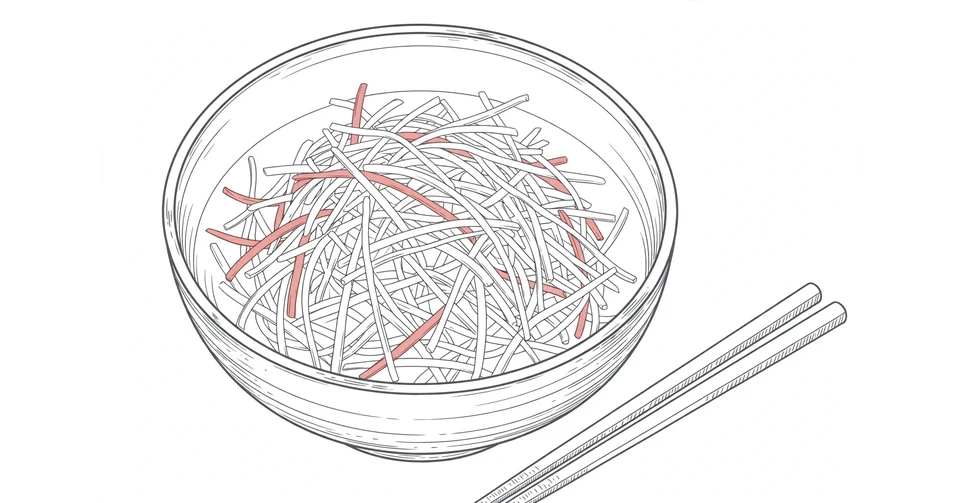
I first noticed namasu because it was the dish nobody talked about. At a New Year table in Shizuoka, the talk went to the black beans, the herring roe, and the golden chestnut paste, all of them sweet and rich and full of story. The namasu sat quietly in its small bowl, pale and plain, and I almost passed it by. Then I tasted it, and I understood its job. After the sweetness of the chestnut paste and the salt of the roe, the sharp clean bite of vinegar woke my mouth up again. It did not ask for attention. It made room for everything else to be tasted properly. That is a modest kind of greatness, and I have liked the dish ever since.
What namasu is
Namasu is a Japanese dish of thinly sliced vegetables or seafood marinated in rice vinegar, and the version most people meet first is the one made from daikon and carrot. Just One Cookbook describes namasu as daikon and carrot salad lightly pickled in sweetened vinegar, crunchy, slightly sharp, with a bright refreshing taste, and notes that it can be enjoyed all year round. That short description is accurate, and it is also a good warning. If you expect a pickle that shouts, namasu will surprise you by whispering.
The word namasu itself has a longer history than the dish on the table suggests. In its oldest form, it was not a vegetable salad at all. It was finely cut raw meat or fish, seasoned and eaten raw, a dish that came to Japan from China. The name is often traced to words for raw meat, and the written character for the dish once carried a fish radical, a small sign of what it used to be. Over the centuries, the meat and fish gave way to vegetables, the seasoning changed, and vinegar became the heart of the dish. What survived was the method, thin strips, a light dressing, and a flavour that stays fresh rather than heavy.
Today, when people in Japan say namasu without adding anything else, they usually mean the vegetable kind, and when they say kohaku namasu, they mean the red and white version made for the New Year. The name is a small map of the dish. Kohaku tells you the colours, namasu tells you the method, and together they tell you the occasion. A dish that began as raw meat became a salad of roots, and a salad of roots became a wish.
There is a useful distinction to keep in mind, because namasu is often confused with its close cousin sunomono. Both are vinegared dishes, and both are served cold, but the usual explanation is that sunomono is food dressed with vinegar, while namasu is food marinated in vinegar. The difference is small, and in a home kitchen it hardly matters, but it points to something real about namasu. The vegetables spend time in the dressing, they soften a little, they take in the sweet and sour flavour, and they come out changed in a way that a quick splash of vinegar would not achieve. Namasu is not a salad with vinegar on top. It is a salad that has lived in vinegar for a while.
How a dish of raw meat became a vegetable salad
The history of namasu is a history of slow change, and the sources agree on the broad shape of it even when they differ on the details. Just One Cookbook says namasu was first introduced to Japan from China around the 700s, in the Nara period. Sudachi Recipes puts the origin even earlier, saying namasu is said to have originated from China more than 2000 years ago and was made of thin strips of raw meat or fish, such as carp or sea bass. The two accounts do not quite match, and that is worth saying plainly. The older origin is a claim about China, the later date is a claim about arrival in Japan, and a careful reader should not force them into one neat number. What both agree on is that namasu began with raw flesh, not with roots.
In Japan, the dish changed in stages. Sudachi Recipes explains that in the late Heian period, a period that ran from 794 to 1185, the term changed to mean fish and vegetables chopped into small pieces and mixed together. Before the Muromachi period, which ran from 1336 to 1573, namasu was made using a condiment called irizake, made by adding dried bonito flakes and pickled plums to sake and boiling it down. Only in the Muromachi period did people start using vinegar to dress the ingredients, according to several sources. The vinegar we now think of as the soul of namasu arrived late, and it arrived after the dish had already been in Japan for centuries.
Up until the Edo period, which ran from 1603 to 1867, namasu was still often made with fish and was consumed as a main dish. These days, it is often made with vegetables and served as a side dish. That shift matters, because it explains why namasu feels so light now. It was once the centre of the meal, a dish of substance. It is now a supporting dish, a small bowl that resets the palate and adds colour. The dish did not lose its importance when it moved to the side of the table. It found a different kind of importance, the kind that belongs to the dish that makes the rest of the meal work.
I like this history because it is a reminder that traditions are not frozen. A dish can begin as raw carp in China, become a fish dish in a Japanese court, pick up vinegar in the Muromachi period, and end up as a bowl of daikon and carrot on a New Year table, and still be the same dish in the ways that count. The name stayed, the method of cutting thin and dressing lightly stayed, and the spirit of eating something fresh and sharp stayed. Everything else was allowed to change. That is how a food survives for more than a thousand years, not by refusing to change, but by changing slowly enough that each generation still recognises it.
Why red and white matter in namasu
The red and white of kohaku namasu are not decoration. In Japan, red and white are considered celebratory colours, and they are used at weddings, at school openings, at the start of a joint venture, and at town festivals. The combination signals that something good is happening, and that it deserves to be marked. When those colours appear in food, they carry the same message. A bowl of namasu on a New Year table is a small flag of celebration, and it is also a wish that the celebration will last.
The most common reading of the colours links them to mizuhiki, the decorative red and white cords tied around gift envelopes and New Year decorations. The thin strips of daikon and carrot in namasu are said to resemble those cords, and mizuhiki are said to ward off bad spirits while tying people together through a common bond. Whether you believe in the warding off of spirits or not, the image is a good one. The strips lie together in the bowl, white and red, separate but mixed, and they look like cords that have been tied. A family eating together from one bowl is, in its own quiet way, tied together too.
There is another name for the dish that points in the same direction. Food in Japan notes that kohaku namasu is also sometimes called Genpei namasu, after the red and white flags of the Heike and Genji clans in Japanese history. The two clans fought each other, and their colours became a shorthand for rivalry, but in the dish the two colours sit peacefully side by side. I do not want to push that reading too far, because the sources present it as a side note rather than the main meaning, and the main meaning is celebration and peace. Still, there is something gentle about a dish that takes two colours once used by opposing sides and turns them into a salad. It is the opposite of a battle, and it tastes like it.
A second layer of meaning comes from the vegetables themselves. Daikon and carrot are root vegetables, and they grow straight down through the soil. Sudachi Recipes says the roots are linked to a wish for stability of the house and family business, and for keeping one's feet on the ground. Other sources make the same point in slightly different words, and it is a reading that feels right even without a source to lean on. A root that goes deep does not blow away. A household that is grounded does not fall apart at the first hard wind. Namasu is a dish of roots, and it wishes the eater to be rooted too.
The colours also do practical work. Osechi is a feast of dark and golden dishes, black beans, golden chestnut paste, dark simmered vegetables, and the deep red of fish cake. A bowl of white and pale red strips breaks that palette open. It gives the eye somewhere fresh to rest, and it gives the mouth something crisp to bite into. Symbolism is lovely, but a dish also has to work on the table, and namasu works. It is the bright note in a rich chord, and without it the meal would be heavier and duller.
How namasu is made, step by step
Making namasu is simple, and the simplicity is part of the point. There are only a few ingredients, and there is no cooking, so the quality of the cutting and the balance of the dressing carry the whole dish. The method below follows the recipes I read in full, and it is a blend of their shared steps rather than a copy of any one of them. The two recipes differ in their ratios and their details, and I will say where they differ, because a cook deserves to know that there is no single correct version.
First, peel the daikon and the carrot, and cut them into thin matchsticks. Just One Cookbook cuts the daikon into pieces about 5 cm long, then slices them into slabs about 3 mm thick, then cuts the slabs into matchsticks about 3 mm thick, and does the same with the carrot. Sudachi Recipes cuts the vegetables into matchsticks about 2 to 3 mm thick, and prefers slightly thick sticks so that they still have a good crunch. The exact thickness is a matter of taste, but the principle is the same in both recipes. Cut evenly, so that every strip pickles at the same speed, and cut thin enough that the vinegar can reach the centre of each strip.
Second, salt the strips and let them rest. Just One Cookbook adds 1 teaspoon of kosher salt to the bowl, rubs it gently into the vegetables, and sets the bowl aside for 10 minutes. Sudachi Recipes adds half a teaspoon of salt, massages it in by hand, and leaves the vegetables for 15 minutes. The salt draws out excess moisture, and that step is the one that decides whether the finished namasu is crisp or watery. If you skip it, the vegetables will release water into the dressing and dilute it. If you rush it, the strips will stay too wet. The salt is not there to make the dish salty. It is there to make the dish dry enough to pickle properly.
Third, squeeze the vegetables firmly and do not rinse them. Both recipes insist on this, and Sudachi Recipes is explicit that you should not wash the vegetables after they have been dehydrated, because washing would undo the work of the salt. Squeeze thoroughly, pour away the liquid, and do not be gentle about it. The liquid that comes out can taste bitter, and it varies in quantity, so it should be discarded rather than added to the pickling liquid. This is the step that first time cooks most often get wrong, because it feels wasteful to throw liquid away, and because squeezing a bowl of vegetables by hand feels rough. It is not rough. It is the technique that makes the dish.
Fourth, make the sweet vinegar dressing, called amazu. Just One Cookbook mixes 1 and a half tablespoons of sugar, 1 and a half tablespoons of unseasoned rice vinegar, 1 tablespoon of water, and a quarter teaspoon of kosher salt, and whisks until the sugar is completely dissolved. Sudachi Recipes mixes 2 tablespoons of unseasoned rice vinegar, 3 tablespoons of water, 2 tablespoons of sugar, a quarter teaspoon of salt, 1 tablespoon of yuzu juice, and a quarter teaspoon of Japanese soy sauce, and adds a piece of kombu, dried kelp, for umami. The two dressings are cousins, not twins. One is simpler, the other is brighter with citrus and deeper with kelp. Both use unseasoned rice vinegar, which is milder and slightly sweeter than ordinary white vinegar, and both are clear that seasoned sushi vinegar is not a substitute.
Fifth, combine the squeezed vegetables with the dressing and let them pickle. Just One Cookbook tosses the strips in the seasonings and serves the dish, and notes that it can be prepared 2 to 3 days before it is served as part of osechi. Sudachi Recipes seals the strips in a bag with the liquid, pushes the air out, and stores the bag in the fridge for at least 12 hours, preferably overnight, and says the flavour improves with time. The difference is a matter of timing, not of principle. A short pickle gives a bright, sharp crunch. A longer pickle gives a deeper, more rounded flavour. For the New Year, when the dish is made days ahead, the longer pickle is the point. For a weekday side dish, a few hours can be enough.
Sixth, garnish lightly and serve cold. Just One Cookbook suggests 1 to 2 strips of yuzu zest on top, cut thin, and notes that fresh yuzu adds an amazing citrus fragrance. Sudachi Recipes uses yuzu peel in the pickling liquid and as a garnish, and suggests serving the namasu in a hollowed out yuzu skin for a special occasion. If you cannot get yuzu, both recipes offer substitutes, and Sudachi Recipes suggests a half and half mix of orange and lemon juice, or orange alone in a pinch. A little citrus goes a long way, and thick strips of peel can turn bitter during pickling, so thin is better. The garnish should lift the dish, not take it over.
The ratio argument, and why it does not matter much
If you read three recipes for namasu, you will find three different ratios of daikon to carrot, and that is a good thing to know before you start cooking. Just One Cookbook uses 14 ounces of daikon, about 400 grams, and 3 ounces of carrot, about 85 grams, a ratio of roughly 5 parts daikon to 1 part carrot. Sudachi Recipes uses 200 grams of daikon and 100 grams of carrot, a ratio of 2 parts daikon to 1 part carrot. Food in Japan gives a ratio of 10 parts daikon to 1 part carrot, with 500 grams of daikon and 10 grams of carrot for 4 persons, and calls that ratio the golden ratio for red and white pickles. Three recipes, three answers, and all three are presented as normal.
The reason for the difference is that the ratio is about colour, not about chemistry. A small amount of carrot is enough to make the dish read as red and white, because the white daikon dominates and the red carrot stands out against it. A larger amount of carrot makes the dish sweeter and more colourful, and it shifts the balance toward the carrot. Neither is wrong. A cook who wants a pale dish with a few red threads will use the 10 to 1 ratio. A cook who wants a dish where the carrot is a real presence will use the 2 to 1 ratio. The dish is forgiving, and the cook is allowed to decide.
There is a practical detail that matters more than the ratio, and it is the colour of the carrot itself. In Japan, a variety called Kintoki ninjin, a vibrant red carrot, is used for this dish around the New Year season, and it is really red, not orange like an ordinary carrot. Outside Japan, most cooks will use an ordinary orange carrot, and the dish will still be called kohaku namasu, and it will still be red and white in the loose sense that orange reads as red against white. If you can find a red carrot, use it, and the dish will look closer to the traditional version. If you cannot, do not worry. The wish does not depend on the exact shade.
I think the ratio argument is a useful reminder that a traditional dish is not a single recipe. It is a family of recipes, each one shaped by the cook who made it, the vegetables that were available, and the taste of the household. The recipes I read agree on the method, salt, squeeze, sweet vinegar, and rest, and they disagree on the numbers. That is how cooking works when it is alive. The method is the tradition. The numbers are the cook.
Regional variants of namasu
Kohaku namasu is the most well known form of namasu, but it is not the only one, and the regional variants show how wide the family is. Sudachi Recipes lists several, and each one is a small window into a different part of Japan. Hizu namasu is made from the cartilage part of the salmon snout. Imo namasu is made with potatoes from around Iiyama City in Nagano Prefecture. Mizu namasu is made with fresh horse mackerel and other blue fish. Nuta namasu is a dish of vegetables and seafood dressed with vinegared miso, and it is considered a type of namasu. Kaki namasu is kohaku namasu made with daikon and carrot with dried persimmon, from Nara Prefecture. The list is not exhaustive, and it is not meant to be. It is a sample, and it shows that namasu is a method before it is a recipe.
Hizu namasu deserves a closer look, because it is the variant that most clearly shows the old meaning of the word. Our article on osechi notes that in Iwate, the vinegared dish may be hizu namasu, made from salmon head cartilage, thin and crunchy. The Ministry of Agriculture, Forestry and Fisheries of Japan gives a recipe for hizu namasu from Iwate, using 2 raw salmon heads, 100 grams of radish, and 30 grams of carrot for 5 servings, with the salmon cartilage sliced thin, rubbed with salt, washed, and soaked in vinegar, then combined with the salted radish and carrot and seasoned with vinegar, sugar, and salt. The cartilage is called hizu because it is transparent like ice, and it is traditionally eaten mainly in Hokkaido and the Tohoku region. It is crunchy in a way that daikon is not, a clean snap that comes from cartilage rather than from a root.
Hizu namasu is a good test of what a cook means by tradition. To a cook in Tokyo, namasu is daikon and carrot. To a cook in Iwate, namasu can be salmon cartilage, and the daikon and carrot are there to support it. Neither cook is wrong, and neither dish is more authentic than the other. The dish belongs to the place that makes it, and the place decides what goes into it. That is true of osechi as a whole, and it is true of namasu in particular. A national dish is often a collection of local dishes that share a name.
The other variants follow the same logic. Imo namasu uses potatoes because potatoes grow in Nagano. Mizu namasu uses horse mackerel because the sea is close. Kaki namasu adds dried persimmon because persimmons are a fruit of Nara. Each variant is a record of what was available, and each one is a record of what people liked. A dish that can hold salmon cartilage and dried persimmon and still be called by the same name is a dish with a strong idea at its centre. The idea is thin strips, vinegar, and a balance of sweet and sour. Everything else is local.
Where namasu sits in the osechi box
Namasu has a place in the osechi box, and the place tells you how the meal is meant to be eaten. Our article on osechi and the stacked boxes that hold a whole year of luck explains that the middle tier of the jubako holds grilled and vinegared foods, prawns, sea bream, yellowtail, and kohaku namasu, while the top tier holds the celebratory dishes and sweets and the bottom tier holds the simmered foods. The same article quotes the source phrase that led to this piece, noting the red and white vinegared salad called kohaku namasu among the dishes of the middle tier, and naming yellowtail and kohaku namasu together in that tier. The placement is not random. The middle tier is where the palate is reset, where the vinegared dishes sit beside the grilled fish, and where a crisp bite can follow a rich one.
The osechi article also notes that the dishes are sweet, salty, sour, and savoury in turn, and that they are served cold or at room temperature, straight from the boxes. Namasu is the sour turn in that sequence, and it is the dish that keeps the sweetness from becoming too much. The black beans are sweet, the chestnut paste is sweet, the rolled omelette is sweet, and the simmered vegetables are sweet and salty. Without a sour dish, the meal would be a slow slide into sugar. Namasu stops the slide. It is a small bowl, but it changes the whole meal.
The timing of the cooking fits the place in the box. Just One Cookbook suggests starting osechi about five days before New Year, cooking the long lasting dishes first, then the vinegared dishes, and finishing with the simmered ones closest to the day. Namasu is made in the middle of that schedule, and it is made to keep. The vinegar is not only flavour, it is preservation. In the past, when families avoided cooking with fire during the first days of the year, dishes that kept for days without refrigeration were essential, and namasu was one of them. Today, the dish keeps for 3 days in the refrigerator according to Just One Cookbook, and for 4 to 5 days according to Sudachi Recipes, and it can be frozen for up to a month in the first source, though the second source does not recommend freezing. The numbers differ, and a cook should follow the more cautious one for storage, but the point is the same. Namasu is made ahead, it waits patiently, and it is ready when the year begins.
The prawn in the same tier offers a useful contrast. Our article on ebi and the long life it wishes you follows a dish that is there for its shape, a cooked prawn that curves like the bent back of an old person, and wishes the eater a life long enough to bend the same way. Namasu is there for its colour, and it wishes the eater peace and stability. The two dishes sit side by side in the middle tier, one wishing a long life, the other wishing a calm one, and together they cover a good deal of what a person might want from a year. A long life without peace is not much of a wish, and peace without a long life to enjoy it in is not much either. The box holds both, and it holds them together.
What namasu tastes like
If you have never tasted namasu, the first bite is a small surprise. The strips are cold, and they are crisp, and they give a clean snap when you bite them. The flavour is sweet first, then sour, then a little salty, and then a faint peppery note from the daikon that stays at the back of the mouth. The carrot adds sweetness and a soft earthiness, and the yuzu, if it is there, adds a bright citrus lift that smells like a winter garden. The whole thing is light, and it leaves the mouth clean, ready for the next bite of something richer.
The texture is the part that is hardest to describe and easiest to get wrong. A good namasu is crunchy but not hard, soft but not limp. The strips should bend a little when you pick them up with chopsticks, and they should snap when you bite them, not shatter and not flop. The salting and squeezing are what create that texture, and the pickling time is what keeps it. Too short a pickle, and the strips taste raw and the vinegar sits on the surface. Too long a pickle, and the strips go soft and the vinegar takes over. A pickle of a night, as Sudachi Recipes recommends, is a good middle point, and it gives a flavour that is balanced rather than sharp.
The taste changes a little with the recipe. A dressing with more sugar will taste rounder and sweeter, and it will suit a table full of salty dishes. A dressing with more vinegar will taste sharper, and it will suit a table full of sweet dishes. A dressing with kombu will taste deeper, with a savoury note that is hard to name but easy to notice. A dressing with yuzu will taste brighter, and it will smell wonderful when the lid comes off the container. There is no single correct balance, and the cook should taste the dressing before adding the vegetables, and adjust it to the table it will be served at. A dish that is meant to reset the palate should be a little sharper than a dish that is meant to be eaten on its own.
I should be honest about one thing. Namasu is not a dish that will change your life in a single bite. It is not rich, it is not dramatic, and it does not have the deep flavour of a simmered dish or the luxury of herring roe. Its pleasure is quieter, and it grows with attention. The first time I ate it, I liked it but I did not love it. The third time, at a table where I knew what to expect, I reached for it first, and I understood that it was the dish I had been missing without knowing it. Some foods impress you at once. Others earn your liking slowly, and namasu is one of the slow ones.
Making namasu at home, beyond the New Year
Namasu does not need a New Year to be worth making, and that is one of the best things about it. Just One Cookbook says it can be enjoyed all year round, and that it goes well with grilled fish and meat, and can be added to a bento box. The ingredients are ordinary, daikon, carrot, rice vinegar, sugar, salt, and water, with yuzu and kombu as optional extras, and the work takes about 15 minutes of active time plus the pickling. It is the kind of dish that fits a weekday, not only a holiday.
There are a few practical points that make the difference between a good namasu and a disappointing one. Cut evenly, because uneven strips pickle unevenly. Salt and squeeze firmly, because water is the enemy of crunch. Use unseasoned rice vinegar, because seasoned sushi vinegar is sweeter and saltier than the recipe expects, and it will throw the balance off. Taste the dressing before you add the vegetables, because it is easy to adjust sugar and vinegar in a bowl and hard to adjust them once the strips are in. Keep the finished dish fully submerged in its pickling liquid, in an airtight container in the fridge, and remove the kombu after 24 hours, because leaving it in can make the liquid slimy. Make the dish 1 to 2 days ahead if you can, because the flavour improves with time as the seasoning equalises.
The dish also travels well, in the sense that it can be adapted to what is available. If you cannot find daikon, a mild white radish such as Korean mu can stand in, though the taste may lean slightly peppery, and the pickling brine smooths it out. If you cannot find yuzu, bottled yuzu juice is available year round at Asian groceries, and fresh yuzu is a short season find, often from October to December, at Japanese markets. If you cannot find either, a half and half mix of orange and lemon juice is a good substitute. The dish is forgiving about substitutes, and it is strict about method. The method is what makes it namasu.
A small bowl of namasu also makes a good introduction to Japanese home cooking for a cook who is new to it. It asks for knife work, not for heat, and it teaches the hand to cut evenly. It asks for patience, not for speed, and it teaches the cook to wait while the salt does its work. It asks for tasting and adjusting, not for following a number blindly, and it teaches the cook to trust their own mouth. Those are useful lessons, and they are learned in a dish that costs very little and takes very little time. A cook who can make a good namasu can make a good salad of any kind.
For a family table, namasu has one more virtue. It is a dish that children can help make, because the steps are safe and simple, and the result is visible at once. A child can peel a carrot, can rub salt into the strips, can squeeze the water out, and can watch the white and red strips turn bright in the vinegar. A child who has helped make a dish is more likely to eat it, and a dish that a child has helped make becomes part of the family story. I do not know if that is true in every household, but it has been true in the ones I have seen, and it is a good reason to make namasu together rather than alone.
A quiet wish, and what it is worth
Namasu is a small dish, and it would be easy to treat it as a small subject. It is two root vegetables, a little sugar, a little vinegar, and a little salt. It takes 15 minutes to prepare, and it sits in a small bowl in the middle of a crowded table. But the smallness is the point, and it is the reason the dish has lasted. A wish does not have to be large to be sincere, and a dish does not have to be rich to be meaningful. A bowl of red and white strips can carry a wish for peace, for stability, and for a family that stays together, and it can carry that wish without ever raising its voice.
The history of namasu supports that reading. A dish that began as raw meat, that changed into a fish dish, that picked up vinegar late, and that settled into a vegetable salad, is a dish that has been remade by each generation to fit the life that generation lived. It did not survive by staying the same. It survived by staying useful, by staying fresh, by staying simple enough to make and meaningful enough to keep. The red and white colours stayed, the thin strips stayed, the sweet vinegar stayed, and everything else was allowed to change. That is a good model for a tradition, and it is a good model for a life.
There is also a lesson in the way namasu works on the table. It does not compete with the rich dishes. It does not try to be the sweetest or the most luxurious. It makes room for them, it cleans the palate, it adds colour, and it lets the meal be better than it would be without it. A person can live the same way, not by being the loudest in the room, but by being the one who makes room for others, who clears the air, who adds a little brightness to a heavy day. I do not want to make too much of a salad, and a salad is only a salad, but the best small dishes have a way of teaching without preaching, and namasu teaches quietly.
If you make namasu this year, make it the day before, let it rest overnight, and serve it cold in a small bowl. Eat a little between the sweet dishes, and notice how the meal changes. If you are making it for the New Year, remember that it is a wish, and that the wish is for peace and for roots that hold. If you are making it on an ordinary day, remember that it does not need an occasion, and that a quiet dish can be enough. The year will bring what it brings, rich and sweet and salty and difficult in turn, and a small bowl of red and white strips will not change that. It will simply be there, crisp and bright, ready to reset the palate and to remind you that a calm start is a good start.
More in Food & Travel
- Ebi Bends Like an Old Back and Wishes You a Long Life
- Kobumaki Rolls Joy Into a Strip of Kelp
- Kurikinton Is the Golden Mash That Wishes You Wealth
- Japanese Beer and the Dry Wars That Changed How Japan Drinks
- Kamaboko Paints the New Year Red and White
- Datemaki Rolls Sweet Eggs Into a Spiral of Good Luck
Latest posts
- Mawashi Carries a Wrestler's Rank Around His Waist
- Yokai, the Strange Spirits That Haunt Japanese Folklore
- Yokozuna Is the Rank Sumo Never Takes Back
- Japanese Bento and the Lunch Box That Became an Art Form
- Tazukuri Turns Tiny Sardines Into a Wish for a Good Harvest
- Kazunoko Is the Herring Roe That Promises Children and Plenty
- Kuromame Turns Black Beans Into a Wish for Health
- Gyoji Are Sumo's Referees in Silk and Calligraphy
- Japanese Baseball and the Game Japan Made Its Own
- Jubako Layers a Family's Luck One Box at a Time
- The Banzuke Remembers Every Basho in Calligraphy
- Osechi Packs a Whole Year of Luck Into Stacked Boxes
- Fifteen Days of Basho Decide Who Sumo Remembers
- Kojiri Is the End Cap That Takes Every Knock for a Katana
- Kurikata Is the Chestnut Knob That Holds a Katana at the Hip