Shimenawa Marks the Line Between Ordinary and Sacred
· 17 min read
A shimenawa is a twisted rope of rice straw that tells you a place is sacred, and once you learn to spot one, shrines across Japan start to read differently.
Walk into almost any shrine in Japan and you will see it before you see anything else. A thick rope of twisted rice straw hangs across the entrance, or wraps around an old tree, or stretches between two rocks standing in the sea. It is a shimenawa, and it is doing quiet work that most visitors never notice.
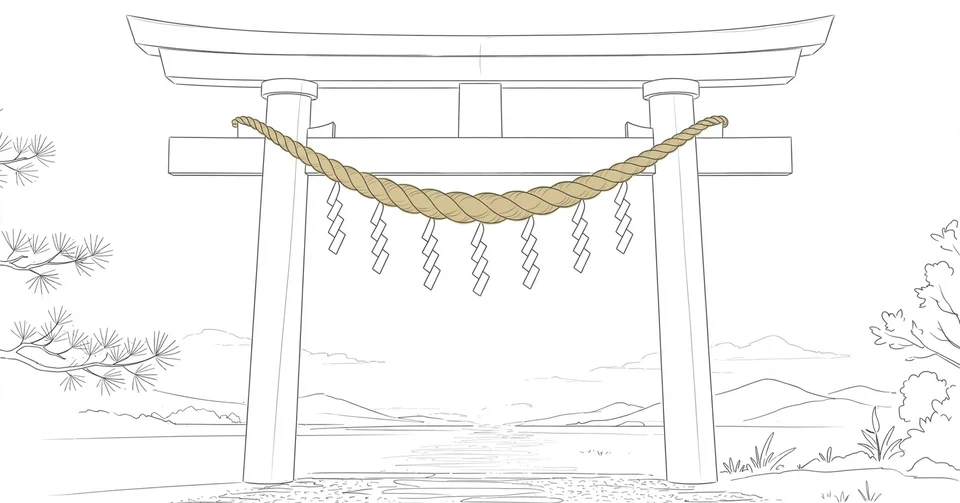
A shimenawa marks a line. On one side is the ordinary world of streets, shops, and daily errands. On the other side is a space set apart for kami, the spirits at the heart of Shinto. The shimenawa does not build a wall. It draws a boundary you can see, and it asks you to cross that boundary with a different kind of attention.
Once you learn to read it, the shimenawa changes how shrines feel. The same shrine you once walked through as a tourist becomes a place with rooms, thresholds, and manners. This article follows that rope from its mythic beginnings to the workshops where the largest ones are made, and it ends with the simple question the rope asks of everyone who passes beneath it.
What a shimenawa actually says
The word itself explains the job. Shime means to close off or to claim a space, and nawa means rope. Put together, a shimenawa is a rope that encloses something, a visible claim that the space inside is different from the space outside. It is not decoration, and it is not a fence. It is a sentence written in straw.
When a shimenawa encircles something or hangs above it, it marks one of three things. It may mark a place where kami reside. It may mark the boundary at the entrance to such a place. Or it may mark a space that ritual has set apart from ordinary life for a time. In every case, the message is the same. Something here deserves care.
The rope also carries a protective meaning. A shimenawa is believed to act as a ward against evil spirits, keeping impurity out of the space it guards. That is why you will see a simple rope stretched across a bare patch of ground before construction begins, in a ground breaking ceremony called jichinsai. Before a single foundation is dug, the site is purified and the rope declares it clean and set apart.
It helps to understand what the shimenawa does not do. A shimenawa around a tree does not make the tree sacred. The tree, known as a shinboku, is already understood by the shrine community to be a dwelling place for kami. The rope only acknowledges that quality and makes it visible to everyone else. In Shinto, such an object is called a yorishiro, a thing that can attract or house a spirit. A rock given the same treatment is called an iwakura. The shimenawa is the sign, not the source.
There is a generosity in this way of marking things. The boundary is honest about what it is. It does not hide the sacred behind walls or locked doors. It hangs in plain sight, made from the most ordinary material in the country, and it trusts you to understand it.
How the shimenawa is made
A shimenawa looks simple, and that simplicity is the point. Today most ropes are made from rice straw, known as wara, an abundant byproduct of rice farming in Japan. Traditionally they were made from hemp fiber, which carried its own ritual associations with purity. Hemp is rarely used now, because the Cannabis Control Act of 1948 made its cultivation strictly licensed, and only a few shrines still source hemp for important ceremonial ropes.
The making itself is a hand craft. Bundles of straw are rolled between the palms to twist them in one direction, then braided together in the opposite direction, so the rope holds its shape. The work is done by hand, usually by parishioners and local volunteers, often in late autumn as shrines prepare for the new year. A small rope for a doorway can be finished in an afternoon. A large one is a community project that can take months.
I find something moving in that process. Straw is what remains after the harvest, the part of the rice plant nobody eats. Turning it into a sacred object is a quiet act of respect for ordinary material, and for the farmers who grew it. Nothing is imported, nothing is gilded, and nothing is hidden. The shimenawa is honest about what it is made of, and that honesty is part of its meaning.
The size of a shimenawa varies enormously, from a few centimetres across to several metres long. The small ones hang over household doors. The large ones need cranes to lift them into place. What changes is the scale, not the logic. Every rope, large or small, is doing the same job.
The paper streamers that hang from it
Most ropes carry white paper streamers called shide, folded into zigzag shapes that hang down from the straw. The folded shape is said to suggest lightning, and the streamers signal divine presence and ritual cleanliness. A space marked with shide has been formally purified, and the more streamers you see, the more carefully the space has been prepared.
Other attachments vary by shrine and region, and each one carries its own meaning. Bitter oranges, called daidai, signal generational continuity and prosperity. Pine twigs indicate longevity and the ongoing presence of kami. At Izumo Taisha, a large bell hangs at the centre of the great rope, so that purification happens through sound as well as through sight. These combinations are not interchangeable. The specific mix tells you something about the shrine, its tradition, and the kami being honoured.
If you stand before a shimenawa and look at what hangs from it, you are reading a small language. Straw says this place is set apart. Paper says it has been purified. Orange says the family line continues. Pine says the kami are still here. The shimenawa speaks in materials, and it rewards a visitor who slows down long enough to listen.
Where the shimenawa appears in daily life
The most common placement is stretched beneath the eaves of the haiden, the hall where worshippers approach to pray. The rope formally separates the human side of the encounter from the side of the kami. A shimenawa at a torii gate does the same work at the outer boundary of the shrine, marking the moment you pass from ordinary street to sacred ground. That is why a torii gate so often carries a shimenawa across its top beam. The gate is the doorway, and the rope is the sign on the doorway. If you want to understand the gate itself, it helps to know that a torii gate marks where the ordinary world ends, and the rope is what makes that ending visible.
At large shrines you will often find ropes in several locations at once, each marking a specific boundary inside the layered structure of the space. They are not redundant. Reading where each one sits helps you understand how the shrine organises its sacred geography, with thresholds inside thresholds, like rooms inside a house.
The shimenawa also appears well outside permanent shrine settings. A himorogi is a temporary sacred space, often just four bamboo or sakaki branches at the corners of a small area, joined by a shimenawa, with a central branch serving as a yorishiro. The space exists for the duration of a rite and is then dismantled. It is a useful reminder that sacred space in Japan does not always need a building. Sometimes a shimenawa and four sticks are enough.
The household version of the shimenawa is called a shimekazari, a smaller decorated rope with fern fronds, pine, bitter orange, and shide, hung above the front door for the new year. Its purpose is to prepare the home to receive Toshigami, the new year deity, and to keep the fresh purity of the new year intact. In the weeks before the new year, shimekazari appear above shop entrances, office doors, and apartment lobbies across the country. For a few weeks, the visual language of the rope saturates the city in a way that does not happen at any other point in the year.
Tradition gives specific dates for hanging one. The proper window is 26 to 28 December, or 30 December. The 29th is avoided, because 29 can be read as nijuku, meaning double suffering. The 31st is avoided as well, because a decoration hung the night before the new year is called ichiyakazari, and is considered insufficiently prepared. When the new year period ends, the rope should not go into regular household waste. In the Kanto region it is taken down on 7 January, while in Kansai the tradition runs until 15 January, when consecrated new year items are ritually burned at shrine bonfires called dondoyaki. Modern Japan adapts these customs freely, and you will see ropes appear at various points through December, but the old dates are still worth knowing.
The giant rope at Izumo Taisha
Every rope follows the same logic, but one of them follows it at a scale that changes how you think about rope itself. The shimenawa at the Kaguraden hall of Izumo Taisha, in Shimane Prefecture, is believed to be the largest in Japan. It measures about 13.6 metres long and weighs around five tons, and it hangs above the hall where sacred music and dance are performed.
The rope is made in Iinan, a small town in the same prefecture, by members of the Iinan-cho Shimenawa Cooperative. Each spring, local farmers plant specially designated rice fields with Akaho-mochi, a glutinous rice variety whose long, strong stalks suit rope making. The straw is cut in July, before the grain ripens and while the fibers are at their strongest, in a process called aogari, or green harvesting. The straw is dried and stored away from sunlight so it does not turn brown, preserving its green colour for the outer layer of the rope. The inside can be filled with ordinary straw, since only the outside is what people see and photograph.
The work takes around four months, and the participants span three generations. Some are veterans, while others are joining for the first time. The hall where the work happens was built in 2015 specifically for this purpose, and it doubles as a museum where visitors can try making a small rope themselves. The cooperative has even supplied ropes to a branch shrine in Hawaii and to places in Europe, shipping them by sea for local installation.
There is no fixed rule for when the Izumo rope must be replaced. The shrine reviews its own schedule and agrees a date with Iinan, usually every five to eight years, and the latest replacement took place in July 2026, after the previous rope had hung for eight years. The shimenawa is built from multiple sections, each produced separately and combined at the end, like a giant puzzle whose shape only becomes clear once most of the pieces are in place. When the finished rope travels to Izumo, some of the artisans travel with it for the dedication.
The story of the rope makers is worth knowing in full, and a detailed account of the Iinan craftspeople and their work explains how a farming town kept a ritual craft alive across generations. What strikes me most is that nobody in Iinan set out to make the biggest rope in Japan. It simply happened that way, because the hall was large, the community was willing, and the work was done properly year after year. Scale was a side effect of care, not a goal.
Two rocks, one rope, at Meoto Iwa
If Izumo shows the rope at its largest, the Meoto Iwa rocks at Futami, in Mie Prefecture, show it at its most tender. Two rocks stand in the sea just offshore from the village of Futamigaura. The larger rock, named Izanagi, stands nine metres tall. The smaller rock, named Izanami, stands about four metres tall. They are joined by thick ropes of braided rice straw, and together they are known as the wedded rocks.
The rocks represent Izanagi and Izanami, the creator deities of Shinto cosmology, and they are a symbol of marriage and lasting partnership. Couples come to pray before them in the hope that their own marriage will be as strong and as lasting. The rocks also serve as a torii gate for worshipping a sacred stone in the sea beyond them, called Okitama Shinseki, where the deity Sarutahiko is said to have descended.
The ropes are replaced in a public ceremony three times a year, in May, September, and December. The event is important enough to make the news each time it happens, and crowds gather to watch the old rope come down and the new one go up. From May to July, the sun rises directly between the two rocks, and on clear evenings around the winter solstice, the moon rises there instead. The site sits beside Futami Okitama Shrine, which has long been the starting point for pilgrims purifying themselves on the way to Ise Jingu.
There is a lesson in the replacement ceremony that applies well beyond Futami. The shimenawa is not meant to last forever. Straw weathers, frays, and fades, and the community accepts that. Three times a year, people gather to renew something that could have been built once from steel and forgotten. They choose not to. The renewal is the point. A boundary that is remade by hand, in public, on a schedule everyone knows, stays alive in a way that a permanent fixture never could.
The shimenawa a wrestler wears
The rope also appears in a place that surprises first time visitors to Japan. It is worn around the waist of a yokozuna, the highest ranking sumo wrestler, during his ring entering ceremony. The connection is not a coincidence. As the bayu.id article on the ceremony explains, the wrestler's rope closely resembles the shimenawa, the sacred ropes hung at Shinto shrines and around sacred trees, and the resemblance is deliberate. You can read the full account in the dohyo-iri gives a yokozuna three minutes to own the ring, which describes how the ceremony turns a wrestler into a living boundary.
In Shinto terms, the yokozuna wearing the rope becomes a living yorishiro, a vessel capable of housing a spirit. The ring itself is purified before tournaments, and the wrestler's rope marks him, for the length of the ceremony, as a sacred space in human form. Sumo began as a ritual, and the rope is one of the clearest surviving signs of that origin.
This is the part of the story I keep returning to. The same object can mark a shrine, a tree, a rock, a doorway, and a person. The shimenawa does not care what it circles. It only cares that something has been set apart, and that the people around it know. A culture that can use one simple object to say the same thing in so many places has found something economical and true.
What to do when you meet one
The most common misunderstanding about the shimenawa is that it always means do not enter. It does not. Passing under a shimenawa at a shrine entrance is completely normal, because that is often the path through. The rope marks a threshold you are expected to cross. What matters is how you cross it.
A few simple rules cover almost every situation. Do not touch the rope itself without a ritual reason, and do not pull at the shide streamers or grab the rope for a photograph. At Izumo Taisha, visitors are asked not to throw coins into the great rope, a habit that damages the straw and is considered disrespectful. A shimenawa stretched across a path, around a rock, or encircling a section of ground that is not part of the normal visitor route is a clear signal to stay outside that boundary. A shimenawa above an entrance is an invitation to pass through. If you are genuinely unsure, watch how local visitors behave before you move.
Photography is generally permitted at most shrines, and there is no rule against photographing a shimenawa. The question is one of intent. Point your camera at the rope because you want to understand the place, not because you want a dramatic backdrop. At a small shrine with no other visitors, move more quietly and act with more care than you might at a famous tourist site.
One exception is worth knowing. At Ise Jingu, the most important Shinto complex in Japan, every tree within the grounds carries the designation goshinboku, meaning sacred tree, so none are individually marked with ropes. The entire grove holds that status, and the boundary of the complex is the boundary of the sacred space. An unmarked tree inside a shrine compound is not necessarily an ordinary tree. When you are uncertain, treat the whole precinct with the same respect the rope asks of you around the most visible objects within it.
Famous places to see the rope at its finest include Izumo Taisha and the Meoto Iwa rocks, but the small shrine around the corner matters just as much. Its parishioners probably made the rope above the hall in late autumn, and they will replace it when the shrine's own ritual calendar calls for it, with nobody there to watch. Standing in front of that rope and understanding what it is doing is a different experience from photographing the famous one, and in some ways a deeper one.
For a fuller picture of the rope, its history, and the mythology behind it, a clear guide to shimenawa at Japanese shrines covers the meanings, the materials, and the places to see them, including the Ise Jingu exception and the customs around the new year rope.
A quiet lesson in drawing lines
A shimenawa is the simplest boundary humans have ever made, and Japan has spent centuries refining what a simple rope can say. It can say this tree is not firewood. It can say this rock is not a climbing frame. It can say this doorway is a threshold, this hall is a meeting place with kami, and this wrestler, for three minutes, is a sacred space. It says all of this without a sign, a fence, or a guard.
I think modern life could use more of this kind of boundary. We are good at building walls and bad at drawing lines that invite respect rather than enforcing obedience. A shimenawa does not threaten. It does not lock anything away. It hangs in plain sight and asks you to notice, to slow down, and to behave as though the place in front of you matters. That is a small request, and it is also a serious one.
The next time you walk through a shrine in Japan, look up before you look ahead. Find the rope, read what hangs from it, and notice where it asks you to pause. The line it draws is thin, and it is made of straw, and it has outlasted empires. That is worth a moment of your attention.
More in Culture & Society
Latest posts
- Walking Through Senbon Torii Feels Like Entering Another World
- Onigiri, Japan's Two-Thousand-Year-Old Portable Meal
- Prambanan Towers Over Java With a Love Story in Stone
- Ekiben, the Train Station Bento That Turns a Journey into a Meal
- Iaido Is the Art of Drawing the Sword Before the Fight Begins
- Natto, the Sticky Fermented Beans Japan Loves and Visitors Fear
- Pancawara Gives Bali a Five Day Week That Never Stops Turning
- Hanami Turns Cherry Blossom Season Into Japan's Longest Picnic
- Bogu Is the Armour That Lets Kendo Strike at Full Speed
- Ema Lets You Hang a Wish Where the Kami Can Read It
- Bonsai and the Thousand-Year Art of Tiny Trees
- The Shinai Is a Bamboo Sword That Teaches Before It Strikes
- Omikuji Tells Your Fortune on a Slip of Paper
- Japan Meets the New Year at Hatsumode
- The Way of the Sword Lives On in Kendo