A Saito Goma Burns Its Prayers Outdoors
· 17 min read
A saito goma takes the goma fire ritual out of the temple hall and into the open air, where yamabushi burn prayer sticks on a pyre of cedar branches before walking barefoot across the embers.
Most temple fires in Japan stay indoors, behind doors and under a roof. A saito goma does the opposite. It takes the whole ritual outside, builds a pyre of cedar branches in an open plaza, and lets the fire grow until it is taller than the monks who lit it. Then, when the flames fall, the monks walk across what is left.
The name tells you what to look for. Saito means brushwood, and goma is the fire offering at the heart of esoteric Buddhism. A saito goma is therefore a fire offering built from brushwood, out in the open, where anyone standing nearby can feel the heat on their face. It is the same prayer as the indoor goma, only bigger, louder, and impossible to ignore.
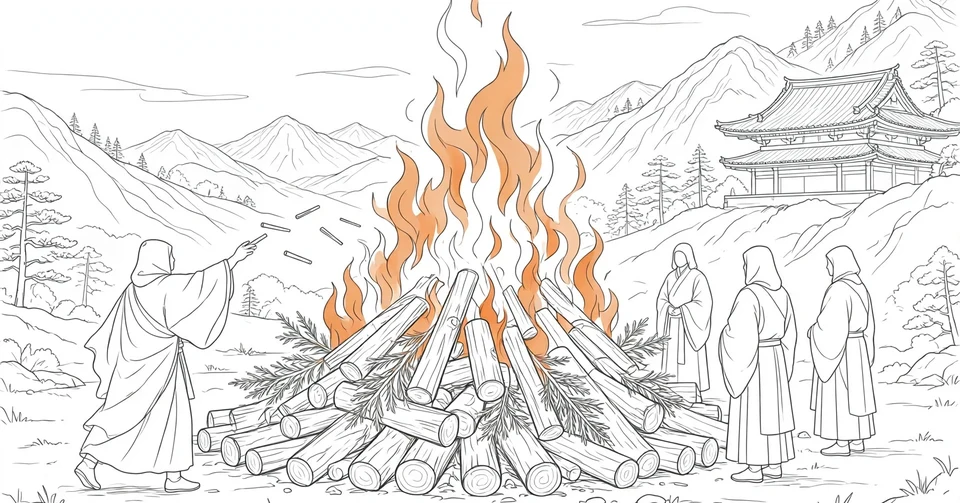
I first heard about the rite the way most people do, through the fire walk that ends it. The walking is the part that photographs well, and it is the part that gets talked about. But the walk is only the last few minutes of a ceremony that takes hours, and the fire is the point, not the feet. The monks do not walk on fire to show that they can. They walk because the fire has done its work, and the walk is the proof of it.
What a saito goma is
A saito goma is an outdoor goma, a fire ritual performed in the open air rather than inside a temple hall. The form belongs to Shugendo, the mountain ascetic tradition of Japan, and its practitioners are the yamabushi, the monks who train in the mountains. In the words of one guide to the rite, the outdoor goma happens on a much bigger scale than the indoor version, but the spiritual meaning is the same: to purify body, mind and spirit, to destroy negative energies, and to invite a better state of mind in their place.
The structure of the rite is simple to describe and hard to watch without feeling it. A pyre is built, usually from logs and cedar branches, sometimes with green fern leaves laid over the wood. The officiating monks purify the ground and the fire, chant sutras, and feed the flames with wooden prayer sticks. Worshippers write their names and wishes on those sticks, and the sticks are burned one by one, or in bundles, until the pile collapses into embers. The fire is understood as the wisdom of Fudo Myoo, the fierce guardian deity who burns away impurity, and the smoke carries the prayers upward.
What makes a saito goma different from an ordinary temple fire is not only its size. An indoor goma is a private, contained rite, performed by a priest at a small altar while worshippers sit and watch. A saito goma is a public event. It happens in a plaza or a car park at the foot of a mountain, with thousands of people standing around the pyre in a ring. The fire is the centre of the gathering, and everyone present is part of it, whether they throw in a stick or simply stand close enough to feel the heat.
The characters used for saito goma give a clue to its origin. The first character means brushwood, and tradition holds that the rite began as an ascetic practice in the mountains, where monks could not decorate the elaborate ritual implements of the temple hall. They built a mound of brushwood and firewood instead, and lit it. The ceremony kept that roughness. Even today, a saito goma looks less like a temple service and more like a mountain camp that has been given a liturgy.
The mountain, the monks and the fire
To understand a saito goma, you have to understand the people who perform it. The yamabushi are mountain ascetics, and their tradition, Shugendo, is a blend of esoteric Buddhism, Shinto mountain worship, and older folk practice. Shugendo means the path of training and testing, and its followers test themselves against the mountain itself: cold water, steep trails, long fasts, and fire. The tradition is described in detail in our article on Shugendo, the mountain faith that turns climbing into a test, and the fire rite is one of its oldest tools.
Tradition credits the ascetic and mystic En no Gyoja, also known as En no Ozunu, as the patriarch of Shugendo. He lived in the seventh century, and legend says he commanded demons, flew between peaks, and founded the mountain temples that later became the centres of the tradition. Whether or not you take the legends literally, his name is still invoked at the fire. The rite is his inheritance, and the yamabushi who perform it today wear the same white robes, carry the same conch shells, and blow them in the same way to open the ceremony.
The fire itself comes from older roots still. Goma is the Japanese form of homa, a Brahmanic ritual of offerings to fire that travelled from India through China to Japan with esoteric Buddhism. In Shingon, the school founded by Kukai, the fire became the central rite, and the deity at its centre became Fudo Myoo. The yamabushi took that rite out of the hall and onto the mountain, and the saito goma is the result: the Shingon fire, performed the way mountain ascetics perform everything, outside, in the weather, with their whole bodies involved.
That is why the ceremony feels so physical. The monks do not only chant. They swing axes and sabres and loose arrows to drive away evil spirits. They splash themselves with boiling water. They walk. The body is part of the prayer, and the fire is the place where the body meets it.
The prayer sticks carry the names
The most personal part of a saito goma is the smallest object in it: a wooden stick. Worshippers buy or receive sticks called gomagi, or goma ki, and write their names and wishes on them. A wish can be anything: health for a parent, safety for a child, success in an exam, protection on the road. The sticks are collected and, during the ceremony, a monk reads the names aloud, one by one, before the sticks are fed into the fire.
At Mount Takao, the official account of the rite describes a second kind of stick as well. Worshippers rub their bodies with sticks called nadegi, as though by the hands of Izuna Daigongen, the deity enshrined at the temple, and the sticks are later thrown into the flames. The idea is simple and direct: the stick takes the dirt of the body onto itself, and the fire burns it away. It is the same logic as the prayer stick, only turned inward. One stick carries a wish. The other carries whatever you want to leave behind.
At a saito goma, hundreds of these sticks go into a single fire. At Takao, the monks stoke the flames with them as the ceremony goes on, and the pile of wood burns down through them. There is something honest about the scale of it. A wish written on a piece of wood is a small thing, and a fire that eats hundreds of them is a large thing, and the gap between the two is the whole point of the rite. You bring something small and personal, and you watch it disappear into something much larger than you.
A saito goma at Mount Takao, step by step
The best known saito goma in Japan is the one at Mount Takao, west of Tokyo, and it is the easiest to see for yourself. The temple at the foot of the mountain is Takao-san Yakuo-in, built in 744 under the orders of Emperor Shomu, and restored in the fourteenth century by a monk of the Shingon school. Mount Takao itself stands about fifty kilometres west of Tokyo, inside the Meiji no Mori Takao Quasi-National Park, and the temple flourished as a retreat for practitioners of Shugendo.
The festival is called Hiwatari-sai, the fire walking festival, and it is held every year on the second Sunday of March. The temple's own events page describes it plainly: a large open air fire ritual called Saito Goma-ku, held in the open area in front of the Kito-den Hall at the foot of Mount Takao. The ceremony starts at one in the afternoon, and a few thousand people come to watch, standing around the plaza where the pyre has been built.
The day of a saito goma begins with a procession. Monks dressed in white, wearing the small skullcap of the yamabushi, leave the temple and parade to the sound of conches down to the plaza, where a large pile of cypress branches has been formed into a long brazier. A crowd is already gathered around it. The saito goma that follows is long and heavily ritualised, made up of chanting, incantations, and gestures that have been performed the same way for centuries.
First comes the reading of the names. A monk reads the long list of the faithful who have bought a goma-gi, the small wooden plaque on which their name and wishes are written, and which will be burned in the hope that the wishes will be granted. Then come the rituals of purification and protection: monks move through the plaza with a long axe, a sabre, and arrows, to chase away evil spirits. Then, with many gestures, the senior monk sets fire to the pile of branches.
The heat of a saito goma rises fast. The monks stoke the fire with hundreds of gomagi, and the flames grow taller than the men tending them. Then comes one of the most striking moments of the day. Two bare chested monks douse themselves with hot water, using a branch of a sacred tree dipped in cauldrons of boiling water. The practice is called yutate, and it opens the way of purification. Only after that does the superior monk begin to walk barefoot on the brazier, followed by the other monks.
The whole sequence is described in a detailed account of the festival by Japan Experience, which notes that the public is then invited to walk as well, once the heat of the embers has subsided. The temple's own page says the same thing in simpler terms: when the fire dies down, yamabushi and participants walk barefoot over the hot coals, praying for protection against sickness and calamity and for safety within the family, and the flames are considered to purify people by burning all defilements away.
Hiwatari, the walk across the embers
Hiwatari, the fire walk, is the part of the saito goma that everyone remembers, and it is worth understanding what it is and what it is not. It is not a trick, and it is not a test of pain. The monks walk after the flames have died down and the fire has been raked into a bed of embers, and the walk is short, a few steps across the coals, taken slowly, while chanting. The official Tokyo travel guide notes that by the time visitors are invited to try it, the temperature of the coals is only slightly warmer than body temperature, and it advises bringing a wet towel to wipe your feet afterward.
That does not make the walk ordinary. At a saito goma, the monks walk first, and they walk as part of the rite, not as a performance. The visitors who follow do so for the same reason the monks do: as an act of purification, and as a prayer for safety. At Takao, people pray for protection against sickness and calamity, for safety within the family, and for protection from traffic accidents. The walk is the physical form of the prayer. You step onto the embers, and you step off them, and the crossing is the point.
I think the walk is often misunderstood by people who have only seen photographs of it. The photographs show flames and bare feet, and they suggest danger. The reality, as the temple describes it, is quieter. The danger is not the point. The point is that the fire has already done its work, and the embers are what is left after the prayers have been burned. Walking across them is a way of saying that you trust the fire to have taken what you gave it. It is an ending, not a stunt.
There is also a practical side that the guides are honest about. The number of participants is limited, the walk happens in the early afternoon, and the plaza is crowded. If you go, you will wait. You will stand in a ring of strangers, watching monks chant in a language you may not understand, smelling cedar smoke, and feeling the heat on your face from several metres away. That waiting is part of the experience, and I would not trade it for a closer view.
How a saito goma differs from an indoor goma
The indoor goma is the form most visitors to Japan are more likely to see. It is performed inside a temple hall, at a small altar, where a priest feeds prayer sticks into a contained fire while worshippers sit in rows and watch. Our article on the goma, where prayers are written to be burned describes that rite, and the contrast with the saito goma is instructive.
The meaning is the same in both forms. The fire is the wisdom of Fudo Myoo, the sticks carry the wishes, and the burning is the offering. What changes is the scale, the setting, and the body. Indoors, the fire is small and the rite is quiet, and the worshipper's role is mostly to sit and listen. Outdoors, the fire is large and the rite is loud, and the worshipper's role is to stand in the smoke, to throw in a stick, and finally to walk.
The indoor goma is also a daily rite. Temples perform it every morning, sometimes several times a day, for whoever comes. A saito goma is an annual event, tied to a date on the calendar: the second Sunday of March at Takao, the last day of the spring festival at Kumano Hongu Taisha. A saito goma is a festival as much as a rite, and people plan their year around it. The difference is the difference between a prayer said every day and a prayer said once a year, in public, with a mountain behind you.
There is one more difference, and it matters. An indoor goma can be performed by a single priest. A saito goma needs a team: monks to build the pyre, monks to chant, monks to read the names, monks to tend the fire, and monks to walk first. It is a collective act in a way the indoor rite is not, and that collectivity is part of its meaning. The fire is too big for one person, and that is the point.
Where else the fire is lit outdoors
Mount Takao is the most famous saito goma, but it is not the only one. The saito goma is performed at mountain temples across Japan wherever the Shugendo tradition has survived, and each place has its own date and its own character.
One of the best known is at Kumano Hongu Taisha, in Wakayama, where yamabushi perform a saito goma on the last day of the Hongu Taisha Spring Festival in April each year. The setting could hardly be more different from Takao: a remote shrine in the Kii mountains, reached by a long walk through cedar forest, rather than a plaza a short train ride from Tokyo. But the saito goma is the same, and the meaning is the same. The fire is built outdoors, the sticks are burned, and the mountain is the temple.
The tradition is also kept alive by the Daigo-ji lineage, which traces the first saito goma to Shobo Rigen Daishi, a disciple of a disciple of Kukai. The great public fire rites of Kyoto, including the Hoshi Matsuri held on February 11 each year, belong to the same family, though the largest of them have grown into events of a different scale altogether, with millions of prayer sticks and hundreds of thousands of visitors. The traditional saito goma of the mountain temples is smaller, and it stays close to its origin: a fire built by hand, in the open, by people who train in the mountains.
That spread is part of what makes a saito goma worth writing about. It is not a single festival in a single place. It is a form, and the form travels. Wherever there is a mountain, a temple, and a community that still believes fire can carry a prayer, a saito goma can be built.
What it is like to stand and watch
I have never walked across the embers at Takao, and I am not sure I would. What draws me to the saito goma is not the walk but the fire itself, and the way it gathers people. A fire outdoors does something that no indoor rite can do. It makes a circle. Strangers stand shoulder to shoulder around it, all facing the same light, all smelling the same smoke, and for an hour or two they are not strangers. They are a congregation, and the fire is the reason.
There is also something about the honesty of the rite that I respect. It does not promise that your wish will come true. It promises only that your wish will be burned, and that the burning is itself a form of care. The monks read your name aloud, they throw your stick into the flames, and the smoke rises. What happens after that is not theirs to guarantee. I find that restraint moving, in a culture of promises. The rite does not sell certainty. It sells attention.
If you go to Takao on the second Sunday of March, go early, wear shoes that are easy to remove, and bring a wet towel for your feet, as the guides suggest. Stand where you can see the pyre and the monks, not where you can get the best photograph. Listen to the conches. Watch the names being read. When the fire dies down and the monks begin to walk, you will understand why people come back every year. The fire is not a spectacle. It is a place where a community puts its worries, one stick at a time, and watches them burn.
A saito goma is, in the end, a simple idea carried out at a large scale. Take the fire out of the hall. Build it big enough that everyone can see it. Let people write their wishes on wood, and burn the wood. Then walk across what is left, and go home. The mountain will still be there next year, and another saito goma will be lit again, and the names will be read again. That is enough, and it has been enough for centuries.
More in Culture & Society
- Desa Pakraman Is the Name the Law Gave the Old Village
- A Primbon Reads Your Life From the Day You Were Born
- Pasaran Is the Five-Day Week Java Never Gave Up
- A Ceper Folds a Coconut Leaf Into a Crescent Moon
- Your Neptu Is the Number Hidden Inside Your Birthday
- Tilem Is the Dark Moon Bali Counts Its Year By
Latest posts
- The Saka Calendar Sets Nyepi on a Different Date Every Year
- On Tumpek Kuningan Bali Feeds Its Ancestors
- Garuda Carried a Mountain to the Middle of the Ocean
- Vasuki Was the Rope That Churned the Ocean of Milk
- En No Gyoja, the Mystic Shugendo Calls Its Patriarch
- Kongobuji Still Governs the Mountain Kukai Left Behind
- A Shukubo Lets You Sleep Inside a Working Temple
- Okunoin Is Japan's Largest Cemetery and Its Quietest Forest
- Suka Duka Means the Banjar Shows Up for Joy and Grief Alike
- Tabuh Rah Spills Blood So the Ground Stays Calm
- The Bendesa Adat Speaks for a Village That Has Two Governments
- Catur Brata Is Four Silences Kept at the Same Time
- On Koyasan the Founder Is Said to Be Still Meditating
- Your Weton Is the Day You Were Born, Counted Two Ways
- Rahu and Ketu Still Chase the Sun and Moon Across the Sky