On Koyasan the Founder Is Said to Be Still Meditating
· 9 min read
Koyasan is a temple town in the mountains of Wakayama, built around the mausoleum of Kukai, the founder of Shingon Buddhism, who his followers believe never died and still sits in eternal meditation at Okunoin.
Twice a day, monks at Koyasan carry a wooden box of hot, freshly cooked food along a stone path lined with gravestones, and deliver it to a locked mausoleum at the end of the forest. The food is real, the delivery is punctual, and it has been going on, believers say, for almost 1,200 years. The man it is cooked for is Kukai, the monk who founded this mountain town, and in the faith of Koyasan he is not dead. He is meditating.
Koyasan sits on a plateau about 800 metres above sea level in the mountains of Wakayama Prefecture, south of Osaka. Eight peaks ring the plateau, and tradition reads their shape as the petals of a lotus. More than a hundred temples crowd the streets of the small town that grew here, and at its eastern edge lies Okunoin, the largest cemetery in Japan. Everything on the mountain, the temples, the cemetery, the daily timetable, is arranged around one presence at the centre of it.
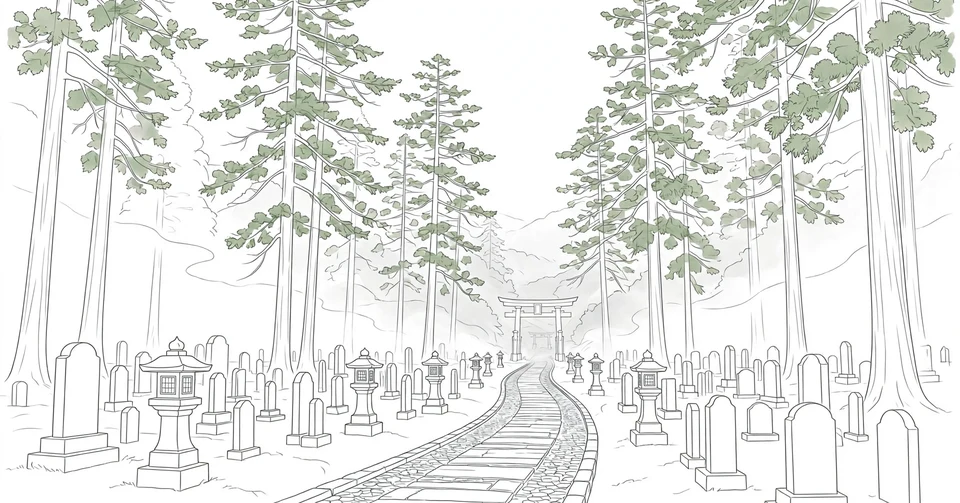
That is what makes a visit to Koyasan feel different from a visit to an old temple district anywhere else in Japan. You are not walking through a preserved relic. You are a guest in a working religious town, and somewhere behind a wooden door its most important resident is, as far as his followers are concerned, still at home.
A mountain granted to a monk
Kukai lived from 774 to 835 and is known across Japan by the name he was given after his death, Kobo Daishi. In 804 he sailed to Tang China as a young monk in search of teachers, and he came home in 806 carrying the texts, mandalas and ritual implements of Shingon, the esoteric school of Buddhism he had received there. Shingon is still practised on this mountain today, and the fire ritual that Kukai's school has kept burning for 1,200 years is one of its most dramatic survivals.
Kukai wanted a headquarters far from the politics and noise of the capital, a place where training could come before everything else. In 816, Emperor Saga granted him this remote plateau in the Kii Mountains, and construction began a few years later, in 819. The work was slow and still unfinished when Kukai died, but the settlement kept growing after him. Kongobuji, the head temple of the Koyasan Shingon sect, still governs the mountain, and the Danjogaran precinct, with its great pagoda rising 48.5 metres at what Shingon teaching treats as the centre of a mandala covering all of Japan, still marks the sacred heart of Koyasan.
There is something shrewd in the choice. A teaching that asks for total concentration was given a home that is genuinely hard to reach by accident, and the difficulty of the journey became part of the discipline. Koyasan never had to build walls against the world. The mountain did it.
The belief at the heart of Koyasan
Shingon teaching holds that a person can become a Buddha in this very body, a doctrine called sokushin jobutsu, and followers believe Kukai proved it in the most literal way available. In 835, tradition says, he sat down in meditation at Okunoin and simply did not stop. He is understood to be resting in an eternal meditation, waiting for the arrival of Miroku Nyorai, the Buddha of the Future, and offering help to those who pray to him in the meantime. His followers are careful with the wording. They do not say that he died and was turned into a god. They say he is still here.
The daily routine of Koyasan is built around that sentence. In the Gokusho offering hall near the entrance to Okunoin, monks still prepare his meals, a ritual called shojinku that temple tradition counts as unbroken for some 1,200 years. The food is tasted first, then carried in procession across the bridges of the cemetery to the mausoleum, twice a day, every day, in all weathers. He is, in the plainest terms the tradition can find, treated as a living resident of Koyasan and attended to daily by his priests.
I find the feeding more moving than any monument on the mountain. A statue asks to be admired. A meal asks to be cooked, carried and served on time, forever, whether or not anyone is watching. Koyasan chose the meal.
Okunoin, the largest cemetery in Japan
Okunoin begins at the Ichinohashi Bridge, where visitors bow before crossing, because from that point they are walking toward Kobo Daishi himself. Behind the bridge the cemetery opens out under enormous cedar trees, and the approach to the mausoleum runs for almost two kilometres past more than 200,000 tombstones. Feudal lords, famous monks and generals all wanted the same thing from this ground: to wait for the future Buddha in the same forest as Kukai, close enough to receive his help when the time comes. No other corner of Koyasan explains its pull as clearly as this path does.
Along the way stand rows of Jizo statues, protectors of children, travellers and the dead, and visitors ladle water over a group of them known as the Mizumuke Jizo, the water covered Jizo, as a small offering for their own departed family members. Near the end of the approach stands the Torodo, the Hall of Lamps, where more than 10,000 donated lanterns are kept eternally lit in front of the mausoleum. In its basement sit 50,000 tiny statues, donated in 1984 to mark 1,150 years since Kukai entered his meditation. Past the final bridge, the Gobyobashi, photography, food and drink are forbidden, and the forest goes very quiet.
Not everything here is ancient, and Koyasan is honest about that. Companies keep memorials in Okunoin too, including, famously, a pest control firm's monument to the termites its products have killed. I like that detail. A cemetery that can hold warlords and termites inside the same act of remembrance is not being sentimental about death. It is being thorough.
Sleeping in a temple, eating like a monk
Koyasan is one of the best places in Japan to sleep inside a working temple. Around fifty of its temples run shukubo, temple lodgings, where travellers and pilgrims sleep on futons in tatami rooms, eat with the community, and can join the monks for morning prayers before the town has properly woken. For a town built around a man who never left, it feels right that the standard way to visit Koyasan is to stay the night.
The food is shojin ryori, the vegetarian cuisine of Buddhist monks, served as an early dinner and again at breakfast. There is no meat, fish or egg, and the cooking avoids the stimulating flavours of garlic and onion, yet nothing about it feels like a lesser version of dinner. Sesame tofu, silky and rich, is the dish Koyasan is proudest of, set among small plates of mountain vegetables, pickles, simmered tofu in several forms, rice and soup. To me, the meals explain the mountain better than any plaque. A cuisine built on restraint, eaten in silence a few streets away from 200,000 graves, is not a novelty for tourists. It is the town keeping its voice down.
Getting to Koyasan
The journey up is part of the design. From Namba Station in Osaka, the Nankai Electric Railway runs south to Gokurakubashi, the station at the foot of the mountain, whose name means Paradise Bridge. From there a cable car climbs the last steep slope in about five minutes, and the whole trip takes roughly an hour and a half by express train. Timetables and fares change, and the Koyasan pages on Japan Guide keep a current breakdown of the route and the town's main sights.
Most visitors split their time between Okunoin and the town. Kongobuji is worth an hour for the Banryutei rock garden alone, the great Daimon gate still stands at the western entrance guarded by its pair of fierce wooden warriors, and the Tokugawa family mausoleum, built by the third shogun Iemitsu over the course of ten years, shows how far the mountain's prestige reached into the politics of old Japan. Koyasan is also the traditional start and end point of the Shikoku 88 Temple Pilgrimage, the great circuit of temples on Kukai's home island. His presence in the Japanese imagination is enormous: hot spring towns across the country credit Kobo Daishi with striking their springs from the rock, and his name is attached to wells, roads and festivals far from Wakayama.
Since 2004, Koyasan has been protected as part of the UNESCO World Heritage listing for the Sacred Sites and Pilgrimage Routes in the Kii Mountain Range, together with Yoshino and Omine and the Kumano Sanzan shrines, linked by some 307 kilometres of pilgrimage trails through the forest. The listing recognises a tradition of sacred mountains documented for more than 1,200 years, which is a formal way of saying what the meal carriers already demonstrate every morning.
Most founders get a tomb, a statue and a paragraph in the guidebook. Koyasan gave its founder something harder to maintain: a routine. Twice a day, through war, fire, earthquake and the entire reinvention of Japan, somebody has cooked for him, tasted the food, and carried it up the path. You do not have to share the belief to feel the weight of that. The real monument of Koyasan is not the cemetery, enormous as it is. It is the decision, renewed every morning, to keep behaving as if he never left.
That, in the end, is what a night on the mountain leaves with you. The forest is beautiful and the silence is real, but the lasting thing is the discipline of care, a place that refuses to let its central relationship become history. The lamps in the Torodo are kept lit. The food keeps arriving. And behind the last bridge, in the understanding of the people who keep his house, Kobo Daishi is still sitting there, in no hurry at all.
More in Food & Travel
Latest posts
- Suka Duka Means the Banjar Shows Up for Joy and Grief Alike
- Tabuh Rah Spills Blood So the Ground Stays Calm
- The Bendesa Adat Speaks for a Village That Has Two Governments
- Catur Brata Is Four Silences Kept at the Same Time
- Your Weton Is the Day You Were Born, Counted Two Ways
- Rahu and Ketu Still Chase the Sun and Moon Across the Sky
- Hiwatari Asks You to Walk Across the Fire
- Ngembak Geni Is the Morning Bali Starts Talking Again
- Karang Ayahan Is the Plot of Land a Village Trusts You With
- On Tumpek Landep Bali Blesses Everything Made of Metal
- Shugendo Turns a Mountain Into a Place of Testing
- A Canang Sari Is Made Fresh Every Morning and Gone by Night
- The Aling-Aling Wall Exists Because Spirits Walk in Straight Lines
- The Tobi Were Edo's Daredevils Before They Were Its Firemen
- A Yamabushi Trains Where the Mountain Is the Temple