A Hishaku Is the Bamboo Ladle That Starts Every Shrine Visit
· 13 min read
A hishaku is the long handled bamboo ladle at the temizuya of a Shinto shrine, and learning how to hold it, rinse with it, and set it down again is the first lesson of every shrine visit.
Before you bow, before you clap, before you drop a coin into the offering box, your hands will meet a hishaku. It waits for you at the entrance of almost every Shinto shrine in Japan, resting in a row across the rim of a stone basin, a long handled ladle of bamboo or wood with a small cup at one end. It looks too simple to matter, until you pick it up and find that this plain tool carries the whole first lesson of a shrine visit in its shape.
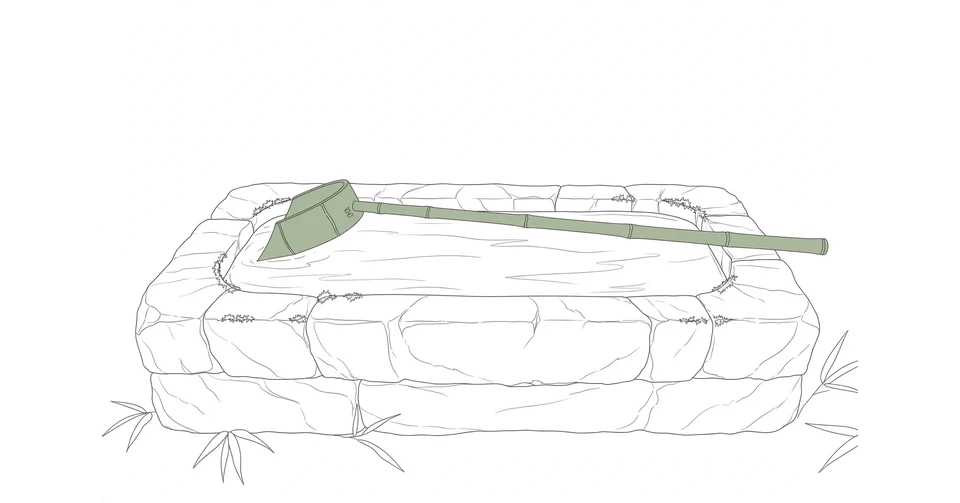
A hishaku is not a souvenir and not a decoration. It is a working tool, shared by everyone who comes to the shrine that day, which is exactly why the rules around it are so precise. One scoop of water, a fixed order of hands, a mouth rinsed from the palm and never from the cup, and a final rinse of the handle for the next person. Learn those few movements and you have learned something larger than etiquette.
I first paid attention to a hishaku on a cold morning at a small shrine in Shizuoka, watching an old man move through the ritual without a wasted motion. He scooped once, rinsed, rinsed again, and set the ladle back exactly where he had found it. There was nothing grand about it, and that was the point. The hishaku does not ask for admiration. It asks for care.
What a hishaku is
A hishaku is a ladle with a long handle and a small cup, written in Japanese as 柄杓. The handle lets you reach into a stone basin without leaning over the water, and the cup holds just enough for the ritual, which is deliberate. One scoop is meant to carry you through the whole purification, so the cup is never large and the handle is never short.
Most shrine ladles are made of bamboo or wood. Bamboo is light, strong for its weight, and naturally resistant to water when it is properly seasoned, which makes it a sensible choice for a tool that lives beside a basin all day. Wooden versions exist too, some of them lacquered to keep the water out, and in a few places you will find metal ladles, though bamboo remains the classic material. The ladles rest across the rim of the basin or on bamboo poles laid over it, always within easy reach and always in a row.
The size of a hishaku changes with its setting. The ladles at a shrine basin are long, long enough to dip into a deep stone basin while you stand comfortably at its edge. In the tea room, by contrast, the hishaku is smaller and more precise, sized to move water between a kettle and a bowl while the host sits on tatami. The word is the same and the shape is related, but the two tools answer to different rooms and different kinds of attention.
How to use a hishaku at the temizuya
The ritual at the basin is called temizu, and the hishaku is the only tool it needs. The pavilion where it happens is the temizuya, the roofed structure near the shrine entrance, and you can read a fuller portrait of it in Temizuya Is Where Every Shrine Visit Begins With Water. The steps below follow the order taught by the Association of Shinto Shrines and set out in detail by Japan Experience in its guide to the chozuya, and the order is the same at almost every shrine in Japan.
Take the hishaku in your right hand and fill the cup from the basin. Pour a little water over your left hand. Pass the hishaku to your left hand and rinse your right hand the same way. Take the hishaku back in your right hand, pour a little water into your cupped left palm, and rinse your mouth from your palm. Spit the water quietly onto the ground beside the basin, never back into it. Rinse your left hand once more, then hold the hishaku upright so the remaining water runs down the handle, and set it back where you found it.
Notice how economical the sequence is. You do not refill the hishaku between steps. One scoop covers everything, which means each pour is small and each movement is quick. The water is for rinsing, lightly and in order, and the discipline of a single scoop is part of the teaching. You take only what you need, and you leave the rest for the person behind you.
Why you never drink from a hishaku
The rule that surprises visitors most is the simplest one. Never put your lips to a hishaku, and never drink from it. The reason is partly hygiene, since the ladle is shared by strangers all day, but the deeper reason is respect for the water itself. The basin holds water for purification, not for thirst. Your mouth is rinsed from your cupped palm, and the water is spat out quietly beside the basin.
Pouring used water back into the basin is the same kind of mistake. The basin is fed by running water, often through the mouth of a bronze dragon, and its water is meant to stay clean for the next person. Water that has touched your hands or your mouth has done its job and should fall to the ground, where it drains away.
The same logic explains why you rinse the handle at the end. Your hands have gripped the hishaku through every step, so the last movement is a courtesy to whoever picks it up next. Stand the ladle upright, let the remaining water run down the handle, and put it back.
I think there is a quiet generosity in this rule. Every instruction assumes someone else is waiting behind you, and every instruction protects that person. A hishaku used properly leaves the basin as clean as it found it.
Bamboo, wood, and the hands that make a hishaku
A hishaku looks like a single piece of wood or bamboo, but in the tea room at least, it is not. The cup and the handle are separate elements, joined at the neck, and the resulting construction is extremely light. That lightness matters, because the host moves the ladle through precise arcs between kettle, water jar, and bowl, and a heavy tool would make those movements clumsy. A tool you lift a hundred times a day should feel like almost nothing in the hand.
Bamboo is chosen with care. Mature stalks with thick walls and tight nodes are preferred, because they resist cracking and hold their shape through seasons of wet and dry. The node of the bamboo, the ringed joint in the stalk, is often left visible near the middle of the handle, and in the tea room it becomes a reference point for the grip. The cup is shaped so that water leaves it in a thin, controlled stream rather than a splash.
Wooden ladles follow the same logic with a different material. A wood hishaku is heavier and sturdier, and a lacquered one sheds water cleanly, which suits a busy shrine. The material changes, but the form stays the same, a long handle, a small cup, and nothing extra.
The craft is easy to overlook because the object is so plain, but plainness is the achievement. A hishaku is the product of someone deciding, over centuries, exactly how long a handle should be and exactly how little material a tool needs to do its job well. The bamboo is not trying to impress me. It is trying to disappear into the task, and it succeeds.
The tea room hishaku and the shrine hishaku
The same word, hishaku, names two different tools, and confusing them is easy. At a shrine, the hishaku is a public ladle for purification, long and sturdy, shared by strangers at a stone basin. In the tea room, the hishaku is a private instrument of chanoyu, used by the host to move hot water from the iron kettle and fresh water from the water jar. The two ladles share a shape and a material, but they live in different worlds.
The tea hishaku is the more specialised of the two. According to the Urasenke school, whose teaching is summarised in a detailed guide to the tea ceremony hishaku, the ladle is made from bamboo and takes different forms for the sunken ro hearth and the portable furo brazier. The ro version is the larger of the two, with a handle around 40 centimetres and a diagonal cut at its end, while the furo version is smaller, with its handle cut differently. There is also a form called sashitoshi, in which the handle passes through the cup, a construction reserved for particular procedures and display contexts.
Handling a tea hishaku is a discipline of its own. The host lifts it, rests it, and sets it down in named forms that change with each action, after drawing hot water, after drawing fresh water, after placing it to rest. Beginners often find the ladle the hardest part of learning tea, because it forces the practitioner to coordinate kettle, water jar, lid rest, and bowl all at once, in a sequence where every placement is visible to the guest. The shrine hishaku asks for none of that. It asks only for a fixed order of hands.
The contrast tells you something about the two settings. The tea room is a closed room where a host performs for a few guests, and its hishaku is an instrument of precision, tuned to the season and the school. The shrine is an open gate where hundreds of strangers pass, and its hishaku is an instrument of shared use, tuned to be picked up by anyone and put down clean. One ladle is about mastery. The other is about manners.
Where else a hishaku appears
Once you know the shape, you start seeing a hishaku everywhere in Japan. Buddhist temples have temizuya too, and the ritual there is the same, because the water does not change its job when the religion changes. Zen gardens keep a stone basin, a chozubachi, by the path, with a ladle resting beside it for visitors to rinse their hands before entering the garden.
The word also stretches beyond the shrine gate. Long handled ladles of the same family appear in kitchens and at festival stalls, wherever water or broth needs to be moved in small, measured amounts. Their proportions change with the task, but the shape is recognisable at a glance.
I find this spread comforting rather than confusing. The hishaku is not a museum piece locked to one building. It is a working shape that Japan has kept because it keeps working, in a tea room, at a shrine, beside a garden basin. Tools that survive for centuries usually do so because they do one thing well and do not pretend to do anything else.
The mistakes visitors make with a hishaku
The mistakes are small, and they are all forgivable, but they are worth knowing before you travel. The most common is putting the ladle to your lips, which breaks the rule of the shared tool. The second is spitting the rinse water back into the basin, which spoils the water for everyone behind you. The third is dropping coins into the basin, as if it were a wishing well. Coins belong in the offering box at the hall, never in the water.
A fourth mistake is treating the basin as a place to wash your face, rinse a water bottle, or cool your hands on a hot day. The water is for the ritual and nothing else. A fifth is taking too much water, refilling the hishaku halfway through, or splashing it across the stone. One scoop is enough, and a calm pour is part of the ritual.
The last mistake is not about the water at all. It is about time. At a busy shrine the temizuya can draw a queue, and the temptation is to hurry through the steps or to linger and take photographs while people wait behind you. The ritual takes less than a minute when you know it. Learn the order before you travel, move through it calmly, and step aside when you are done.
What a small ladle teaches about purification
The idea behind the water is called harae, ritual purification, and its roots run deep. Japan Experience traces the practice to the myth of Izanagi and Izanami, the kami who created the world in the Kojiki, the chronicle of ancient matters compiled in 712. After Izanagi returns from Yomi, the realm of the dead, he immerses himself in water to rid himself of its impurities. The temizuya is the small, everyday descendant of that bath, a river shrunk into a basin and placed at the gate.
The important thing to understand is that this impurity is not sin. Shinto does not teach that people are born stained, and there is no confession waiting at the end of the path. Impurity in Shinto is closer to dust, the tiredness and the small grime of ordinary life that gathers on you as you move through the world. A hishaku does not forgive you. It rinses you. That difference is why the ritual feels light rather than heavy, and why it works even for visitors who arrive with no belief at all.
The paper streamers called shide mark the same boundary in a different way, hanging from the thick straw rope at the shrine entrance, and you can read how they work in Shide Are the Paper Lightning That Marks a Sacred Space. The shide tells your eyes where the boundary is. The hishaku tells your hands. One marks the line, the other helps you cross it.
That is, I think, the real lesson of the ladle. Shinto could have asked visitors to arrive pure, and instead it built a basin at the gate and handed everyone the same tool. Purity here is not a condition you bring with you. It is something you practise, for less than a minute, with a bamboo cup and a little running water. The hishaku is small because the lesson is small, and the lesson is small because it has to be repeated every day, by everyone.
So the next time you stand at a temizuya, pick up the hishaku slowly. Feel how light it is, how the bamboo sits in your palm, how little water the cup holds. Rinse one hand, then the other, then your mouth from your palm, then your hand again, then the handle for the stranger behind you. It is a minute of your life, and it is the oldest part of the visit.
More in Culture & Society
- Kagura Is the Sacred Dance Shinto Still Performs
- Norito Give a Shinto Ceremony Its Voice
- The Gohei Wand Carries the Kami Into the Ceremony
- Origami and How a Single Sheet of Paper Became Japan's Quiet Art
- A Kitsune Is the Fox Messenger Who Guards the Shrines of Japan
- Temizuya Is Where Every Shrine Visit Begins With Water
Latest posts
- Kitsune Udon Is the Bowl the Fox Would Order
- Shide Are the Paper Lightning That Marks a Sacred Space
- Tokyo Disneyland and Why Japan Loves It Differently
- Yabusame Turns Horseback Archery Into a Moving Prayer
- Walking Through Senbon Torii Feels Like Entering Another World
- Onigiri, Japan's Two-Thousand-Year-Old Portable Meal
- Roro Jonggrang and the Thousand Temples Built in One Night
- Ten Thousand Vermilion Gates Lead Up Fushimi Inari
- Prambanan Towers Over Java With a Love Story in Stone
- Shimenawa Marks the Line Between Ordinary and Sacred
- A Torii Gate Marks Where the Ordinary World Ends
- The Yumi Stands Taller Than Its Archer
- Ekiben, the Train Station Bento That Turns a Journey into a Meal
- Kyudo Turns Archery Into a Moving Meditation
- Iaido Is the Art of Drawing the Sword Before the Fight Begins