Ten Thousand Vermilion Gates Lead Up Fushimi Inari
· 12 min read
Fushimi Inari is the head shrine of about 30,000 Inari shrines in Japan, and its mountain path is lined with roughly 10,000 vermilion torii gates. This guide walks the whole trail, from the founding legend in 711 to the quiet summit above Kyoto.
There is a mountain in southern Kyoto where the path itself is the shrine. Fushimi Inari is not a single building you visit and leave. It is a whole hillside of vermilion gates, stone foxes, and small altars, climbing 233 metres through cedar forest to a summit that looks out over the city. The most famous part is the tunnel of gates near the bottom, but the real experience begins after the crowds thin out and the mountain gets quiet.
The shrine is older than Kyoto. It was founded in 711, more than eighty years before the capital moved to the city in 794, and it has been a place of prayer for rice, for business, and for a safe home ever since. Today Fushimi Inari is the head shrine of about 30,000 Inari shrines across Japan, and millions of people climb its paths every year.
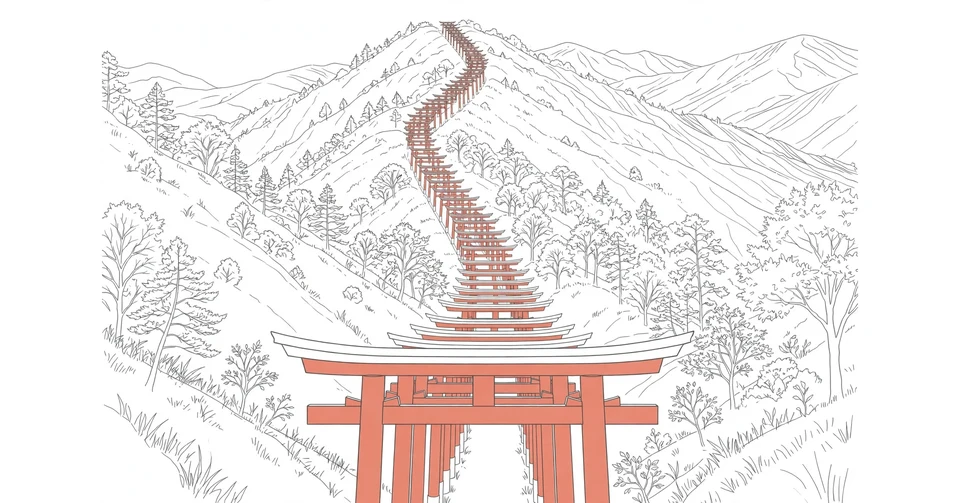
You do not need to be religious to feel something here. You only need to walk slowly, read the names on the backs of the gates, and notice how the light changes as the tunnel gives way to open forest. This guide covers the history, the gates, the foxes, and the hike itself, with the practical details you need to plan a visit to Fushimi Inari.
A shrine older than Kyoto itself
The story of Fushimi Inari begins with an arrow and a rice cake. According to an old account of Yamashiro Province, a wealthy landowner named Hata no Irogu shot an arrow at a piece of mochi for target practice. The rice cake turned into a white bird and flew to the peak of Mount Inari, and where the bird landed, rice grew. Irogu enshrined the deity there, and the shrine dates its founding to 711.
The Hata clan, the family behind the shrine, were immigrants from the Korean Peninsula who settled in the region during the Kofun period. They brought advanced skills in irrigation, silk farming, and sake brewing, and their tutelary deity of rice gradually became a protector of the harvest for the whole country. The name Inari itself is traced to the phrase "ine ga naru", meaning "rice grows", which fits the legend neatly.
Fushimi Inari did not stay in one place. The earliest structures stood on the hill, but the shrine was moved to its present site at the foot of the mountain in 816, at the request of the monk Kukai. The main hall that stands today was built in 1499, after fighting during the Onin War burned the earlier buildings in 1468. The great tower gate at the entrance, the romon, was donated in 1589 by the warlord Toyotomi Hideyoshi, who had prayed here for his mother's recovery and promised a gift of rice if she got well. She recovered, and the gate was built.
What strikes me about this history is how ordinary the shrine's survival has been. Fushimi Inari was never preserved in a glass case. It burned, it was rebuilt, it was moved, it was endowed by warlords and merchants, and it kept changing because people kept coming. A shrine that is 1,300 years old is not old because nothing happened to it. It is old because it was useful enough, and loved enough, to be rebuilt again and again. That is a different kind of permanence, and it feels more honest than a monument that was never touched.
Ten thousand gates, each one a thank you
The sight that defines Fushimi Inari is the Senbon Torii, the "thousand torii" tunnel. Two dense, parallel rows of gates run up the slope just behind the main hall, and walking through them is like walking through a corridor of red light. The name says a thousand, but the real number is much larger. About 800 gates stand close together in the tunnel section, and roughly 10,000 torii of all sizes are spread across the shrine grounds and the mountain paths.
Every gate was paid for by someone. The custom of donating a torii spread during the Edo period, which ran from 1603 to 1868, as a way to mark a wish made or a wish already granted. Each gate carries the name of its donor and the date of the donation inscribed on the back, so the tunnel is also a long record of answered prayers. A smaller gate costs from around 400,000 yen, and a large one costs over a million yen, and new gates are still added today.
The vermilion colour is not decoration. In Shinto, vermilion is associated with protection against evil and disaster, and it is also the colour of a good harvest, the colour of ripe rice and of the sun. The gates mark the boundary between the ordinary world and the sacred one, and that is why a torii matters in the first place. A torii gate marks where the ordinary world ends, and at Fushimi Inari that boundary is repeated ten thousand times, once for every wish someone thought was worth paying for.
I find the economics of the gates moving rather than crass. A business that prospers gives back a gate, and the gate becomes part of the path for everyone else. Nobody owns the view. The donation is visible, the name is on the back, and the gift is a public one. It is an old model of sponsorship, and it works because the thing being sponsored is a shared walk, not a billboard.
Fushimi Inari and the foxes who guard it
Inari is the kami of rice and agriculture, and over the centuries merchants adopted Inari as a patron of business as well. That is why the shrine draws both farmers and shopkeepers, and why the wish written on a wooden plaque here might be for a good harvest, a thriving shop, or a safe household. Fushimi Inari is the head shrine for all of them, the original from which the roughly 30,000 Inari shrines across Japan descend.
The messengers of Inari are foxes, called kitsune, and their statues are everywhere at Fushimi Inari. You will see them guarding the main hall, sitting along the paths, and watching from the small shrines on the mountain. A fox statue often holds something in its mouth: a key for the rice granary, a jewel, a scroll, or a sheaf of rice. The key is the most common, and it is a small, practical symbol. A granary needs a key, and a good harvest needs somewhere safe to keep it.
The foxes even shape what people eat on the mountain. Along the trail there are small restaurants serving Inari sushi and kitsune udon, both made with aburaage, fried tofu, which is said to be a favourite food of foxes. It is a gentle joke built into the menu, and it tells you something about how the Japanese relationship with the kami works. The fox is a messenger of the god, but it is also a familiar animal with a favourite snack, and the shrine treats both ideas as true at once.
There is a small shrine practice here that connects Fushimi Inari to another custom. Visitors write wishes on wooden ema plaques and hang them where the kami can read them, and the same habit of writing a wish and leaving it in a sacred place runs through many Japanese shrines. An ema lets you hang a wish where the kami can read it, and at Fushimi Inari the plaques hang near the main hall before you start the climb, as if the mountain itself is the reply.
Walking Fushimi Inari, step by step
The mountain is the shrine, and the only way to understand Fushimi Inari is to walk it. The trails behind the main buildings run for about 4 kilometres, and the walk to the summit and back takes about two to three hours. You are free to walk as far as you wish and turn back whenever you like, and most visitors do exactly that.
The first part is the famous part. After the main hall, the Senbon Torii tunnel climbs steeply, and for the first few hundred metres the gates are so close together that the light comes through in stripes. It is crowded here, and it is worth arriving early if you want the tunnel to yourself. The crowds thin quickly, though, and that is the first lesson of the mountain. Most people stop after the tunnel, and the shrine rewards the ones who keep going.
After about 30 to 45 minutes of climbing, you reach the Yotsutsuji intersection, roughly halfway up the mountain. The gate density drops, the forest opens, and there is a view over Kyoto that is worth the sweat. Many hikers stop here, and it is a sensible turning point if you are short on time or energy. From Yotsutsuji the trail splits into a circular route to the summit, and the atmosphere changes again. The path gets quieter, the gates get smaller and more spaced out, and the mountain starts to feel like a neighbourhood of small shrines rather than a tourist attraction.
Along the way you will pass tens of thousands of stone altars called otsuka, small rock mounds set up for private worship, many with individual names for Inari engraved on them. These are not official shrine buildings. They were placed here by ordinary people over the centuries, each one a personal act of devotion. The summit itself, called Ichinomine, is 233 metres above sea level, and the walk there is not difficult, just steady. Wear proper shoes, bring water, and take the climb at your own pace.
I think the best advice for Fushimi Inari is to treat the summit as a bonus, not a goal. The mountain is generous to anyone who walks even part of it, and the quiet middle section between Yotsutsuji and the top is where the shrine stops performing and starts simply being a forest with gates in it. That is the part I remember most, and it is the part that costs nothing but time.
What to know before you go
Getting to Fushimi Inari is easy, which is part of its charm. The shrine stands just outside JR Inari Station on the JR Nara Line, a five minute ride from Kyoto Station that costs 150 yen one way. It is also a short walk from Fushimi Inari Station on the Keihan Main Line. You step off the train and the great vermilion torii is right in front of you, which is a rare thing in a city where most famous places demand a bus and a walk.
The shrine is open 24 hours a day, every day, and there is no entrance fee. The approach and the main hall are lit all night, so an early morning or evening visit is possible, and dawn is the best time to walk the tunnel without a crowd. The approach is lined with sweet shops selling tsujiura senbei, a kind of fortune cookie that dates back at least to the 19th century and is believed by some to be the origin of the American fortune cookie.
A few practical notes will make the visit smoother. Go early, ideally before 8 in the morning, if you want photographs of the tunnel without strangers in them. Bring water and wear shoes with grip, because the stone steps get slippery when wet. Respect the fact that this is a working shrine, not a theme park: keep voices down near the main hall, do not climb on the gates, and do not leave litter on the mountain. The shrine draws several million worshippers over the Japanese New Year period, with 2.69 million visitors recorded over three days in 2006, the largest New Year crowd in western Japan, so avoid the first days of January unless you want to experience that particular crush.
The trail is free, the shrine is free, and the best hours are the ones nobody else wants. That combination is rare at a place this famous, and it is worth protecting by visiting with the same care you would bring to someone's home. Details on hours, access, and the trail are covered well in the Japan Guide page on Fushimi Inari Shrine, and the full history, including the founding legend and the shrine's structures, is laid out in the Wikipedia article on Fushimi Inari-taisha.
Why Fushimi Inari still matters
Fushimi Inari matters because it is still doing the job it was built for. It is not a ruin, and it is not a museum. People still climb the mountain to pray for rice, for business, for health, and for family, and they still pay for gates when those prayers are answered. The shrine has survived 1,300 years not by staying the same but by staying useful, and the ten thousand gates are the receipts.
If you visit, walk past the tunnel. The famous photographs end at the Senbon Torii, but the shrine does not. The forest above is quieter, the small altars are humbler, and the view from Yotsutsuji is better than any photograph of a gate. Fushimi Inari rewards the people who keep walking, and that is a lesson worth carrying home from any mountain.
More in Culture & Society
Latest posts
- Walking Through Senbon Torii Feels Like Entering Another World
- Onigiri, Japan's Two-Thousand-Year-Old Portable Meal
- Prambanan Towers Over Java With a Love Story in Stone
- Ekiben, the Train Station Bento That Turns a Journey into a Meal
- Iaido Is the Art of Drawing the Sword Before the Fight Begins
- Natto, the Sticky Fermented Beans Japan Loves and Visitors Fear
- Pancawara Gives Bali a Five Day Week That Never Stops Turning
- Hanami Turns Cherry Blossom Season Into Japan's Longest Picnic
- Bogu Is the Armour That Lets Kendo Strike at Full Speed
- Ema Lets You Hang a Wish Where the Kami Can Read It
- Bonsai and the Thousand-Year Art of Tiny Trees
- The Shinai Is a Bamboo Sword That Teaches Before It Strikes
- Omikuji Tells Your Fortune on a Slip of Paper
- Japan Meets the New Year at Hatsumode
- The Way of the Sword Lives On in Kendo