Kagura Is the Sacred Dance Shinto Still Performs
· 15 min read
The sacred dance of Shinto, kagura has been performed for more than a thousand years, from a goddess dancing before a cave to village shrines where masked dancers still tell the old myths tonight.
On a cold night in a mountain village in Miyazaki, the drums start after dark and do not stop until morning. Inside a small shrine hall, a dancer in a painted mask spins slowly to the sound of a flute, telling a story that is older than the shrine itself. Nobody in the room is checking the time. The dance has been going on, in one form or another, for more than a thousand years, and the people watching it know they are not the audience. They are the latest guests at a performance given for the gods.
Kagura is the sacred dance of Shinto, a ritual of music, movement and storytelling offered to the kami, the deities of the Japanese tradition. The word is usually translated as god entertainment, and that is close to the truth, but it misses the deeper point. Kagura is not entertainment put on for people who happen to be watching. It is a gift made to the gods, and the people in the room are witnesses to an act of hospitality that has outlasted empires, wars and the arrival of every new fashion in Japanese theatre.
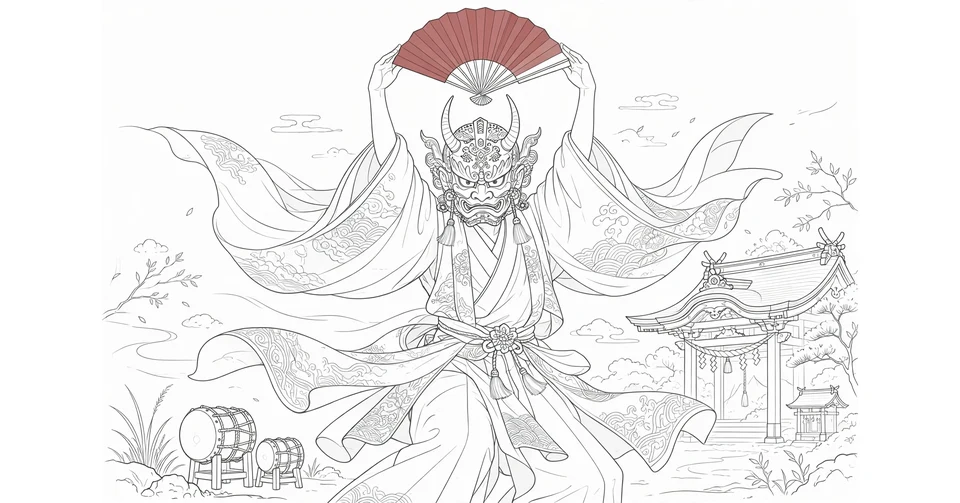
What makes kagura remarkable is not only its age but its stubborn refusal to become a museum piece. You can still see it performed as a living rite, not a reconstruction, in shrines and village halls across Japan. Some performances are solemn and slow, meant for the gods alone. Others are loud, fast and funny, with sword fights, demons and serpents that fill the hall. Together they form one of the oldest performing arts in Japan, and one of the least known outside it.
What kagura is, and who it is for
The name kagura is a shortening of kami no kura, meaning the seat of the gods, and it was once written as kamukura. The idea behind the name is simple and beautiful. When the dance begins, a place is prepared where the kami can sit and be present, and the dancers perform before them with sacred objects in their hands, a branch of sakaki, a fan, a sword, a bell. The dancers are not showing off. They are keeping the gods company.
A kagura performance usually has two jobs at once. It entertains the kami, and it purifies the people and the place. The old word for the second job is chinkon, the settling and shaking of the spirit, and it explains why so much kagura movement is grounded and percussive. Dancers stamp the floor, and the stamping is not decoration. It is the same stomping gesture found in kagura, the sacred dance performed at shrines, where the vibration driven into the earth is meant to settle the ground and drive out disorder, and it is also the gesture at the heart of sumo, whose wrestlers stamp the clay of the ring for the same reason. Kagura and sumo share a ritual ancestor, and the stamp is the clearest proof of it.
Most kagura is performed by men, and in the oldest court forms by shrine maidens called miko, whose dances are known as miko kagura or mikomai. The performers are often local people rather than professional artists. In many villages the dancers are farmers, teachers and shopkeepers who rehearse after work and inherit their roles from their fathers. That amateur quality is part of the point. Kagura belongs to the community that performs it, and the community performs it because the shrine, the harvest and the turning of the year ask for it.
The dance that brought back the sun
Every kagura dancer knows the story the art claims as its origin, and it is one of the great myths of Japan. It is told in the Kojiki, the Record of Ancient Matters, and the Nihon Shoki, the Chronicles of Japan, the two oldest histories of the country, both compiled in the eighth century. The sun goddess Amaterasu, angered and grieved, hid herself inside a cave called Amano Iwato, the Heavenly Rock Cave, and the world went dark. The other gods gathered outside the cave and wondered how to bring her back.
The goddess Ame no Uzume, the goddess of dawn, mirth and revelry, answered by dancing. She overturned a wooden bucket, climbed on top of it, and danced with such abandon that the watching gods burst into laughter. Amaterasu, hearing the laughter and wondering what could possibly be worth celebrating while she was hidden away, pushed the rock aside to look out, and the light returned to the world. Kagura traces itself back to that dance on the bucket, and it has been trying to repeat its effect ever since, to make the gods laugh, to make them look, and to bring back the light.
Whether you read the myth as history or as poetry, it tells you what kagura is for. It is a dance meant to be seen by someone beyond the room. The gods are the intended audience, and human beings are lucky to be present. That is why the most solemn forms of kagura feel less like a show and more like a ceremony you are allowed to watch. The dancers face the altar, not the crowd, and the crowd understands that its role is to witness, not to applaud on cue.
There is a quiet lesson in that arrangement. Much of modern performance is built around the audience, shaped and shortened to hold our attention. Kagura refuses that bargain. It keeps its slow parts slow, its rituals intact and its stories whole, because its first loyalty is to the gods and the community, not to the visitor. I think that is why it still moves people who know nothing about Shinto. A performance that does not beg for your attention somehow earns it more completely than one that does.
Two kinds of kagura, the court and the village
Kagura is usually divided into two broad families, and the division tells the story of how the art spread. The first is mikagura, the kagura of the Imperial court. In the fourth year of the Choho period, the year 1002, mikagura was performed for Emperor Ichijo at the Naishi-dokoro, the palace sanctuary where the sacred mirror was kept. That performance became an annual event, and it continues today as Kashiko-dokoro Mikagura, the kagura of the imperial sanctuary. Court kagura is formal, slow and restrained, a sequence of dances and sacred songs performed to welcome, entertain and honour the kami. It is not a show for tourists. It is a rite of the court, and its survival for more than a thousand years is itself a kind of miracle.
The second family is satokagura, the kagura of the villages. As the court dances spread beyond the palace, they were taken up by shrines and communities across the country, and each region made them its own. Satokagura is the umbrella under which most of the kagura a visitor will ever see now sits, and it is gloriously varied. Some forms are performed by shrine maidens, some by masked troupes retelling myths, some by lion dancers, and each region has its own repertoire, its own music and its own way of telling the same old stories. The scholar Yasuji Honda, one of the great authorities on Japanese folk performance, divided satokagura into schools such as the miko kagura of the shrine maidens, the Izumo school and the Ise school, but even his careful map has begun to look too neat for a tradition that keeps growing new branches.
The two families are not rivals. They are two answers to the same question, how a community keeps its gods close, one given by a court and one given by a village. The court kept kagura pure and formal. The villages kept it alive and loud. Japan needed both, and still does.
The music, masks and costumes
Before you ever see a kagura dancer, you hear the music, and the music does much of the work. A kagura ensemble is small, usually a flute, a drum and cymbals, sometimes with hand clapping and chanting added. The flute carries the melody, high and wavering, while the drum sets the pulse that the dancers stamp against. In the slower court forms the music is spare and meditative. In the folk forms it can be driving and urgent, fast enough to make the whole hall feel like it is leaning forward.
Masks are the most striking part of the visual language. A kagura mask turns an ordinary neighbour into a god, a demon or a hero in the moment it is put on, and the audience accepts the transformation without question. Some masks are carved from wood in the older tradition, solemn and heavy. Others are made from sekishu washi, a strong locally produced paper in the Iwami region, which makes them lighter for the dancer and allows a much finer level of detail and expression. The masks are often displayed in the entrances of homes and businesses to ward off evil spirits, which says something about how seriously people take the beings the masks represent.
Costumes range from the plain white robes of the court dancers to the spectacular embroidered garments of the folk troupes, some of them worth upwards of ten thousand dollars, stitched with miles of gold thread and tiny mirrors, and cleverly designed so that a dancer can transform on stage, a robe reversed in a single movement to reveal a demon where a god stood a moment before. The spectacle is real, but it is worth remembering what it is for. The glitter is not decoration. It is how a village makes a god visible to the human eye, and how it honours the stories it has carried for centuries.
Three famous regional kagura
If you want to understand how one ritual became many, look at three regional forms that could hardly be more different from each other.
Iwami Kagura, from the Iwami region of Shimane Prefecture, is the showman of the family. It is performed all year round by more than 130 kagura groups, and its drums and flutes are played much faster than in any other kind of kagura. The stories come mostly from the ancient histories of the eighth century and from the legends made famous by Noh theatre, and they are told with sword fights, comic interludes and astonishing stagecraft. The finale is usually Yamata no Orochi, the tale of the hero Susanoo battling the eight headed serpent, in which eight serpents, each about seventeen metres long, writhe across the stage with blazing eyes and sparks at their jaws. Iwami troupes have added smoke machines, wireless microphones and fireworks to the old form, and the art has become so beloved that it is now regularly performed at the famous Gion Festival in Kyoto. The Japan National Tourism Organization has a good guide to Iwami Kagura and to the shrine festivals and competitions where it can be seen.
Hayachine Kagura, from Iwate Prefecture in the north, is the quiet scholar of the family, and the one the world has formally recognised. In the fourteenth or fifteenth century, the people of the region began to worship Mount Hayachine as a deity, and a tradition of folk performance grew up around that worship. It continues to enliven the Great Festival of the Hayachine Shrine in Hanamaki City, held on the first day of August. The performance is a series of twelve masked dances accompanied by drum, cymbals and flute. Six ritual dances open it, five dances recount stories of the deities and of medieval Japanese history, and a final dance features a performer dressed as a shishi, an imaginary lion-like creature representing the Hayachine deity himself. Originally danced by holy officers of the shrine, Hayachine Kagura is now performed by representatives of the whole community. UNESCO inscribed it on the Representative List of the Intangible Cultural Heritage of Humanity in 2009, and the UNESCO listing for Hayachine Kagura records the twelve dance structure and the festival it belongs to.
Takachiho Yokagura, from Miyazaki Prefecture, is the night owl of the family. It is performed from mid-November through the beginning of February, the long winter nights when farming work is done and the village can give itself to the gods. The tradition belongs to the town of Takachiho, a place steeped in the mythology of the descent of the gods, and at Takachiho Shrine four representative dances from a repertoire of thirty three are performed nightly in the shrine's kagura hall. The all night form, in which the full sequence runs from dusk to dawn, is still performed at shrines through the winter, and sitting through even part of it is one of the most quietly intense experiences Japan offers a traveller.
Three regions, three temperaments: Iwami loud and dazzling, Hayachine solemn and honoured, Takachiho patient and nocturnal. Yet all three are telling the same stories, honouring the same gods, and stamping the same floor. The variety is the point. Kagura is not a single dance preserved in amber. It is a living art that each community has shaped to its own character.
Where to watch kagura today
Seeing kagura takes a little planning, and that is part of its charm. It is not a show with a nightly curtain time in a theatre district. It belongs to shrines, festivals and seasons, and the best way to see it is to go where it already lives.
The most reliable introduction is Takachiho, where the shrine offers its nightly performance through the winter season, an easy way to see the art in its home without waiting for a festival. In Shimane, the Iwami region holds its shrine festivals most often in October or November, after the rice harvest, and the best of them run all night, from evening until midnight or dawn. Small hot spring resorts in the region, such as Yunotsu and Arifuku, put on short performances on Saturday nights for their guests, and most towns hold annual kagura competitions in halls and auditoriums, where several groups perform in one evening and local audiences, who know the repertoire well, judge them keenly. In Iwate, the Great Festival of the Hayachine Shrine on the first day of August is the occasion for Hayachine Kagura in its full ceremonial setting.
A few practical notes will make the experience better. Arrive early, because the best seats at a shrine performance are often just a cushion on the floor, and the hall fills fast. Expect the ritual sections to be slow and quiet, and let them be. The loud dances land harder when you have sat through the solemn ones first. Photographs are usually tolerated at public performances, but watch what the locals do and follow them rather than the other way around. Kagura is a rite before it is a spectacle, and the dancers are performing for the kami first. Respecting that order is the price of admission, and it is a small one.
The same instinct runs through other ritual arts of Japan, and it is worth noticing. In yabusame, the mounted archery performed at shrines, the rider's prayer matters as much as the arrow, and the audience watches a rite, not a sport. Kagura asks for the same kind of attention, the kind that listens before it applauds.
A dance that refuses to end
Kagura has survived for more than a thousand years without ever becoming fashionable, and that may be the secret of its survival. It was never preserved by being frozen. Court dancers kept the old forms exact, village troupes made them louder and faster, and each generation handed the art on in the only way that works, by dancing it in front of the next one. UNESCO recognition and tourist guides help, but they are not what keeps kagura alive. What keeps it alive is a village that still clears its shrine hall on a winter night, a community in Hanamaki that still gathers on the first day of August, and a dancer who still puts on a mask and becomes, for a little while, something larger than himself.
The goddess on the bucket danced to make the gods laugh and bring back the sun. The dancers of kagura are still doing the same work, one stamped floor and one winter night at a time. Sit with them for an evening, and you may find that the light they are calling back is not only the sun. It is the feeling that some things are worth doing slowly, together, and for reasons larger than ourselves.
More in Culture & Society
- Norito Give a Shinto Ceremony Its Voice
- The Gohei Wand Carries the Kami Into the Ceremony
- Origami and How a Single Sheet of Paper Became Japan's Quiet Art
- A Hishaku Is the Bamboo Ladle That Starts Every Shrine Visit
- A Kitsune Is the Fox Messenger Who Guards the Shrines of Japan
- Temizuya Is Where Every Shrine Visit Begins With Water
Latest posts
- Kitsune Udon Is the Bowl the Fox Would Order
- Shide Are the Paper Lightning That Marks a Sacred Space
- Tokyo Disneyland and Why Japan Loves It Differently
- Yabusame Turns Horseback Archery Into a Moving Prayer
- Walking Through Senbon Torii Feels Like Entering Another World
- Onigiri, Japan's Two-Thousand-Year-Old Portable Meal
- Roro Jonggrang and the Thousand Temples Built in One Night
- Ten Thousand Vermilion Gates Lead Up Fushimi Inari
- Prambanan Towers Over Java With a Love Story in Stone
- Shimenawa Marks the Line Between Ordinary and Sacred
- A Torii Gate Marks Where the Ordinary World Ends
- The Yumi Stands Taller Than Its Archer
- Ekiben, the Train Station Bento That Turns a Journey into a Meal
- Kyudo Turns Archery Into a Moving Meditation
- Iaido Is the Art of Drawing the Sword Before the Fight Begins