Norito Give a Shinto Ceremony Its Voice
· 16 min read
A norito is the formal prayer a Shinto priest reads aloud during a ceremony, and hearing one is the moment a shrine visit turns into something you feel in your chest.
If you have ever stood in a shrine hall while a ceremony was under way, you probably remember the sound before anything else. The priest bows, the offerings are set out, the room goes quiet, and then a voice begins to read in a slow, measured rhythm that does not sound like ordinary Japanese at all. That voice is reading a norito, and it is the part of the ceremony that gives everything else its meaning.
A norito is a formal Shinto prayer, a liturgical text read aloud by a priest and addressed to a kami. It is not a silent prayer and it is not a song. It is a spoken declaration, delivered in a set form, at a set moment, for a set purpose. The offerings on the altar, the bows, the waving of the purification wand, all of these are gestures. The norito is the words that explain what the gestures are for.
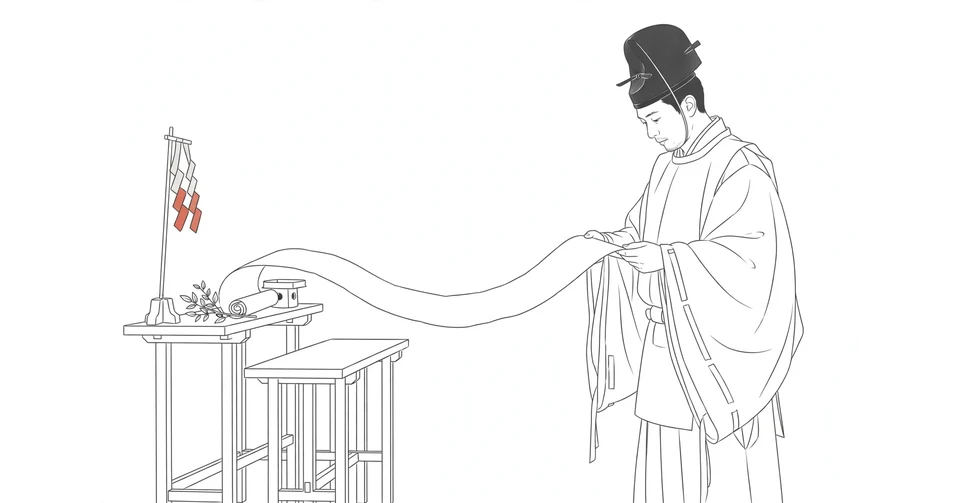
This article began with a single line in an earlier piece about the gohei, the paper wand that stands on the altar. That article noted that the gohei marks the place where the kami are understood to sit while the priest reads the norito prayers and the offerings are presented. The wand is the address. The norito is the message sent to that address. To understand one, you need to understand the other, and the prayer turns out to be the older and stranger of the two.
What a norito actually is
A norito is a prayer text, but that plain description hides how unusual it is. Shinto has no scripture in the way other religions do. There is no single holy book that believers read and study. The Kojiki and the Nihon Shoki, the two great chronicles of early Japan, are histories full of myths, not books of doctrine. Scholars have pointed out that the norito are almost the only writings Shinto produced that can be called theology, because they are the place where the tradition says, in its own words, what it believes about the kami and what it asks of them.
The word itself is old and its exact origin is still debated. One widely cited theory traces norito to noru, a verb meaning to declare, combined with the suffix to. That reading makes sense, because a norito is above all a declaration. The priest stands before the kami and declares who is present, why the ceremony is being held, what is being offered, and what is being asked. Another old term, notto, comes from combining norito with koto, meaning word. A more recent scholar summed up the original meaning as magic by means of words, which sounds dramatic until you hear a norito read aloud and realize that the words really do feel like they are doing something.
The point is worth pausing on. In most of daily life, words describe things. In a norito, words perform things. When the priest declares that the offerings have been presented and asks the kami to accept them, the declaration is part of the offering. The prayer does not talk about the ceremony from outside. It is inside the ceremony, doing the work.
The oldest prayers on record
The first written records of norito appear in the Kojiki, completed in 712, and the Nihon Shoki, completed in 720. These are the oldest surviving books in Japan, and the prayers appear inside them as part of the myths and court records. But the prayers themselves are almost certainly older than the books. They were spoken long before anyone wrote them down, passed from priest to priest by voice, and the written versions we have are snapshots of an oral tradition that was already ancient when it was first recorded.
The great collection came later. The Engishiki, a compilation of court law and ritual procedure, was completed in 927, and its eighth book preserves twenty seven representative norito. These are the classic texts: prayers for a good harvest, for the wind gods, for the fire ritual, for the road gods, for the great purification, and more. They were the official prayers of the imperial court, used at state ceremonies, and they remain the foundation of everything priests read today.
Twenty seven sounds like a small number, and it is. But each of those twenty seven is long, formal, and built to be reused. A single norito could serve a whole festival, and the same text could be read year after year, century after century, with only the names and the occasion changed. That is why the Engishiki matters so much. It did not invent the norito. It froze a living oral tradition into a form that could survive, and a thousand years later priests are still reading words that were first written down in that book.
There is a second old collection worth knowing about. The Nakatomi no yogoto, a prayer of the Nakatomi clan, survives in the diary of the court noble Fujiwara no Yorinaga. The Nakatomi were the family traditionally responsible for reading the great purification prayer, and their text is one of the most famous norito of all. Together with the twenty seven in the Engishiki, it gives us a picture of a tradition that was already rich, formal, and self aware more than a thousand years ago.
How a norito is built
A norito is not a free improvisation. It follows a structure that scholars have traced across the Engishiki texts, and once you know the structure you can hear it even when you cannot understand a word.
It begins by naming the kami. The priest announces which deity the prayer is addressed to, using the full formal name and titles. This is not a formality. Naming the kami is how the prayer finds its listener, the way the gohei on the altar gives the ceremony an address. Then the prayer explains the mythological origin of the festival or rite, recalling the story that gives this occasion its meaning. After that comes a reference to shintoku, the virtue that flows from the kami's actions, and then a description of the shinsen, the food offerings laid out on the altar. Finally the prayer states its purpose, what is being asked or thanked for, and closes with one of two formulas: "I announce" or "I humbly say."
That closing matters more than it looks. The scholar Shinobu Orikuchi, studying the ancient texts, argued that there were originally two kinds of prayer here. One ended with "I declare" and was spoken by a superior to an inferior, a blessing handed down. The other ended with "I humbly report" and was spoken by an inferior to a superior, a tribute offered up. Over time both kinds came to be called norito, but the two closings survived, and they still tell you something about the relationship the prayer is describing. A norito can be a declaration from above or a humble report from below, and the ending tells you which one you are hearing.
Modern norito usually drop the mythological explanation, which makes them shorter and more practical for daily use. But the rest of the shape survives: name the kami, name the offerings, state the purpose, close with respect. The form is a kind of skeleton, and every ceremony hangs its own details on it.
The great purification prayer
If there is one norito that ordinary people are most likely to hear, it is the Oharai no Kotoba, the words of the great purification. This is the prayer at the center of the Oharae, the great purification ceremony held twice a year, on June 30 and on the last day of December. Its purpose is to cleanse the whole community of the sins and impurities, tsumi and kegare, that have built up over the previous six months without anyone noticing.
The ceremony is old. The first firm record of it as a state rite dates to the year 676, in the reign of Emperor Tenmu, and the Engishiki preserves its text under the title of the June purification. In the old court, the chief ceremony was held near the southern gate of the imperial palace in Kyoto, and it was understood to purify everyone from the highest ministers down to the common people. Today every public shrine holds its own version, and the prayer is read by the shrine priest rather than by a member of the Nakatomi clan, whose hereditary office no longer exists.
The best known description of the rite comes from Kamigamo Jinja in Kyoto, where the June ceremony begins in the evening and runs by torchlight. Priests pass through a great ring of reeds, present offerings to the deity, and then gather at the hall beside the stream. A reciter steps forward, and the purification prayer is chanted while priests sweep paper dolls called hitogata into the running water. Each doll carries the name of a person who submitted it, and as the paper floats away it is believed to take that person's impurities with it. The Japan Tourism Agency describes the scene in plain terms: braziers casting firelight over the water, the sound of traditional instruments, and the rhythmic chanting of prayers as the papers drift downstream.
What strikes me about this is the modesty of the mechanism. No grand gesture, no spectacle for its own sake. A paper doll, a breath blown onto it, a stream, and a prayer read aloud. The norito does not claim to wash anyone clean by itself. It names the impurity, declares it carried away, and trusts the words to hold. There is a humility in that which I find more convincing than any display of power.
Where you will hear a norito
The great purification is the most famous occasion, but it is far from the only one. A norito is read at almost every formal Shinto ceremony, and the calendar of a shrine is really a calendar of prayers.
At hatsumode, the first shrine visit of the new year, priests read a norito asking for health and good fortune in the year ahead. The crowds pressing into the shrine grounds may not hear it, but it is being read inside the hall while they wait, and it is the reason the visit counts as more than a walk. At a Shinto wedding, a norito is read to announce the marriage to the kami and to ask for their blessing on the couple. The couple stands, the priest reads, and the words make the union a matter of record before the deity, not just before the families.
At a jichinsai, the ground breaking ceremony held before a new building goes up, a norito is read to calm the kami of the land and ask permission to build. This is a ceremony many people in Japan have attended without ever knowing its name, standing in a roped off patch of bare earth while a priest in white reads from a scroll. At a kinensai, the spring prayer for a good harvest preserved in the Engishiki, the norito asks the harvest gods to send the crop in full ears. At shrine festivals, a norito opens the proceedings by announcing the kami and the occasion. And in daily shrine life, priests read short norito each morning as part of the regular rites, a quiet routine that keeps the tradition alive between the big days.
The range is the point. A norito can bless a marriage, break ground for a house, ask for rain, or simply open the shrine for the day. The same form serves all of these, because the form is not about the occasion. It is about the relationship between people and kami, and that relationship is the same on a festival day and on an ordinary Tuesday morning.
The old language
One reason a norito sounds so strange to a modern listener is that it is not written in modern Japanese. The texts are composed in an archaic form of the language, full of words and grammar that fell out of everyday use centuries ago. Priests learn to read them as part of their training, the way a choir singer learns Latin, and most worshippers understand only the shape of the prayer, not its sentences.
The writing is distinctive too. Norito were traditionally written in a variety of man'yogana, the early system of writing Japanese with Chinese characters used for their sound, in which particles and suffixes are written in a smaller script than the main body of the text. This style, known as senmyogaki, was also used for imperial edicts preserved from the eighth century. On the page, a norito looks like a formal document from another age, because that is what it is. The small script, the old words, the careful spacing, all of it signals that this text belongs to a different register from everyday speech.
This is also why the rhythm matters so much. A norito is built to be heard, not read silently. The long phrases, the repetitions, the steady pace, all of it helps the words carry across a hall and helps the listener follow even when the meaning is out of reach. Scholars have described the norito as a form of rhythmic poem, recited in a way that helps it be passed down, and that is exactly how it feels in person. You do not parse it like a sentence. You ride it like a current.
There is a Japanese idea that belongs here, and it is kotodama, the belief that words carry a spirit of their own. A norito is kotodama in its most formal shape: words chosen, ordered, and spoken with the understanding that saying them correctly is itself an act. Whether or not you share the belief, it explains why the language has not been modernized. To update the words would be to change the act, and the act is the point.
What it feels like to listen
Here is the honest part, from someone who has stood in the back of a shrine hall and listened without understanding most of it. The first thing you notice is the pace. It is slower than conversation, slower than a speech, slow enough that each phrase has time to land before the next one begins. The priest reads without hurry and without drama, and the steadiness itself becomes a kind of authority. Nothing is being performed for you. Something is being done, and you are allowed to watch.
The second thing you notice is the sound of the room. A norito is read in a space built for it, wood and tatami and paper, and the voice does not echo so much as settle. The other sounds of the ceremony go on around it: the rustle of the priest's robes, the soft tap of a wooden clapper, the faint hiss of the purification wand moving through the air. The prayer sits in the middle of those sounds the way the gohei sits in the middle of the altar, quiet and central at once.
I think the reason it stays with you is that it asks so little of you and gives so much back. You do not need to believe anything to feel the weight of a thousand year old text being read aloud in the room where you are standing. You do not need to follow the archaic grammar to understand that something careful is happening. The norito does not try to convince you. It simply speaks, in the voice the tradition has kept for this exact purpose, and lets the sound do the persuading.
That is, I suspect, why the tradition has never replaced these prayers with something easier. Ease was never the goal. Continuity was. When a priest today reads the same words that were written down in 927, the congregation is not hearing an old text. They are hearing a living one, kept alive by the simple decision to keep reading it exactly as it was written.
Why words still matter
There is a temptation to treat the norito as a museum piece, something to admire from a distance and file under history. That misses what is most interesting about it. The norito survive because they are still used, every day, in shrines all over Japan, and they are still used because they do something nothing else in the ceremony can do. They say, out loud, what the ceremony is for.
A shrine is full of objects that speak without words. The shimenawa, the thick twisted straw rope that marks sacred space, says that this ground is set apart. To understand that rope and the boundary it draws, it helps to know that a shimenawa marks the line between ordinary and sacred, and the same idea runs through the whole shrine. The gohei on the altar says the kami are present. The offerings say that people have come with gifts and gratitude. But none of those objects can say why today, why these people, why this request. Only the norito can say that, and it says it in words old enough to carry the weight of the whole tradition behind them.
The lesson I take from this is a practical one, and it has nothing to do with religion. Most of us live surrounded by gestures that have lost their words. We bow, we clap, we light candles, we send flowers, and we hope the gesture is enough. Sometimes it is. But a gesture without words can be misunderstood, and a gesture with the right words becomes unmistakable. The norito are a reminder that words, spoken carefully and at the right moment, are not decoration on top of an act. They are part of the act itself.
So the next time you visit a shrine and a ceremony is under way, stay a little longer and listen. You will not understand the old language, and that is fine. You will understand the pace, the steadiness, and the sense that someone is speaking on your behalf to something larger than the room. That is what a norito is for. It gives a Shinto ceremony its voice, and the voice has been speaking for more than a thousand years.
More in Culture & Society
- Kagura Is the Sacred Dance Shinto Still Performs
- The Gohei Wand Carries the Kami Into the Ceremony
- Origami and How a Single Sheet of Paper Became Japan's Quiet Art
- A Hishaku Is the Bamboo Ladle That Starts Every Shrine Visit
- A Kitsune Is the Fox Messenger Who Guards the Shrines of Japan
- Temizuya Is Where Every Shrine Visit Begins With Water
Latest posts
- Kitsune Udon Is the Bowl the Fox Would Order
- Shide Are the Paper Lightning That Marks a Sacred Space
- Tokyo Disneyland and Why Japan Loves It Differently
- Yabusame Turns Horseback Archery Into a Moving Prayer
- Walking Through Senbon Torii Feels Like Entering Another World
- Onigiri, Japan's Two-Thousand-Year-Old Portable Meal
- Roro Jonggrang and the Thousand Temples Built in One Night
- Ten Thousand Vermilion Gates Lead Up Fushimi Inari
- Prambanan Towers Over Java With a Love Story in Stone
- Shimenawa Marks the Line Between Ordinary and Sacred
- A Torii Gate Marks Where the Ordinary World Ends
- The Yumi Stands Taller Than Its Archer
- Ekiben, the Train Station Bento That Turns a Journey into a Meal
- Kyudo Turns Archery Into a Moving Meditation
- Iaido Is the Art of Drawing the Sword Before the Fight Begins