Ekiben, the Train Station Bento That Turns a Journey into a Meal
· 11 min read
An ekiben is a boxed meal sold at Japanese train stations, a local specialty packed for the ride. This is the story of the ekiben, from its first sale in 1885 to the two thousand varieties sold today.
There is a small ritual that millions of travellers in Japan perform without thinking about it. Before boarding a long train, they stop at a kiosk inside the station, pick up a neat wooden or cardboard box, and carry it to their seat like a small piece of luggage. Inside the box is lunch, but it is also a map. The rice, the fish, the pickles and the shape of the container all say something about the place the train is leaving behind. That box is an ekiben, and it may be the most delicious souvenir Japan ever invented.
An ekiben is a boxed meal sold at a train station or on a train, made to be eaten during the journey. The word comes from eki, meaning station, and ben, short for bento. Unlike an ordinary lunch box, a station bento is tied to one place. Each station, or at least each region, has its own version, built around local ingredients and local cooking. To ride a train across Japan with one of these boxes in your lap is to taste the country station by station, one box at a time.
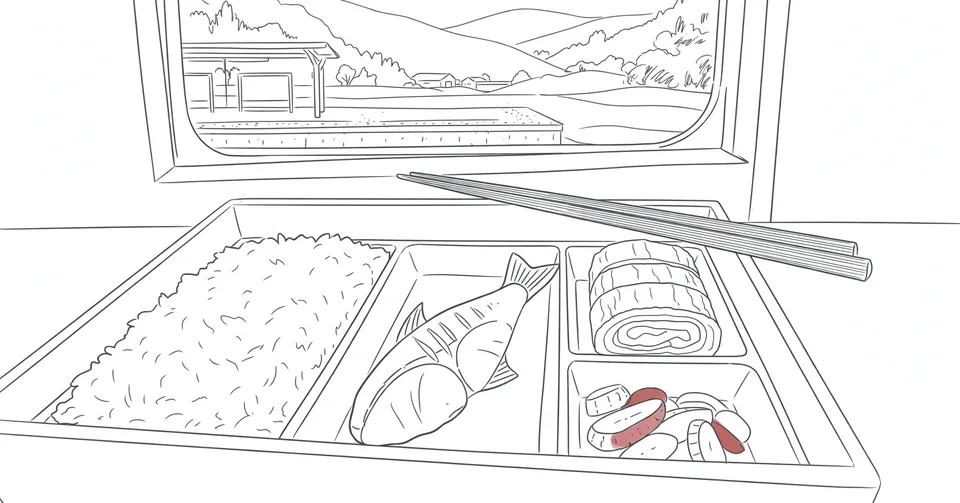
The first boxed station meal was sold long before anyone called it an ekiben, and the idea behind it has barely changed in 140 years. A train journey used to be long, slow and hungry work. The ekiben solved the hunger, and somewhere along the way it became a pleasure in its own right. This is the story of how a practical packed lunch became a national institution, and how to enjoy one properly the next time you ride a Japanese train.
The first box sold on a platform
The most widely accepted origin of the ekiben dates to 16 July 1885, at Utsunomiya Station in Tochigi Prefecture. The railway line had just linked Utsunomiya to Ueno Station in Tokyo, and passengers faced a long ride with no food on board. A local inn called Shirakiya began selling a simple parcel to travellers on the platform: two rice balls filled with pickled plum, a few slices of pickled daikon radish, all wrapped in bamboo leaves. It cost five sen, a tiny sum even then, and it sold.
The idea spread quickly. Within a few years, stations across the country were selling their own versions. In 1888, Himeji Station began selling what is often described as the first standard boxed station meal, a box of rice with several small side dishes in the makunouchi style, the format borrowed from the boxed meals served between acts at kabuki theatres. The makunouchi layout, rice in one compartment and a handful of small dishes beside it, became the template that most ekiben still follow today.
There was a practical reason the station lunch took off so fast. Early trains had no dining cars, stops were short, and the food sold on platforms had to survive a journey without refrigeration. Rice, pickled vegetables, grilled fish and simmered dishes kept well at room temperature, and a wooden box protected them better than paper. What began as a solution to a logistics problem turned out to be a very good way to eat.
What goes inside an ekiben
A classic box follows a simple structure. Rice fills the largest compartment, usually white rice, sometimes rice cooked with chestnuts, mushrooms or bamboo shoots in the local style. Beside it sit the side dishes: a piece of grilled or simmered fish, a rolled omelette called tamagoyaki, some simmered vegetables, and pickles to cut through the richness. A pair of disposable chopsticks is tucked under the lid or taped to the side, and the whole box is wrapped in a paper sleeve, often printed with a picture of the local scenery.
What makes a station bento different from an ordinary bento is that the contents are local by design. A station in a fishing town fills its box with the morning catch. A mountain town uses mushrooms, river fish and wild vegetables. A famous beef-producing region puts its best-known cut on top of the rice. The box is, in effect, a short introduction to the place you are passing through, written in food. That is why travellers collect them. Some people plan entire journeys around which box they will eat at which station.
The packaging is part of the appeal too. Some boxes come in plain lacquered wood, others are shaped like local landmarks, trains or animals. The most famous example is the kamameshi ekiben from Yokokawa Station in Gunma, served in a small Mashiko pottery pot that passengers keep as a souvenir. The pot is the point as much as the food, and many Japanese households have a shelf of old ekiben containers collected over years of travel.
Prices are modest. Most boxes cost between 800 and 1,500 yen, with elaborate versions, often featuring wagyu beef or crab, reaching around 2,000 yen. For the quality and the quantity, that is good value, and it is one reason the station lunch has survived as a working lunch rather than becoming a tourist novelty. Commuters buy them, families buy them for weekend trips, and tourists buy them because they are told to. Everyone eats the same box.
The golden age of the ekiben
The station bento reached its peak in the decades after the Second World War. As Japan rebuilt and rail travel boomed, the station lunch boomed with it. A television drama in the 1970s, Ekiben Hitoritabi, about a traveller touring the country to taste each region's boxed meal, pushed the craze further. At its height in the mid-1980s, an estimated twelve million boxes were eaten every day across Japan. The station kiosk was, for a while, one of the busiest food counters in the country.
Then the decline came, and it came from two directions at once. Trains got faster, so journeys got shorter and there was less time, and less need, to eat on board. Air travel got cheaper, pulling long-distance travellers off the rails entirely. The number of station bento makers fell by half between 1987 and 2008, and many small stations stopped selling their local box altogether. The ekiben, it seemed, was a relic of the slow-train era, and the slow-train era was ending.
But the tradition did not die. It shrank, and then it found a new audience. Domestic tourists began treating the ekiben as a destination in itself, and speciality shops appeared in the biggest stations. The most famous is Ekibenya Matsuri, inside Tokyo Station, which stocks more than 170 varieties from all over Japan under one roof. A traveller who never leaves Tokyo can now eat the boxed lunch of Hokkaido, Kyushu and everywhere in between, and the shop is busy every day. Today there are around two thousand varieties of ekiben sold across Japan, and the tradition that looked finished in the 1990s is, quietly, healthy again.
Famous ekiben worth planning a trip around
Some ekiben are so well known that they are worth a detour. A few of the classics, and the stations where they began, are listed here. If you ever find yourself near one of these stations, the box is the reason to stop.
| Ekiben | Station | What is inside |
|---|---|---|
| Toge no Kamameshi | Yokokawa, Gunma | Rice and chicken cooked in a keepsake pottery pot, sold since 1958 |
| Ikameshi | Mori, Hokkaido | Squid stuffed with sticky rice, simmered in a sweet soy sauce |
| Gyutan Bento | Sendai, Miyagi | Grilled beef tongue over barley rice, a Sendai speciality |
| Masu no Sushi | Toyama | Trout sushi pressed in a round wooden box, a Toyama classic |
| Matsusaka Beef Bento | Matsusaka, Mie | Slices of prized Matsusaka wagyu over rice |
Each of these boxes tells you something true about its home town. Toyama's trout comes from its rivers. Sendai's beef tongue became famous because the city turned an offcut into a delicacy after the war. Mori's squid is the catch of the bay outside the station. Eating the box is the fastest way to understand the place, faster than any guidebook, and it costs about the price of a sandwich.
The list is also a reminder that the ekiben is not one dish but a format. The same idea, a local meal in a portable box, produces completely different results in different regions. That variety is the whole point, and it is why no two ekiben lovers will ever agree on which one is best.
How to buy and eat an ekiben like a local
Buying an ekiben is easy, but a little timing helps. The best boxes sell out, and they sell out early, often before noon on weekends and holidays. If you have a specific box in mind, buy it before you board, not at the station where the train stops for two minutes. At large stations, the ekiben shops are usually near the Shinkansen gates, clearly signed, and the boxes are displayed like a small exhibition, which is half the fun.
Eat it on the train, not on the platform. On a Shinkansen or a limited express, eating at your seat is normal and expected. On a crowded commuter train, it is not, so save the box for a long-distance ride. Most ekiben are designed to be eaten at room temperature, which is why they travel so well, and a few come with a small chemical heater that warms the box when you pull a string. If yours has one, follow the pictures on the lid. They are usually self-explanatory.
A few points of etiquette are worth knowing. Keep strong smells in mind if the carriage is full, though an ekiben is rarely a problem. Take all the packaging with you when you leave the train, including the box and the chopsticks, and use the rubbish bins on the platform. And if the train has a tray table, use it. Eating an ekiben balanced on your knees is possible but it is not the experience the makers had in mind.
It is also worth remembering that the ekiben pairs naturally with a drink from the station. A can of local beer, a bottle of cold tea, or a small carton of sake turns the box into a small celebration. Japan's trains allow drinking on long-distance services, and the combination of a boxed local meal and a local drink, eaten while the landscape slides past the window, is one of the quiet pleasures of travelling in Japan. The Suica card will get you through the gates and onto the train, and the bullet train will get you there fast, but it is the ekiben that makes the journey feel like Japan.
Why the ekiben still matters
I have eaten ekiben on trains for years, and the thing that keeps me coming back is not the food alone, good as it often is. It is the way the box slows the journey down without stopping it. A train can make a landscape feel like a film, something you watch through glass. An ekiben breaks the glass. You taste the place you are passing through, you handle something made by people who live there, and for twenty minutes the journey has a flavour as well as a view.
That is also why the ekiben survived its decline. Japan has no shortage of fast food, and a convenience store lunch is cheaper and easier to find. The convenience store will always win on convenience. But the ekiben was never really competing on convenience. It was competing on meaning, and meaning is the one thing a faster train cannot provide. The box says: this place has its own food, its own history, and it is worth your attention for one meal.
There is a practical lesson in that for travellers too. The best way to understand a country is rarely the fastest way. The bullet train will take you from Tokyo to Osaka in two and a half hours, and the journey will be comfortable and forgettable. The same journey with an ekiben from Tokyo Station, eaten slowly while Mount Fuji appears and disappears outside the window, is a memory. The train is the same. The box is the difference.
So the next time you ride a long-distance train in Japan, arrive a little early and look for the ekiben shop. Buy the box that belongs to the place you are leaving, or the one from the place you are going to, and eat it at your seat as the stations roll past. You will spend about a thousand yen. In return you will get lunch, a souvenir, and a small taste of somewhere you might never have stopped to notice. That is a very good deal for a boxed meal, and it is why, after 140 years, the ekiben is still waiting on the platform.
More in Food & Travel
- Natto, the Sticky Fermented Beans Japan Loves and Visitors Fear
- Base Genep Seasons Every Balinese Feast From the Mortar Up
- Sambal Matah Wakes Up Every Balinese Plate Raw
- Sate Lilit Wraps Bali's Feast Around a Lemongrass Stick
- Babi Guling Turns a Whole Pig Into a Balinese Feast
- Lawar Is the Dish Bali Serves When the Whole Village Eats
Latest posts
- A Torii Gate Marks Where the Ordinary World Ends
- The Yumi Stands Taller Than Its Archer
- Kyudo Turns Archery Into a Moving Meditation
- Iaido Is the Art of Drawing the Sword Before the Fight Begins
- Pancawara Gives Bali a Five Day Week That Never Stops Turning
- Hanami Turns Cherry Blossom Season Into Japan's Longest Picnic
- Bogu Is the Armour That Lets Kendo Strike at Full Speed
- Ema Lets You Hang a Wish Where the Kami Can Read It
- Bonsai and the Thousand-Year Art of Tiny Trees
- The Shinai Is a Bamboo Sword That Teaches Before It Strikes
- Omikuji Tells Your Fortune on a Slip of Paper
- Japan Meets the New Year at Hatsumode
- The Way of the Sword Lives On in Kendo
- Hakama Turn a Kimono Into Ceremony
- A Haori Is the Jacket That Turns a Kimono Formal