Temizuya Is Where Every Shrine Visit Begins With Water
· 12 min read
A temizuya is the water pavilion at the entrance of a Shinto shrine, where visitors rinse their hands and mouth before approaching the kami, and learning its small ritual changes how a shrine visit feels.
Before the offering box, before the bell, before the two bows and two claps, there is water. Every shrine visit in Japan begins the same way, at a small roofed pavilion near the entrance where a stone basin waits under a trickle of clear water. It is called a temizuya, and it is the first thing a shrine asks of you. Not a prayer, not a coin, not a belief. Just clean hands and a rinsed mouth, offered before you walk any further into sacred ground.
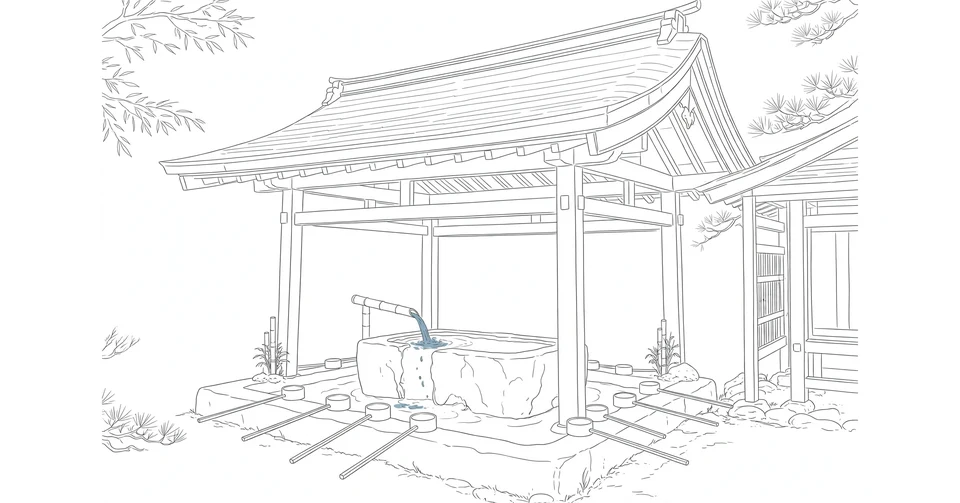
A temizuya looks simple, and that is the point. A low roof on wooden posts, a stone basin filled with running water, and a row of long handled ladles resting across the rim. You will find one at almost every shrine in Japan, from the great shrines of Kyoto and Tokyo to the tiny neighbourhood shrine squeezed between houses and shops. The ritual performed there is called temizu, and it takes less than a minute. What it does to a visit, though, lasts much longer than a minute.
The first time I watched a temizuya in use, I expected something formal and slow. Instead I saw a grandmother show her grandson the order of the hands, a salaryman rinse quickly on his way to the hall, and a tourist copy the person ahead of her and get it almost right. Nobody was watching for mistakes. The water was doing what it has always done, giving each person a small pause between the street and the sacred.
What a temizuya is for
Shinto is built on the idea that the world is full of kami, spirits that live in wind and rain, in mountains and rivers, in trees and in people who lived remarkable lives. The Japan Guide page on Shinto puts the purpose of most Shinto rituals plainly, to keep away evil spirits by purification, prayers and offerings to the kami, and purification comes first. You can read that background in full at Japan Guide's introduction to Shinto. The concept behind the water is called harae, ritual purification, and its older and stricter cousin is misogi, the full bathing in cold running water that ascetics still practise. Temizu is the gentle everyday version of misogi, shortened for ordinary visitors, and the temizuya is where it happens.
The important thing to understand is that this impurity is not sin. Shinto does not teach that people are born stained, and there is no confession waiting at the end of the path. Impurity in Shinto is closer to dust. It is the tiredness, the noise, the small grime of ordinary life that gathers on you as you move through the world. A temizuya does not forgive you. It rinses you. That difference is why the ritual feels light rather than heavy, and why it works even for visitors who arrive with no belief at all.
A text written for Sumiyoshi Taisha in Osaka, quoted by the Japan Tourism Agency, explains where the custom comes from. In ancient times, worshippers would bathe in a river or the ocean, but today a rinse of the hands and mouth will suffice. The shrine moved the river to the entrance, shrank it into a basin, and kept the meaning intact. I find that practical in a way that suits Japan. The sacred is not made distant and difficult. It is made small enough to fit into a minute of your morning.
The temizu ritual, step by step
The ritual has a fixed order, and the order is the whole point. The method set out in this detailed guide to shrine etiquette follows Jinja Honcho, the Association of Shinto Shrines, and the official pages of Ise Jingu, and the steps are the same at almost every shrine in Japan.
- Scoop. Using your right hand, fill the ladle from the basin.
- Left hand. Rinse your left hand with a little of the water.
- Right hand. Change hands and wash your right hand the same way.
- Mouth. Take the ladle back in your right hand, pour a little water into your cupped left palm, and rinse your mouth from your palm, never from the ladle.
- Spit it out. Let the water fall quietly to the ground or the drain beside the basin, not back into it.
- Left hand again. Rinse the hand that touched your mouth once more.
- Clean the handle. Stand the ladle upright so the remaining water drains down the handle, and put it back where you found it.
You do not refill the ladle between steps. One scoop is meant to cover the whole ritual, which is why the movements are quick and economical rather than a proper wash. The water is for your hands and your mouth, and only for those. Do not drink from the ladle, do not put coins in the basin, and do not spit the water back into it. Spit quietly beside the basin, at its base, and rinse your left hand once more after your mouth has touched it. The last movement is a small courtesy to the next person. Tip the ladle upright so the remaining water runs down the handle, then set it back where you found it.
A sign at Meiji Jingu adds that everyone, regardless of faith, is welcome to take part. That welcome matters, because the temizuya is the most democratic part of a shrine. You do not need to know the prayers, the claps, or the correct offering. You only need to know the order of the hands. If you are unsure, watch the person ahead of you for ten seconds, then copy them. The ritual is designed to be learned by watching, and the shrine expects you to learn it that way.
Stone, wood, and a dragon
The pavilion itself is worth a look before you pick up a ladle. A temizuya is usually an open structure, four wooden posts holding a low roof of tile or thatch, built to shelter the basin from rain and falling leaves. The basin, called a chozubachi, is carved from a single block of stone, often granite, and the water inside it is always running, fed by a spring or a pipe, never still. The ladles, called hishaku, are made of bamboo or wood, with a long handle and a small cup, and they rest in a row across the rim of the basin or on bamboo poles laid over it.
At many shrines the water arrives through the open mouth of a bronze dragon. The dragon is a guardian of water in the traditions Japan inherited from China, and its image at the basin is both decoration and reminder. The water is not tap water in a trough. It is a gift that passes through a sacred animal on its way to your hands. Some temizuya use a bamboo pipe instead, and some small shrines have no spout at all, just a basin fed quietly from below. The form changes. The function does not.
Size follows the shrine. A great shrine may have a temizuya large enough for a dozen visitors at once, with a roof that echoes the main hall. A neighbourhood shrine may have a single basin under a simple shelter, or even just a stone trough by the path. The smallest ones are often the most charming, because nothing about them is built for show. The roof exists so the water stays clean. The posts exist to hold the roof. Everything else is patience.
I have come to think the architecture is the lesson. Nothing at a temizuya is grand, and nothing is hidden. The roof, the stone, the dragon, the ladles, all of it is out in the open, doing one job. It is the opposite of a monument. A monument asks you to look up. A temizuya asks you to look down, at your own hands, and to take responsibility for them before you ask anything of the kami.
Temizuya worth stopping for
If you want to see a temizuya at its most alive, go to Meiji Jingu in Tokyo. The shrine stands in a forest in the middle of the city, dedicated to Emperor Meiji and Empress Shoken, and its temizuya serves a constant stream of visitors. At New Year the queue at the basin stretches back along the gravel approach, and the ritual becomes a slow moving river of people, each one rinsing, bowing slightly, and moving on. Jinja Honcho says that about 80 percent of the population visits a shrine at New Year, a custom called hatsumode, and you can read how that first visit of the year unfolds in Japan Meets the New Year at Hatsumode.
At the other end of the scale is Ise Jingu, the most sacred shrine in Shinto. Worshippers at the Inner Shrine still use the traditional form of ablution, purifying themselves at a spring or stream rather than at a basin, keeping alive the practice from which the temizuya descends. Standing there, you understand that the pavilion is a convenience, not the custom itself. The custom is water, and the pavilion is only the place where the shrine keeps it.
In recent years a gentler variation has spread across Japan. Some shrines fill the basin with seasonal flowers, a practice called hanachozu, turning the water into a floating garden of camellias in winter or hydrangeas in the rainy season. The flowers are an offering, and they are also an invitation. A basin full of flowers is hard to walk past without stopping, and stopping is the whole point. During the pandemic many shrines removed their ladles and replaced the running water with hand sanitiser, and most have since restored the temizuya to full use. The flowers, though, stayed.
The same water at a temple
A temizuya is not only a shrine fixture. Many Buddhist temples in Japan have one too, and the ritual there is the same. Rinse the hands, rinse the mouth, rinse the hands again. The water does not change its job when the religion changes. What changes is what happens next. At a temple you put your hands together and pray in silence. There is no clapping, and where incense is sold you light a stick and let its smoke wash over you, a different kind of purification for a different kind of prayer.
The difference tells you something about the two traditions. Shinto treats impurity as something to wash away with water before you approach the kami. Buddhism treats suffering as something to understand, and its purification leans on incense, chanting, and the stillness of joined hands. Japan Guide notes that death is considered a source of impurity in Shinto and is left to Buddhism to deal with, which is why there are almost no Shinto cemeteries and most funerals are held in Buddhist style. The two faiths divide the work of a human life between them, and the temizuya sits on the Shinto side of that line, at the gate, before anything else begins.
Mistakes visitors make at the temizuya
The mistakes are small, and they are all forgivable, but they are worth knowing. The most common is putting the ladle to your lips. The ladle is shared, and the rule is simple. Water goes into your cupped palm first, and your palm carries it to your mouth. A second mistake is spitting the water back into the basin, which spoils the water for everyone behind you. A third is dropping coins into the basin, as if it were a wishing well. Coins belong in the offering box at the hall. A fourth is treating the basin as a place to wash your face, rinse a water bottle, or cool your hands on a hot day. The water is for the ritual and nothing else.
The last mistake is not about the water at all. It is about time. At a busy shrine, the temizuya can draw a queue, and the temptation is to hurry through the steps or to linger and take photographs while people wait behind you. The ritual takes less than a minute when you know it. Learn the order before you travel, move through it calmly, and step aside when you are done. The pause the temizuya gives you is a gift. Taking too much of it is the one way to spoil it for someone else.
Why a minute of water matters
I used to think of the temizuya as a formality, a piece of etiquette to get right before the real visit started. I have changed my mind. The visit starts at the water. Everything after it, the walk down the gravel path, the bow at the hall, the clap and the quiet prayer, happens on the other side of that rinse. The thick straw rope called a shimenawa marks the boundary of sacred ground, and you can read how that rope works in Shimenawa Marks the Line Between Ordinary and Sacred, but the temizuya is where you cross that boundary with your body rather than your eyes.
There is also something quietly radical about a ritual that asks so little and gives so much. No fee, no ticket, no test of belief. A stranger can walk in off a Tokyo street, rinse their hands beside a salaryman and a schoolchild, and arrive at the hall a little calmer than they were on the pavement. The water does not care who you are or what you believe. It only asks that you pause, and that you leave the dust of the street behind you. That is a small thing. It is also, I think, the whole of it.
More in Culture & Society
- The Gohei Wand Carries the Kami Into the Ceremony
- Origami and How a Single Sheet of Paper Became Japan's Quiet Art
- A Hishaku Is the Bamboo Ladle That Starts Every Shrine Visit
- A Kitsune Is the Fox Messenger Who Guards the Shrines of Japan
- Shide Are the Paper Lightning That Marks a Sacred Space
- Yabusame Turns Horseback Archery Into a Moving Prayer
Latest posts
- Kitsune Udon Is the Bowl the Fox Would Order
- Tokyo Disneyland and Why Japan Loves It Differently
- Walking Through Senbon Torii Feels Like Entering Another World
- Onigiri, Japan's Two-Thousand-Year-Old Portable Meal
- Roro Jonggrang and the Thousand Temples Built in One Night
- Ten Thousand Vermilion Gates Lead Up Fushimi Inari
- Prambanan Towers Over Java With a Love Story in Stone
- Shimenawa Marks the Line Between Ordinary and Sacred
- A Torii Gate Marks Where the Ordinary World Ends
- The Yumi Stands Taller Than Its Archer
- Ekiben, the Train Station Bento That Turns a Journey into a Meal
- Kyudo Turns Archery Into a Moving Meditation
- Iaido Is the Art of Drawing the Sword Before the Fight Begins
- Natto, the Sticky Fermented Beans Japan Loves and Visitors Fear
- Pancawara Gives Bali a Five Day Week That Never Stops Turning