Shide Are the Paper Lightning That Marks a Sacred Space
· 15 min read
Shide are zigzag paper streamers that mark sacred space in Japan, and learning to spot them changes how every shrine reads.
Walk through the gate of almost any shrine in Japan and you will notice something fluttering above you. White paper, cut into sharp zigzags, hangs from the thick straw rope stretched across the entrance, or from a wooden wand in a priest's hand. That paper has a name, and once you learn it, you will start seeing it everywhere. It is called shide, and it is one of the smallest and most eloquent objects in Japanese ritual life.
A shide is a streamer of white paper, folded and cut into a zigzag shape. It hangs from a shimenawa rope, from a branch of sacred sakaki, or from a ritual wand, and wherever it hangs it carries the same message. This place, this object, this moment has been set apart. The paper is ordinary, the kind of material you could hold in one hand, and that ordinariness is part of the point. Shinto does not need gold to mark the sacred. A strip of folded paper will do, and that is what the paper does.
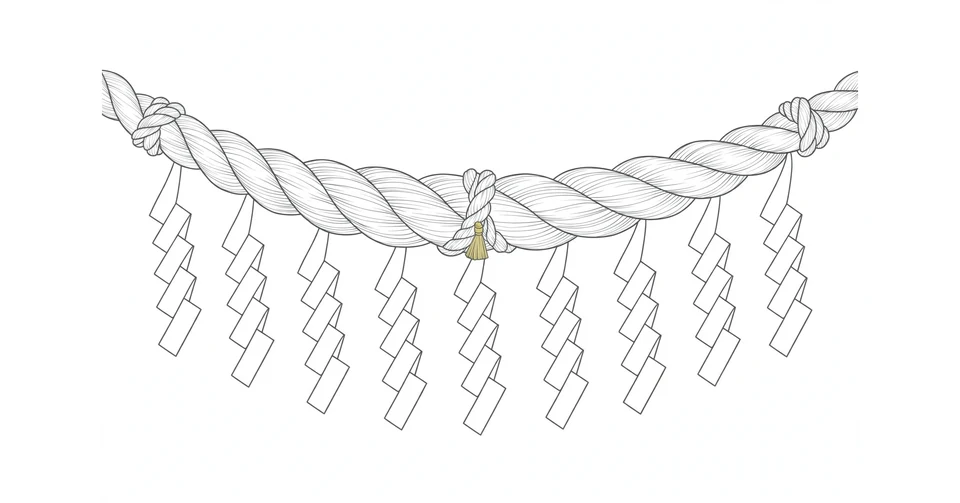
The first thing to understand about shide is that they are not decoration in the way a visitor might assume. They do not exist to make a shrine prettier, though they do make it more beautiful. A shide is a sign, and like any good sign it works quietly. It tells you that a boundary has been drawn and that the space on the other side of it has been purified. A space marked with shide has been formally purified, and the more of them you see, the more carefully the space has been prepared.
There is a second thing worth noticing, which is how little the object asks of you. It does not demand belief. It does not block your path. It hangs in the wind and waits for you to notice it. I think that is a generous way for a religion to speak. Instead of a wall or a locked door, you get a strip of paper that trusts you to slow down and pay attention.
What a shide is made of
A shide is usually made from washi, the strong white handmade paper used for many Shinto ritual items. Washi is tough for its weight, which matters for something that must hang outdoors and keep its shape in wind and rain. The paper is white, and the colour is part of the meaning. In Shinto, white conveys purity, and the shide carries that purity into the open air where everyone can see it.
Paper was not always the material. Before paper was widely available in Japan, early versions of shide were made from the bark fibres of the paper mulberry tree. These early forms were called yushide, and they used a rough cloth woven from the bast fibres of the tree. Over time, as paper became more available and easier to fold, paper replaced bark. The change happened during the Heian period, which ran from 794 to 1185, and the folding techniques developed in that era turned into styles you still see at shrines today. The material changed, but the meaning stayed the same.
That history matters because it shows how practical Shinto can be. When a better material came along, the tradition adopted it without losing the idea. One made of bark and one made of paper are doing the same job, and nobody at a shrine today would treat one as more sacred than the other. The sacredness lives in the act of marking, not in the rarity of the material.
A single shide is a modest thing. Typical examples measure about 20 to 30 centimetres long and 3 to 5 centimetres wide, small enough to fit in the palm of your hand. But they are rarely seen alone. They hang in rows along a rope, or in clusters on a wand, and the effect of many small white zigzags moving together is much larger than any one streamer. It is a reminder that ritual objects in Japan often work in groups. One streamer is a note. A row of them is a sentence.
Why the zigzag shape matters
The most common explanation for the zigzag shape is that it suggests lightning. In Shinto, lightning is associated with rain, agricultural fertility, and the awe inspiring power of the kami, the spirits at the heart of the tradition. A bolt of lightning is sudden, bright, and impossible to ignore, and the folded paper borrows that energy in miniature. When you see a shide, you are looking at a small, quiet version of a force that farmers once watched in the sky and prayed would bring rain to their fields.
It is worth knowing that this is a popular reading rather than a proven origin. Some writers on Shinto ritual caution that the lightning comparison is a modern interpretation, and that the shape may simply be the most practical way to make a strip of paper visible, audible, and alive in the wind. I find that honesty refreshing rather than disappointing. A symbol does not need a single settled origin to do its work. The zigzag reads as lightning to many people, and that reading has become part of the meaning, whether or not it was the original intent.
The shape also does something practical. The folds catch the wind, so the paper moves even in a light breeze, and the movement makes the boundary it marks impossible to miss. When a priest waves a wand hung with shide, the paper makes a dry rustling sound, and that sound is believed to sweep away impurity. The shide works on the eyes and the ears at once. It is a sign you can see from across a courtyard and a sound you can hear in a quiet hall.
There is also a small numerical custom worth knowing. On a shimenawa rope, shide are traditionally hung in odd numbers, for a sacred reason that shrine tradition treats as important even when it does not explain it in detail. You do not need to count them to appreciate the rope, but knowing the rule changes how you look. The next time you stand under a great rope, count the white zigzags. The pattern is deliberate, and it has been deliberate for a very long time.
How shide are folded
Making one is a craft that anyone can learn, and that is part of its charm. The basic method is simple enough to describe in a few steps. A strip of paper is cut to about 25 centimetres long and 4 centimetres wide, then folded lengthways to double its thickness. Along both long edges, cuts are made every centimetre and a half, each cut reaching about two thirds of the way across, alternating from one side to the other. Then the strip is folded down and behind, again and again, until the whole length has become a zigzag.
The folding is usually done with clean hands and a clear mind, and some guides advise preparing yourself before you begin, washing your hands and settling your thoughts. That may sound like a small detail, but it fits the logic of the object. A shide is a marker of purity, so it makes sense to approach the making of one in a pure state of mind. The craft is not difficult, but it is not careless either.
Different shrine traditions fold them in slightly different patterns, and the variations are part of what makes the object interesting to study. Some are folded with two points, some with four, some with eight, and each pattern belongs to a particular school or shrine. You do not need to memorise the patterns to enjoy them. It is enough to know that the zigzag you see at one shrine may not be identical to the one you see at another, and that the difference is a signature, not a mistake.
Shide are not meant to last forever. They are believed to collect impurities over time, so they are replaced regularly, and old ones are disposed of respectfully, usually burned or returned to nature. This is the same logic that governs the straw rope they hang from. Nothing in this system is built to be permanent. The paper frays, the straw weathers, and the community renews them by hand. I think there is something deeply sane about a sacred object that admits it wears out. It asks for maintenance rather than worship of the object itself, and that keeps the attention on what the object points to rather than on the object.
Where you will see shide
The most common place to see shide is on a shimenawa, the twisted straw rope that marks sacred space in Japan. The rope hangs across shrine entrances, around sacred trees, and between rocks standing in the sea, and the white paper streamers hang down from it at intervals. If you want to understand the rope itself, it helps to know that a shimenawa marks the line between ordinary and sacred, and the shide are what make that line visible. Straw says this place is set apart. Paper says it has been purified.
You will also see them at the top of a torii gate, where the rope often stretches across the upper beam. Passing under that gate means passing from ordinary street into sacred ground, and the fluttering paper is the first thing you meet on the way in. The gate itself is worth understanding on its own terms, and a torii gate marks where the ordinary world ends, with the paper above it doing the quiet work of announcing the crossing.
Beyond the rope, shide appear on the tools of Shinto ritual. A gohei is a wooden wand with two strips of folded white paper attached to it, and it represents the presence of the kami during ceremonies. A priest holds it, offers it, or sets it in place as a sign that the kami are present in the rite. A haraigushi is a purification wand with many shide attached to the top, and a priest waves it slowly over people, objects, and spaces to cleanse them. The dry rustle of the paper is part of the purification. You will see a haraigushi used before festivals, at rites of passage, and when a new building or business is blessed.
A tamagushi is a different kind of offering, a branch of sakaki with shide attached, presented to the kami during prayers or special requests. Worshippers place it before the kami as a formal offering, and it is one of the most respectful gestures in shrine ritual. At home, sakaki branches with shide stand on many kamidana, the small household altars where families honour the kami, and many families refresh them on a regular schedule to keep the household altar pure.
During festivals, ropes hung with shide mark portable shrines, processional routes, and performance areas, so the sacred boundary travels with the celebration through the streets. A detailed guide to the paper streamers explains how they appear in all of these settings, from shrine doorways to home altars and purification wands, and a clear guide to shide in Shinto ritual covers the meanings, the materials, and the places to see them. At the great shrine of Izumo Taisha, the shide hang from the largest rope in Japan, and an account of the rope and its streamers at Izumo describes how the paper, the straw, and the bell at the centre of the rope work together to protect the boundary of the kami. The rope there represents clouds, the shide represent thunder, and the bell represents lightning, so the whole assembly is a small sky hung above the hall.
Shide at home and at the new year
The streamers are not confined to grand shrines. They belong to household worship as well, and that is where most Japanese people meet them most often. A kamidana is a small shelf altar kept in the home, and families place offerings there such as rice, salt, water, and branches of sakaki decorated with shide. The altar is tended regularly, and the branches and paper are refreshed to keep the household spiritually pure and to maintain a strong tie with the protective kami. It is a quiet, domestic version of the same logic that governs the great shrine rope. The sacred is not only somewhere you visit. It is also something you keep.
The most visible moment for shide in home life comes at the new year. A shimekazari is a small decorated rope hung above the front door, made from straw and dressed with fern fronds, pine, bitter orange, and shide. Its purpose is to prepare the home to receive Toshigami, the new year deity, and to keep the fresh purity of the new year intact. In the weeks before the new year, shimekazari appear above shop entrances, office doors, and apartment lobbies across the country, and for a few weeks the visual language of the rope and the paper saturates the city in a way that does not happen at any other point in the year.
Priests also carry the paper streamers out into daily life in a very practical way. They bless new cars, new shops, and new offices with a haraigushi, waving the paper streamers over the thing being blessed. A new car blessed in this way is not a strange sight in Japan, and it shows how the paper moves between the shrine and the street without losing its meaning. The shide does not care whether it hangs from a thousand year old shrine or from a wand waved over a family car. It only cares that something has been set apart and purified.
I find the household side of shide the most touching part of the story. It is easy to admire the great rope at Izumo Taisha and forget that the same object, folded smaller, hangs above a front door in an ordinary neighbourhood. The sacred in Japan is not kept behind a fence. It is folded into paper, hung above a doorway, and refreshed by hand when it frays. That is a religion that trusts ordinary people with sacred work, and I think that trust is worth admiring.
What to do when you meet shide
The etiquette around shide is simple, and it follows from what the paper means. Do not touch the streamers, and do not pull at them or grab them for a photograph. They are not decorations to handle, and pulling at them damages the paper and disrespects the space they mark. A shide stretched across a path or around a rock or a section of ground that is not part of the normal visitor route is a clear signal to stay outside that boundary. Streamers above an entrance are an invitation to pass through, and passing under them is completely normal.
Photography is generally permitted at most shrines, and there is no rule against photographing shide. The question is one of intent. Point your camera at the paper because you want to understand the place, not because you want a dramatic backdrop. At a small shrine with no other visitors, move more quietly and act with more care than you might at a famous tourist site. The paper will not tell you to be quiet. It will simply hang there, white and patient, and leave the decision to you.
If you are genuinely unsure how to behave, watch how local visitors behave before you move. That is good advice for almost any shrine custom, and it applies here too. People who grew up with them treat them as ordinary and sacred at the same time, which is exactly the right attitude. They do not make a fuss over the paper, and they do not ignore it either. They walk past it the way you might walk past a good neighbour, with a nod and without stopping the day.
A quiet lesson in noticing paper
A shide is, in the end, a very small thing. It is a strip of paper, folded by hand, hung from a rope or a wand, and left to move in the wind. It will fray. It will fade. It will be taken down and burned, and a new one will be folded in its place. Nothing about it is built to impress you, and that is precisely why it stays with you once you have learned to see it.
What I take from shide is a lesson about how little it takes to mark something as mattering. We tend to assume that importance needs size, expense, or permanence, and that a boundary needs a wall. Japan has spent centuries proving the opposite with a strip of white paper. A boundary can be a zigzag. A purification can be a rustle. A sacred space can be announced by something so light that a breeze moves it.
The next time you walk through a shrine in Japan, look up before you look ahead. Find the rope, find the white paper hanging from it, and notice where it asks you to pause. The line it draws is thin, and it is made of paper, and it has outlasted empires. That is worth a moment of your attention, and the paper will still be there, fluttering quietly, when you give it one.
More in Culture & Society
- The Gohei Wand Carries the Kami Into the Ceremony
- Origami and How a Single Sheet of Paper Became Japan's Quiet Art
- A Hishaku Is the Bamboo Ladle That Starts Every Shrine Visit
- A Kitsune Is the Fox Messenger Who Guards the Shrines of Japan
- Temizuya Is Where Every Shrine Visit Begins With Water
- Yabusame Turns Horseback Archery Into a Moving Prayer
Latest posts
- Kitsune Udon Is the Bowl the Fox Would Order
- Tokyo Disneyland and Why Japan Loves It Differently
- Walking Through Senbon Torii Feels Like Entering Another World
- Onigiri, Japan's Two-Thousand-Year-Old Portable Meal
- Roro Jonggrang and the Thousand Temples Built in One Night
- Ten Thousand Vermilion Gates Lead Up Fushimi Inari
- Prambanan Towers Over Java With a Love Story in Stone
- Shimenawa Marks the Line Between Ordinary and Sacred
- A Torii Gate Marks Where the Ordinary World Ends
- The Yumi Stands Taller Than Its Archer
- Ekiben, the Train Station Bento That Turns a Journey into a Meal
- Kyudo Turns Archery Into a Moving Meditation
- Iaido Is the Art of Drawing the Sword Before the Fight Begins
- Natto, the Sticky Fermented Beans Japan Loves and Visitors Fear
- Pancawara Gives Bali a Five Day Week That Never Stops Turning