Prambanan Towers Over Java With a Love Story in Stone
· 15 min read
Prambanan is Java's tallest Hindu temple, a 47 metre tower built for Shiva, and its stones still tell the love story of Roro Jonggrang.
Stand on the flat plain east of Yogyakarta as the afternoon light turns gold, and the first thing you notice is how the towers refuse to blend in. Prambanan rises out of rice fields and low rooftops like a range of stone mountains, its tallest spire reaching 47 metres into a sky that seems built to frame it. It is the largest Hindu temple in Indonesia, and it has been standing, falling, and rising again for more than eleven centuries.
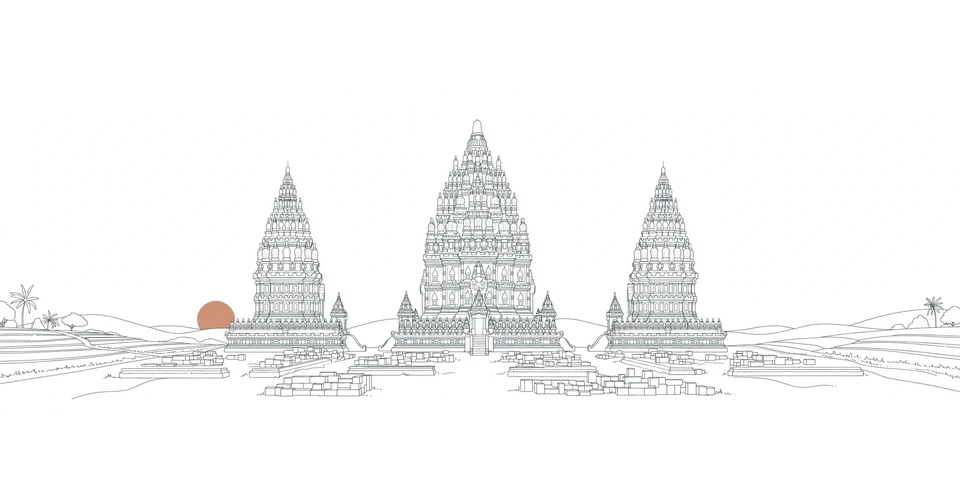
The temple is older than most countries on a modern map. Builders raised Prambanan around 850 CE, when the Hindu kings of the Mataram kingdom ruled central Java, and they dedicated it to the three great gods of Hinduism, Brahma the creator, Vishnu the preserver, and Shiva the destroyer. UNESCO added the compound to the World Heritage List in 1991, and it remains the second largest Hindu temple site in Southeast Asia, after Angkor Wat.
Yet ask an Indonesian about Prambanan and the answer rarely starts with dates or dynasties. It starts with a princess who was turned to stone. The temple is a love story, a royal statement, and a ruin that refused to stay ruined, all at once, and that is why it still draws crowds more than a thousand years after the first stones were set in place.
Prambanan rises above the plain
Prambanan sits about 17 kilometres northeast of Yogyakarta, on the boundary between the Special Region of Yogyakarta and Central Java province. The Opak River runs along its western side, and the volcano Merapi looms to the north, a reminder that this whole plain was shaped by fire as much as by faith. On a clear morning you can see the towers from the main road long before you reach the gate, and the sight still stops first time visitors in their tracks.
The scale of Prambanan is hard to grasp until you walk it. The original compound held 240 temples, arranged in three walled zones in the shape of a mandala, a sacred diagram in stone. The innermost zone is the holiest ground, a raised platform with eight main shrines and eight small shrines. Around it, in four concentric rows, stood 224 small pervara shrines, like a crowd gathered around a king. Today only six of those 224 small shrines at Prambanan have been fully rebuilt. The rest survive as foundations and scattered blocks, and the empty rows are part of the experience. They show you how much was lost, and how much work it takes to bring even a little of it back.
That incompleteness is worth sitting with. Many famous monuments present themselves as finished, as if history had been kind to them. Prambanan does not pretend. The broken rows and the restored towers stand side by side, and the contrast is honest. A place that admits what it lost earns more trust than a place that hides it, and the stones here have nothing to hide.
A temple built for three gods
The heart of Prambanan is the Trimurti, the three forms of God in Hindu belief. Three great temples stand in a row, and the Shiva temple in the middle towers over the other two. It measures 47 metres tall and 34 metres wide, and it was the tallest building of its time in Java. The Brahma and Vishnu temples beside it each rise 33 metres. In front of the three stand smaller temples for the gods' mounts, Nandi the bull for Shiva, Garuda the eagle for Vishnu, and Hamsa the goose for Brahma.
Inside the Shiva temple at Prambanan, five chambers hold five statues. The central chamber holds a three metre statue of Shiva Mahadeva, the supreme god, four armed and crowned, standing on a lotus pedestal. The smaller chambers hold his family and companions. Ganesha, his elephant headed son, sits in the west chamber. The sage Agastya occupies the south chamber. In the north chamber stands Durga Mahisasuramardini, the goddess Durga as the slayer of the buffalo demon, and it is her statue that the legend of Roro Jonggrang claims as the princess herself.
Prambanan was not built in a single reign. Work likely began under King Rakai Pikatan around 850 CE, and the Shiva temple was inaugurated by his successor, King Lokapala. The Shivagrha inscription of 856 CE, issued by Lokapala, describes the compound and gives it its original name, Shiva-grha, the House of Shiva. A short inscription bearing the name Pikatan was even found painted on one of the finials at the top of the Shiva temple, a small signature left by the king who started it all.
Historians read Prambanan as a political statement as much as a religious one. The Buddhist Sailendra dynasty had raised Borobudur and the Sewu temple nearby, and Prambanan answered them in stone, marking the return of the Hindu Sanjaya dynasty to power and a shift in royal patronage from Mahayana Buddhism to Shaivite Hinduism. Two faiths built their greatest monuments within sight of each other on the same plain, and both still stand. That is worth remembering in any age when people claim that different faiths cannot share ground. The plain of Prambanan proves they already did, more than a thousand years ago. The full history of the compound, from its construction to its long restoration, is recorded in detail on Wikipedia.
The night of a thousand temples
Long after Prambanan was abandoned, the people of the surrounding villages told their own story about how it came to be, and that story is now inseparable from the stones. It is the legend of Roro Jonggrang, the slender maiden, and it is one of the best loved folktales in Indonesia, taught in schools and retold to children across Java.
Roro Jonggrang was the daughter of King Boko, whose kingdom was conquered by the warrior prince Bandung Bondowoso. Bandung fell in love with her and asked her to marry him. She refused him, but he would not accept the refusal, so she set him a condition she believed was impossible. First he must build a well, Jalatunda, and then he must build one thousand temples in a single night, finished before the first rooster crowed at dawn.
Bandung agreed. He finished the well, then called on an army of spirits from the earth, and temple after temple rose from the plain through the night. By the small hours he had built 999 temples and had started work on the last one. Roro Jonggrang saw that she was about to lose, so she woke the village women and told them to pound rice and light fires to the east, faking the signs of dawn. The spirits believed the sun was rising and fled back into the darkness, leaving the thousandth temple unfinished.
When Bandung discovered the trick, his fury was terrible. He cursed Roro Jonggrang to become the thousandth statue herself, and she turned to stone on the spot. According to the legend, she is the statue of Durga that still stands in the north chamber of the Shiva temple today, and the whole complex is still known locally as Candi Roro Jonggrang, the temple of the slender virgin.
The story is a folktale, not history. Scholars date the legend itself to a much later period than the temple, probably the era of the Mataram Sultanate, and the statue is a ninth century carving of the goddess Durga, not a petrified princess. But that misses the point of the tale. The legend explains the ruins to people who had no written history of them, and it ties three sites together, the palace of Ratu Boko, the Sewu temple whose name means thousands, and the Durga statue at Prambanan, into one sweeping story. Sewu itself holds only 249 temples, despite a name that promises a thousand, which fits the legend beautifully.
There is also a warning in the tale that still holds. Bandung made a promise he could not keep honestly, and Roro Jonggrang answered a dishonest demand with a trick of her own. Both of them cheated, and both of them paid for it. Prambanan stands as the result of that mutual failure, a thousand temples that were almost finished, and a princess who almost escaped. Love that begins with conquest and ends with a curse was never love at all, and the stones have been saying so for centuries. Some visitors still believe that unmarried couples who enter the Durga chamber together risk their relationship, a folk belief the temple authorities treat as cultural heritage rather than fact, but which shows how deeply the story still lives in the place.
The Ramayana, carved in stone and danced at dusk
Walk around the Shiva temple at Prambanan at ground level and the story of the Ramayana unfolds in carved panels along the balustrade, 432 of them, running continuously around the temple and continuing onto the Brahma temple beside it. Visitors who want to follow the story properly enter from the east and walk clockwise, letting the tale unroll panel by panel. It is one of the most extensive Ramayana relief programmes in Southeast Asia, and it turns the temple itself into a book you read with your feet.
The scenes include Rama, Sita, Hanuman and the demon king Ravana, and among them is the great bird Jatayu, who flew at Ravana to save Sita and fell from the sky for his courage. The carvings at Prambanan were not decoration. They were a statement of who the builders were, devotees of Shiva and Vishnu, telling the story of Rama, the avatar of Vishnu, on the walls of a Shiva temple. The epic belonged to everyone, and the temple made that visible.
At dusk, the story steps off the walls. The Ramayana Ballet has been performed at Prambanan since 1961, with more than 200 dancers and musicians filling the open air stage west of the temples on full moon nights and on most Tuesday, Thursday and Saturday evenings. In the dry season, from May to October, the performance takes place outdoors, with the floodlit temples rising behind the dancers. In the rainy season it moves indoors to the Trimurti Theatre. A separate Roro Jonggrang ballet plays on Friday evenings in the same indoor theatre, so the love story that built the temple in legend is also danced in the shadow of the real stones.
Stay for the ballet if you can. The carvings are magnificent in daylight, but they were made to be read slowly, and the dance gives them back their movement. Watching the Ramayana performed with the illuminated Shiva temple as a backdrop is the closest a modern visitor can come to seeing Prambanan as its builders intended, alive with music, colour and story rather than silent behind a fence. A good overview of the temple's reliefs, the ballet, and the 2006 earthquake is available from Cultural Heritage Online.
Earthquakes, abandonment and a century of repair
Prambanan was used and expanded for only about 80 years. In the 930s, the Javanese court moved to East Java under Mpu Sindok, and the temple was abandoned. Historians still debate the reason. A power struggle may have caused the move, or the devastating eruption of Merapi in the year 1006, or a slow decline that no single event explains. Whatever the cause, the temples were left to the jungle, and a major earthquake in the 16th century brought many of them down.
The ruins were never fully forgotten. Local people knew them and wove legends around them, but the first written report came in 1733 from a Dutch East India Company employee, Cornelis Antonie Lons, who described them as Brahmin temples that resembled a mountain of stones. In 1805, an engineer named H.C. Cornelius cleared the site of earth and vegetation, measured it, and made the first drawings. That was the first serious effort to study Prambanan, and it began a long story of theft and neglect before restoration. Dutch residents carried off sculptures as garden ornaments, villagers reused foundation stones for building, and excavations in the 1880s made the looting worse.
Real restoration began in 1918 under the Dutch colonial government, with proper work starting in 1930 using anastylosis, the method of rebuilding a ruined temple from its own original stones wherever possible. The work stopped during the Second World War and the Indonesian National Revolution, then resumed in 1949. The main Shiva temple was completed in 1953 and inaugurated by President Sukarno. The Brahma temple was rebuilt from 1978 to 1987, the Vishnu temple from 1982 to 1991, and by 1993 the whole group of main temples stood complete again, inaugurated by President Suharto.
The ground has not finished with Prambanan yet. On 27 May 2006, a magnitude 6.3 earthquake struck Yogyakarta and damaged Prambanan badly enough to close the site. Carvings and pieces of stone were scattered across the ground, and it took months to assess the full extent of the harm. Around 300 restored stones were damaged. The site reopened to visitors some weeks later, and repair work continued, as it still does. Under the rules of anastylosis, a small shrine is only rebuilt when at least 75 percent of its original masonry survives, which is why so few of the 224 pervara shrines have come back. Each one takes eight to twelve months of careful work, and at that pace rebuilding all of them would take at least 200 years.
There is a lesson in that pace. We live in a time that expects everything restored quickly, photographed, and finished. Prambanan refuses that timetable. The restorers work stone by stone, year by year, knowing they will not live to see the work done. That is not failure. It is the only honest way to care for something a thousand years old, and the slow pace is part of what makes Prambanan feel real.
Pairing Prambanan with Borobudur
Most travellers to Yogyakarta visit two temples, and they belong together. Prambanan is the great Hindu monument of the plain, and Borobudur, the largest Buddhist temple in the world, is its Buddhist counterpart, roughly 40 kilometres to the northwest. They were built within a few decades of each other by rival dynasties, both were inscribed by UNESCO in 1991, and both were abandoned, buried, and restored. Seeing them together is the best way to understand the plain itself, a place where two faiths built at the height of their power, side by side.
| Prambanan | Borobudur | |
|---|---|---|
| Faith | Hindu, dedicated to the Trimurti | Mahayana Buddhist |
| Built | Around 850 CE | Around 825 CE |
| Tallest point | Shiva temple, 47 metres | Great stupa, about 35 metres |
| Temples in the compound | 240 originally | One massive stepped monument |
| UNESCO listing | 1991 | 1991 |
| Distance apart | About 40 kilometres | About 40 kilometres |
The two sites reward different times of day. Prambanan is at its best in the late afternoon, when the low sun warms the grey stone and the shadows stretch across the empty rows of shrines, and the evening belongs to the Ramayana Ballet. Borobudur belongs to the early morning. Many visitors split them across two days, and that is the wiser choice, since each deserves unhurried hours. If you only have one day, start at Borobudur at dawn and reach Prambanan by mid afternoon, but expect to leave both places wishing you had stayed longer.
Come to Prambanan in the dry season, from May to October, for the most reliable weather and the open air ballet. Bring water, sun protection and good walking shoes, because the compound is large and the stone reflects the heat. Prambanan is about 17 kilometres from Yogyakarta, an easy drive or bus ride, and it drew nearly a million visitors in 2008 alone, a number that has only grown since. Go early or late in the day to escape the midday crowds, and give yourself at least three hours inside the walls.
Why the stones still matter
Prambanan is no longer only a monument. Since the main temples were restored in the 1990s, Hindu communities in Java have reclaimed it as a living place of worship, holding ceremonies there through the year. In November 2019, a grand Abhiseka consecration ceremony was held at Prambanan for the first time in 1,163 years since its founding, a reminder that the stones were built for prayer before they were built for visitors.
That is the right way to leave Prambanan, with the sense that it is still being used, still being repaired, and still being argued over by history and legend alike. The temple outlasted the kingdom that built it, the earthquake that broke it, and the centuries that forgot it. It outlasted the pride of a prince who demanded a thousand temples in one night, and the cleverness of a princess who thought a trick could set her free. What remains is the work itself, 47 metres of carved stone rising over a Javanese plain, telling anyone willing to listen that the things we build with patience last longer than the things we demand in haste.
More in Food & Travel
- Walking Through Senbon Torii Feels Like Entering Another World
- Onigiri, Japan's Two-Thousand-Year-Old Portable Meal
- Ekiben, the Train Station Bento That Turns a Journey into a Meal
- Natto, the Sticky Fermented Beans Japan Loves and Visitors Fear
- Base Genep Seasons Every Balinese Feast From the Mortar Up
- Sambal Matah Wakes Up Every Balinese Plate Raw
Latest posts
- Yabusame Turns Horseback Archery Into a Moving Prayer
- Roro Jonggrang and the Thousand Temples Built in One Night
- Ten Thousand Vermilion Gates Lead Up Fushimi Inari
- Shimenawa Marks the Line Between Ordinary and Sacred
- A Torii Gate Marks Where the Ordinary World Ends
- The Yumi Stands Taller Than Its Archer
- Kyudo Turns Archery Into a Moving Meditation
- Iaido Is the Art of Drawing the Sword Before the Fight Begins
- Pancawara Gives Bali a Five Day Week That Never Stops Turning
- Hanami Turns Cherry Blossom Season Into Japan's Longest Picnic
- Bogu Is the Armour That Lets Kendo Strike at Full Speed
- Ema Lets You Hang a Wish Where the Kami Can Read It
- Bonsai and the Thousand-Year Art of Tiny Trees
- The Shinai Is a Bamboo Sword That Teaches Before It Strikes
- Omikuji Tells Your Fortune on a Slip of Paper