The Yumi Stands Taller Than Its Archer
· 18 min read
The yumi is the tall asymmetrical Japanese longbow used in kyudo, a bow over two metres long that has barely changed its shape in centuries.
Stand beside a kyudo archer and the first thing that surprises you is not the silence or the ceremony. It is the size of the bow. The yumi rises past the archer's head, a long curve of bamboo and wood that looks too tall to be practical and too graceful to be a weapon. It is called a yumi, and it stands over two metres tall, taller than most of the people who shoot it.
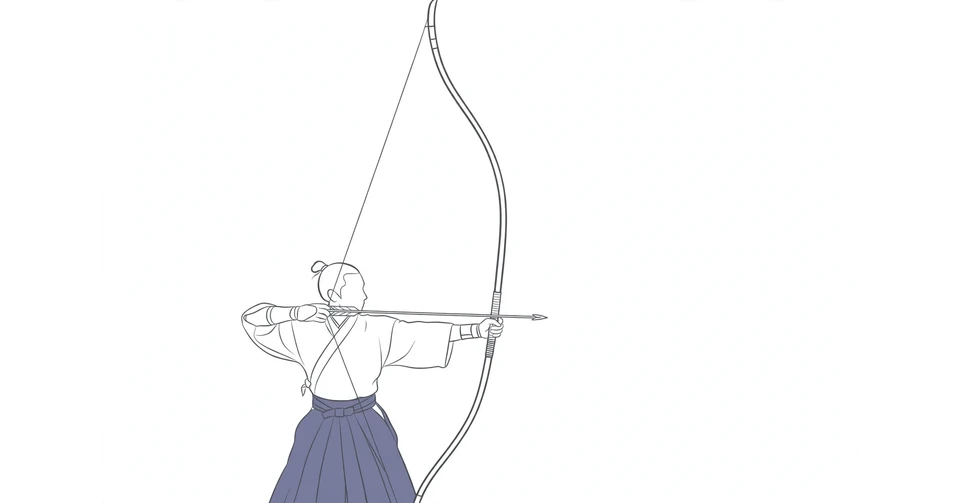
That height is not a mistake or a decoration. The yumi is the oldest of Japan's samurai weapons, older in daily use than the sword, and its shape was worked out over centuries of war, craft and ceremony until it stopped changing. The modern bamboo bow is practically identical to the yumi of the 16th and 17th centuries, which is a rare thing to say about any tool that is still used every day.
I find that continuity quietly moving. In a country famous for rebuilding itself, here is one object that refused to be improved. The yumi asks its archer to grow into it, literally, since the bow you shoot is chosen by your height, and it rewards patience the way few modern objects do. This article looks at what the yumi is, why it is so tall and so lopsided, how it is made, and why it is still shot in dojos across Japan.
Why the yumi is so tall
A yumi is exceptionally tall, standing over two metres, and it usually passes the height of the archer who holds it. Standard lengths run from 212 to 245 centimetres, and the common size, called namisun, measures 221 centimetres. The length is not chosen for show. It is matched to the archer: a taller archer shoots a longer bow, and the bow is roughly two and a third times the archer's draw length.
The reason for the extra length is the material. Japan had little of the horn and sinew that went into the powerful composite bows of the steppe, so Japanese bowyers worked with what they had, which was wood and bamboo. Those materials are not as strong, so to reach a draw weight that was useful in war the bow had to be made longer, spreading the strain over a wider area and giving a longer draw, which sends the arrow away faster. Length was the answer to a shortage, and the answer worked so well that it became the shape itself.
There is a second reason, and it is about the archer's body. A long bow with a long draw lets the arms extend fully at full draw, and the string sits at the mouth rather than somewhere near the chest. The result is a shooting style that is calm and upright, with no crouching and no straining. It fits the human body the way a well made chair fits it, by asking for good posture rather than force.
The length also has a history of its own. In the Nara period, from 710 to 794, many yumi became as long as roughly 7 shaku 3 sun, about 2.21 metres, and that length has been passed down to the present day. So when a modern archer picks up a yumi, she is holding a measurement that was settled more than a thousand years ago. Few objects in daily use can claim that.
A short history of the yumi
The yumi is older than the samurai. Most of the bows excavated from the Jomon period, roughly 14,000 to 300 BCE, are 1.2 to 1.6 metres long, while most Yayoi period bows, from about the 3rd century BCE to the 2nd or 3rd century CE, are 2 to 2.3 metres long. Those early bows were made from a single piece of processed wood and were called maruki yumi, round wood bows, and that simple form was used until the Nara period.
Nobody knows exactly when the asymmetrical yumi came into use, but the first written record is found in the Book of Wei, a Chinese historical manuscript dating to the 3rd century CE. It describes the people of the Japanese islands using wooden bows made with the lower limbs short and the upper limbs long, and bamboo arrows with points of iron or bone. The oldest asymmetrical bow found to date was discovered in Nara Prefecture and is estimated to be from the 5th century. The bow was already lopsided before Japan had a samurai class.
Some of the bows found as burial goods in kofun, ancient tombs from the Kofun period of 300 to 538 CE, were decorated with gold or silver, and it is believed they were also used in ceremonies. The yumi was already more than a weapon. It was an object worth honouring, and that double life as tool and treasure never left it.
From the mid to late Heian period, from 794 to 1185, the Japanese developed the fusedake no yumi, the first yumi in Japan with a laminated structure. Bamboo was attached to a wooden bow with glue made from a fish float, and the elasticity of the bamboo improved the bow's range, power and durability. From the end of the Heian period to the beginning of the Kamakura period, the sanmaiuchi no yumi was developed, with bamboo glued on the front side and the reverse side as well. Then came the toyumi, in which rattan was wrapped around the laminated bow to improve its elasticity and sturdiness. The shigeto bow in particular was the strongest weapon of the Kamakura period, with a maximum range of 400 metres and an effective range of 80 metres. In the Muromachi period, from 1336 to 1573, the shihodake bow added bamboo on the sides of the bow to increase its range and power.
During the Sengoku period, from 1467 to 1615, the higoyumi used in modern kyudo was developed, completing the original form of the Japanese bow known around the world today. Its core is about four pieces of bonded bamboo, with bamboo glued to the front and the back and wood glued to the sides. That structure, called yohonhigo, is the most advanced form of the weapon, with a bamboo laminate core, bamboo back and belly, and hardwood sides. A detailed account of this long evolution, from single piece wood bows to the laminated bow of the samurai, is given in this history of the yumi bow.
The samurai themselves made the yumi the centre of their identity. The phrase kyuba no michi, the way of horse and bow, described the samurai life long before the sword took that place in popular imagination. It was the mainstay of the samurai arsenal for hundreds of years, and it held the same prestige as the English longbow held in Europe. Nasu no Yoichi, famous as a master of archery in the late Heian period, became a hero of The Tale of the Heike and of later Noh, kabuki and ukiyo-e.
The gun did not kill the yumi. In 1543 the Portuguese brought matchlock firearms to Japan, and the Japanese soon made their own version, the tanegashima. Yet the matchlock was slow to load and useless in rain, when damp gunpowder would not fire, so the bow stayed in use long after the guns arrived. Even in the famous Toshiya contest at Sanjusangen-do in Kyoto, archers shot at targets 132 metres away, a distance that still impresses today. When Japanese society became peaceful in the Edo period, from 1603 to 1868, the spirituality and decorativeness of the yumi became important, and archery developed as a samurai's way of doing things rather than only as a weapon.
How a yumi is made
A traditional yumi is made by laminating bamboo, wood and leather, using techniques which have not changed for centuries. The earliest yumi were self bows, made from a single piece of wood, most often yew, waxwood or maple. Later, bamboo became an integral part of the bow, often used as a laminated surface to impart more strength and flexibility to the wood core. Rattan strips and leather are also present. Rattan windings around the yumi add strength and durability, while leather was most often used to make the nigiri, the grip.
The craft begins with the bamboo. The bowyer collects madake bamboo that has been growing for at least five years, which allows it to grow enough to have the strength and flexibility required to make an acceptable yumi. Each stalk makes a single bow. The bowyer selects carefully for uniform node length and straightness, and winter is the best time to harvest, because there is less moisture in the bamboo.
Once harvested, the bamboo is cut into four pieces lengthwise and allowed to dry for several months. Meanwhile the bowyer selects already harvested bamboo that has undergone a smoking process that can last for over five years. The pieces are shaved down to tiny strips, because no two pieces of bamboo are alike and there are no uniform cross section measurements. Additional pieces of bamboo are cut and glued to the back and belly of the bow, and wood is glued to the sides. Then the shaping begins.
After wrapping the bow in overlapping crisscrossing knots, the bowyer inserts small wedges at each cross, hammering them into place and gradually bending the bow to take its final shape, then letting it rest on a rack while the glue finishes drying. Once this is complete, the bowyer puts on the string, which is made from hemp or silk. The string of a yumi is called a tsuru, and most modern archers use strings made of synthetic materials such as Kevlar, which last longer. While the bottom of the bow has the string centred as would be expected, the top has the string slightly right of centre, a small detail that belongs to the asymmetry of the whole design.
A yumi comes in two broad categories: the daikyu, the extremely large bow that we associate with the term, and the hankyu, or half bow, which is shorter and used in some forms of practice. Within the daikyu, the lengths have names of their own. An archer under 150 centimetres tall shoots a sansun-zume of 212 centimetres. An archer of 150 to 165 centimetres shoots a namisun of 221 centimetres. An archer of 165 to 180 centimetres shoots a nisun-nobi of 227 centimetres. An archer of 180 to 195 centimetres shoots a yonsun-nobi of 233 centimetres. An archer of 195 to 205 centimetres shoots a rokusun-nobi of 239 centimetres. An archer over 205 centimetres shoots a hassun-nobi of 245 centimetres. The bow is fitted to the body the way a suit is fitted, and a borrowed bow of the wrong length feels wrong at once.
In modern times, yumi can also be made from synthetic materials such as fibreglass, which makes them last longer, but they are not considered as aesthetically pleasing or as responsive. Beginners often start with a synthetic bow, which is cheaper and tougher, and move to bamboo when they are ready. There is no shame in that order. The bamboo bow is a living thing in the sense that matters: it changes with use and with the weather, and it asks for attention.
That attention is part of owning one. A bamboo yumi requires careful attention, because left unattended it can warp out of shape and may eventually become unusable. Its shape changes through normal use and can be reformed when needed through manual pressure, through shaping blocks, or by leaving it strung or unstrung when not in use. A yumi that is relatively flat when unstrung is usually left unstrung, a state sometimes called tired, while a yumi with excessive curvature when unstrung is typically left strung for a time to tame it. A well cared for yumi can last many generations, while the usable life of a mistreated yumi can be very short. I like that bargain. It is honest about what care is worth.
The grip that sits off centre
The most striking feature of the yumi, after its height, is its asymmetry. Where most bows have the grip at the centre, the grip of the yumi is a third of the way up the bow, making the upper portion twice as long as the lower. According to the All Nippon Kyudo Federation, the grip, called the nigiri, has to be positioned at about two thirds of the distance from the upper tip. The upper and lower curves also differ, so the bow is not simply a long bow held low. It is two different limbs joined at a point that is not the middle.
Several explanations have been offered for this shape, and the honest answer is that nobody is certain. One of the most commonly held theories maintains that the unusual grip location was meant to allow the archer to switch between firing to the right or the left more easily while mounted. However, the earliest yumi date to before horses were widely used in warfare, and the o-yoroi armour worn by Heian and early Kamakura period samurai had extra protection on the left, indicating that they would fire primarily to the left side. The mounted theory is elegant, but the dates argue against it.
Another explanation is the vibration node. The grip position sits at a vibration node on the bow, meaning that the recoil causes little if any vibration in the archer's hand or arm, which helps to keep the aim steady. The grip also naturally aligns with the anatomy of the hand, wrist and forearm, making it less tiring or stressful on the wrist to shoot for long periods, like during a battle. Others claim that asymmetry was needed to enable shooting from a kneeling position, and yet another explanation points to the characteristics of the wood from a time before laminating techniques, when the elasticity of a single piece of wood differed between the part taken from the treetop side and the other side, so a lower grip balanced it.
I suspect the real answer is all of these at once, layered over centuries. A shape that survives for a thousand years rarely survives for one reason. It survives because many small reasons point the same way, and because the people who used it kept testing it against real shooting. The Japanese value asymmetry in their art and culture, and even though the shape of the bow is what it is for practical reasons, it became ingrained in aesthetic values, and many yumi are also seen and treated as works of art rather than just weapons. A yumi leaning in the corner of a dojo is beautiful before anyone draws it.
The string adds its own small asymmetry. Because the yumi has its string off centre, the recoil causes the bow to naturally twist in the wrist. When coupled with the loose grip used by kyudo archers, the bow's momentum causes it to spin all the way around after the release, so the arrow does not make too much contact with the bow and flies in a straighter path, rather than having to curve around the bow and correct its path back to the target. That spin, called yugaeri, is unique to kyudo, and it is the reason the archer's hand must stay loose. Grip the bow tightly and the spin cannot happen. The bow teaches the hand to let go, which is a lesson that travels well beyond archery.
The yumi in the dojo today
Today the yumi is used in kyudo and in ceremonies, and its home is the dojo. The bow is taller than its archer, its shot is mostly preparation, and its highest ideal is a state in which the arrow belongs in the target. That description comes from kyudo, the Japanese martial art of archery, and it is worth reading in full, because the bow only makes sense inside the practice that uses it.
In the dojo, the yumi is handled with a care that looks ceremonial and is practical at the same time. The bow is never leaned carelessly or left strung on a hot day. The string is checked, the grip is dusted with powder so the bow can turn in the hand, and the archer learns the eight stages of shooting before she is allowed to worry about hitting anything. The yumi is the teacher in that arrangement. It is too tall to be rushed, too long to be forced, and too sensitive to be gripped hard. A beginner learns patience from the object before she learns it from the instructor.
The yumi also appears outside the dojo, in a place most visitors would not expect. In grand sumo tournaments, a ceremony called the yumitori-shiki is held, in which a bow is dedicated to the Shinto kami. The bow in that ceremony is a yumi, and its presence there says something about how Japan regards the object: not only as a weapon and not only as sporting equipment, but as a thing with a spiritual weight of its own.
Kendo, the louder sibling of kyudo, shares the same structure of form first and result second, as the way of the sword lives on in kendo shows. The sword and the bow were the two arms of the samurai, and both arts kept the same lesson after the wars ended: that how you do a thing is the thing itself. The yumi simply makes that lesson visible, because you can see the archer's whole body in the shape of the bow.
Choosing a yumi
If you want to learn kyudo and buy a yumi for yourself, it is important to get the proper measurements. To find your draw length, called yazuka, stand upright and hold your left arm parallel to the ground with your fingers extended, then measure from the tip of the middle finger to the centre of your body. The length of the yumi should be roughly two and a third times greater than this measurement, and the arrows should be a little longer than the draw length. If you go to an archery shop that sells yumi, have the seller take your measurements and help you select the bow that is the right size for your body.
Price is a real consideration. A handmade bamboo yumi is expensive, and the price rises with the quality of the bamboo and the reputation of the bowyer. Check the seller's reviews independently of the main site if possible, and familiarise yourself with any warranties or return policies. For beginners, or for those on a budget, it might be worth getting a synthetic bow, but if you plan to join a kyudo school, they may require you to own a traditionally made bow. Most dojos lend the gear at first, so there is no need to buy anything before the first lesson.
The arrows matter too. The arrows, known as ya, are made of steam straightened bamboo, cut to different lengths depending on their intended use. They are on average a metre long, making them larger than the arrows most archers are familiar with, because the yumi has a longer draw length and the arrow has to be stabilised against the bow. A variety of arrowheads, called yajiri, were made for specialised uses. The kaburi-ya was equipped with a whistle to frighten the enemy or call upon the favour of the kami. The karimata had a crescent shaped head used for cutting ropes during naval warfare. The watakusi were barbed arrows that would make gaping wounds. The sankaku arrows were bodkin points designed to pierce armour. Fletching was traditionally made of the feathers of hawks, cranes, pheasants or eagles, and if those were unavailable, archers would use geese.
The full history of the bow, from its earliest single piece forms to the laminated yumi of the samurai, is laid out in the Yumi article on Wikipedia, which also lists the standard bow lengths by archer height and the care a bamboo bow needs. It is a useful companion to the history above, and it is honest about the places where the record is uncertain.
A bow that outlasted its wars
The yumi began as a hunting tool, became the main weapon of the samurai, survived the arrival of the gun, and outlived the class that carried it. It did that without changing its shape in any important way for four hundred years. The reason is simple enough: the shape works, and the people who used it knew it worked, so they kept making it the same way.
What I take from the yumi has little to do with archery. Most of the objects in my life were designed to be replaced, and most of the tools I use are improved every year whether they need it or not. The yumi is the opposite. It is a finished thing, made from grass and wood and glue, that asks its user to change instead. The archer grows into the bow's height, learns its off centre grip, accepts its need for care, and in return gets a tool that can last generations. That exchange, patience for permanence, feels like something worth keeping.
Stand beside a kyudo archer once more and look at the bow rather than the target. It is taller than the person holding it, older than the school that teaches it, and still exactly the shape it needs to be. The arrow is the briefest part of the story. The yumi is the rest of it.
More in Culture & Society
- A Torii Gate Marks Where the Ordinary World Ends
- Kyudo Turns Archery Into a Moving Meditation
- Iaido Is the Art of Drawing the Sword Before the Fight Begins
- Pancawara Gives Bali a Five Day Week That Never Stops Turning
- Hanami Turns Cherry Blossom Season Into Japan's Longest Picnic
- Bogu Is the Armour That Lets Kendo Strike at Full Speed
Latest posts
- Ekiben, the Train Station Bento That Turns a Journey into a Meal
- Natto, the Sticky Fermented Beans Japan Loves and Visitors Fear
- Ema Lets You Hang a Wish Where the Kami Can Read It
- Bonsai and the Thousand-Year Art of Tiny Trees
- The Shinai Is a Bamboo Sword That Teaches Before It Strikes
- Omikuji Tells Your Fortune on a Slip of Paper
- Japan Meets the New Year at Hatsumode
- The Way of the Sword Lives On in Kendo
- Hakama Turn a Kimono Into Ceremony
- A Haori Is the Jacket That Turns a Kimono Formal
- The Taiko Musubi Turned a Kimono Sash Into a Drum
- Hiroshige Walked the Tokaido and Japan Followed
- Hokusai Spent a Lifetime Chasing One Mountain
- Tabi Are the Split Toe Socks Japan Wears Under Everything
- Ukiyo-e Turned Everyday Edo Into Art Anyone Could Own