Onigiri, Japan's Two-Thousand-Year-Old Portable Meal
· 15 min read
Onigiri is Japan's oldest portable meal, a hand-pressed ball of rice that has fed samurai, schoolchildren and commuters for two thousand years. This is the story of the onigiri, from a Yayoi-period rice lump to the convenience store shelf.
Walk into any convenience store in Japan and you will find a whole shelf of triangles. They sit in neat rows in a chilled case, each one wrapped in plastic, each one costing little more than a coin. Commuters grab two on the way to the train. Schoolchildren unwrap one at lunch. Hikers pack a few for the trail. It is the cheapest hot meal that is not hot at all, and it may be the oldest fast food on earth.
An onigiri is a ball of cooked rice, pressed by hand into a triangle, a cylinder or a round, lightly salted, often hiding a savoury filling in the middle and often wrapped in a sheet of dried seaweed called nori. The rice is plain short-grain rice, the kind that sticks to itself just enough to hold a shape. The filling can be as simple as a pickled plum or as rich as grilled salmon. There is no plate, no chopsticks and no ceremony. You eat an onigiri with your hands, standing up if you have to, and it tastes exactly like it should.
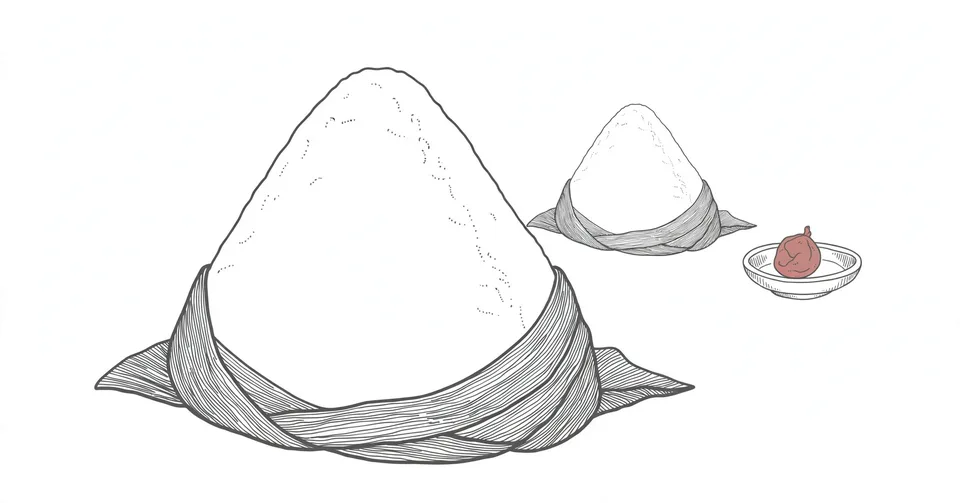
That simplicity is the point. Long before Japan had restaurants, refrigeration or plastic wrap, people needed food they could carry. Rice was the answer, and the onigiri was the shape it took. The food has barely changed in two thousand years. The packaging changed, the fillings multiplied, and the price stayed low, but the idea is the same one a farmer carried into the fields in the time of the Yayoi. An onigiri is lunch you can hold in one hand, and Japan has never found a reason to improve on that.
A rice ball two thousand years old
The oldest onigiri we know of is not a recipe. It is a lump of carbonised rice, found in November 1987 at the Sugitani Chanobatake site in Nakanoto, Ishikawa Prefecture, inside a Yayoi-period pit dwelling. Archaeologists dated it to roughly two thousand years ago, and its shape is unmistakably that of a pressed rice ball. People were already shaping rice by hand and carrying it with them before Japan had a written history.
The first written mention comes a thousand years later. Sei Shonagon, writing her Pillow Book around the year 1002, describes eating rice formed in the hand. The Murasaki Shikibu Diary, from the early eleventh century, records rice balls being given to servants at a palace celebration. In the Heian period, from 794 to 1185, balls of rice called ton-jiki were carried as field rations and travel food, plain and practical, the kind of thing you eat because you are hungry and far from home.
By the feudal period, the onigiri had become campaign food. Samurai carried rice balls on the march because they kept for a day without spoiling, needed no fire and no utensils, and could be eaten in the saddle or on foot. A record from 1221, during the Jokyu War, describes rice balls filled with umeboshi, pickled plum, being given to warriors. The plum was not only flavour. Its salt and acidity helped preserve the rice, and the red fruit sitting in the middle of white rice later became a small piece of symbolism, the red disc of the Japanese flag in miniature.
The food stayed close to this form for centuries. Farmers carried onigiri into the fields. Travellers packed them for long walks between post towns. Mothers made them for children going to school. It was never a dish for guests or celebrations. It was the food you made when someone had to leave the house and eat on the road, and that is still, in the end, what it is.
How the triangle got its nori
The onigiri we recognise today, a neat triangle wrapped in dark green seaweed, took shape in the Edo period, from 1603 to 1868. Two things came together. First, nori farming took hold along the shores of Edo Bay, around Omori and Shinagawa, starting in the Kyoho era about three hundred years ago. Sheets of dried seaweed became cheap and common. Second, the boxed lunch, the bento, became an everyday habit, and the rice ball became its natural centrepiece.
Wrapping rice in nori did more than look good. The seaweed kept the rice from sticking to the fingers, added salt and a taste of the sea, and protected the ball from drying out. The triangle shape, called sankaku, became the standard because it is easy to press in the hands and easy to hold, a point at the top and a flat base that sits in the palm.
In the Meiji period, the onigiri became standard fare for soldiers and schoolchildren, and the fillings began to diversify beyond plum and salt. One of the most famous regional inventions came much later. In 1957, a tempura shop in Tsu City, Mie Prefecture, invented tenmusu, an onigiri filled with a tempura shrimp, a local specialty that is still sold across the country today.
There is a quiet craft to making a good onigiri at home, and Japanese home cooks will tell you it is harder than it looks. The rice must be warm, not hot, so it holds together without turning to paste. The hands are wet with salted water, and the rice is pressed just firmly enough to keep its shape, never squeezed hard. Press too gently and the ball falls apart. Press too hard and the rice turns dense and heavy. The best onigiri, people say, is one that holds together until the first bite, then breaks apart softly in the mouth.
The convenience store revolution
For most of its history, the onigiri was home food. That changed in 1978, when 7-Eleven Japan began selling onigiri in its stores. The chain faced one problem: nori goes soggy against warm rice within hours, and a soggy rice ball is a sad thing. The solution was a piece of packaging called Paricco Film, a layered plastic wrapper that keeps the nori and the rice physically separate until the moment of eating. You pull a tab, then two strips, and the nori falls against the rice just before the first bite, still crisp.
The invention turned the onigiri from home food into a national snack. Lawson and FamilyMart followed with their own versions, and today the three chains sell onigiri by the hundreds of millions every year. A standard one costs about 110 to 220 yen, with premium fillings like salmon roe or wagyu beef at the top of the range. The rice is prepared fresh twice a day, and the shelf is restocked through the night, so the triangle you buy at seven in the morning was made a few hours earlier, not a few days.
The convenience store also invented a filling. Tuna mayonnaise, a mix of canned tuna and Japanese mayonnaise, was introduced by 7-Eleven in 1983, and it became an instant bestseller. It had never existed before the convenience store era, and it is now one of the most popular fillings in the country, especially among younger buyers. The onigiri guide at All Day I Eat notes that tuna mayonnaise has led national surveys of younger consumers for years, a filling born in a laboratory of convenience that now feels completely traditional.
If you want to understand why Japan's convenience stores are a destination in themselves, the onigiri shelf is the place to start. It is where a two-thousand-year-old food met modern logistics and neither side had to compromise. The store sells what mothers used to make, and it sells it at all hours, in dozens of varieties, for the price of a coffee.
How to open one without making a mess
First-time buyers often stare at a convenience store onigiri the way you would stare at a puzzle. The wrapper has numbers on it, usually one, two and three, and the whole point is to follow them in order. Pull tab one down the middle, then pull the two side strips apart, and the nori wraps itself around the rice. Tear the wrong strip first and the seaweed ends up in pieces, or the rice ball comes apart in your hands.
It is worth learning, because the design is genuinely clever. The film keeps the seaweed dry for hours on a chilled shelf, and the three pulls take about five seconds once you know them. Children in Japan learn the sequence before they learn to tie their shoes, and office workers do it one-handed on a crowded train without looking down. The packaging is, in its own small way, a piece of Japanese engineering as elegant as anything in a factory, a solution to the problem of keeping something crisp until the exact second you want to eat it.
There is also an etiquette to it, though a forgiving one. You eat an onigiri with your hands, not with chopsticks, and you eat it from the top of the triangle downwards, turning it as you go so the filling stays inside. You do not unwrap the whole thing at once. You peel the plastic as you eat, keeping the rest wrapped, so the rice stays clean and the nori stays crisp to the last bite.
The fillings that win every poll
Ask a hundred Japanese people for their favourite onigiri filling and you will get the same short list, in roughly the same order, every time. The classics have not changed in decades, and the newer inventions rarely break into the top five.
| Filling | What it is | Why it wins |
|---|---|---|
| Salmon | Salted grilled salmon flakes | The most popular classic, rich and salty |
| Tuna mayonnaise | Tuna mixed with Japanese mayonnaise | The convenience store invention of 1983, still number one with the young |
| Umeboshi | Pickled plum | Sharp, salty and red, the oldest filling of all |
| Kombu | Simmered kelp | Sweet and dark, a quiet favourite |
| Mentaiko | Spicy cod roe | Pink, salty and a little fiery |
Salmon, called sake or shake, is the steady favourite, the filling your grandmother would have used. Tuna mayonnaise is the modern champion. Umeboshi is the purist's choice, the one that has been in rice balls since the thirteenth century, and the one that divides visitors most sharply, since a single plum can be startlingly sour. Kombu, simmered kelp with a little soy and sweetness, is the dark horse that people discover late and then never give up. Mentaiko, spicy cod roe from Fukuoka, brings a gentle heat that suits the plain rice perfectly.
Regional fillings reward the curious. In Okinawa you may find onigiri with spam and egg, a legacy of the American presence on the island. In the north, salmon roe appears in the autumn. In Shizuoka, where I live, you can find onigiri mixed with sakura ebi, the tiny pink shrimp caught only in Suruga Bay, a local filling that never travels far from home. The best onigiri in Japan is often the one sold within a few kilometres of where its filling was caught, cooked or pickled.
Onigiri is not sushi
Visitors sometimes confuse the onigiri with sushi, and it is easy to see why. Both involve rice and seaweed, both are eaten by hand, and both appear in chilled cases in the same stores. But the two foods are different in almost every way that matters. Sushi rice is seasoned with vinegar, sugar and salt, and it is served cool, often with raw fish. Onigiri rice is plain, salted only lightly, and it is meant to be eaten at room temperature, as a meal in itself rather than a delicacy.
The confusion is a compliment to both. Sushi is the food Japan serves to guests. Onigiri is the food Japan eats itself, every day, without thinking about it. One is a craft perfected over centuries in specialist restaurants. The other is a habit perfected over centuries in home kitchens. If sushi is Japan showing off, onigiri is Japan being honest, and both deserve their reputation.
There is a small test. If the rice is vinegared and the fish is raw, it is sushi. If the rice is plain and the whole thing fits in one hand, it is an onigiri. Once you know the difference, you will never mix them up again, and you will start to notice how often the onigiri is the better choice, cheaper, faster, and somehow more satisfying on an ordinary day.
Onigiri or omusubi
The food has two names, and which one you hear depends on where you are. Onigiri is the common term across most of Japan, and it is the word the convenience stores adopted, which is why it is the word the world knows. Omusubi is the older word, still widely used in western Japan, especially around Kansai, and it carries a warmer, more old-fashioned feeling. Both come from the same idea: rice pressed, or gripped, by hand.
The Kojien dictionary, Japan's most respected dictionary, treats onigiri, omusubi and nigirimeshi as the same thing, three names for one food. A survey of 1,386 high school students at thirteen schools in 2001 found that 86.2 percent said onigiri, 9 percent said omusubi, and 3 percent said nigirimeshi. The numbers tell the story of a word that won because the stores printed it on millions of wrappers, not because the other words were wrong.
There is a small piece of folklore attached to the name omusubi that is worth repeating, even though nobody can prove it. The word musubu also means to tie or to bind, and some people say the rice ball ties people together, the cook to the eater, the eater to the place the rice grew. It is the kind of story that sounds too neat to be true, and it probably is, but it survives because it feels right. A food you make with your hands for someone who is leaving the house is, in the end, a small act of care.
Where to find the best ones
The honest answer is that the best onigiri is often the one you buy at the nearest store when you are hungry. But if you want to treat the food seriously, there are places worth a detour. Onigiri Asakusa Yadoroku, in Tokyo, is the city's oldest onigiri restaurant, established in 1954, a narrow counter where rice balls are made to order from carefully chosen rice and seaweed. It has survived seventy years on a single idea: that a rice ball made by hand, in front of you, is worth more than one made in a factory.
Train stations are the second-best place. The first ekiben, sold at Utsunomiya Station in 1885, contained two onigiri with pickled plum and pickled daikon, and the station lunch box has carried rice balls ever since. A station onigiri tastes better than a store one for a simple reason: you eat it on a train, watching the country pass, and the food becomes part of the journey.
Specialty shops are appearing in more cities now, selling onigiri with premium rice, unusual fillings and prices to match. They are worth trying once, and they are good, but they are not the point. The point of the onigiri is that it is ordinary, and ordinary food done well is harder to achieve than a luxury version. A convenience store triangle, eaten on a bench outside the station, is the truest version of the food there is.
If you are in a supermarket, look for the onigiri made in store rather than the factory-packed ones, and if you are at a department store food hall, the basement food halls sell beautiful ones, though at prices that make you think twice. And if you ever eat a tamago sando from the same chilled case, you will understand the shelf as a whole, a small museum of Japanese lunch, priced for everyone.
For the full background, the onigiri guide at ByFood covers the history from the Yayoi period to the convenience store era, including the 1987 archaeological find and the Edo-period spread of nori wrapping.
The quiet genius of a rice ball
What I admire about the onigiri is how little it asks of you. It asks for no table, no heat, no money to speak of, and no skill beyond knowing which tab to pull. In return it gives you a complete meal, one that has fed farmers, soldiers, schoolchildren and salarymen across two thousand years without ever needing to be reinvented. Most foods that old have become museum pieces or festival food, eaten once a year out of duty. The onigiri is eaten every day, by millions of people, because it still works.
There is a lesson in that for anyone who likes to make things. The foods and the tools that last are rarely the cleverest ones. They are the simplest ones, the ones that solve a real problem, that fit in a hand and a pocket, that anyone can make and anyone can afford. The onigiri does not try to impress you. It just feeds you, and it has done so longer than almost any other fast food on earth. The next time you are in Japan and you are hungry and in a hurry, skip the restaurant, walk into the nearest convenience store, and buy a triangle. You will be eating the same lunch a samurai ate, and you will understand why nobody has ever bothered to change it.
More in Food & Travel
- Walking Through Senbon Torii Feels Like Entering Another World
- Prambanan Towers Over Java With a Love Story in Stone
- Ekiben, the Train Station Bento That Turns a Journey into a Meal
- Natto, the Sticky Fermented Beans Japan Loves and Visitors Fear
- Base Genep Seasons Every Balinese Feast From the Mortar Up
- Sambal Matah Wakes Up Every Balinese Plate Raw
Latest posts
- Yabusame Turns Horseback Archery Into a Moving Prayer
- Roro Jonggrang and the Thousand Temples Built in One Night
- Ten Thousand Vermilion Gates Lead Up Fushimi Inari
- Shimenawa Marks the Line Between Ordinary and Sacred
- A Torii Gate Marks Where the Ordinary World Ends
- The Yumi Stands Taller Than Its Archer
- Kyudo Turns Archery Into a Moving Meditation
- Iaido Is the Art of Drawing the Sword Before the Fight Begins
- Pancawara Gives Bali a Five Day Week That Never Stops Turning
- Hanami Turns Cherry Blossom Season Into Japan's Longest Picnic
- Bogu Is the Armour That Lets Kendo Strike at Full Speed
- Ema Lets You Hang a Wish Where the Kami Can Read It
- Bonsai and the Thousand-Year Art of Tiny Trees
- The Shinai Is a Bamboo Sword That Teaches Before It Strikes
- Omikuji Tells Your Fortune on a Slip of Paper