Walking Through Senbon Torii Feels Like Entering Another World
· 17 min read
The Senbon Torii at Fushimi Inari is a tunnel of about 800 vermilion gates that turns an ordinary hillside walk into something quietly extraordinary. This is what it is like to walk it, and why it stays with you.
There is a moment, a few steps into the Senbon Torii, when the world outside stops existing. The noise of the street falls away, the sky narrows to a strip of light above the rooftops of red gates, and the path ahead glows like a corridor in a dream. You are still in Kyoto, still on an ordinary hillside, but it does not feel that way. Walking through the Senbon Torii feels like entering another world, and the feeling does not fade with familiarity. It deepens.
The Senbon Torii is the most photographed sight at Fushimi Inari, and it is also the most misunderstood. People arrive expecting a backdrop, a pretty tunnel to pose in for a few minutes before moving on. What they find instead is a place that rewards slowness. The gates are not a decoration. They are a record of wishes, paid for one by one over centuries, and walking through them is less like sightseeing and more like reading a long letter written by thousands of strangers.
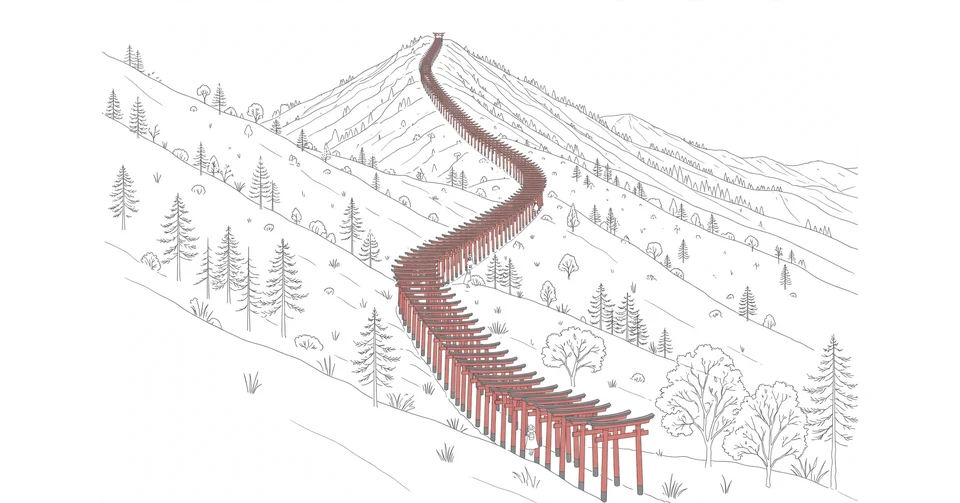
That is the honest answer to the question of what the tunnel is worth. It is worth your time, not just your camera. Give it an unhurried hour, arrive early if you can, and let the tunnel do what it was built to do, which is to slow you down and mark a crossing from the everyday into something sacred. The rest of this article explains what you are walking through, who paid for it, why it is red, and how to walk it well.
What the Senbon Torii actually is
The Senbon Torii is the name for the two dense, parallel rows of vermilion gates that climb the slope just behind the main hall of Fushimi Inari Taisha. The name means "thousand torii", and it is the part of the shrine that most visitors remember. The gates stand so close together that they form a roof over the path, and the light that filters between them falls in stripes on the stone steps. The Japan Guide page on Fushimi Inari Shrine describes the tunnel as the start of the torii covered hiking trail, and that is exactly how it feels, like a doorway into the mountain itself.
A torii is a gateway that marks the boundary between the ordinary world and the sacred one, and the Senbon Torii repeats that boundary hundreds of times in a row. You pass under one gate, then another, then another, and with each crossing the ordinary world gets a little further behind you. The effect is deliberate, even if no single person designed it. The tunnel grew gate by gate, donation by donation, over hundreds of years, and the result is a place that feels both built and grown, like a forest that learned to be architecture.
The shrine behind the tunnel is Fushimi Inari Taisha, the head shrine of about 30,000 Inari shrines across Japan. It was founded in 711, more than eighty years before Kyoto became the capital, and it has been a place of prayer for rice, for business, and for a safe home ever since. If you want the full story of the shrine itself, the guide to Fushimi Inari on this site walks the whole mountain, from the founding legend to the quiet summit. The tunnel is the most famous part of that walk, but it is only the beginning of it.
What makes the Senbon Torii different from a single grand gate is its repetition. One gate is a symbol. Eight hundred gates in a row become an experience, a rhythm you walk inside. Your eyes adjust to the red light, your footsteps fall into the pace of the steps, and the tunnel starts to feel less like a place you are visiting and more like a place you have entered. That is why the title of this article is not an exaggeration. The Senbon Torii really does feel like another world, because it was built, gate by gate, to be one.
Eight hundred gates, ten thousand wishes
The name says a thousand, but the real numbers are both smaller and larger than that. About 800 gates stand close together in the tunnel section of the Senbon Torii, packed tightly enough to form a continuous corridor. Across the whole shrine grounds and the mountain paths, roughly 10,000 torii of all sizes stand in total, from the great gate at the entrance to the miniature gates stacked at small shrines along the trail. The Senbon Torii is the densest part of that forest of gates, and it is where the numbers become something you can feel with your body rather than just read.
Every gate in the tunnel was paid for by someone. The custom of donating a torii spread during the Edo period as a way to mark a wish made or a wish already granted, and each gate carries the name of its donor and the date of the donation inscribed on the back. Walk the tunnel slowly and turn around from time to time, and you will see the backs of the gates covered in black lettering, company names, family names, dates going back generations. The Senbon Torii is not just a tunnel. It is a long record of answered prayers, and every name on it belongs to someone who thought a wish was worth paying for.
The donations are not small. A smaller gate costs from around 400,000 yen, and a large one costs over a million yen, and new gates are still added today. That is a serious amount of money for a single gate, and it tells you something about how much the shrine matters to the people who give. A business that prospers gives back a gate, and the gate becomes part of the path for everyone else. Nobody owns the view. The donation is visible, the name is on the back, and the gift is a public one.
I find this arrangement quietly admirable, and I think it explains why the Senbon Torii has survived while so many other grand projects have not. The tunnel was never funded by a single patron who could change their mind. It was funded by thousands of ordinary decisions, each one small enough to be personal and large enough to matter. If one donor stopped giving, the tunnel would still stand. That is a sturdy way to build something meant to last centuries, and it is a model worth remembering whenever we talk about paying for public beauty. Shared things last longest when many hands hold them up.
There is also something humbling about walking past so many names you will never know. Each inscription in the tunnel is a small story, a shop that survived a hard year, a family that wanted a safe home, a person who got well and came back to say thank you. You cannot read them all, and you do not need to. The point is not the individual names. The point is the weight of them together, a thousand quiet thank yous forming a roof over your head.
Why the gates are vermilion
The first thing anyone notices about the Senbon Torii is the color. The gates are painted a bright vermilion red, and in the shade of the mountain the color seems to glow from inside. It is not a color chosen for photographs, although photographs love it. It is a color with a meaning that goes back to the oldest ideas in Shinto.
Vermilion is said to ward off evil and disaster, and it is also the color of a good harvest, the color of ripe rice and of the sun. The paint also has a practical job, since the vermilion coating helps preserve the wood against rot and insects, which matters for gates that stand outdoors on a damp forested mountain. Beauty and usefulness are the same thing here, and that is a combination worth noticing. The tunnel is not red in spite of being practical. It is red because the practical choice and the sacred choice pointed at the same color.
The color also does something to the light that no photograph quite captures. Inside the Senbon Torii, the vermilion gates reflect warm light onto the stone path and onto the faces of the people walking through, so the whole tunnel feels lit from within even on a cloudy day. Step out of the tunnel into the green forest and the world looks briefly pale by comparison, as if the color stayed behind you. Then your eyes adjust, and the mountain takes over with its own palette of cedar green and stone grey. The contrast is part of the walk, and it is one of the reasons the tunnel stays in the memory long after the visit ends.
There is a lesson in the color that goes beyond the shrine. We tend to think of sacred places as quiet and pale, all stone and shadow, but the Senbon Torii is loud and bright and warm, and it is no less sacred for it. Reverence does not have to whisper. Sometimes it can be the color of ripe rice and morning sun, and it can still be serious. I think we lose something when we assume that only muted things are holy. The Senbon Torii disagrees, in the brightest possible way.
Walking the Senbon Torii at dawn
If there is one piece of practical advice worth giving about the Senbon Torii, it is this, go early. The shrine is open 24 hours a day and there is no entrance fee, so dawn is not only possible, it is the best time to walk the tunnel. Before 8 in the morning, the Senbon Torii belongs to the worshippers and the early risers, and the gates stand empty enough for you to hear your own footsteps. By midday the tunnel is a slow moving crowd, and the experience changes completely. The gates are the same, but the feeling is not.
At dawn the tunnel is a different place in another way too. The light comes in low and warm, and the vermilion gates catch it one row at a time, so the tunnel seems to wake up section by section as you climb. The stone steps are cool and sometimes damp, the cedar forest smells fresh after the night, and the only sounds are birds and the soft shuffle of other early walkers. It is the closest the tunnel comes to being what it was for most of its history, a quiet path for prayer rather than a famous sight.
Photographs are part of the visit for most people, and the Senbon Torii is generous to cameras, but the tunnel rewards a different kind of attention too. Try walking a stretch without taking a photograph at all. Look at the inscriptions on the backs of the gates, notice how the light changes as the gates get sparser, listen to how the sound of the crowd fades behind you. The photographs will still be there later. The feeling of being alone inside a thousand red gates will not wait for you, and it is the part of the visit that actually stays with you.
The crowd has its own lesson, and it is worth being honest about it. The Senbon Torii is crowded because it is wonderful, and resenting the crowd is a strange way to enjoy a wonderful place. The gates were built by thousands of people who all wanted to be here, and the crowd is just the newest version of that same wish. Go early if you can, be patient if you cannot, and remember that you are part of the crowd for everyone else too. A little humility goes a long way in a tunnel full of other people's prayers.
Beyond the tunnel, the mountain gets quiet
Most visitors stop after the tunnel, and that is the great missed opportunity of Fushimi Inari. The tunnel is the famous part, but the shrine does not end where the gates thin out. The full mountain loop to the summit and back takes about 2 to 3 hours, and the walk beyond the tunnel is where the mountain stops performing and starts simply being a forest with gates in it.
After about 30 to 45 minutes of climbing, you reach the Yotsutsuji intersection, roughly halfway up the mountain. The gate density drops, the forest opens, and there is a view over Kyoto that is worth the sweat. Many hikers stop here, and it is a sensible turning point if you are short on time or energy. From Yotsutsuji the trail splits into a circular route to the summit, and the atmosphere changes again. The path gets quieter, the gates get smaller and more spaced out, and the mountain starts to feel like a neighbourhood of small shrines rather than a tourist attraction.
The summit itself, called Ichinomine, is 233 metres above sea level, and the walk there is not difficult, just steady. Along the way you will pass small shrines, stacks of miniature torii gates donated by visitors with smaller budgets, and tens of thousands of stone altars called otsuka, small rock mounds set up for private worship. These are not official shrine buildings. They were placed here by ordinary people over the centuries, each one a personal act of devotion, and they give the upper mountain a feeling the tunnel does not have, the feeling of a place that belongs to worshippers first and visitors second.
I think the best way to understand the Senbon Torii is to walk past it. The tunnel teaches you what a torii is, but the mountain teaches you what the tunnel is for. A torii marks a boundary, and the guide to the torii gate on this site explains that idea in full, how a single gate can mark where the ordinary world ends. At Fushimi Inari that boundary is repeated ten thousand times, and the repetition only makes sense when you keep walking past the famous part and into the quiet part. The Senbon Torii is the doorway. The mountain is the house.
Wear proper shoes and bring water, because the stone steps get slippery when wet, and take the climb at your own pace. You are free to walk as far as you wish and turn back whenever you like, and there is no prize for reaching the summit that the middle of the mountain does not already offer. The quiet section between Yotsutsuji and the top is where I would send anyone who asks what the shrine is really like, and it costs nothing but time.
How to walk the Senbon Torii well
Getting to the Senbon Torii is easy, which is part of its charm. The shrine stands just outside JR Inari Station on the JR Nara Line, a five minute ride from Kyoto Station that costs 150 yen one way. It is also a short walk from Fushimi Inari Station on the Keihan Main Line. You step off the train and the great vermilion torii is right in front of you, which is a rare thing in a city where most famous places demand a bus and a walk. The official shrine site, Fushimi Inari Taisha, gives the history of the shrine and its mountain, and it is worth reading before you go so the names on the gates mean something when you see them.
A few practical notes will make the visit smoother. Go early, ideally before 8 in the morning, if you want the tunnel without strangers in your photographs. Bring water and wear shoes with grip. Keep voices down near the main hall, do not climb on the gates, and do not leave litter on the mountain. The shrine draws several million worshippers over the Japanese New Year period, so avoid the first days of January unless you want to experience that particular crush. None of this is complicated, and all of it is a form of respect, the same respect you would bring to someone's home.
The other thing worth knowing is that the Senbon Torii is free, the shrine is free, and the best hours are the ones nobody else wants. That combination is rare at a place this famous, and it is worth protecting by visiting with care. Free does not mean worthless. It means the shrine belongs to everyone, including the people who come to pray, and a visitor's job is to act like a guest in a place that is still doing its real work. If you treat the Senbon Torii as a home that happens to welcome strangers, rather than an attraction that owes you a photograph, the walk will give you far more than a picture.
One more practical thought, for anyone planning the day. Pair the Senbon Torii with something slow afterwards, a quiet temple, a walk along the Kamo River, a long lunch in a small restaurant. The tunnel leaves you in a particular mood, bright and a little dazed, and it is a shame to spend that mood rushing to the next famous place. Let the red light settle. The mountain will still be there tomorrow, and the gates will still be standing, and the feeling the Senbon Torii gives you is the kind that grows if you give it an afternoon to breathe.
What the Senbon Torii teaches about patience
There is a reason the Senbon Torii was not built in a year, and the reason is the whole point. A thousand gates, each one paid for by a different person, each one inscribed with a different name and date, cannot be rushed. The tunnel is slow by design, not by accident. It grew the way a forest grows, one tree at a time, and it is still growing today, with new gates added whenever someone's wish is answered and they come back to say thank you.
That slowness is a rebuke to the way most of us travel now, and I include myself in that. We want the famous sight in twenty minutes, the photograph, the next stop. The Senbon Torii refuses that pace. It is too long to hurry through, too repetitive to skim, too full of names to ignore. Walk it quickly and you will see red gates and stone steps. Walk it slowly and you will see a community's gratitude made solid, a thousand people saying the same thing in the same red paint over hundreds of years. The tunnel does not change for a hurried visitor. It waits for the visitor to change for it.
I think that is why the Senbon Torii stays with people long after they leave Kyoto. It is not just beautiful, although it is very beautiful. It is a proof that patience can build something no single act of will could produce. No emperor ordered the Senbon Torii. No company built it. Thousands of ordinary people, each giving what they could, built a corridor of light that millions now walk through. That is a hopeful fact about human beings, and it is worth carrying home from any mountain, even if you never set foot on one again.
Walking out of another world
The Senbon Torii ends the way it begins, with a gate and a step back into the ordinary world. The red light fades, the forest opens, the sounds of the street come back, and Kyoto is waiting where you left it. Nothing has changed, and yet the walk feels like it mattered, because for a little while you were inside something built entirely out of gratitude.
If you go, walk the Senbon Torii slowly, read the names on the backs of the gates, and keep walking past the tunnel into the quiet mountain above. The famous photographs end at the gates, but the shrine does not. The Senbon Torii rewards the people who give it time, and time is the one thing the tunnel has never been short of. Walk through it like you mean it, and it will feel, as it should, like entering another world.
More in Food & Travel
- Tokyo Disneyland and Why Japan Loves It Differently
- Onigiri, Japan's Two-Thousand-Year-Old Portable Meal
- Prambanan Towers Over Java With a Love Story in Stone
- Ekiben, the Train Station Bento That Turns a Journey into a Meal
- Natto, the Sticky Fermented Beans Japan Loves and Visitors Fear
- Base Genep Seasons Every Balinese Feast From the Mortar Up
Latest posts
- Yabusame Turns Horseback Archery Into a Moving Prayer
- Roro Jonggrang and the Thousand Temples Built in One Night
- Ten Thousand Vermilion Gates Lead Up Fushimi Inari
- Shimenawa Marks the Line Between Ordinary and Sacred
- A Torii Gate Marks Where the Ordinary World Ends
- The Yumi Stands Taller Than Its Archer
- Kyudo Turns Archery Into a Moving Meditation
- Iaido Is the Art of Drawing the Sword Before the Fight Begins
- Pancawara Gives Bali a Five Day Week That Never Stops Turning
- Hanami Turns Cherry Blossom Season Into Japan's Longest Picnic
- Bogu Is the Armour That Lets Kendo Strike at Full Speed
- Ema Lets You Hang a Wish Where the Kami Can Read It
- Bonsai and the Thousand-Year Art of Tiny Trees
- The Shinai Is a Bamboo Sword That Teaches Before It Strikes
- Omikuji Tells Your Fortune on a Slip of Paper