Kyudo Turns Archery Into a Moving Meditation
· 14 min read
Kyudo is the Japanese martial art of archery, a slow and ceremonial discipline where the archer's form matters as much as the arrow, and where a hit is the result of correct shooting rather than the goal itself.
Stand at the edge of a kyudo dojo on a quiet morning and the first thing you notice is silence. There is no shouting, no drumbeat, no crowd counting down. An archer in white keikogi and a dark hakama steps to the line, raises a bow taller than herself, and draws it apart with a slowness that looks almost like hesitation. Minutes pass before a single arrow flies. Then the bow spins gently in her hand, and she stands perfectly still, as if the shot were not yet finished. In kyudo, it is not.
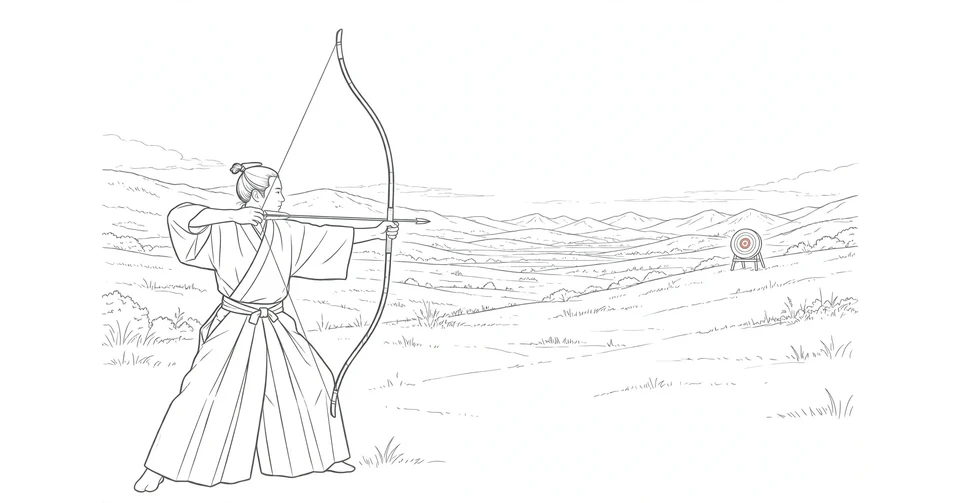
That stillness is the whole point. Kyudo is the Japanese martial art of archery, one of the quietest disciplines Japan has ever produced. The target stands 28 metres away, a modest circle of 36 centimetres, yet the archer is taught to care less about hitting it than about the quality of every movement before the release. A hit that comes from sloppy form is a failure. A miss that comes from correct form is a lesson.
I find that reversal quietly radical. Most of modern life judges everything by the result: the score, the number on the screen. Kyudo refuses that bargain and insists that the process is the product, that how you stand, breathe, draw and release matters more than where the arrow lands. This article follows that insistence: what kyudo is, where it came from, how a single shot is built in eight stages, and why so many people still give their evenings to it.
What kyudo actually is
Kyudo means the way of the bow, and the word itself tells the story of a change. The older name was kyujutsu, the art of archery, a battlefield skill of the samurai class. In 1919 the name was officially changed to kyudo. An art, a jutsu, is a technique for winning. A way, a do, is a path for living. Kyudo kept the bow and the arrow and gave them a different purpose: the training of attention, posture and character. By 1933 the old name had disappeared altogether.
The bow is the first surprise. It is called a yumi, and it stands over two metres tall, taller than most of the people who shoot it. It is also asymmetrical: the archer grips it at about the lower third of the stave, so the upper limb is roughly twice the lower one. Traditionally the yumi is made of bamboo, wood and leather using techniques barely changed in centuries, though beginners often start with a synthetic bow of laminated wood coated with glass fibre or carbon fibre.
The arrows are called ya, traditionally bamboo shafts with eagle or hawk feathers, though today the feathers usually come from turkey or swan. An archer normally shoots two arrows per round, the haya, the first arrow, and the otoya, the second. Their feathers are set so the haya spins clockwise and the otoya counter-clockwise, said to keep two well shot arrows from colliding. An arrow's length is the archer's yazuka, about half the archer's height, plus six to ten centimetres.
The archer wears a deerskin glove on the right hand, the yugake. The common form is the three fingered mitsugake, used with lighter bows, while heavier bows of 18 to 20 kilograms of draw weight and above call for the four fingered yotsugake. Beginners use a single finger glove called an ippongake. A little resin powder called giriko helps the grip, powder from burnt rice husks called fudeko is dusted on the bow hand so the bow can turn in it, and women wear a chest protector called a muneate.
From battlefield bow to a way of life
Archery in Japan is older than the samurai. The first images of the distinct Japanese asymmetrical longbow appear on dotaku, bronze bells from the Yayoi period, roughly 500 BC to 300 AD, and the first written description comes from the Chinese chronicle Weishu, dated to around 297 AD.
The art took its first formal shape when the samurai rose to power at the end of the Heian period, from 794 to 1185. The need to teach archery properly led to the first kyujutsu school, the Henmi-ryu, founded by Henmi Kiyomitsu in the 12th century, whose descendants later founded the Takeda-ryu and the mounted archery school Ogasawara-ryu. Demand for archers grew sharply during the Genpei War, from 1180 to 1185, and in the Kamakura period, from 1185 to 1333, mounted archery flourished in three forms: yabusame, inuoumono and kasagake.
The 15th century brought a revolution in foot archery. Heki Danjo Masatsugu developed a new and accurate approach summed up in three words, hi, kan, chu, fly, pierce, center, and his foot archery spread rapidly. Schools formed in that period still survive today, including branches of Heki-ryu such as Chikurin-ha, Sekka-ha and Insai-ha.
Then, in 1543, the Portuguese arrived in Japan carrying matchlock firearms. The Japanese soon made their own version, the tanegashima, and in 1575 an army of farmers armed with tanegashima destroyed a traditional samurai archer cavalry in a single battle. Yet the bow did not vanish: matchlocks were slow to load and useless in rain, when damp gunpowder would not fire, so the yumi stayed in use long after the guns arrived.
Peace changed archery more than war had. During the Edo period, from 1603 to 1868, the samurai became administrators and archery became a voluntary skill, practised in ceremony and as competition. The most famous contest was the Toshiya, held at the Buddhist temple Sanjusangen-do in Kyoto, where archers shot at a target 133 metres away. Today the Toshiya survives as an annual event on Coming of Age Day, January 15, with women archers taking part and the distance shortened to 60 metres.
The Meiji era, from 1868 to 1912, nearly ended kyudo altogether. The samurai lost their status, kyujutsu was considered obsolete, and practitioners opened dojos to survive, spreading the art among ordinary people. Kyujutsu entered school education in 1895, and in 1896 masters gathered to save it. Honda Toshizane, the archery teacher of the Imperial University of Tokyo, merged the war and ceremonial styles into a hybrid called Honda-ryu. The renaming to kyudo followed in 1919, and a ranking system was established in 1923.
After the Second World War, martial arts were banned under the Allied occupation, and kyudo had to be rebuilt. The All Nippon Kyudo Federation was formed in 1949, and its first task was to set a standard style drawn from the main schools. That manual, the Kyudo Kyohon, was first published in 1953, and its standard form, the shaho hassetsu, is still taught in most dojos in Japan and abroad today. The federation's stated purpose was to promote kyudo, improve the physical strength of the people and cultivate sportsmanship. You can read the federation's own account of its history and its work on the official site of the All Nippon Kyudo Federation.
The eight stages of a single shot
The heart of kyudo practice is the shaho hassetsu, the eight stages of shooting. Every shot follows the same sequence, performed slowly enough that each stage can be felt, with ritual breathing setting the rhythm.
- Ashibumi, placing the footing. The archer steps onto the shooting line, turns to face the kamiza, the honoured seat of the dojo, and sets the feet apart by one yazuka, about half the body height, at a 60 degree angle.
- Dozukuri, forming the body. The archer straightens the back and checks that pelvis and shoulders are parallel to the line set in ashibumi, which keeps the bowstring from striking the face.
- Yugamae, readying the bow. Three phases: torikake, gripping the string; tenouchi, settling the left hand on the grip; and monomi, gazing at the target.
- Uchiokoshi, raising the bow. The archer raises the bow above the head to prepare for the draw, in the vertical shomen style or the diagonal shamen style.
- Hikiwake, drawing apart. The archer brings the bow down while spreading the arms, pushing with the left hand and drawing with the right, passing the midway point called daisan.
- Kai, the full draw. The arrow rests slightly below the cheekbone, level with the mouth, and the archer waits, building the lines of the body in tsumeai and uniting its expansions in nobiai.
- Hanare, the release. The string leaves the right hand and the right arm extends behind the archer, while the bow spins in the hand in a movement called yugaeri, unique to kyudo.
- Zanshin, the remaining mind. The archer holds the posture reached after the release, and only then lowers the bow in yudaoshi.
Six of the eight stages happen before the arrow leaves the bow. The shot is mostly preparation, and the release is the smallest part of it. There is a lesson in that ratio for anyone whose work ends in a single moment of judgement: the moment is brief, the preparation is the real work.
The bow that is taller than the archer
The dojo itself is part of the discipline. A Japanese kyudo dojo has a large wooden floor, a high ceiling, a position for the makiwara targets, and a wide wall of sliding doors opening onto a grassy area and a separate building, the matoba, which houses the targets, 28 metres from the dojo floor. The most common target is the hoshi mato, 36 centimetres across, shot at from 28 metres, while long distance enteki shooting at 60 metres uses the omato, 158 centimetres across.
Competition in kyudo is formal and ceremonial. An archer shoots four arrows in two sets, each hit earning a maru, a circle, and each miss a batsu, an X. Archers enter in groups of up to five, bow to the adjudicators, kneel in a form of sitting called kiza, and move through the hassetsu in lockstep. There are three levels of skill, describing the quality of the hit: toteki, the arrow hits the target; kanteki, the arrow pierces the target; and zaiteki, the arrow exists in the target. The last is the highest. The arrow does not merely strike the target. It belongs there.
The clothing is part of the form too: a kyudo archer trains in keikogi and hakama, the wide pleated trousers worn over a kimono. As an earlier article on this site notes, practitioners of kendo, iaido, aikido, kyudo, jodo and naginata all wear it for training, and the hakama turns an ordinary robe into formal dress.
Why hitting the target is not the point
Every account of kyudo eventually arrives at the same question: if the target is not the point, what is? The federation's answer is a phrase, shin-zen-bi, truth, goodness and beauty. According to the All Nippon Kyudo Federation, this is the supreme goal of kyudo: when archers shoot correctly, with truth, and with a virtuous spirit towards all people and things connected to kyudo, with goodness, then beautiful shooting is realised naturally. Beauty is not aimed at directly. It arrives when the other two are in place.
Two older sayings sharpen the same idea: seisha hicchu, true shooting, certain hitting, and seisha seichu, correct shooting is correct hitting. The spiritual goal behind both is munen muso, no thoughts, no illusions, a state in which the archer gives herself completely to the shooting.
It is easy to misunderstand this as mysticism, and the misunderstanding has a history. Since the Second World War, kyudo has often been associated with Zen Buddhism, largely because of a single book, Zen in the Art of Archery, published in 1948 by the German author Eugen Herrigel. Herrigel spoke only a little Japanese and usually worked through a translator, yet his book, translated into Japanese in 1956, had a huge effect on how kyudo was perceived, even in Japan. The honest record is more complicated. Kyudo is not a religion, though it carries influences from both Shinto and Zen, and after the Meiji era kyudo in Japan was practised for physical education, without any connection to Zen or religion at all.
I think the correction matters more than the romance. Kyudo does not need Zen to justify its slowness; the slowness justifies itself. A practice that asks you to stand still, breathe deliberately, and release only when the body is ready is valuable on its own terms. The archers in the dojo are people doing a difficult, repetitive, physical thing with great care, and the care is the teaching. Kendo, the louder sibling of kyudo, shares the same structure of form first and result second, as the way of the sword lives on in kendo shows.
Who practices kyudo today
Kyudo is practised by over a hundred thousand people worldwide, mostly in Japan. The All Nippon Kyudo Federation counts 47 affiliated federations, one for each prefecture. As of March 31, 2021, the federation had 135,660 members, including 67 holders of the hanshi title, 1,942 kyoshi and 4,691 renshi. Those numbers are large for an art that asks so much patience of its students.
Many Japanese high schools and colleges have kyudo clubs, known as bukatsu, where students gather after classes to practise. The clubs have recently begun appearing in junior high schools as well, though the art is generally left until high school. In towns where a junior high school has no kyudo club, a student may take lessons outside school instead. The school club is where most Japanese archers first meet the bow.
Outside Japan, kyudo has grown slowly and quietly, much like the art itself. It appeared in Italy as early as 1898, but in most Western countries it arrived only in recent times, often brought back by Westerners who had studied it in Japan. The International Kyudo Federation, founded in 2006, now maintains standards for official member bodies in 48 countries as of 2024, and the American Kyudo Renmei, founded in 1998, is the official body for kyudo in the United States. Many countries still have no kyudo dojo at all, or only very small groups.
Beginners are welcomed without ceremony and without equipment. Most dojos lend the gear, and the first lessons use a rubber practice bow, so neither strength nor youth is a requirement. The art can be enjoyed competitively, as a simple recreation, or as a pursuit of the beauty of form. A beginner does not need to choose between them on the first day. The first day is for learning how to stand.
Watching kyudo, or trying it
The easiest way to meet kyudo is to watch it. The Toshiya at Sanjusangen-do in Kyoto, held on Coming of Age Day, is open to spectators, and the sight of young archers in formal dress shooting at 60 metres is one of the most striking ceremonies in Japan. Local dojos also hold open days, and a visitor who sits quietly at the back of a practice session will see the whole art in miniature.
Silence in the dojo is expected, not requested, and applause is not part of the culture. The right response to a good shot is the archer's own: a brief stillness, and then the next archer steps forward. Trying kyudo is a slower commitment than watching it. A beginner's first months are spent on the hassetsu with a rubber bow, then on drawing an empty bow, and only later on shooting at the makiwara from a few feet away. Progress is measured in months and years, not in sessions.
A quieter way to aim
Kyudo began as a weapon, became a ceremony, nearly disappeared, and returned as a discipline for ordinary people who want to learn how to be still. Its bow is taller than its archer, its shot is mostly preparation, and its highest ideal is a state in which the arrow belongs in the target.
The lesson I take from kyudo has nothing to do with archery. A result improves when you stop chasing it directly and attend instead to the quality of the steps that produce it. The archer at the line is not trying to hit the target. She is trying to stand correctly, breathe correctly, draw correctly and release correctly, and the target is simply where the truth of all that becomes visible. Whether the arrow hits or misses, the form tells her why. Either way, she steps back, bows, and begins again, because in kyudo the next shot is the only one that matters.
More in Culture & Society
- A Torii Gate Marks Where the Ordinary World Ends
- The Yumi Stands Taller Than Its Archer
- Iaido Is the Art of Drawing the Sword Before the Fight Begins
- Pancawara Gives Bali a Five Day Week That Never Stops Turning
- Hanami Turns Cherry Blossom Season Into Japan's Longest Picnic
- Bogu Is the Armour That Lets Kendo Strike at Full Speed
Latest posts
- Ekiben, the Train Station Bento That Turns a Journey into a Meal
- Natto, the Sticky Fermented Beans Japan Loves and Visitors Fear
- Ema Lets You Hang a Wish Where the Kami Can Read It
- Bonsai and the Thousand-Year Art of Tiny Trees
- The Shinai Is a Bamboo Sword That Teaches Before It Strikes
- Omikuji Tells Your Fortune on a Slip of Paper
- Japan Meets the New Year at Hatsumode
- The Way of the Sword Lives On in Kendo
- Hakama Turn a Kimono Into Ceremony
- A Haori Is the Jacket That Turns a Kimono Formal
- The Taiko Musubi Turned a Kimono Sash Into a Drum
- Hiroshige Walked the Tokaido and Japan Followed
- Hokusai Spent a Lifetime Chasing One Mountain
- Tabi Are the Split Toe Socks Japan Wears Under Everything
- Ukiyo-e Turned Everyday Edo Into Art Anyone Could Own