Origami and How a Single Sheet of Paper Became Japan's Quiet Art
· 10 min read
Origami turns one square of paper into a crane, a flower, or a satellite part. This is the story of how folding became one of Japan's quietest and most enduring arts.
Origami needs nothing but a square of paper and two hands. No scissors, no glue, no expensive tools. Fold, crease, turn, fold again, and a flat sheet becomes a crane with its wings half open, as if it might take off from your palm. That is the whole miracle of origami, and it has kept people folding for more than a thousand years.
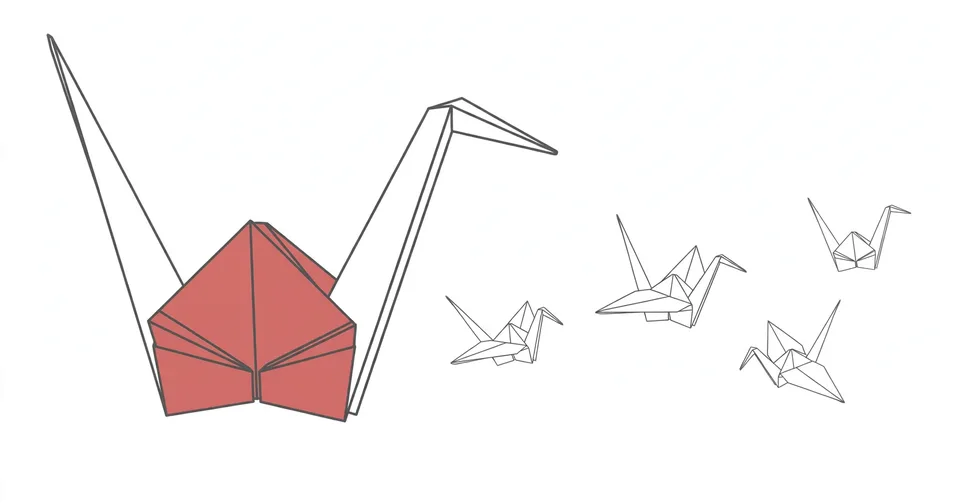
The word itself is simple. It comes from oru, to fold, and kami, paper. But the art it names is anything but simple. Origami has been a temple offering, a samurai courtesy, a children's game, a school lesson, and, in our own time, a design language for space telescopes and medical devices. Few crafts have travelled so far while asking so little of the person who practises them. I have folded cranes on train rides and at kitchen tables, and I keep coming back to the same thought: origami is the rare art that rewards patience without punishing beginners. A child can fold a boat in five minutes. A master can spend a week on a single dragon. Both are doing the same thing.
Origami began with paper, not with play
Paper was invented in China around 105 AD, and papermaking reached Japan in the early seventh century, carried by Buddhist monks. In those early centuries paper was scarce and costly, so folding it was not a pastime. It was ceremony. Priests and nobles folded paper into formal shapes for offerings and gifts, a practice known as origata, and the folds themselves carried meaning. A gift wrapped in a certain way said something about the giver, the occasion, and the respect owed to the receiver.
By the Muromachi period, from the 1300s to the 1500s, warrior households had turned paper folding into a matter of etiquette. The Ogasawara and Ise schools set the rules for how paper should be folded at formal occasions, and those rules became part of a samurai's education. Origami at this stage was not art for its own sake. It was manners made visible.
The shift toward play came slowly. Paper grew cheaper, and by the Edo period, from 1603 to 1868, folding had become a pastime as well as a ceremony. A poem from 1680 mentions butterfly origami, which tells us the practice was already well established in everyday life. The oldest known technical book on recreational folding, Hiden Senbazuru Orikata, was published in 1797. It showed how to fold 49 linked cranes from a single sheet, a feat that still impresses folders today. You can read the full history of origami on Wikipedia, which traces the craft from its ceremonial roots to its modern revival.
What strikes me about this long history is how little the core idea has changed. The sheet is still square. The hands still do the work. Everything else, the books, the diagrams, the exhibitions, grew around that one quiet act.
The crane that became a symbol
No model matters more in origami than the crane. In Japanese folklore the crane is a sacred bird said to live for a thousand years, and folding one thousand paper cranes, a senbazuru, was believed to grant the folder a single wish. The cranes are threaded together and given at weddings, births, and hospital beds, where they carry the simple hope that things will get better.
The crane took on a second meaning after the Second World War. Sadako Sasaki was two years old when the atomic bomb fell on Hiroshima in August 1945. Ten years later she developed leukaemia, and in hospital she began folding cranes, aiming for one thousand. The popular version of her story says she folded 644 before she grew too weak and her classmates finished the rest. Her family says she passed one thousand and kept folding, reaching about 1,400 before she died on 25 October 1955, at the age of twelve. Either way, the image of a sick child folding paper birds became one of the most powerful symbols of peace in the world. A statue of Sadako holding a crane stands in Hiroshima Peace Memorial Park, and cranes sent from around the world are still laid at its base.
The crane is also the model most people fold first, and that is no accident. It uses the classic bird base, a foundation that also produces the frog, the iris, and half a dozen other traditional designs. Learn the crane and you have learned the grammar of origami. It is the same kind of quiet discipline that runs through other Japanese crafts. The patience behind a repaired bowl in kintsugi, the Japanese art of repairing broken things and the search for purpose in ikigai, the Japanese idea of a reason to live both start from the same place: small, careful work repeated until it becomes something larger than itself.
Akira Yoshizawa and the language of folds
For most of its history, origami was passed down by watching and copying. There was no standard way to write down a fold. That changed in 1954, when Akira Yoshizawa published Atarashii Origami Geijutsu, or New Origami Art. Yoshizawa, often called the grandmaster of modern origami, invented a system of diagram symbols, dashed lines for valley folds, dotted lines for mountain folds, arrows for direction, that let anyone in any country read a design. American folder Samuel Randlett later refined the system, and the Yoshizawa-Randlett notation is now the international standard. A diagram drawn in Tokyo can be followed in Toronto without a single translated word.
Yoshizawa also invented wet folding, dampening paper that contains a water soluble glue so it can be shaped into soft curves that harden as they dry. Before him, origami animals were angular and geometric. After him, they could have rounded backs, gentle necks, and faces with expression. His exhibitions in Europe in the 1950s introduced the wider world to origami as a serious art, not just a children's craft. Lillian Oppenheimer founded the Origami Center of America in 1958, and societies soon followed in Britain and across Europe.
The notation system matters more than it might seem. It turned a craft that lived in memory into a craft that could be stored, shared, and improved. Every modern folder, from the schoolchild with a paper frog to the engineer designing a folding solar panel, is working in a language Yoshizawa wrote down seventy years ago. The Japan Craft site Kogei Japonica has a clear account of how origami moved from ceremony to modern design, including the notation system and its later uses.
Origami in the age of satellites and stents
The most surprising chapter of origami is the one being written now, by people who may never fold a crane. Engineers realised that the mathematics of folding, how a flat sheet becomes a compact bundle and then opens into a precise shape, solves real problems. The Miura fold, invented by astrophysicist Koryo Miura, lets a large sheet collapse into a small package and unfold with a single pull. It has been used in solar panels for satellites, and the same logic shapes the sunshield of the James Webb Space Telescope, which had to fold small enough to fit inside a rocket and open to the size of a tennis court in space.
Medicine has borrowed the idea too. Stents, the tiny tubes that hold open blood vessels, are folded into a catheter and expand once inside the body. Researchers are designing origami inspired capsules that unfold in the stomach to deliver drugs slowly, and airbags that fold into dashboards the way paper folds into a crane. The connection is not poetic. It is geometric. A fold is a fold, whether the material is paper or titanium.
Even so, the paper itself has not been left behind. Artists now fold from a single uncut square into insects with dozens of legs, using paper so thin it is almost tissue, and mathematicians use origami to teach geometry in classrooms. The craft keeps growing in both directions at once, toward the laboratory and toward the kitchen table.
How to start folding origami today
Starting is cheap and forgiving. A pack of coloured squares costs less than a coffee, and the first models take minutes. The table below lists five traditional first folds, from the easiest to the one that opens the door to everything else.
| Model | Folds | What it teaches |
|---|---|---|
| Paper boat | 6 | Valley folds and opening a pocket |
| Tulip | 8 | Petal folds and shaping |
| Jumping frog | 10 | The waterbomb base |
| Butterfly | 12 | Symmetry and thin layers |
| Crane | 16 | The bird base, the heart of origami |
The crane sits last for a reason. It asks for the bird base, and the bird base asks for patience. But once you can fold a crane, dozens of other models become reachable, because they share the same foundation. My advice is to fold the first four without worrying about neatness, then take your time with the crane. Creases should be sharp, so run a fingernail or a ruler along each fold. Work on a hard, flat surface. And if a model collapses, unfold it and look at the crease pattern. The paper remembers every fold, and the pattern will show you where you went wrong.
Paper choice matters more than beginners expect. Standard kami, the thin coloured paper sold in packs, is best for learning. It creases sharply and holds a fold. Washi, the traditional Japanese handmade paper, is thicker and tougher, good for display pieces. Foil paper looks striking but tears easily and shows every mistake. Avoid printer paper at first. It is too thick for models with many layers, and it fights back.
Why origami still matters
Origami has survived for fourteen centuries because it asks almost nothing and gives back more than it should. It needs no electricity, no studio, no audience. It can be folded on a train, in a hospital waiting room, or at a kitchen table late at night. It teaches the hands to be patient and the mind to think in steps, and it does both without a lecture. Children learn geometry from it without realising they are learning. Adults find in it a rare kind of quiet, the kind that comes from giving full attention to a small task.
Japan has given the world many arts that look simple and turn out to be deep, from the cherry blossoms that draw crowds every spring to the tea ceremony and the garden. Origami belongs in that company. It begins with a square and ends with a bird, and in between it asks only that you slow down and pay attention. That may be the most useful thing a piece of paper can teach.
More in Culture & Society
- Kagura Is the Sacred Dance Shinto Still Performs
- Norito Give a Shinto Ceremony Its Voice
- The Gohei Wand Carries the Kami Into the Ceremony
- A Hishaku Is the Bamboo Ladle That Starts Every Shrine Visit
- A Kitsune Is the Fox Messenger Who Guards the Shrines of Japan
- Temizuya Is Where Every Shrine Visit Begins With Water
Latest posts
- Kitsune Udon Is the Bowl the Fox Would Order
- Shide Are the Paper Lightning That Marks a Sacred Space
- Tokyo Disneyland and Why Japan Loves It Differently
- Yabusame Turns Horseback Archery Into a Moving Prayer
- Walking Through Senbon Torii Feels Like Entering Another World
- Onigiri, Japan's Two-Thousand-Year-Old Portable Meal
- Roro Jonggrang and the Thousand Temples Built in One Night
- Ten Thousand Vermilion Gates Lead Up Fushimi Inari
- Prambanan Towers Over Java With a Love Story in Stone
- Shimenawa Marks the Line Between Ordinary and Sacred
- A Torii Gate Marks Where the Ordinary World Ends
- The Yumi Stands Taller Than Its Archer
- Ekiben, the Train Station Bento That Turns a Journey into a Meal
- Kyudo Turns Archery Into a Moving Meditation
- Iaido Is the Art of Drawing the Sword Before the Fight Begins