Roro Jonggrang and the Thousand Temples Built in One Night
· 19 min read
The legend of Roro Jonggrang tells how a princess set an impossible task, a prince built 999 temples in a single night, and a curse turned her to stone at Prambanan.
The legend of Roro Jonggrang is the most famous folktale attached to a temple in Indonesia. It tells of a princess who set an impossible task, a prince who almost finished it, and a curse that turned the princess to stone. The story is taught in Indonesian schools, retold to children across Java, and performed on stage beneath the very towers it claims to explain.
The heart of the tale is simple enough to tell in one breath. Roro Jonggrang, daughter of a defeated king, was asked to marry the man who had killed her father. She agreed on one condition, that he build one thousand temples in a single night. He built 999. She faked the dawn to stop him. He cursed her to become the thousandth temple, and so the story goes, she still stands in stone inside Prambanan today.
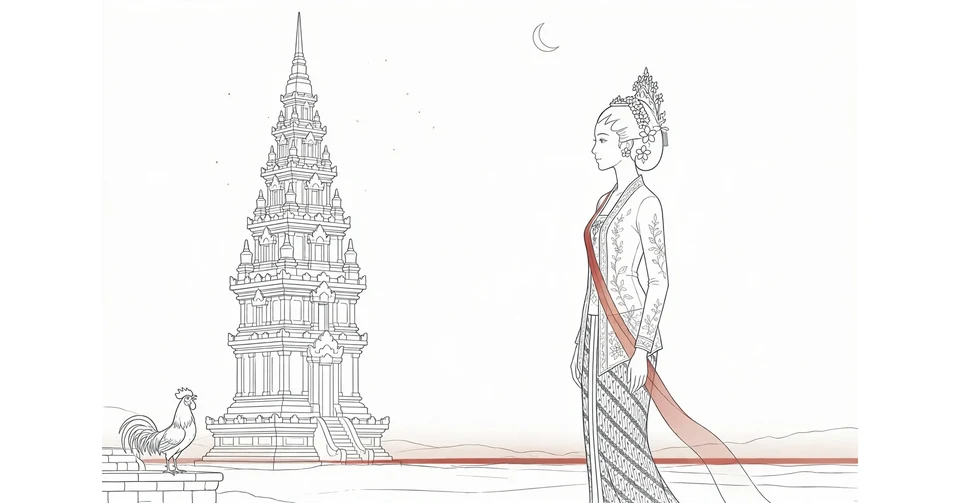
That is the story as millions of Indonesians know it, and it is worth telling in full, because the legend of Roro Jonggrang is more than a spooky tale for tourists. It is a story about grief, consent, cleverness, deception, and revenge, and it is tied to real stones that anyone can visit. The temples are real. The statue is real. Only the night of building is a matter of faith, not history, and that tension between stone and story is exactly what has kept the legend alive for centuries.
Two kingdoms and a war that started it all
The legend begins with two neighbouring kingdoms in ancient Java, Pengging and Boko. Pengging was prosperous and wisely ruled by King Prabu Damar Moyo, who had a son named Bandung Bondowoso. Boko, by contrast, was ruled by Prabu Boko, a cruel giant king, supported by his commander Patih Gupolo, also spelled Gupala in some retellings. Despite her father and his fearsome reputation, Princess Roro Jonggrang was celebrated for her extraordinary beauty.
Prabu Boko wanted to expand his kingdom, so he raised an army and increased taxes to pay for an invasion of Pengging. His forces launched a surprise attack, and the war that followed brought devastation and famine to both sides. To defeat the invader, Prabu Damar Moyo sent his son Bandung Bondowoso to fight Prabu Boko. After a furious battle, the prince killed the giant king with his supernatural powers, and Patih Gupala led the defeated armies away from the battlefield.
This is where the legend turns from a war story into a love story, and a dark one. Patih Gupala returned to Boko Palace and told Princess Roro Jonggrang that her father was dead. She was heartbroken, and before she could recover from her grief, the Pengging army besieged and captured the palace. Prince Bandung Bondowoso saw the mourning princess, was mesmerized by her beauty, and proposed marriage. For him it was love at first sight. For Roro Jonggrang, the man standing before her was not a hero. He was the killer of her father.
That gap between how the two of them saw the same moment is the engine of the whole legend. Bandung Bondowoso believed that victory had earned him the princess. Roro Jonggrang believed that no victory could earn her consent. She could not refuse the victorious prince outright, so she did the only thing left to a person with no army and no power. She set a condition she believed no one could meet.
It is worth pausing on that choice, because it is easy to read the legend as a story about a clever princess tricking a prince, and to miss the grief underneath it. Roro Jonggrang had just lost her father and her kingdom in the same day. Her proposal was not a game. It was a refusal dressed up as a challenge, the only kind of refusal a conquered princess could safely make. That is one reason the story still moves people. It is not only about magic temples. It is about a woman trying to protect her own freedom with the only tool she had, her wits.
The well of Jalatunda and the first impossible task
Roro Jonggrang did not set one impossible condition. She set two. First, the prince must build a well named Jalatunda. Second, he must construct one thousand temples in only one night. The lovestruck prince agreed to both without hesitation, and he started work on the well at once.
Using his supernatural powers and summoning demons to help him, Bandung Bondowoso finished the well swiftly and proudly showed his work to the princess. Here the legend gives us its first twist, and it is a darker one than most school retellings dwell on. Roro Jonggrang urged the prince to enter the well to admire it from inside, and when he did, Patih Gupala piled stones into it and buried him alive.
With great effort, Bandung Bondowoso escaped from the well. His love for the princess was so strong that he forgave her for the attempt on his life, and he moved on to the second condition as if nothing had happened. Some versions of the story treat this forgiveness as proof of his devotion. Others read it as proof of his obsession, since a man who has just been buried alive by the woman he wants to marry and still insists on marrying her is not listening to what she is telling him. Either way, the well matters to the story because it establishes the pattern. Roro Jonggrang would try to stop him. Bandung Bondowoso would refuse to stop. The temples would be the final test of that pattern.
The well of Jalatunda also matters because it anchors the legend of Roro Jonggrang to the landscape. The story does not take place in a nowhere kingdom. It names places, and the places can be visited, which is part of why the legend feels so solid to the people who tell it. A folktale that explains a well, a palace, a temple, and a statue all at once is a folktale that gives a whole region its memory.
Roro Jonggrang and the thousand temples
When night fell, Bandung Bondowoso entered meditation and conjured a multitude of spirits from the earth. With their help he began to build, and temple after temple rose from the plain of Prambanan with astonishing speed. The work went so fast that by midnight, the impossible no longer seemed impossible. Stone was cut, carried, and set in place by hands that were not human, and the plain filled with towers.
Roro Jonggrang watched in growing alarm. Roro Jonggrang had counted on the task being impossible, and the spirits were proving her wrong. Only one temple remained unfinished as the night wore on, and she knew that if the last tower was completed before sunrise, she would have to keep her word and marry the man who had killed her father.
There is a detail in the legend that deserves attention, and it is the number 999. The prince did not fail by a little. He failed by one temple out of a thousand. That narrow margin is what makes the story of Roro Jonggrang so tense, and it is what makes the ending feel so unfair to both sides. Bandung Bondowoso was one temple away from winning everything he wanted. Roro Jonggrang was one temple away from losing everything she had. The whole legend balances on that single missing temple, and every retelling keeps the number exact, because the number is the point.
The scale of the task is also worth picturing honestly. One thousand temples in a single night is not a big building project. It is an absurd one, and the legend knows it. That is why the prince needs an army of spirits, and that is why the story has always been told as a folktale rather than as history. Nobody who tells the story of Roro Jonggrang believes that a thousand stone temples were raised between sunset and sunrise by human hands. The wonder of the story is not that it could have happened. The wonder is that the temples are really there, standing on the plain, and the story gives them a beginning that matches their grandeur.
The faked dawn
Desperate, Roro Jonggrang called upon the women of the village. She instructed them to pound rice in large wooden mortars, a sound that traditionally marked the beginning of dawn. Others lit fires in the east so that the sky glowed as though sunrise had arrived. The roosters crowed. The whole village performed the morning, hours before the morning had come.
Fooled into thinking the sun was about to rise, the spirits fled back beneath the earth. Construction stopped. Only 999 temples stood completed, and the thousandth was left unfinished. The trick had worked, and the princess had won her freedom, at least for the moment.
The faked dawn is the most human scene in the legend of Roro Jonggrang. There is no magic in it, only teamwork, timing, and a deep knowledge of how mornings sound and look in a Javanese village. The women pounding rice, the fires in the east, the roosters crowing, these are ordinary things, and the legend turns them into the hinge of the story. It is also the scene that makes the moral of the tale complicated. Roro Jonggrang cheated, and the story does not hide that. She made a promise, set a condition, and then broke the rules of her own bargain when she saw she was going to lose. Generations of Indonesian schoolchildren have argued about whether she was right to do it, and that argument is part of the reason the story is still taught. A tale with a clean hero and a clean villain is easy to forget. A tale where the heroine cheats to escape a forced marriage, and the prince is both a murderer and a heartbroken lover, is a tale people keep arguing about.
My own feeling, for what it is worth, is that the legend is wiser than a simple lesson about honesty. Honesty matters, and the story does not let Roro Jonggrang escape the cost of her deception. But consent matters too, and a promise extracted by conquest is not the same as a promise freely given. The legend holds both of those truths at once and refuses to settle them, which is why it still feels honest centuries later. A story that only punished the princess would be a warning. A story that only celebrated her would be a fantasy. The legend of Roro Jonggrang does neither, and that refusal is its wisdom.
The curse and the statue in the north chamber
Bandung Bondowoso soon realized he had been deceived, and his fury was terrible. Heartbroken and consumed by rage, he pronounced a curse on Roro Jonggrang. If she sought one more statue to complete her thousand temples, he declared, then she would become the last one herself. Instantly, Roro Jonggrang was transformed into stone.
According to the legend of Roro Jonggrang, she became the graceful statue still standing today inside the northern chamber of Prambanan's Shiva Temple. In this way, she became a feature of the final temple, completing its construction and fulfilling the conditions for their union in the cruellest possible way. The prince got his thousandth temple. The princess got permanence, at the price of her life.
Visitors entering the great Shiva Temple eventually reach the northern chamber, where an elegant stone figure stands in quiet dignity. For many Indonesians, this is not merely a Hindu goddess. It is Roro Jonggrang herself, frozen forever in the moment of her punishment. A detailed modern retelling of the legend of Roro Jonggrang describes how the statue's eight arms, its weapons, and its calm expression have only deepened the identification, because the figure looks like a princess and a goddess at the same time, which is exactly what the story says she became.
The statue is, in archaeological terms, Durga Mahishasuramardini, one of Hinduism's most powerful goddesses, shown with eight arms holding divine weapons given by the gods before her battle against the buffalo demon Mahishasura. One hand grasps the demon by his hair while she stands triumphantly upon the defeated buffalo beneath her feet. Researchers note that the sculpture follows classical Hindu iconography and is positioned in the northern chamber as Shiva's divine consort, alongside statues of Shiva, Agastya, and Ganesha in the temple's other chambers. The full retelling of Roro Jonggrang on Wikipedia records the same identification, and the same sources note that the later association with the princess arose through local oral tradition and was eventually adopted by colonial era writers, becoming firmly embedded in popular memory.
That double identity, goddess and princess at once, is what makes the chamber so moving to visit. A visitor is free to see both at the same time, a powerful Hindu goddess carved by ninth century sculptors, and a princess who became immortal through a story. The temple speaks through inscriptions and archaeology. The legend speaks through imagination. Together, they turn Prambanan from a remarkable monument into a living cultural landscape where every carved stone seems to carry a story. The full story of the temple itself, its towers, its reliefs, and its long restoration, is told in the companion piece on this site about Prambanan, the temple that towers over Java with a love story in stone.
A folk belief has grown up around the statue as well. Local guides tell visitors that unmarried couples who enter the chamber of the Roro Jonggrang statue together risk having their relationship fall apart, a warning that is repeated so often it has become part of the site's folklore. Most guides and scholars treat it as a cultural story rather than a literal prediction, and the temple's management acknowledges the myth as part of the site's heritage rather than as a factual warning. Still, the belief shows how deeply the legend has settled into the place. A story about a forced marriage that ended in a curse has become, over the centuries, a story that young couples whisper about before they step inside.
What the temples really are
The historical Prambanan tells a story every bit as dramatic as the legend, and it is worth setting the two side by side. Unlike the folktale, historians know that Prambanan was not built in a single night. Construction began around 850 CE during the reign of Rakai Pikatan of the Hindu Sanjaya dynasty and continued under later rulers including Lokapala and Balitung. Originally known as Siwagrha, meaning House of Shiva, it was built as the grandest Hindu temple complex in ancient Java, and it remains the largest Hindu temple complex in Indonesia today.
The towering central Shiva Temple rises nearly 47 metres, surrounded by temples dedicated to Brahma and Vishnu, forming the sacred Trimurti of Hinduism. The Hindu temples are decorated with reliefs illustrating the Indonesian version of the Ramayana epic, masterpieces of stone carving that cover the walls in long narrative bands. The complex was recognised as a UNESCO World Heritage Site in 1991, and its full name in that listing, Prambanan Temple Compounds, covers not only the main temple, also called Loro Jonggrang, but the nearby Sewu, Bubrah, and Lumbung temples as well.
That last detail connects back to the legend in a way that delights visitors. Sewu means thousands in Javanese, and the name fits the story of the thousand temples so neatly that it is easy to assume the legend was invented to explain it. In fact the Sewu complex actually contains only 249 temples, a sober count that sits beside the round number of the folktale and quietly reminds us which of the two is history and which is story. The legend of Roro Jonggrang says the thousandth temple is part of the Sewu compound, and the name of the place has carried that association ever since.
Prambanan is also the great Hindu counterpart to another of Java's wonders. Where Prambanan rises in sharp spires toward the sky, Borobudur, the largest Buddhist temple in the world, spreads in massive terraces across a hill, and the two monuments together anchor Central Java as one of the richest archaeological landscapes in Southeast Asia. Both were built within a century of each other, both were lost to jungle and earthquake and rediscovered in later centuries, and both now draw visitors from around the world. The legend of Roro Jonggrang belongs to Prambanan in the same way that the story of the Buddha's life belongs to Borobudur, not as a history textbook, but as the living voice of the place.
Some scholars believe the legend may preserve distant memories of real political events. One interpretation suggests that the characters symbolize the struggle between two powerful dynasties that competed for control of Central Java during the ninth century. In that reading, Bandung Bondowoso represents Rakai Pikatan, Roro Jonggrang echoes Princess Pramodhawardhani, and Prabu Baka reflects the Sailendra royal line. The actual historical event was probably a contest of power between Balaputradewa, the Sailendran heir, and his sister Pramodhawardhani, aided by her husband Rakai Pikatan, which ended with Pikatan as the victor and the end of Sailendran rule in Central Java. It is a reminder that folktales are often history remembered in a different key, with politics turned into princes and princesses, and wars turned into curses.
The people behind the names
The legend of Roro Jonggrang is short, but its cast is worth keeping straight, because the names recur in guides, dance programmes, and schoolbooks, and the historical readings add a second layer to each one.
| Figure | In the legend | In the historical reading |
|---|---|---|
| Roro Jonggrang | Princess of Boko, daughter of Prabu Boko, turned to stone | Echoes Princess Pramodhawardhani of the Sailendra line |
| Bandung Bondowoso | Prince of Pengging with supernatural powers | Represents Rakai Pikatan of the Sanjaya dynasty |
| Prabu Boko | Giant king of Boko, killed in battle | Reflects the Sailendra royal line |
| Patih Gupala | Commander of Boko who buries the prince in the well | No direct historical counterpart |
| Prabu Damar Moyo | Wise king of Pengging, father of the prince | Ruler of Pengging in the folktale tradition |
The table is a useful map, but it is not the story. The story is what happens between these people, and the table cannot show the grief, the trick, or the curse. Keep it as a reference while reading, then forget it and follow the tale itself, because the legend works as a story first and a history lesson second, and it is the story that people carry home with them.
One more detail about the name is worth knowing. Roro Jonggrang is also spelled Rara Jonggrang or Loro Jonggrang, and the word Roro, pronounced Rara in Javanese, is an ancient honorific title used to address unmarried princesses and noblewomen. The name itself means slender maiden, a description of the princess's grace that has become her identity. It is a gentle name for a story that ends so harshly, and that contrast is part of its pull. The slender maiden is remembered not for her beauty alone, but for the night she tried to outwit a prince and the dawn she faked to do it.
Why the legend still matters
Few legends are woven so deeply into Indonesian culture. Its popularity has several roots, and each one says something about why some stories survive while others fade. First, it explains the landscape. The story links three remarkable archaeological sites, Prambanan, Ratu Boko, and Candi Sewu, into one sweeping narrative, so that a visitor who knows the tale sees more than stones. Second, it teaches moral lessons. For generations, the tale has been used to discuss honesty, loyalty, the consequences of deception, and the dangers of forcing another person's will. Third, it celebrates Java's cultural identity, bridging Hindu mythology, Javanese storytelling, and local history into a uniquely Indonesian narrative that belongs to everyone, regardless of religion.
It also comes alive on stage. Against the illuminated backdrop of Prambanan, the famous Ramayana Ballet retells the epics carved into the temple walls, and the legend of the princess is woven into the dance traditions performed at the complex, allowing visitors to experience Java's storytelling through movement, music, and theatre. Watching the story danced in the open air, with the towers lit behind the performers, is a different experience from reading it, and it is the reason the legend reaches people who have never opened a history book. The tale was made to be performed, and it still is.
There is a final reason the legend endures, and it is the simplest one. It is a good story, told well, with a beginning that hooks you, a middle that tightens like a rope, and an ending that refuses to let you go. A thousand temples, a faked dawn, a curse, and a statue that is still standing. A story does not need to be true to be worth keeping. It needs to be honest about the people in it, and the legend of Roro Jonggrang is honest about all of them, the grieving princess, the obsessed prince, the women who pounded rice in the dark, and the spirits who fled from a sunrise that had not happened yet.
Stand in the northern chamber of the Shiva temple, look at the statue of Durga with her eight arms and her calm face, and the legend of Roro Jonggrang stops being a story from a schoolbook. It becomes a question that the stones ask every visitor. What would you have done in her place, with a conqueror at the door and only one night to save yourself? The legend does not answer that question for you. It leaves you standing in front of the statue, turning it over in your own mind, and that is why, after a thousand years, people are still telling it.
More in Culture & Society
Latest posts
- Walking Through Senbon Torii Feels Like Entering Another World
- Onigiri, Japan's Two-Thousand-Year-Old Portable Meal
- Prambanan Towers Over Java With a Love Story in Stone
- Ekiben, the Train Station Bento That Turns a Journey into a Meal
- Iaido Is the Art of Drawing the Sword Before the Fight Begins
- Natto, the Sticky Fermented Beans Japan Loves and Visitors Fear
- Pancawara Gives Bali a Five Day Week That Never Stops Turning
- Hanami Turns Cherry Blossom Season Into Japan's Longest Picnic
- Bogu Is the Armour That Lets Kendo Strike at Full Speed
- Ema Lets You Hang a Wish Where the Kami Can Read It
- Bonsai and the Thousand-Year Art of Tiny Trees
- The Shinai Is a Bamboo Sword That Teaches Before It Strikes
- Omikuji Tells Your Fortune on a Slip of Paper
- Japan Meets the New Year at Hatsumode
- The Way of the Sword Lives On in Kendo