Yabusame Turns Horseback Archery Into a Moving Prayer
· 16 min read
Yabusame is Japanese horseback archery performed as a Shinto ritual, where a rider at full gallop shoots three wooden targets as an offering for peace and good harvests.
The horse is already running before you understand what you are watching. A rider in hunting dress comes down the track at full gallop, both hands on a bow taller than himself, and no hands at all on the reins. He draws, looses, and reaches for the next arrow while the horse keeps running. Three targets, three arrows, a few seconds of thunder, and then it is over. The crowd cheers, and the rider slows his horse at the far end of the course as calmly as if he had been out for a morning ride. That is Yabusame.
Yabusame is Japanese mounted archery, and it is also a prayer. The word names a skill that began as samurai training and became a Shinto ritual, performed at shrines as an offering for peace, good harvests, and the health of the people. The rider shoots at three wooden targets set along a straight track, and every part of the performance, from the dress to the shout that goes up as the horse runs, is part of the offering.
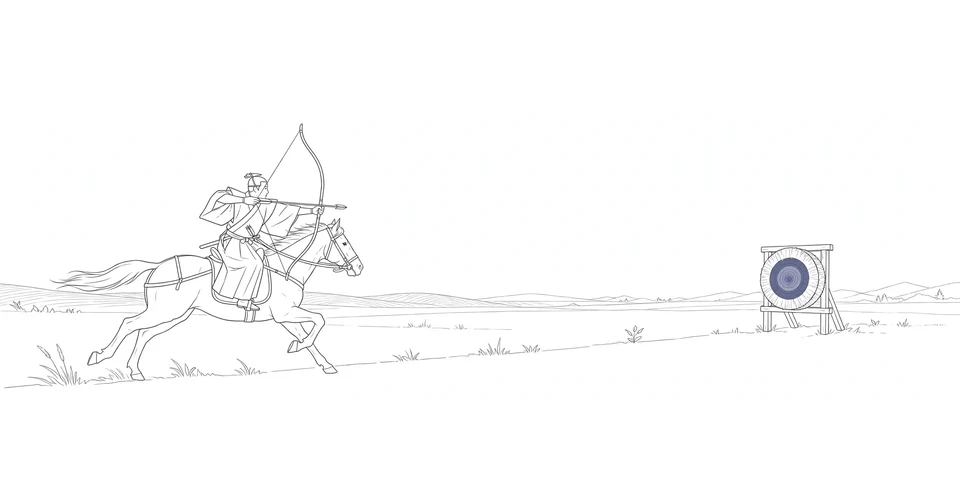
What makes Yabusame worth a second look is the combination it asks for. Speed and stillness do not usually belong together, yet here they do. The horse runs as fast as it can while the archer holds his body steady enough to shoot. This article follows that combination: what Yabusame is, how a battlefield skill became a shrine ritual, who keeps it alive today, and where you can watch it.
What Yabusame is
At its simplest, Yabusame is archery on horseback. The rider gallops down a straight track of about 250 metres and shoots at three wooden targets placed along its length, one arrow for each target. The targets stand to the left of the rider, so he must draw, aim, and loose while the horse carries him past at speed, then prepare the next arrow before the next target arrives. There is no time to hesitate and no second chance at a target once it has passed.
The riding itself is part of the skill. The archer rests his weight on iron stirrups and balances with his lower body alone, leaving both hands free for the bow. That is the detail that surprises most first time watchers. A rider steering a galloping horse with no hands on the reins looks impossible until you see it done, and then it looks like the only way it could ever have been done. The horse knows the track. The rider trusts it to run straight.
But Yabusame is not a sport, and it is not a show put on for tourists. At a shrine, the shooting is an offering to the kami, the deities honoured there. The targets and arrows are sanctified before the deities, and in the old practice archers would bring them home as protection, praying for a good grain harvest and peace in the world. The arrow is not only aimed at a target. It is aimed, in a sense, at the coming year, and the wish is that the year goes well.
I find that framing quietly moving. Most ceremonies ask people to stand still and be reverent. Yabusame asks for reverence at full gallop, and it treats skill itself as a form of prayer. The archer does not pray and then shoot. The shooting is the prayer, and a well shot arrow is a well made wish.
From battlefield skill to shrine ritual
Mounted archery in Japan is older than the samurai. It was practised as a form of recreation at the imperial court, and with the rise of the samurai it became a central battlefield skill, a way for a warrior to shoot accurately from a moving horse. In the Kamakura period, from 1185 to 1333, mounted archery flourished in three forms: yabusame, inuoumono, and kasagake. Of the three, Yabusame is the one that survived most visibly into the present, because it found a home in the shrines.
The landmark date in the story is 1187. Minamoto no Yoritomo, the founder of the Kamakura shogunate and of Tsurugaoka Hachimangu in Kamakura, is said to have dedicated a Yabusame ritual at the shrine after a hojoe, a religious ceremony that warns against the taking of lives and releases birds and beasts into the natural world. Yoritomo had his warriors trained intensively in the bow, and the ritual gave that training a sacred purpose. The shrine is dedicated to Hachiman, the guardian deity of the warrior class, so the offering went to the god the warriors themselves honoured.
Over the centuries, horseback archery gradually changed from a strictly martial pursuit into a ritual practice performed at shrines and at the imperial court in Kyoto. The bow stayed, the horse stayed, and the targets stayed, but the enemy disappeared. What remained was the discipline and the prayer. The change is worth noticing because it is the opposite of what usually happens to a weapon. Weapons normally fade when wars end. Yabusame survived because it stopped being only a weapon and became a ceremony, and ceremonies are kept alive by communities, not by armies.
Its quieter cousin on foot took a similar road. Kyudo, the way of the bow, also began as samurai archery and became a discipline of posture and attention, and the two arts still share the same longbow and the same belief that how you shoot matters as much as whether you hit. The difference is the horse. Kyudo asks for stillness on the ground. Yabusame asks for stillness at speed, and that makes it the louder and more dramatic of the pair.
Three targets at full gallop
The setting matters as much as the shooting. At Tsurugaoka Hachimangu, the Yabusame track is about 250 metres long and crosses the approach to the main shrine at right angles, near the middle of the shrine grounds. The targets are placed on the southern side of the track, deliberately, so that no arrow is ever shot in the direction of the shrine. Even the direction of an arrow expresses respect for the deity, and the layout of the course is part of the ritual, not just a practical choice. The Japan Tourism Agency describes the track and its arrangement in its guide to the Yabusame archery track.
A run begins before the first target. The rider waits for the signal, often a fan raised by an assistant, and then the horse is sent forward. Between the targets there is only the work of preparing the next arrow while the ground rushes past, and the archer must do three things at the same time: ride the horse, pull the bow, and make a shout. The shout is "in-yo," called out as the horse runs, and it is part of the ritual sound of the day along with the drums, the hoofbeats, and the thud of arrows striking wood.
Hitting all three targets is rare, and nobody in the crowd seems to mind. A single hit draws a cheer, and a clean run with good form draws applause even when an arrow misses. That tells you what the audience is really watching. They are watching a person do something extremely difficult with apparent calm, and the calm is the achievement. Speed makes the difficulty visible. Anyone can look composed standing still. Looking composed on a galloping horse, with a bow in both hands, is another matter entirely.
There is a lesson in that for the rest of us, I think. We tend to believe that pressure is the enemy of good work, and that the answer is to slow down and remove the pressure. Yabusame suggests a different answer: train until the pressure stops mattering. The archer does not wish the horse would run more slowly. He has practised until the speed feels normal, and the ritual gives him a reason to want the speed, because the offering is only complete when it is performed properly, at the pace the tradition demands.
The schools that keep Yabusame alive
Yabusame survived for more than 800 years because schools kept it, and the schools are still the heart of the tradition. The most famous is the Ogasawara school, founded by Ogasawara Nagakiyo, who lived from 1162 to 1242 and was invited by Minamoto no Yoritomo to be an instructor of archery and horse riding. The school teaches archery and equestrian etiquette as one discipline, combining etiquette, archery on foot, and horseback archery, and its heads served the shoguns of the Muromachi and Edo periods, passing their skills and spirit to a single chosen child in each generation.
The Ogasawara school performs Yabusame at Tsurugaoka Hachimangu in September, in an elaborate and highly formalised ceremony. Its present head has said that the posture a samurai adopts as his ideal is efficient, rational, and also beautiful, and that to learn it, core and lower body strength are indispensable. Beginners may be totally exhausted after practising basic movements such as walking, standing, and sitting, and it is said that it takes ten years to learn how to walk according to etiquette. Archers strengthen their core by sitting on a wooden horse as preparation for the real events, long before they ever shoot from a live one.
The rival Takeda school performs Yabusame at the same shrine in spring, during the Kamakura Festival. The two schools preserve different lineages of the same art, and their friendly rivalry gives Kamakura two Yabusame occasions each year instead of one. The Takeda tradition is maintained today by the Japan Equestrian Archery Association, which also keeps the teaching alive through lessons and public performances beyond the shrine calendar.
What strikes me about the schools is how much they protect by refusing to hurry. A tradition that takes ten years to teach a walk is not in a rush to be popular, and that slowness is exactly what has kept it honest. Yabusame has never been simplified for beginners or shortened for television. It is performed as it was, by people who have given years to it, and the audience is asked to meet it on its own terms. In a culture that remakes everything for convenience, that refusal is a kind of wisdom.
The dress, the bow and the shout
The clothing of Yabusame is part of the ceremony, not a costume put on for effect. The archer wears hunting dress known as kariginu, the formal dress of a Kamakura period hunter, with a formal hat, and the left shoulder covering bears a family crest embroidered in gold thread. The dress connects the rider to the samurai of eight centuries ago, and it also serves a practical purpose: it is cut to allow the arms to move freely while riding, and its loose shape makes the rider's posture visible to the judges and the crowd.
The bow is the Japanese longbow, the yumi, an asymmetrical bow over two metres tall, gripped at about the lower third of its length. It is the same family of bow used in kyudo, but here it must be drawn and loosed from a moving horse, with no time to settle into a stance. The arrows are carried ready for the next target, and the archer's hands move between bow, arrow, and reinless balance in a sequence practised until it needs no thought.
The horse's equipment is traditional too. The saddle is a wooden Japanese saddle called a wagura, and the stirrups are broad iron stirrups called waabumi, which support the rider's posture and carry his weight while he shoots. The Japan Equestrian Archery Association describes repairing antique saddles and stirrups and using them carefully, a quiet detail that says a great deal: maintaining an object helps maintain the practice that depends on it, and preservation is not only about keeping the ceremony but also about keeping the tools.
The ceremony around the rider matters as well. Flag bearers lead the procession, drums signal the key stages, and assistants wave fans to begin a horse's run. Other participants judge the hits, indicate successful shots, and return the discharged arrows. The rider attracts the attention, but the supporting work keeps the event functioning, and every person on the ground has a role learned through the same slow training.
I think there is something to learn from the way the equipment is treated. Nothing in Yabusame is disposable. The saddle is repaired, not replaced. The dress is worn, not redesigned. The bow is the same shape it was centuries ago. Modern life trains us to replace things at the first sign of wear, and to call that progress. Yabusame keeps its old tools in working order and calls that respect, and I am inclined to agree with it.
Where to watch Yabusame
The most famous Yabusame of the year takes place at Tsurugaoka Hachimangu in Kamakura, on 16 September, the last day of the shrine's annual festival, the Reitaisai. The Ogasawara school performs the ritual in full ceremonial form, and crowds gather along the track from early in the day. The same shrine holds a second Yabusame in spring, during the Kamakura Festival, when the Takeda school takes to the track. A detailed account of the September ritual and the etiquette behind it is given in the Japanese government's feature on Yabusame in Kamakura.
In Kyoto, Shimogamo Shrine holds its Yabusame ceremony in early May, on 3 May, in Tadasu no Mori, the wooded shrine precinct. It is a purification rite praying for the safety of the Aoi Matsuri procession, which follows on 15 May, and the setting could hardly be more different from Kamakura: instead of a shrine approach crowded with spectators, the riders pass through an ancient forest, with the trees closing over the track. The shrine offers free viewing and paid seating, and the ceremony proceeds even in rain.
A third occasion takes place in Tokyo at Meiji Jingu, on Culture Day, 3 November. It is the easiest Yabusame to reach for a visitor staying in the capital, and the riding ground runs along the shrine's western approach. Like the others, it is a public ceremony rather than a ticketed performance, though the shrine's announcement for the year should always be checked for viewing arrangements, entrance, and capacity.
For anyone planning to watch, a little preparation helps. Arrive early, because the best places beside the track fill quickly, and read the shrine's notice for the year before travelling, since times and admission arrangements can change. Watch one complete run first without worrying about photographs, and follow what happens between the targets, where the archer prepares the next arrow. The hit is the loudest moment, but the preparation is the most instructive, and a clear view of one full sequence teaches more than a photograph of the impact.
What the horse teaches the archer
Every account of Yabusame eventually comes back to the horse, and that is as it should be. The Takeda tradition describes the ideal as jinba ittai, rider and horse as one, and the riding posture called tachisukashi keeps the rider's hips slightly above the saddle, with weight passing through the stirrups. The horse is not a vehicle the archer uses. It is a partner whose movement he must join, and the shooting only works when the two of them move as a single creature.
That partnership is the real difficulty of Yabusame, more than the archery. A bow can be practised alone in a field. A horse cannot be ordered to run straight and steady; it must be trained, trusted, and ridden by someone it knows. The archer gives up the reins, the one tool that would let him control the animal, and in exchange he gains both hands for the bow. It is a trade, and it only works because the training has made the trade safe.
There is a wider lesson there, and I do not think it is a stretch to name it. Much of modern life is built around keeping control: more information, more options, tighter plans. Yabusame is built on the opposite skill, the willingness to give up direct control and trust something you have trained well, whether that is a horse, a colleague, or your own preparation. Letting go of the reins looks reckless until you understand the years of work underneath it. Then it looks like confidence, and it is.
Kyudo teaches the same lesson from the other side. In the dojo, the archer stands still and learns that the shot is mostly preparation, and that the release is the smallest part of it. Yabusame teaches that preparation can hold even at full speed, and that stillness is not the absence of movement but the quality of attention inside movement. The two arts are siblings, and together they describe a complete idea: calm is not a place you go to escape the world. It is something you carry into the middle of it.
A prayer that moves
Yabusame began as a skill for war, became a ceremony for the gods, and survives today as both a discipline and a festival. The horse still runs, the bow is still drawn, and the arrows still fly toward three wooden targets on a track laid out eight centuries ago. What changed along the way was the purpose, and the change is the point. A weapon was turned into an offering, and the offering is still being made, year after year, by people who have given their lives to keeping it exact.
The rider at the far end of the track slows his horse, turns, and rides back past the crowd. The prayer has been made, the arrows have been shot, and nothing in the world has visibly changed. Yet the shrine is full, the tradition is intact, and the wish for peace and a good harvest has been spoken in the clearest language the samurai knew: a straight run, a steady hand, and an arrow loosed at speed. Some prayers are said on your knees. This one is said at a gallop, and after eight centuries it still arrives.
More in Culture & Society
Latest posts
- Tokyo Disneyland and Why Japan Loves It Differently
- Walking Through Senbon Torii Feels Like Entering Another World
- Onigiri, Japan's Two-Thousand-Year-Old Portable Meal
- Prambanan Towers Over Java With a Love Story in Stone
- Ekiben, the Train Station Bento That Turns a Journey into a Meal
- Iaido Is the Art of Drawing the Sword Before the Fight Begins
- Natto, the Sticky Fermented Beans Japan Loves and Visitors Fear
- Pancawara Gives Bali a Five Day Week That Never Stops Turning
- Hanami Turns Cherry Blossom Season Into Japan's Longest Picnic
- Bogu Is the Armour That Lets Kendo Strike at Full Speed
- Ema Lets You Hang a Wish Where the Kami Can Read It
- Bonsai and the Thousand-Year Art of Tiny Trees
- The Shinai Is a Bamboo Sword That Teaches Before It Strikes
- Omikuji Tells Your Fortune on a Slip of Paper
- Japan Meets the New Year at Hatsumode