The Gohei Wand Carries the Kami Into the Ceremony
· 19 min read
A gohei is a wooden wand with two white paper streamers, and it stands on the shrine altar as a sign that the kami are present.
If you ever stand close enough to a Shinto altar to see what the priest is holding, you may notice a short wooden wand with two strips of white paper attached to it. It looks simple, almost plain, next to the mirrors and the silk and the lacquered boxes around it. But that wand is doing some of the most important work in the room. It is a gohei, and it tells everyone present that the kami have arrived.
A gohei is a wooden wand with two strips of folded white paper attached to it, and it represents the presence of the kami during ceremonies. The paper strips are shide, the same zigzag streamers that hang from the sacred straw ropes at shrine entrances. On the wand they are fewer in number, just two of them, but they carry the same message. Something ordinary has been set apart, and a spirit is understood to be present where the wand stands.
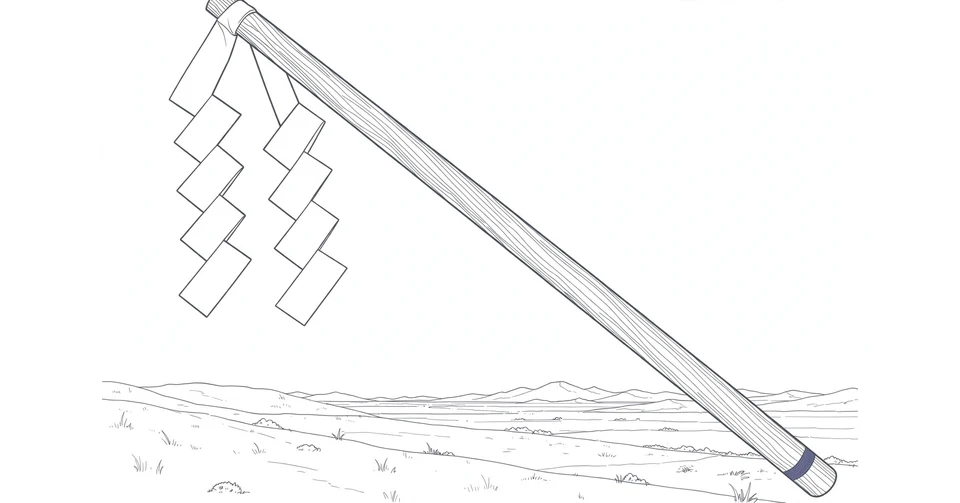
What makes the gohei worth a closer look is how much meaning it carries in so little material. A stick of bamboo or wood, two folded pieces of paper, and nothing else. Yet priests treat it with care, visitors bow toward it, and scholars have spent decades arguing about where it came from. The argument itself tells you something. When a culture keeps an object this simple for this long, the simplicity is the point.
What a gohei is
A gohei is one type of heihaku, the offerings used in Shinto religious services. It is made by clipping two shide into a heigushi, a staff of bamboo or other wood. The word is also written as heisoku, and in some contexts it is called nusa. The staff is usually plain wood or bamboo, sometimes lacquered, and the paper at its head is folded into the sharp zigzag shape that marks sacred things all across Japan.
The two streamers are the defining feature. A gohei always has two of them, no more and no fewer, and that count is what separates it from the wands around it. The paper is usually white, the colour of purity in Shinto, but the streamers clipped into a gohei can also be made of five colour paper, gold foil, or silver foil. The white version is the one you will see most often, and it is the one that matches the shide hanging from shrine ropes, so the wand reads as part of the same visual language.
It helps to think of the gohei as a small, portable version of a shrine. A shrine building holds the kami in a fixed place. A gohei holds the kami in a place that can be carried, set down, picked up, and moved to wherever the ceremony needs it. The wand does not pretend to be grand. It is a tool, and like many tools in Japanese ritual life, it is made from materials anyone could find: wood, bamboo, paper.
The gohei belongs to a family of sacred vessels called seikibutsu, the articles used in Shinto ceremonies. These objects are described as tokens of the kami, abodes of the kami, or decorations, and the gohei can be all three at different moments. It is usually placed on the shrine altar as a symbol of the kami, though it is sometimes merely decorative. That range, from sacred seat to quiet ornament, is part of what makes it interesting. The same object can be the centre of a rite or a piece of the furniture, depending on the moment.
The two paper streamers
The shide on a gohei are the same folded paper streamers you see hanging from shimenawa ropes, and they deserve a moment of their own. A shide is a strip of white paper, folded and cut into a zigzag, and wherever it hangs it carries the same message. This place, this object, this moment has been set apart. To understand the paper itself, it helps to know that shide are the paper lightning that marks a sacred space, and the two streamers on a gohei are that same sign, folded smaller and carried in a priest's hand.
The zigzag shape is usually read as lightning, which in Shinto is linked to rain, fertility, and the power of the kami. That reading is popular rather than proven, and some writers on ritual caution that the shape may simply be the most practical way to make paper visible and alive in the wind. Either way, the shape works. The folds catch the air, so the paper moves even in a still room, and the movement makes the wand feel present in a way a bare stick never would.
White is the colour of the paper for a reason. In Shinto, white conveys purity, and the gohei carries that purity into the ceremony in a form everyone can see. The paper is ordinary, the kind of material you could hold in one hand, and that ordinariness is part of the point. Shinto does not need gold to mark the sacred. A strip of folded paper will do. The gohei proves that twice over, with two streamers instead of one.
There is also a practical side to the paper. Shide are not meant to last forever. They are believed to collect impurities over time, so they are replaced regularly, and old ones are disposed of respectfully, usually burned. A gohei is renewed in the same way. The paper frays, the streamers are refolded, and the wand goes back to work. I think there is something deeply sane about a sacred object that admits it wears out. It asks for maintenance rather than worship of the object itself, and that keeps the attention on what the object points to.
What the gohei represents
The most important thing to understand about a gohei is what it stands for. It represents the presence of the kami, the spirits at the heart of Shinto, during a ceremony. When a gohei is set on the altar, it is understood to be the seat of the kami, the place where the spirit rests while the rite goes on. The wand is not the kami itself. It is the sign that the kami are present, and the seat they are understood to occupy.
In the language of Shinto, a gohei can be a yorishiro, an object that represents a divine spirit, or even a shintai, an object in which the spirit of a divine spirit resides. These are careful words, and the difference between them matters to priests and scholars. A yorishiro stands in for the kami. A shintai holds the kami. Sources differ on which word fits the gohei best, and the honest answer is that it has been treated as both at different times and in different shrines. That uncertainty is not a failure of the tradition. It is a sign that the object grew over centuries and gathered meanings as it went.
The gohei also works as an offering. Originally, offerings of cloth, called fuhaku, were presented to the kami by clipping them into a wood staff, and this practice is thought to be the origin of the gohei we see today. In old Shinto, all offerings except food were called mitegura, august hand offerings, and cloth was the most common of them. The cloth was fitted into a split wand and presented to the kami. After the Heian period, paper became an article of value, and it was offered to the kami and in time substituted for cloth. The paper offerings gradually took a special form and became token offerings, and the gohei of today is said to be a form of that token offering.
So the gohei carries two histories at once. It is an offering that became a seat, and a seat that is still, in its form, an offering. When you see one on an altar, you are looking at the end of a long change: cloth turned to paper, a gift turned into a dwelling. I find that history moving because it shows a tradition that could let an object change its meaning without losing it. The wand never stopped being a gift. It simply learned to hold something as well.
How priests use a gohei in ceremony
The most dramatic moment in the life of a gohei comes during kami-oroshi, the rite of bringing down the kami. In this rite, the kami are invited to descend and take their seat, and the gohei is the seat they are invited to. The priest sets the wand in place, and from that moment the ceremony has an address. The prayers are no longer spoken into the air. They are spoken toward the wand, and through the wand toward the kami understood to be present there.
A gohei is also used with a himorogi, a divine enclosure that generally consists of a gohei or a branch of the sakaki tree, hung with strips of paper or hemp and set upon a table covered with a clean straw mat. When a gohei is attached to a himorogi, it indicates the seat of the kami and is at the same time a token of the kami's presence. The himorogi is one of the oldest forms of shrine in Japan, older than the buildings we call shrines today, and the gohei sits at its centre like a small, portable version of the whole idea.
Priests also use a gohei in ceremonial purification. The wand is held or waved, and the rustling of the paper is believed to sweep away impurity. The sound matters. The dry rustle of shide is part of how purification works, on the ears as well as the eyes, and a gohei moved through the air makes a small version of that sound. It is a quieter purification than the one performed with the larger wands, and that quietness suits its role. The gohei marks presence. The larger wands do the sweeping.
On the altar, the gohei often simply stands. It does not need to be waved or carried to do its work. Its job in that position is to be there, to mark the place where the kami are understood to sit while the priest reads the norito prayers and the offerings are presented. A visitor watching a ceremony will see the priest bow toward the altar, and toward the wand on it, again and again. Each bow is directed at what the gohei represents, not at the wood and paper themselves.
The gohei and the shimenawa
A gohei never works alone. It belongs to a family of objects that all use the same paper, and the family is worth knowing as a whole. The shimenawa is the thick twisted straw rope that marks sacred space in Japan, and the white shide hanging from it are what make the boundary visible. To understand the rope itself, it helps to know that a shimenawa marks the line between ordinary and sacred, and the gohei is the same idea in a smaller, portable form. The rope says this place is set apart. The wand says the kami are present here, right now.
The relationship runs in both directions. A gohei can hang from a shimenawa, and shide from a rope can be clipped into a wand. The paper is the shared language, and the objects are sentences made from it. Once you learn to read the paper, the whole shrine starts to make sense as a single system: rope for space, wand for presence, paper for purity, all saying the same thing in different sizes.
The gohei also connects to the sacred tree. A himorogi, the enclosure described above, can be built around a gohei or around a branch of sakaki, the sacred evergreen. In the earliest days of Shinto, trees and groves served as the sites of ritual, and the most sacred tree was decorated with strips of paper and a mirror and enclosed by evergreens. The gohei is a descendant of that tree, reduced to a wand that can be carried indoors. It keeps the shape of the idea while losing the size of it, and that is why it still feels like a tree when you look at it closely: a trunk, and paper where the leaves would be.
Gohei, haraigushi, onusa, and tamagushi
Visitors often confuse the gohei with the other paper wands at a shrine, and the confusion is understandable because the family is close. The differences are real, though, and they are worth learning, because each wand has its own job.
The haraigushi is the purification wand. It is a wand with many shide attached to the top, and a priest waves it slowly over people, objects, and spaces to cleanse them. You will see it used before festivals, at rites of passage, and when a new building or business is blessed. The haraigushi is the wand of movement. It sweeps, it waves, it rustles loudly, and its work is purification.
The onusa, also called haraigusa, is the wider family that the haraigushi belongs to. Onusa are used in purification ceremonies before rituals, and they come in two types. The formal type consists of a branch of sakaki hung with strips of paper or hemp, or both. The informal type consists of a wandlike stick, two or three feet long, with narrow strips of paper. When shide are attached to a hexagonal or octagonal staff, the wand is also known as a haraegushi. The gohei sits inside this family as a special case. One useful rule of thumb, recorded in reference works on the subject, is that a gohei is an onusa with only two shide. Count the streamers, and you will know which wand you are looking at.
The tamagushi is different again. It is a small branch of the sakaki tree hung with strips of white paper, or cloth of red and white, and it is usually regarded as a symbolic offering. Worshippers present it to the kami during prayers or special requests, and it is one of the most respectful gestures in shrine ritual. The tamagushi is offered and left. The gohei is set in place and stays. One is a gift handed over. The other is a seat that remains.
There is one more relative worth knowing. A gohei with several heisoku stripes attached to a long wood or bamboo stick is specifically called a bonten. The bonten takes the gohei's form and stretches it, adding more streamers and a longer staff, for use in particular ceremonies. It shows how flexible the idea is. Two streamers make a gohei. More streamers on a longer stick make something else, and the tradition has a name ready for it.
A short comparison helps keep the family straight.
| Wand | What it is | What it does |
|---|---|---|
| Gohei | Wooden wand with two shide | Marks the presence of the kami |
| Haraigushi | Wand with many shide | Purifies people, objects, and spaces |
| Onusa | Family of purification wands | Cleanses before ritual |
| Tamagushi | Sakaki branch with shide | Offered to the kami as a gift |
| Bonten | Long staff with several streamers | Used in particular ceremonies |
The table is a guide, not a rule book. Real shrines vary, and a priest at one shrine may use a wand slightly differently from a priest at another. The boundaries between these objects are firm enough to learn and soft enough to respect. What matters most is the shared idea underneath them: paper, wood, and a belief that the sacred can be marked with materials anyone can hold.
Where a visitor might see a gohei
Most visitors will see a gohei in one of three places. The first is on the altar inside the shrine hall, where it stands as a symbol of the kami during a ceremony. You may glimpse it through the open doors of the hall during a festival or a formal prayer, small and white against the dark wood of the altar. It will not be the largest thing in the room, and it may take a moment to pick out, but once you know what to look for, you will find it.
The second place is in the hands of a priest during a rite. At a wedding, a blessing, or a purification ceremony, the priest may hold a gohei or set one in place as a sign that the kami are present in the rite. At Shichi-Go-San, when families bring their children to the shrine, a priest waves a paper wand over the children to purify them, and though that wand is usually a haraigushi, the gohei may be present on the altar behind the priest, watching over the rite in its quieter way.
The third place is at home. A gohei can stand on a kamidana, the small household altar where families honour the kami, alongside branches of sakaki decorated with shide. Many families refresh the branches and the paper on a regular schedule to keep the household altar pure. The wand in a home is smaller and plainer than the one in a shrine, but it does the same work. It says the kami are present here too, not only in the grand hall but in the corner of an ordinary room.
You may also see a gohei at a ground breaking ceremony, a car blessing, or the opening of a new shop. Priests carry the paper streamers out into daily life in a very practical way, blessing new cars, new shops, and new offices, and the wand travels with them. The gohei does not care whether it stands in a thousand year old shrine or in a room above a family shop. It only cares that something has been set apart and that the kami have been invited to be present.
How to look at a gohei
The etiquette around a gohei is simple, and it follows from what the wand means. Do not touch it, and do not reach for it for a photograph. It is not a decoration to handle, and it is a working ritual object, not a prop. If a gohei is set in place as part of a ceremony, it is marking the seat of the kami, and reaching toward it is reaching toward the centre of the rite.
Photography is generally permitted at most shrines, and there is no rule against photographing a gohei from a respectful distance. The question is one of intent. Point your camera at the wand because you want to understand the place, not because you want a dramatic backdrop. At a small shrine with no other visitors, move more quietly and act with more care than you might at a famous tourist site. The paper will not tell you to be quiet. It will simply hang there, white and patient, and leave the decision to you.
If you are genuinely unsure how to behave, watch how local visitors behave before you move. That is good advice for almost any shrine custom, and it applies here too. People who grew up with these objects treat them as ordinary and sacred at the same time, which is exactly the right attitude. They do not make a fuss over the wand, and they do not ignore it either. They walk past it the way you might walk past a good neighbour, with a nod and without stopping the day.
There is a temptation, when learning about an object like this, to want a single settled answer to every question about it. Where did it come from? Is it a seat or an offering? Is it a yorishiro or a shintai? Scholars are divided on the origin of the gohei, and the sources I read for this article say so plainly. One theory traces it to paper offerings, another to devices for invoking the presence of the kami, and a third to the ancient banners set up at ritual sites. I find that honesty refreshing rather than disappointing. A symbol does not need a single settled origin to do its work, and the fact that the wand has survived three competing explanations tells you how sturdy the object is.
A small wand with a long memory
A gohei is, in the end, a very small thing. It is a stick of wood or bamboo, two strips of folded paper, and nothing else. It will fray. It will fade. It will be taken down and renewed, and a new pair of streamers will be folded in its place. Nothing about it is built to impress you, and that is precisely why it stays with you once you have learned to see it.
What I take from the gohei is a lesson about how little it takes to mark something as mattering. We tend to assume that importance needs size, expense, or permanence, and that presence needs a building. Japan has spent centuries proving the opposite with a wand you could hold in one hand. A presence can be a pair of paper streamers. A sacred seat can be a stick of bamboo. A ceremony can turn on an object so light that a breeze moves it.
The next time you walk through a shrine in Japan, look for the wand before you look at the hall. Find the two white streamers, notice where the priest has set them, and understand what they are saying. The kami are present here, the paper says, and the room has been prepared for them. The line it draws is thin, and it is made of paper and wood, and it has outlasted empires. That is worth a moment of your attention, and the gohei will still be there, standing quietly, when you give it one.
A detailed account of the gohei as an offering wand and a symbol of the kami, including the theories of its origin, is given in a scholarly study of Shinto symbols, and that study of Shinto symbols traces the wand from cloth offerings through paper to the form used in shrines today. A shorter reference entry describes the gohei as one type of heihaku made by clipping two shide into a wooden staff, and that reference entry on the gohei also records its other names and its later role as a yorishiro and a purification implement.
More in Culture & Society
- Kagura Is the Sacred Dance Shinto Still Performs
- Norito Give a Shinto Ceremony Its Voice
- Origami and How a Single Sheet of Paper Became Japan's Quiet Art
- A Hishaku Is the Bamboo Ladle That Starts Every Shrine Visit
- A Kitsune Is the Fox Messenger Who Guards the Shrines of Japan
- Temizuya Is Where Every Shrine Visit Begins With Water
Latest posts
- Kitsune Udon Is the Bowl the Fox Would Order
- Shide Are the Paper Lightning That Marks a Sacred Space
- Tokyo Disneyland and Why Japan Loves It Differently
- Yabusame Turns Horseback Archery Into a Moving Prayer
- Walking Through Senbon Torii Feels Like Entering Another World
- Onigiri, Japan's Two-Thousand-Year-Old Portable Meal
- Roro Jonggrang and the Thousand Temples Built in One Night
- Ten Thousand Vermilion Gates Lead Up Fushimi Inari
- Prambanan Towers Over Java With a Love Story in Stone
- Shimenawa Marks the Line Between Ordinary and Sacred
- A Torii Gate Marks Where the Ordinary World Ends
- The Yumi Stands Taller Than Its Archer
- Ekiben, the Train Station Bento That Turns a Journey into a Meal
- Kyudo Turns Archery Into a Moving Meditation
- Iaido Is the Art of Drawing the Sword Before the Fight Begins