A Torii Gate Marks Where the Ordinary World Ends
· 15 min read
A torii is the open gate that marks the entrance to a Shinto shrine in Japan, and passing under a torii means stepping from the ordinary world into sacred ground.
A torii is a gate with no door, no walls, and no lock, and yet it is one of the clearest boundaries in Japan. Two pillars and two crossbeams stand at the entrance to a Shinto shrine, and the moment you step beneath them, the ground changes its meaning. The street behind you is ordinary. The ground ahead of you is sacred. That is the whole job of a torii, and it has been doing it for more than a thousand years.
You will see a torii before you see almost anything else at a shrine. It frames the path, it marks the start of the approach, and it tells you, without a single word, that you are expected to slow down. At a shrine, you bow once before passing under the torii gate, a small gesture that costs nothing and changes the whole feeling of the walk. I have always liked that the gate asks so little and gives so much in return.
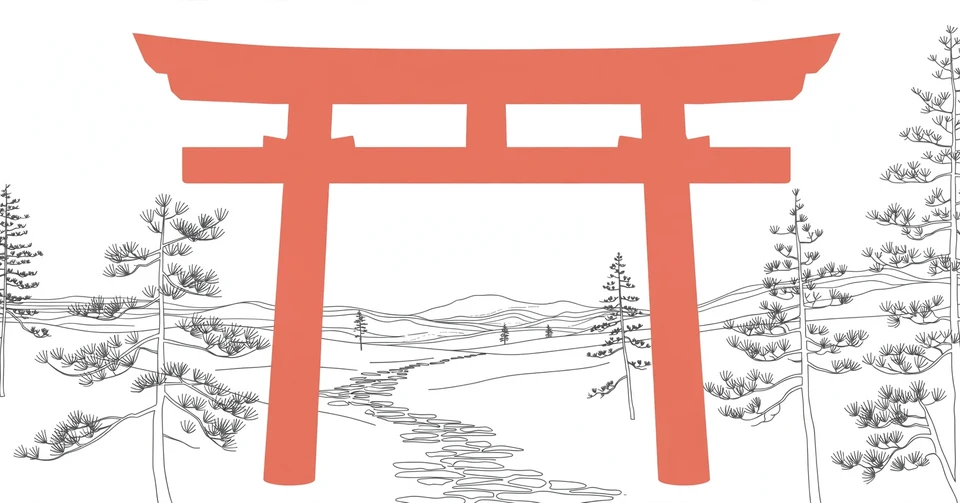
The torii is probably the most photographed object in Japan, and also one of the least understood. Visitors pose under it, walk past it, and sometimes do not notice it at all, because it looks so simple. But simplicity is the point. A torii does not keep anyone out. It has no door to close and no fence attached to it, and you could walk around it without any trouble. Its power is not physical. It is a line drawn in the air, and crossing it is a decision you make with your attention, not with your feet.
What a torii actually is
A torii is a traditional Japanese gate most commonly found at the entrance of, or within, a Shinto shrine, where it symbolically marks the transition from the mundane to the sacred, and a spot where kami are welcomed and thought to travel through. That is the plain definition, and it is worth sitting with, because it explains nearly everything else about the gate. The gate does not belong to a building. It belongs to a boundary. It stands where the everyday world ends and the shrine grounds begin, and it makes that invisible line visible.
The presence of a torii at the entrance is usually the simplest way to identify a Shinto shrine, and a small gate shaped icon is used to represent shrines on Japanese maps. If you are walking through a Japanese town and you see a torii at the end of a street, you know there is a shrine nearby, even if you cannot see the shrine itself. The gate is the sign, the shrine is the destination, and the path between them is called the sando, the approach.
A torii is not a door, and that matters. A door separates inside from outside, and it can be shut. A torii separates sacred from ordinary, and it is always open. Anyone can pass through it, whatever their beliefs, and the gate makes no demand except attention. I think this openness is why the gate has lasted so long as a symbol. A wall says keep out. A torii says pay attention, and then come in.
The gate is also a meeting point. In the Shinto understanding, the kami, the divine forces that inhabit and animate the natural world, are welcomed at the gate and thought to travel through it. The gate is therefore not only a marker for people walking in. It is also a passage for the kami themselves, a place where the sacred and the natural meet. When you bow before passing under a torii, you are acknowledging both directions of that meeting.
The parts of the gate and how to read one
Once you know what to look for, the gate becomes easy to read, like a simple diagram made of wood or stone. In its basic form it has four members. The two pillars are called hashira. The top lintel is called kasagi. The tie beam set lower between the pillars is called nuki. Those four pieces are the whole gate, and nearly every torii you will ever see is a variation on them.
Look closer and you will find smaller details. The kasagi may be reinforced underneath by a second horizontal lintel called shimaki. The nuki is often held in place by wedges called kusabi, which in many cases are purely ornamental. At the center of the nuki there may be a supporting strut called gakuzuka, sometimes covered by a tablet carrying the name of the shrine. The pillars often rest on a white stone ring called kamebara, or turtle belly, and sometimes the base of a pillar is wrapped in a decorative black sleeve called nemaki.
None of these parts is decoration for its own sake. Each one has a job, and together they make a structure that has survived earthquakes, typhoons, and centuries of weather with almost nothing holding it together except balance and craft. The gate has a purely symbolic function, so there are usually no doors or board fences, only the open frame. That is what makes the torii so striking in a photograph. It is a shape with nothing inside it except sky, and yet the eye reads it immediately as a gate.
Two families, shinmei and myojin
All torii can be divided into two families, the shinmei family and the myojin family, and telling them apart is one of the small pleasures of visiting shrines in Japan. A torii of the shinmei family has only straight parts. Its upper lintel is straight, its members are plain, and the whole gate feels calm and severe. The shinmei style is believed to be the oldest, and the great shrine of Ise, the most sacred shrine in Shinto, uses a shinmei gate at its Inner Shrine. When you stand before it, the simplicity feels deliberate, as if the gate is refusing to show off.
A torii of the myojin family has both straight and curved parts. Its upper lintel curves gently upward at the ends, and the gate as a whole feels more decorated and more welcoming. The myojin style is the most common type in Japan, and it is the one most visitors picture when they think of a shrine gate. The great gate of Meiji Jingu in Tokyo is a myojin torii, a gate of two pillars topped with a double lintel and a tie beam, with a curved upper lintel and a long tie beam, as described in the official guide to the shrine published by Japan's Ministry of Land, Infrastructure, Transport and Tourism. Three sixteen petal chrysanthemum crests decorate its upper lintel, the crest of the Imperial Family, and it is the first of three gates along the southern approach to the main shrine.
The myojin style dates to around the 9th century, which means both families have been standing side by side for more than a thousand years. Neither is better than the other. The shinmei gate suits a shrine that wants quiet dignity, and the myojin gate suits a shrine that wants a warm welcome. Once you can tell them apart, every shrine visit becomes a little richer, because you start to notice which family the shrine chose and why.
Why so many are vermilion
Most visitors meet the gate in one color, vermilion, the deep orange red that seems to glow against green trees and grey stone. Torii may be unpainted or painted vermilion with a black upper lintel, and the vermilion is the color most people remember. By tradition, shrine pavilions and gates are painted vermilion, a color believed to ward off evil and used in palaces, shrines, and temples since ancient times.
The color is practical as well as symbolic. At Itsukushima Shrine, the vermilion on the great gate is a lacquer coating that helps protect the wood from degradation, which matters when a gate stands in the sea and faces salt, wind, and sun. Beauty and maintenance turn out to be the same decision. A gate painted vermilion is easier to see from a distance, easier to remember, and better protected against the weather.
Not every gate is red. The shinmei gate at Ise is made of plain, unpainted wood, and stone gates are often left grey. Kamakura even has a gate painted white and red. But the vermilion torii is the one that has become the image of Japan itself, on postcards, in films, and on the covers of guidebooks. I think there is a reason the red one won. A plain wooden torii is beautiful, but a vermilion torii is unmistakable. It says, from a long way off, that something sacred is here.
The torii that stand in the sea and on the mountain
Two places in Japan show what a torii can become when it is given a whole landscape to work with. The first is Itsukushima Shrine, on Miyajima Island in Hiroshima Prefecture. Its great gate stands in the sea, about 16 metres tall and built of decay resistant camphor wood. At high tide it appears to float on the water. At low tide you can walk out across the sand and stand beneath it. The current gate dates to 1875, although there has been a gate on that site since 1168. The shrine complex is listed as a UNESCO World Heritage Site, and the gate is its most recognizable landmark. For more on the shrine and its floating gate, the full account of the torii at Itsukushima Shrine gives the history, the measurements, and the story of how the gate has been rebuilt on the same spot for centuries.
The second place is Fushimi Inari Taisha in Kyoto, famous for its thousands of vermilion torii gates. There the gate is not a single frame but a tunnel, a mountain path lined with gate after gate, each one donated by a person, a family, or a business in gratitude for a wish fulfilled. Each gate bears the name of its donor on the back of its pillars. Walking through them is one of the strangest and most beautiful experiences in Japan, because the light changes with every step, vermilion above, shadow below, and the mountain seems to go on forever.
The two places teach opposite lessons about the same object. At Itsukushima, one gate is enough, because the sea does the rest. At Fushimi Inari, one torii is never enough, because each gate is a single prayer, and the prayers add up to a mountain. Between them, they show the full range of what the gate can be, a single landmark and a crowd of wishes.
How to pass through one
Passing through a torii is simple, and the etiquette around it is gentle rather than strict. You bow once before passing under the torii gate, then walk along the sando toward the main hall. You do not walk down the middle of the approach, which is reserved for the kami, but to one side. You keep your voice low. You do not rush past people who are praying. Nobody will correct you if you get it wrong, but the ten seconds it takes to learn the order makes the moment feel like yours.
If the shrine has more than one gate, the outer one is called ichi no torii, the first torii. The following ones, closer to the shrine, are usually called, in order, ni no torii and san no torii. Other gates can be found farther into the shrine to represent increasing levels of holiness as you near the inner sanctuary. Each gate you pass is another step away from the ordinary world and another step toward the sacred, and the walk itself becomes part of the prayer.
At the main hall you will find the rest of the visit, the offering box, the bow and the clap, and the small objects that make a shrine visit memorable. Many shrines sell ema, wooden plaques on which you write a wish and hang it up for the kami to receive, and the full story of those plaques is told in the article on ema, the wooden plaques that carry a wish to the kami. At New Year the ema often carry the design of the year's zodiac animal, and rows of fresh wishes appear on the racks within hours of midnight, when crowds pour through the gates for the first shrine visit of the year. That first visit, hatsumode, is the busiest morning in the Japanese shrine calendar, and how it works is described in the article on hatsumode, Japan's first shrine visit of the new year.
The etiquette is worth learning, but it is not the point. The point is the pause. The gate gives you a place to stop, to bow, and to notice that you are entering a different kind of space. In a country that moves as fast as Japan does, a gate that asks you to slow down for ten seconds is a small gift, and I think that is why so many people remember the torii long after they have forgotten the rest of the shrine.
Where the gate came from
The origins of the torii are unknown, and there are several different theories on the subject, none of which has gained universal acceptance. That uncertainty is honest, and it is part of what makes the gate interesting. Scholars believe that the stylistic origins of the Japanese torii derived from the Indian torana, a free standing sacred ceremonial gateway that marks the entrance of a sacred enclosure. Others point to the Chinese pailou, or to the Korean hongsalmun. No conclusion has yet been reached, and the gate may also be a Japanese invention, developed step by step from four posts and a sacred rope.
The name itself is unsettled too. The word torii is often glossed as bird perch, from tori, bird, and i, perch or rest. One story connects it to the myth of the sun goddess Amaterasu, who hid in a cave and was lured out by the sound of birds. Another theory takes the name from tori iru, to pass through and enter. The Encyclopedia of Shinto lists proposed roots that include tori iyasu and tori ita, both connected with a perch for birds, and tori iru. None of these has been proven, and the honest answer is that the name, like the gate, keeps a little mystery.
What is certain is the age. The first appearance of torii in Japan can be reliably pinpointed to at least the mid Heian period, because they are mentioned in a text written in 922. The oldest surviving stone torii was built in the 12th century and belongs to a Hachiman shrine in Yamagata Prefecture. The oldest surviving wooden gate is a ryobu torii at Kubo Hachiman Shrine in Yamanashi Prefecture, built in 1535. A gate that old, still standing and still in use, is a rare thing. Most objects from the 12th century live in museums. The gate still does its job, in the open air, in the rain.
The gate also appears in places you might not expect. It was historically used within Buddhist contexts as well, and the founder of Shingon Buddhism, Kukai, used a torii to demarcate the sacred space for the homa ceremony. Until the Meiji period, the gates were routinely adorned with plaques carrying Buddhist sutras. The gate has never belonged to one tradition alone, and that may be another reason it has survived. It marks sacred ground, and sacred ground in Japan has always been shared.
A gate that guards nothing
A torii is a strange object when you think about it plainly. It is a gate with no wall, no door, and no lock, guarding a space that anyone may enter. It keeps nothing out and locks nothing in. It does not even try. And yet Japan has kept building torii for more than a thousand years, in wood, in stone, in concrete and steel, at the entrance to every shrine, on mountaintops, and standing alone in the sea.
I think the reason is simple. Most gates are built to divide people from each other. A torii divides the ordinary from the sacred, and it invites you to cross the line yourself. It does not ask who you are, what you believe, or whether you belong. It only asks you to notice that you are stepping into a different kind of space, and to bow once before you do.
The next time you see a torii, do not walk past it like scenery. Stop at the edge of it, bow once, and step through slowly. On the other side is the same Japan, the same trees, the same sky, and yet it will feel a little different, a little quieter, a little more awake. That difference is the whole meaning of the gate. A torii marks where the ordinary world ends, and it leaves the decision to cross entirely up to you.
More in Culture & Society
Latest posts
- Ebi Bends Like an Old Back and Wishes You a Long Life
- Kobumaki Rolls Joy Into a Strip of Kelp
- Kurikinton Is the Golden Mash That Wishes You Wealth
- Japanese Beer and the Dry Wars That Changed How Japan Drinks
- Kamaboko Paints the New Year Red and White
- Datemaki Rolls Sweet Eggs Into a Spiral of Good Luck
- Japanese Bento and the Lunch Box That Became an Art Form
- Tazukuri Turns Tiny Sardines Into a Wish for a Good Harvest
- Kazunoko Is the Herring Roe That Promises Children and Plenty
- Kuromame Turns Black Beans Into a Wish for Health
- Jubako Layers a Family's Luck One Box at a Time
- Osechi Packs a Whole Year of Luck Into Stacked Boxes
- Kojiri Is the End Cap That Takes Every Knock for a Katana
- Kurikata Is the Chestnut Knob That Holds a Katana at the Hip
- Koshirae Is the Formal Mounting That Turns a Blade Into a Katana