A Kitsune Is the Fox Messenger Who Guards the Shrines of Japan
· 15 min read
A kitsune is the fox spirit of Japanese folklore, a messenger of the rice deity Inari who can also be a trickster, a shapeshifter, and, in the oldest tales, a nine-tailed being close to a god.
Walk up to almost any Inari shrine in Japan and the first thing you meet is not a priest or a gate. It is a fox. A stone kitsune sits on either side of the entrance, calm, alert, and often holding something in its mouth, a key, a jewel, a scroll, or a sheaf of rice. The fox is not decoration. In Japanese folklore, the kitsune is the messenger of Inari, the kami of rice, prosperity, and business, and it has been watching over shrines, fields, and shopkeepers for more than a thousand years.
The word kitsune simply means fox in Japanese, but in folklore it means something more. A kitsune is a fox that has lived long enough, and grown wise enough, to cross the line between animal and spirit. It can change shape, light foxfire in the dark, and, in the oldest stories, grow up to nine tails. The same creature can be a loyal guardian of a shrine and a trickster who leads a traveler astray on a mountain road at night.
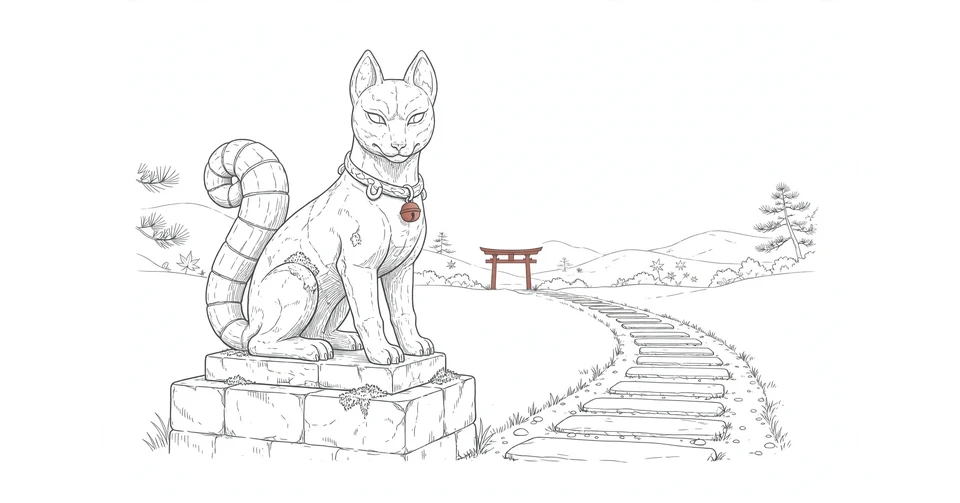
That double nature is the whole point of the kitsune. Japan did not invent a mascot and stop there. It kept a wild animal at the center of its oldest shrine tradition, gave it a job, a rank, a favourite food, and a long list of crimes, and then kept telling stories about it for over a thousand years. To understand the kitsune is to understand how Japanese folklore holds two opposite ideas at once and refuses to choose between them.
The messenger of Inari
Inari is the kami of rice and agriculture, and over the centuries merchants adopted Inari as a patron of business as well. That is why the shrine draws both farmers and shopkeepers, and why a prayer at an Inari shrine might be for a good harvest, a thriving shop, or a safe household. There are about 30,000 Inari shrines across Japan, and Fushimi Inari is the head shrine of them all, founded in 711 in southern Kyoto, long before the capital moved to the city.
The kitsune became Inari's messenger, and the two are now so closely tied that the line between them has blurred. In some depictions Inari itself appears as a fox, and whole shrines are dedicated to the foxes rather than to the kami alone. The foxes of Inari are usually white, a colour of good omen, and they are believed to ward off evil and sometimes serve as guardian spirits for the people who pray to them.
Look closely at a shrine fox and you will usually find it holding something. The four objects recur again and again: a key for the rice granary, a jewel, a scroll, or a sheaf of rice. The key is the most common, and it is a small, practical symbol. A granary needs a key, and a good harvest needs somewhere safe to keep it. The jewel, called a tama, is the fox's own treasure in folktales, sometimes the source of its power to transform. The scroll stands for wisdom and learning, and the sheaf of rice is the harvest itself, held in the mouth of the animal that protects it. No single shrine document lists these meanings as official doctrine, and the details vary from place to place, but the four objects are the ones visitors meet most often, and their meanings are the ones guides and priests repeat.
The foxes stand just inside the torii gates, and that placement matters. A torii gate marks where the ordinary world ends, and the kitsune sits at that boundary as a guard and a go-between, carrying prayers in one direction and blessings in the other. I find that job description quietly beautiful. The fox is not the god, and it does not pretend to be. It is the one who runs the errands, watches the door, and knows the way up the mountain. Most of us will never be the god of anything, but we can all recognise the dignity of being trusted with the messages.
How a kitsune earns its nine tails
The clearest sign of a kitsune's age and power is the number of its tails. A kitsune can have as many as nine, and the rule in the folktales is simple: more tails means an older, wiser, and more powerful fox. One, five, seven, and nine tails are the numbers that appear most often in the stories, and the nine-tailed fox, the kyubi no kitsune, stands at the top of the scale.
How long each tail takes is one of those points where the sources disagree, and it is worth saying so plainly. Some folktales say a fox grows a new tail every hundred years, which would make a nine-tailed kitsune close to a thousand years old. Other accounts say a fox only grows additional tails after it has lived a thousand years, and that the ninth tail turns its fur white or gold and gives it something close to divine sight, the ability to see and hear anything happening anywhere in the world. The honest version is that there was never one rule. Different regions, different centuries, and different storytellers each had their own arithmetic, and the nine-tailed fox survived all of them because the image was stronger than the maths.
The idea of the nine-tailed fox did not start in Japan. It travelled from China, where the fox spirit known as huli jing was already credited with gaining the power to transform at fifty years of age, greater abilities at a hundred, and a near-divine state as a celestial fox after a full thousand years. Japan took that framework and gave it a local home, tying the long-lived fox to Inari and to the rice fields where real foxes hunted rats. The word kitsune itself is old. Its oldest known written use is in a text called the Shin'yaku Kegonkyo Ongi Shiki, dating to 794, and fox omens appear even earlier, in the Nihon Shoki chronicle compiled in 720.
A kitsune does not only grow tails as it ages. It also learns to change shape, usually after about a hundred years, though some tales say fifty. The classic image is a fox placing a leaf on its head and turning, in a blink, into a beautiful woman, a young girl, or an elderly man. The disguise is rarely perfect. Stories love the small giveaway: a tail that slips out when the fox gets drunk or careless, a shadow shaped like a fox, a reflection that shows the true form, or a sudden panic at the sight of a dog. I like that detail more than the magic itself. A creature that can fool a whole village but cannot hide its tail from a dog is a creature with a weakness, and a weakness is what makes a legend feel human.
Good foxes, wild foxes, and the trickster in between
Japanese folklore divides the kitsune into two broad camps, the zenko, or good foxes, who serve Inari, and the yako, also called nogitsune, or wild foxes, who serve nobody. The zenko protect shrines, carry messages, and bring luck. The yako play tricks, cause trouble, and sometimes do real harm. That split sounds neat, but the scholars who study these stories warn that it was never as clean as it looks. Lafcadio Hearn, who collected fox lore in Izumo in the Meiji era, doubted that ordinary people in earlier times drew such a sharp line between good and bad foxes, and later writers agreed that the tidy divide was largely the work of priests and educated writers. In the older tales, a kitsune is loyal to its debts and its grudges alike: it repays kindness with protection and answers malice with revenge, sometimes by setting fire to a man's house.
The trickster kitsune has a favourite repertoire, and it is more mischievous than frightening. It leads travellers astray on mountain paths after dark, a complaint recorded by folklorists well into modern times. It hands over money that turns back into leaves once it is inside the wallet, or gold coins that turn out to be leaves all along. It tricks people into eating dumplings made of horse dung, or into taking a bath in a manure pit. It lights kitsunebi, foxfire, ghostly flames that float over fields at night and lead the unwary further from the road, like a will-o'-the-wisp. None of this is grand evil. It is the behaviour of a clever animal that enjoys watching humans embarrass themselves, and the stories treat it as a joke with sharp edges rather than a horror.
The most famous kitsune stories are the fox wife tales, where a kitsune takes the form of a woman and marries a human man. The gentlest of them is Kuzunoha, a white fox who marries a man named Yasuna and bears him a son, Abe no Seimei, who grows up to become the most famous astrologer and diviner in Japanese history. The darkest is Tamamo-no-mae, a courtesan of legendary beauty and intelligence at the court of Emperor Toba. When the emperor fell mysteriously ill, a court diviner exposed her as a nine-tailed fox, and she fled to the wilds, where she was eventually killed and her spirit was said to live on in a poisonous boulder called the Sessho-seki, the killing stone. Her story draws directly on the Chinese tale of Daji, a nine-tailed fox consort blamed for the fall of a dynasty, which shows how freely these fox stories crossed borders and centuries. Between Kuzunoha and Tamamo-no-mae sits the whole range of the kitsune: devoted mother in one tale, court-destroying seductress in the next, and the same nine tails in both.
What strikes me about the trickster side is that Japan never tried to tidy it away. The same shrine that honours the fox as a holy messenger also tells stories about the fox cheating farmers and frightening travellers, and nobody seems to feel a contradiction. A guardian that never misbehaves is a statue. A guardian that sometimes steals your lunch and leads you in circles is a neighbour, and neighbours are the ones you actually remember.
When a kitsune moves in
There is a darker corner of the folklore that deserves careful handling, because people once took it literally. Kitsune-tsuki, the state of being possessed by a fox, is attested in stories from the Heian period onwards, and the belief was widespread across Japan. A person said to be possessed might speak in a strange voice, crave foods they normally disliked, or behave in ways their family could not explain. The family would call in a miko priestess or a mountain ascetic trained in shugendo to drive the fox out, and in some old tales the exorcist would speak with the fox directly. In one eleventh century tale, the fox inside a sick person turned out to want nothing more dramatic than human food.
From a modern clinical standpoint, these cases look like mental illness, and doctors and scholars were already saying so in the nineteenth century, without much success at ending the belief. The superstition persisted well into the twentieth century, and studies from around 1960 still found families in some regions who were gossiped about as kitsune-mochi, fox owners, supposedly able to keep a fox spirit and set it on their neighbours. That gossip could ruin a family's standing in a village, which is a reminder that folklore was never only entertainment. It was also a way of explaining illness, settling scores, and marking outsiders, and the fox was a convenient shape for all three. The kitsune-tsuki stories are best read today as history, not as medicine: a record of how people made sense of suffering before modern psychiatry, and of how a clever animal became a vessel for fears that had nothing to do with foxes at all.
The fox you can eat
For all its supernatural power, the kitsune is also an everyday presence in Japan, and nowhere more so than on the menu. The folklore says that foxes love aburaage, deep-fried tofu, and that belief gave its name to two of the country's most comforting dishes. Kitsune udon is a bowl of thick udon noodles in light dashi broth topped with a sweet, simmered pouch of aburaage. Inari sushi is vinegared rice tucked inside the same kind of tofu pouch, a portable parcel that people still leave as an offering at the feet of shrine foxes. The full story of how these dishes grew out of shrine offerings is told well in the Bokksu guide to Inari and kitsune udon, which traces the food from temple offerings to modern snack boxes.
The dishes have their own small histories, and the details are charming precisely because they are so ordinary. Kitsune udon is said to have begun in Osaka in 1893, at a noodle shop called Matsubaya, when a customer started putting the fried tofu served alongside his inari sushi on top of his noodles, and the owner began serving it that way. Inari sushi itself took off during the Edo period, when street vendors in Edo were selling it by the 1840s, and it comes in two regional styles: the Tokyo style, where the pouch completely covers the rice like a straw bag, and the Osaka style, where the pouch leaves the rice exposed at the bottom and is said to resemble a fox's ear. Scholars note that the custom of offering aburaage at shrines probably arose rather late, in the Edo period, and that the older stories about a fox's favourite food involved stranger fare, including oil-fried mice used as trap bait. The tofu version is a kinder legend, and it is the one that stuck, which tells you something about how folklore gets edited by appetite.
There is something quietly generous about a god whose messenger has a favourite snack that anyone can cook. You do not need a pilgrimage to meet the kitsune. You can order a bowl of noodles in Osaka, eat the sweet tofu on top, and take part in a story that started in a rice field a thousand years ago. Food is where folklore stops being a museum piece and becomes a habit, and the kitsune is lucky to have a habit this delicious attached to its name.
Kitsune on the modern screen
The kitsune never left the stage. It appears in the Noh play Kokaji, where Inari takes the form of a fox to help the swordsmith Sanjo Munechika forge a blade for the emperor, a sword later named Kogitsune-maru, Little Fox. It drives the kabuki classic Yoshitsune Senbon Zakura, where a thousand-year-old fox mother and father are hunted for their skins to cover a drum, and their kit takes the shape of a retainer to stay near it. In modern times the fox has moved into anime, manga, and video games, where the nine-tailed kitsune is now one of the most recognisable images of Japan anywhere in the world.
That long career is worth pausing over, because few folk creatures survive the jump from medieval chronicle to modern screen without losing their shape. The kitsune kept its shape because it was never only one thing. A storyteller in any century can pick the version they need: the loyal messenger, the beautiful stranger, the trickster, the grieving mother fox, the nine-tailed near-god. The full sweep of that history, from the earliest written mentions to the possession tales and the theatre, is laid out in the Wikipedia article on kitsune, which is the most thorough single overview of the folklore in English.
I think the modern kitsune works for the same reason the old one did. A fox is a real animal that lives at the edge of human places, in the fields and the forest margins, clever enough to be interesting and wild enough to be unpredictable. Give that animal a thousand years, a few extra tails, and a job at a shrine, and you have a character that can carry any story you want to tell about loyalty, deception, love, or revenge. The screen did not invent the kitsune. It just gave it better lighting.
Why the fox still matters
The kitsune has lasted for more than twelve centuries because it refuses to be simplified. It is a holy messenger and a practical joker, a devoted wife and a court-destroying seductress, a guardian of granaries and a thief of fried tofu. Japan could have chosen a grander animal for its most numerous shrines, a dragon or a lion, but it chose the fox, an animal that actually lives in the rice fields and actually steals chickens, and then it let the fox stay complicated.
That complication is the lesson, if the kitsune has one. A creature can be sacred and mischievous at the same time, and a tradition can hold both ideas without breaking. The stone foxes are still sitting at the shrine gates, the noodles are still served in Osaka, and the stories are still being retold, because a fox that can be many things is a fox that never runs out of work to do.
More in Culture & Society
- Kagura Is the Sacred Dance Shinto Still Performs
- Norito Give a Shinto Ceremony Its Voice
- The Gohei Wand Carries the Kami Into the Ceremony
- Origami and How a Single Sheet of Paper Became Japan's Quiet Art
- A Hishaku Is the Bamboo Ladle That Starts Every Shrine Visit
- Temizuya Is Where Every Shrine Visit Begins With Water
Latest posts
- Kitsune Udon Is the Bowl the Fox Would Order
- Shide Are the Paper Lightning That Marks a Sacred Space
- Tokyo Disneyland and Why Japan Loves It Differently
- Yabusame Turns Horseback Archery Into a Moving Prayer
- Walking Through Senbon Torii Feels Like Entering Another World
- Onigiri, Japan's Two-Thousand-Year-Old Portable Meal
- Roro Jonggrang and the Thousand Temples Built in One Night
- Ten Thousand Vermilion Gates Lead Up Fushimi Inari
- Prambanan Towers Over Java With a Love Story in Stone
- Shimenawa Marks the Line Between Ordinary and Sacred
- A Torii Gate Marks Where the Ordinary World Ends
- The Yumi Stands Taller Than Its Archer
- Ekiben, the Train Station Bento That Turns a Journey into a Meal
- Kyudo Turns Archery Into a Moving Meditation
- Iaido Is the Art of Drawing the Sword Before the Fight Begins