Kitsune Udon Is the Bowl the Fox Would Order
· 20 min read
Kitsune udon is thick udon in a light, clear dashi broth topped with a sweet simmered sheet of fried tofu, and its name comes from the old belief that foxes love aburaage.
Order kitsune udon in Osaka and the bowl that arrives looks almost plain. Thick white noodles rest in a pale, nearly clear broth, and a single large sheet of golden fried tofu lies across the top like a blanket. There is no pile of toppings and no drama. The drama is in the first spoonful of broth, which tastes far deeper than its colour suggests.
The name means fox udon, and the fox in question is the kitsune, the messenger of Inari, the kami of rice and prosperity. Folklore says foxes love aburaage, the deep fried tofu that tops the bowl, so kitsune udon took the fox's name. That is the whole joke and the whole charm: a shrine guardian's favourite snack became a noodle topping, and a noodle topping became one of Japan's most loved comfort foods.
A bowl of kitsune udon is also a small lesson in Osaka cooking. The broth is built on kelp and dried fish, seasoned with pale soy sauce, and kept deliberately light so the flavour of the dashi can carry the bowl. Once you have tasted it done well, you start to understand why Osaka people defend their pale broth with such pride.
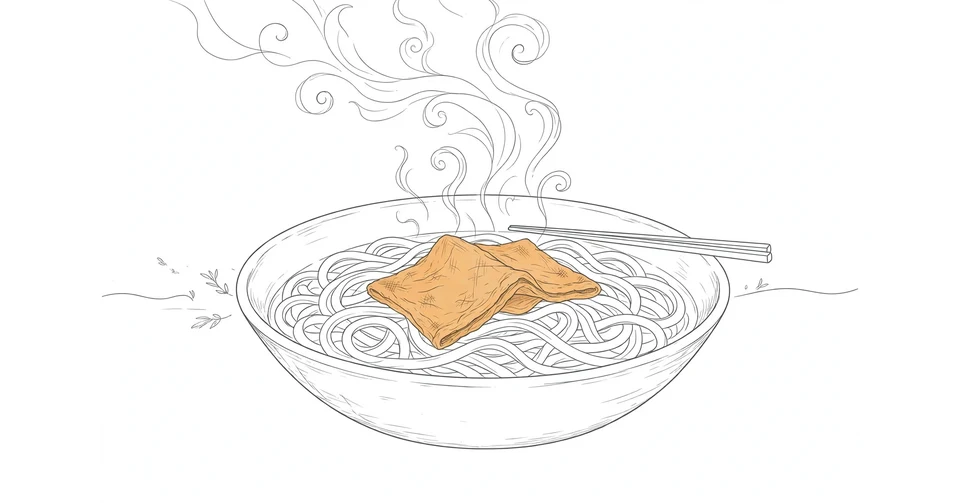
I first met kitsune udon the way most visitors do, as a line on a menu I did not understand, and I ordered it mostly because of the fox. That is a good reason to order anything in Japan, and this time it paid off. The tofu was sweet against the salty broth, the noodles were soft with a gentle chew, and the bowl was gone sooner than I expected. I have since learned that the best food stories in Japan often start exactly like that, with a word you half recognise and a bowl you finish too fast.
What sits in the bowl
At its simplest, kitsune udon is three things in balance: thick udon noodles, a light dashi broth, and aburaage seasoned with soy sauce, mirin, and sugar. Just One Cookbook describes it as a traditional Japanese noodle soup of chewy and thick udon noodles, light and flavourful dashi broth, and deep fried tofu pouches seasoned that way, and that short description is honest. Nothing in a bowl of kitsune udon is trying to impress you. Everything in it is trying to comfort you.
The noodles matter more than they look. Udon is wheat, water, and salt, rolled thick and cut into fat strands that stay springy in hot broth. Osaka udon is not the thickest style in Japan. The agriculture ministry's regional food archive describes it as not too thick, with a soft, gently springy chew, so the noodle takes on the dashi rather than competing with it. That is the right idea for kitsune udon. The noodle should carry the broth to your mouth, not fight it.
The broth is where kitsune udon is won or lost. A good dashi for kitsune udon starts with kombu, dried kelp, and katsuobushi, dried bonito flakes, simmered into a clear stock. The soup is then seasoned with mirin, a little sugar, salt, and usukuchi, the light coloured soy sauce of the Kansai region. The pale colour is deliberate. Usukuchi soy sauce is lighter in colour than the dark koikuchi style used in Tokyo, but it is saltier, so the seasoning is present and only quieter. A pale broth is not a weak broth, and anyone who thinks so has not drunk a good one to the last drop.
Then there is the topping that gives the dish its name. Aburaage is thin tofu that has been deep fried until it puffs into a golden pouch. For kitsune udon, the pouch is simmered in a sweet soy mixture until it turns soft and glossy and soaks up the seasoning like a sponge. When you lift it with your chopsticks, a little of the sweet liquid runs back into the broth, and the broth gets a touch sweeter for it. That exchange, sweet tofu and salty broth trading flavours in the bowl, is the real heart of kitsune udon.
The usual garnishes are small and few: sliced green onion, sometimes a few slices of narutomaki, the white fish cake with the pink spiral, and a pinch of shichimi togarashi, Japanese seven spice, if you want heat. None of them is essential. The three main parts do the work, and the garnishes only sharpen the edges.
Why the fox gets the credit
The kitsune is the fox spirit of Japanese folklore, the messenger of Inari, and the guardian that sits in stone at the gates of Inari shrines across Japan. There are about 30,000 Inari shrines in the country, and the foxes that guard them are usually white, the colour of good omen. Fushimi Inari is the head shrine of them all, founded in 711 in southern Kyoto, and its thousands of vermilion gates are the image of Japan that most visitors carry home.
So how did a shrine guardian end up in a bowl of kitsune udon? The link is the fried tofu. Folklore says that foxes love aburaage, and people still leave fried tofu as an offering at the feet of shrine foxes. When a noodle shop topped its udon with the same fried tofu, the name kitsune udon followed naturally. The fox gave kitsune udon its name, and the dish gave the fox a place on the lunch menu. The full sweep of the folklore, from the earliest written mentions of the fox to the possession tales and the theatre, is worth reading on its own, because the bowl only makes sense once you know the animal behind it. A kitsune is the fox messenger who guards the shrines of Japan, and its story runs from rice fields to noodle shops without ever breaking stride.
There is a second theory, and it is charming enough to mention. Just One Cookbook notes that aburaage may be called kitsune because it is the same golden brown colour as a fox, and Japanese recipes often say to cook something to a fox colour to describe that exact shade. The two theories do not fight each other. One says the fox loves the tofu, the other says the tofu looks like the fox, and both end in the same place: a golden sheet of fried tofu on a bowl of noodles, named after the animal that haunts the shrines.
The same pouch of seasoned fried tofu appears in a second famous dish, inari sushi, where vinegared rice is tucked inside the tofu instead of sitting under it. Kitsune udon and inari sushi are cousins, and both of them trace back to the shrine offering. Inari sushi comes in two regional styles: the Tokyo style, where the pouch completely covers the rice, and the Osaka style, where the pouch leaves the rice exposed at the bottom and is said to resemble a fox's ear. I like that detail, because it shows how seriously Japan takes its food folklore. Even the shape of a sushi parcel is allowed to be a joke about a fox.
What I take from all of this is that the name is not decoration. Japanese food often carries its history in plain sight, and this bowl wears its story on top, where you can see it before you taste it. You do not need to know the folklore to enjoy a bowl of kitsune udon, but knowing it makes the first bite better, because you are eating a story that started in a rice field more than a thousand years ago and ended up, by a very ordinary road, in a bowl.
The Osaka story, and why the date is not quite settled
The best known origin story for kitsune udon belongs to Osaka, and it is a small, human story, the kind that sounds true because nothing grand happens in it. In 1893, at a noodle shop called Matsubaya in the Semba district, fried tofu was served as a side dish with the inari sushi. A customer put the tofu on top of his plain udon and ate them together. The combination proved popular, and the shop began serving it that way. The shop still exists today as Usami-tei Matsubaya, and it still serves the bowl.
That is the version of the kitsune udon story that Japan's Ministry of Agriculture, Forestry and Fisheries gives in its regional food archive, and it is the version most guides repeat. But the honest version has a wrinkle, and it is worth stating plainly. Other theories exist, and the dates do not all agree. Dotonbori Imai, the most celebrated udon house in Osaka, dates the idea of fried tofu in udon to 1877 in its own timeline, and places the sweet simmered version after 1894. One much repeated online claim even gives 1883, which appears to be a simple slip of a digit. The fair reading is that Matsubaya holds the best known claim, that kitsune udon took shape in Osaka in the 1890s, and that the exact first bowl is lost to the kind of history that nobody writes down at the time.
I find that uncertainty reassuring rather than disappointing. Great dishes rarely have a birth certificate. They have a decade, a district, and a habit that caught on, and the 1890s in Osaka provide all three. Osaka was a merchant city, a port where trading vessels brought kelp from Hokkaido and dried fish from across Japan, and that trade is what built the city's distinctive dashi culture. A merchant city invents food the way it invents anything else: a customer tries something, a shopkeeper notices, and a new item appears on the menu. The fox only supplied the name.
There is also a lesson in the story about how food travels. Kitsune udon did not need a chef or a cookbook to spread. It needed one customer who was too impatient to eat his side dish separately, and one shopkeeper wise enough to copy him. That is how most of the food we love actually begins, not with a plan but with someone eating in a slightly unusual way and everyone else deciding to join in.
How a bowl of kitsune udon comes together
Making kitsune udon at home is simpler than the name suggests, and the Just One Cookbook recipe for kitsune udon lays out the whole process in about twenty minutes of cooking. The steps are five, and none of them is hard. The difficulty, if there is one, is in the quality of the ingredients, above all the dashi.
First comes the dashi. Kombu and cold water go into a saucepan, and the kelp is lifted out just before the water boils, because leaving it in makes the stock slimy and bitter. Then katsuobushi goes in, simmers briefly, and sinks to the bottom while the stock rests. Strained, that is awase dashi, the combined kelp and bonito stock that underpins so much of Japanese cooking. For a vegetarian or vegan bowl of kitsune udon, kombu dashi alone does the job, and the recipe notes that this is a genuine option, not a compromise.
Second comes the broth. The dashi is seasoned with mirin, a teaspoon of sugar, a tablespoon of usukuchi soy sauce, and half a teaspoon of kosher salt for two servings, then brought to a boil and kept on a low simmer. The light coloured soy sauce matters here. It keeps the broth pale gold instead of dark brown, which is the Osaka look, and it seasons without colouring.
Third, the toppings are prepared. The seasoned tofu pouches, called inari age, are squeezed gently to remove excess liquid, though you can keep the liquid if you prefer it. A green onion is sliced thin, and a few slices of narutomaki are cut for garnish. If you cannot find aburaage where you live, packaged inari age is widely available in Asian grocery stores, since it is the same pouch used for inari sushi, and it works well.
Fourth, the noodles are cooked separately in a large pot of boiling water, then drained well. Frozen Sanuki udon, the style the recipe recommends, needs only about a minute in boiling water. The important detail is to shake off the excess water before the noodles meet the broth, because stray water dilutes the soup you have just seasoned with care.
Fifth comes assembly, and it is the most satisfying part. The drained noodles go into the bowls, the hot broth is poured over them, and the tofu pouches, fish cake, and green onion go on top. A sprinkle of shichimi togarashi adds heat if you want it. That is the whole recipe. Twenty minutes, five steps, and a bowl that tastes like it took far longer.
The numbers are modest, and that is part of the point. The recipe serves two, and one serving comes to about 328 calories, with the bulk of the energy coming from the noodles themselves. Kitsune udon is not rich food. It is balanced food, a bowl you can eat for lunch and still feel clear headed afterwards, which is exactly what a working lunch in Osaka is supposed to be.
Osaka broth against Tokyo broth
Japan argues about udon the way other countries argue about football, and the argument is almost always about the broth. The two great styles, Kansai in the west and Kanto in the east, start from different stocks and end in different colours, and kitsune udon belongs firmly to the western side.
| Osaka, Kansai style | Tokyo, Kanto style | |
|---|---|---|
| Base stock | Kombu kelp with dried fish such as mackerel flakes | Katsuobushi bonito flakes |
| Soy sauce | Usukuchi, pale and saltier | Koikuchi, dark and rich |
| Colour | Light gold, nearly clear | Deep brown |
| Noodle | Softer, gently springy, not too thick | Often firmer and thicker |
The table makes the difference look neat, and in real bowls it is messier, because shops blend and borrow. But the direction of the difference is real. Osaka builds its broth on kelp and seasons it pale, so the dashi carries the bowl. Tokyo leans on bonito and dark soy sauce, so the seasoning leads. Neither is better in any absolute sense, and I have eaten excellent bowls in both styles. The point is that kitsune udon was born in the pale tradition, and the sweet tofu topping only makes sense against a light broth. Put that same sweet tofu in a dark, strongly seasoned soup and the sweetness would vanish. In a pale broth it stands out, which is why kitsune udon has lasted for more than a century.
There is a useful rule hiding here for anyone cooking Japanese food at home. Colour is not flavour, and paleness is not weakness. A clear soup can be deeply seasoned, and a dark soup can be mild. Judge a broth by tasting it, not by looking at it, and you will stop making the mistake that visitors make with their eyes before their spoon reaches the bowl.
How it differs from its neighbours
Udon has many toppings, and the noodle shop menu can look like a puzzle to a first timer. The differences are simple once you know them, and kitsune udon sits at the gentle end of the range.
Tanuki udon is the closest cousin of kitsune udon, and the easiest to confuse with it. Where kitsune udon is topped with fried tofu, the tanuki bowl, named after the raccoon dog, is topped with tenkasu, the crisp scraps of fried tempura batter. One is soft and sweet, the other is crisp and oily, and the animal names are the menu's way of telling them apart. Tempura udon adds a piece of fried prawn or vegetable tempura. Niku udon adds simmered beef. Curry udon drowns the noodles in a thick curry soup. Each of them is a different answer to the same question, which is what to put on top of a bowl of noodles, and the fox's answer is the sweetest and the softest.
Kitsune udon also has a chilled cousin for summer. The same components can be served cold, with a few spoonfuls of dashi based sauce poured over the noodles instead of a full bowl of hot broth. It is the same idea in a lighter register, and it suits a humid Osaka afternoon better than a steaming bowl does.
I think the comparison matters because it shows what kind of dish kitsune udon is. It is not the richest udon, the spiciest, or the most dramatic. It is the kindest one, the bowl you order when you want comfort without excess, and the one you recommend to a friend who has never eaten udon before. There is wisdom in having a dish like that on the menu, a safe harbour among the louder options, and I suspect that is one reason it has survived so long.
Where to try kitsune udon in Osaka
The honest answer to where to try kitsune udon is that you can try it almost anywhere in Osaka, from department store food halls to standing noodle counters, and most versions will be good. But two shops are worth a deliberate visit, because they hold the two ends of the story.
The first is Usami-tei Matsubaya, the shop with the best known claim to the invention, in the Semba district near Shinsaibashi. It is a long established house, and eating there is a way of tasting kitsune udon at its source. The second is Dotonbori Imai, the most celebrated keeper of the tradition, whose main shop has stood on the Dotonbori canal strip since 1946. The Shoku Noren guide to Dotonbori Imai is the most useful single source for planning a visit, and it is worth reading before you go.
Imai is a good place to understand what kitsune udon is supposed to be. The house builds its dashi on natural makombu kelp from southern Hokkaido, brought slowly to the boil and simmered for close to an hour, then adds finely shaved saba-bushi, mackerel, and urume-bushi, round herring, in a ratio of one part to two parts, with souda-katsuo among the listed ingredients. The broth is finished in a pot of about fourteen litres, which tells you something about the scale of care involved. This is not a stock cube and a kettle. It is an hour of attention in a pot the size of a small bath, for a bowl that costs, at the main shop, 930 yen including tax as of September 2026.
Practical details help. The main shop opens at 11:30 and closes at 21:30, with last orders at 21:00, and it closes on Wednesdays and on the fourth Tuesday of each month except December. It is about five minutes on foot from Namba Station on the Midosuji subway line. You do not need a reservation for udon. Walk in, ideally at the opening or in the middle of the afternoon, order the kitsune udon, and finish the broth. The room seats about 138 people, so a line at the lunch peak usually keeps moving. Prices and hours change, so check the shop page before you go, and treat anything I write here as a starting point rather than a promise.
If you eat there, drink the broth. That is the house's own advice, and it is the right one. The noodles will be gone quickly and the tofu will be sweet, but the broth is the reason the shop has lasted for eighty years, and leaving it in the bowl is like visiting a shrine and not looking at the fox.
Cooking it at home
You do not need to fly to Osaka to eat a good bowl of kitsune udon. The home version of kitsune udon is honest food, and the recipe above is forgiving. Three pieces of advice make the difference between a decent bowl and a good one.
First, spend your effort on the dashi. Just One Cookbook is blunt about this: dashi powder does not provide enough depth for a flavourful broth, and the recipe recommends homemade dashi or a dashi packet instead. Making it from scratch takes less than thirty minutes, and it is the single step that lifts the bowl. A good broth forgives average noodles. A weak broth forgives nothing.
Second, buy the best noodles you can find. Frozen Sanuki udon, if your local Japanese or Asian grocery store carries it, is chewier and less doughy than many dried options, and it will not break as easily in the pot. If you only have dried noodles, follow the package instructions and drain them well. The noodle is the body of the dish, and a broken, floury noodle cannot be rescued by good broth.
Third, do not rush the assembly. Pour the hot broth over the noodles, lay the tofu on top last, and eat it while it is hot. The tofu should be warm and soft, the noodles springy, and the broth clear and steaming. If you make kitsune udon for someone else, serve it the moment it is assembled, the way a noodle shop would, because udon waits for nobody and the broth keeps cooking the noodle in the bowl.
Kitsune udon also appears on screen, which is a pleasant way to meet it before you cook it. It features in the Netflix series Midnight Diner: Tokyo Stories, season two episode seven, where the master prepares a bowl with a large homemade inari age. It is a fitting appearance. Midnight Diner is a show about a small late night counter where the food is simple and the stories are human, and a bowl of fox udon belongs there exactly.
A bowl that keeps its story
Kitsune udon has lasted for more than a century because it does three things at once, and few dishes manage even one of them. It tells a story, it comforts the person eating it, and it costs little. The story is the fox and the shrine, the comfort is the sweet tofu in the salty broth, and the low cost is what lets it stay an everyday lunch instead of a special occasion. That combination is rarer than it looks, and it is worth noticing when you find it.
There is something else here that I keep coming back to. Kitsune udon began with a customer who put his side dish on his noodles, and a shopkeeper who paid attention. Nobody in that story was trying to invent anything. One person was hungry, another was watching, and a tradition started. Most of the good things in a culture begin that way, small and unplanned, and they survive because ordinary people keep choosing them, one bowl at a time.
So order kitsune udon for the fox if you like, or order it because you are hungry, or order it because the pale broth has been quietly praised by everyone who knows it. Any of those reasons will do. A bowl of kitsune udon does not ask much of you. It asks only that you eat it while it is hot, drink the broth, and remember that a shrine guardian's favourite snack is now yours too, for the price of lunch.
More in Food & Travel
- Tokyo Disneyland and Why Japan Loves It Differently
- Walking Through Senbon Torii Feels Like Entering Another World
- Onigiri, Japan's Two-Thousand-Year-Old Portable Meal
- Prambanan Towers Over Java With a Love Story in Stone
- Ekiben, the Train Station Bento That Turns a Journey into a Meal
- Natto, the Sticky Fermented Beans Japan Loves and Visitors Fear
Latest posts
- Kagura Is the Sacred Dance Shinto Still Performs
- Norito Give a Shinto Ceremony Its Voice
- The Gohei Wand Carries the Kami Into the Ceremony
- Origami and How a Single Sheet of Paper Became Japan's Quiet Art
- A Hishaku Is the Bamboo Ladle That Starts Every Shrine Visit
- A Kitsune Is the Fox Messenger Who Guards the Shrines of Japan
- Temizuya Is Where Every Shrine Visit Begins With Water
- Shide Are the Paper Lightning That Marks a Sacred Space
- Yabusame Turns Horseback Archery Into a Moving Prayer
- Roro Jonggrang and the Thousand Temples Built in One Night
- Ten Thousand Vermilion Gates Lead Up Fushimi Inari
- Shimenawa Marks the Line Between Ordinary and Sacred
- A Torii Gate Marks Where the Ordinary World Ends
- The Yumi Stands Taller Than Its Archer
- Kyudo Turns Archery Into a Moving Meditation