A Shichirin Turns a Handful of Charcoal Into a Full Meal
· 16 min read
A shichirin is a small Japanese charcoal grill that cooks a complete meal over just a few pieces of charcoal, and its quiet efficiency has kept it at Japanese tables since the Edo period.
A shichirin is a small Japanese charcoal grill, light enough to carry with one hand and strong enough to cook a whole meal over a handful of glowing coals. It is not a barbecue for a crowd. It is a stove for one or two people, built for fish, skewers, and vegetables cooked slowly at the table while the evening passes.
The secret of the shichirin is how little it asks for. A few pieces of charcoal, a wire rack, and a little patience are enough to grill a Pacific saury until its skin crisps, to brown a skewer of yakitori, or to toast a piece of mochi until it puffs. The grill does not hurry, and it does not waste. It turns a small fire into dinner, one piece at a time.
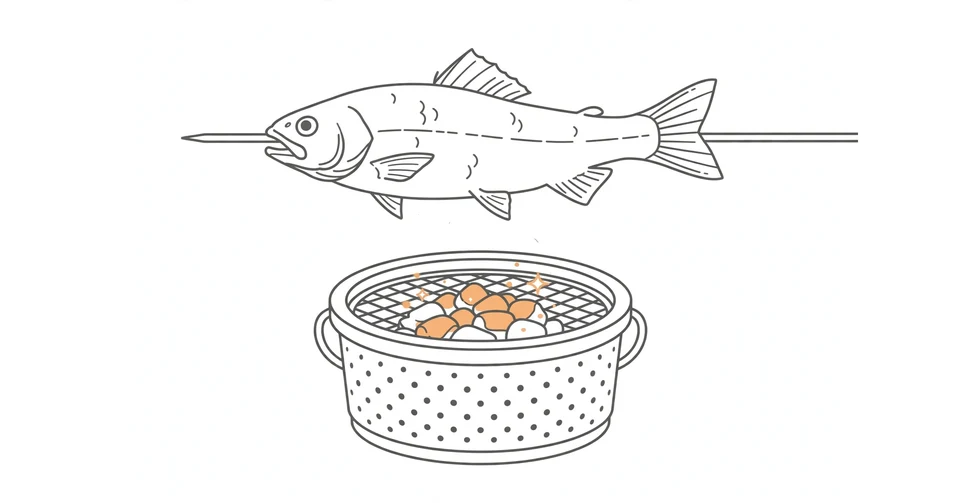
That modesty is exactly why the shichirin has lasted for centuries. Japan has no shortage of grand cooking tools, from the sunken hearth of the old farmhouse to the flat steel of the teppan, but the shichirin stayed because it fits ordinary life. It fits a small kitchen, a narrow balcony, a picnic by a river, and a quiet table for two. It asks for almost nothing and gives back a meal that tastes of charcoal smoke and unhurried time.
I have come to think of the shichirin as the most honest grill in Japan. It hides nothing. You can see the coals, feel the heat on your hands, and watch the food change colour over the fire. There is no dial to turn and no setting to trust, only your own attention, and that attention is part of the pleasure.
The name carries a small price tag
The word shichirin is written with two characters, seven and wheel, and it literally means seven wheels. The name sounds like a riddle until you hear the story behind it, and the story is about money rather than wheels. A popular tale links the second half of the word to the rin, a tiny Edo period coin, and says that the charcoal needed for one lighting of the stove cost only seven rin.
The Wikipedia entry on the shichirin tells the story plainly and notes the small wrinkle in it, that the rin of the name and the rin of the coin are written with different characters. The tale may be folk etymology rather than strict history, but it survives because it captures something true about the stove. A shichirin was cheap to run, and that cheapness mattered. A cooking stove that only the rich could afford would never have become a household object. A stove that cooked a meal on seven rin worth of charcoal could belong to anyone.
That idea, that a good meal need not be an expensive one, runs through the whole history of the shichirin. It was a working stove for ordinary people long before it became a favourite of restaurants and food lovers abroad. Its name is a reminder that the best cooking tools are often the ones that ask the least of the cook.
A block of ancient earth, carved into a stove
A shichirin is usually made from diatomaceous earth, a pale, porous stone formed from the glass like shells of countless tiny plankton that died and sank to the ocean floor long ago. The material is light for a stone, full of tiny air pockets, and it holds heat the way a good oven holds heat, steadily and evenly, without flaring. That is why a shichirin can cook so well on so little fuel. The walls of the stove store the heat of the coals and give it back slowly to the food above.
The best known source of this earth in Japan is the Noto Peninsula in Ishikawa Prefecture, with deposits also found in parts of Hokkaido. The Knifewear guide to how konro grills are made describes the two ways a shichirin is shaped from it. In the older method, called kiridashi, skilled craftspeople go into the mine and cut the diatomite out in solid blocks, then carve each block into the shape of a grill and bake it in a kiln. A kiridashi shichirin is a single piece of stone, and it costs about two to three times as much as a moulded one, because the work is slow and the skill is rare. It is also the more durable kind, and the hardest to find.
The more common method is called nerimono, which means made from paste. The diatomaceous earth is ground up, mixed with water, pressed into moulds, and baked into blocks that are then assembled into the finished grill. Nerimono grills can be made faster and far more cheaply than kiridashi ones, and they cook just as well, and the method also allows for larger sizes. Most of the shichirin you will find in a shop today are nerimono, and there is nothing second rate about that. They are simply the same ancient earth, shaped by a quicker hand.
One company stands behind a large share of these grills. Kaginushi Kogyo has run a diatomite mine and a konro workshop on the Noto Peninsula since 1932, and its nerimono grills are now the best known in the Western world. The company, and the whole peninsula, suffered a heavy blow on the first day of 2024, when a magnitude 7.3 earthquake struck Noto and was followed by a five metre tsunami. The factory and the mine were damaged and flooded, and as of the summer of 2025 the makers were still rebuilding. I think about that whenever I see a shichirin now. The stove in front of you may look like a simple block of pale stone, but behind it stands a small workshop, a mine, and a community that kept going after its ground shook.
Some shichirin are made differently, from ceramic, sometimes with a double wall, an inner and an outer shell, and they come in round, square, and rectangular shapes. In the Kansai region the same stove is often called a kanteki. The shape changes with the maker and the region, but the idea stays the same, a compact body that holds a small fire close under the food.
What a shichirin actually cooks
A shichirin is not built for feasts. It is built for a few pieces at a time, cooked well, and the foods that suit it best are the ones that reward direct heat and a little smoke. A Pacific saury, sanma, is the classic example, a slender autumn fish that grills whole over the coals until its skin turns crisp and its flesh stays moist, with a wedge of grated daikon and a squeeze of citrus beside it. It is a simple dish, and the shichirin makes it taste like the season itself.
Yakitori skewers are the other natural partner. A few skewers of chicken, brushed with sauce or salted, sizzle over the narrow bed of coals while the cook turns them with tongs and watches the edges brown. Vegetables work just as well, slices of eggplant, mushrooms, green peppers, and sweet potato, all of which pick up a light char and a whisper of smoke in a few minutes. Chikuwa, the tube shaped fish cake, and small sausages are common too, quick foods for a grill that is already hot and ready.
Mochi deserves a mention of its own, because it shows the gentle side of the stove. A piece of mochi set on the wire rack over a settled fire softens slowly, then puffs up like a small pillow, ready to be dipped in soy sauce or wrapped in seaweed. It is not a main course, but it is the kind of small pleasure a shichirin is made for, a snack that appears while people are still sitting and talking, cooked in the time it takes to finish a cup of tea.
The portions are small by design, and I think that is a virtue rather than a limit. A shichirin feeds one or two people at a time, and it invites the cook to stay at the table instead of disappearing into a kitchen. The food arrives piece by piece, hot from the coals, and the meal stretches out into a conversation. Nobody is served everything at once, and nobody is rushed. The stove sets the pace, and the pace is slow.
The charcoal decides the meal
A shichirin is only as good as its charcoal, and the choice of fuel changes everything about how it cooks. The finest pairing is binchotan, the dense white charcoal made from ubame oak in Wakayama Prefecture, and the guide to binchotan explains why it became the fuel of choice for small Japanese stoves. Binchotan lights slowly, burns hot for a long time, and gives off very little smoke or smell, which is exactly what a small indoor stove needs. A smoky fire could never sit in the middle of a living room. A binchotan fire can, and that quiet, steady heat is what lets a shichirin cook so evenly.
Outdoors, ordinary black charcoal is the common choice, and it works well in the open air where a little smoke does not matter. Sawdust charcoal is a cheaper alternative that some cooks use, though it does not hold its heat as long as binchotan. The rule of thumb is simple. The smaller and more enclosed the space, the cleaner the charcoal should be. A shichirin used indoors deserves binchotan, both for the taste of the food and for the air in the room.
Lighting the charcoal is the one part of the process that asks for patience. Binchotan in particular takes its time to catch, and a new user is often tempted to rush it with too much flame or too many pieces at once. The better habit is to light a few pieces in a charcoal starter, wait until they are glowing evenly, and then set them in the stove with tongs. A shichirin needs only a small bed of coals, and adding more than that does not cook the food faster. It only makes the fire harder to control. The stove teaches restraint, and restraint is a good teacher in a kitchen.
Once the coals are settled, the heat is remarkably even. The thick diatomite walls hold the warmth and spread it across the rack, so a skewer cooks through without one side burning while the other stays raw. That evenness is the reason restaurants that cook over charcoal every day still choose this shape. A gas grill can be hotter, and an electric grill can be tidier, but neither one gives food the same dry, steady heat with the same faint taste of smoke.
The hibachi mix up, cleared up once more
Anyone who has eaten at a Japanese steakhouse in North America has probably met the word hibachi used for something it is not. In North America, small barbecue stoves that look like a shichirin are often sold and served under the name hibachi, and the word is also used for teppanyaki restaurants, where a chef cooks on a flat iron plate. The confusion is understandable, because both words travelled abroad with Japanese food, but it is still a confusion, and it is worth clearing up.
The real hibachi is not a grill at all. It is a fire bowl, a round container of ash and glowing charcoal that warmed Japanese rooms for centuries, and the story of the hibachi traces how that quiet heater carried the hearth from one room to another. A hibachi heats people. A shichirin cooks food. The two objects are cousins, both built around charcoal and both small enough to carry, but their jobs were never the same.
The mix up happened when the shichirin arrived in North America and needed a name that customers would recognise. Hibachi was the word that had already travelled, so it was borrowed for a stove it was never meant to describe. The result is that a whole continent pictures a flat steel grill with leaping flames when it hears the word hibachi, and pictures nothing at all when it hears the word shichirin, which is the stove actually doing the cooking. Knowing the difference does not spoil the restaurant meal. It simply gives the small clay grill its proper name back, and I think a tool that has cooked Japanese meals for centuries deserves to be called by its own name.
Cooking at the table, one piece at a time
The best way to understand a shichirin is to eat a meal cooked on one, and the first thing you notice is how close everything is. The stove sits in the middle of the table, the coals glow a few hand spans away, and the food is never more than a reach from the fire. There is no oven door to open, no lid to lift, no distance between the cook and the meal. You watch the fish crisp, you smell the smoke rise, and you take each piece off the rack at the moment it is ready.
That closeness changes how a meal feels. A normal dinner is cooked first and eaten second, with the cooking hidden away in another room. A shichirin meal is cooked and eaten at the same time, in the same place, by the same people. The cook is not separated from the table, and the table is not waiting for the cook. Everyone watches the fire together, and the waiting becomes part of the pleasure rather than a delay before it.
There is also a gentleness to the pace that I have come to value. A shichirin cannot cook ten skewers at once, so nobody expects it to. The meal arrives slowly, piece by piece, and the conversation fills the gaps. A modern kitchen is built around speed, getting food to the table as fast as possible, but the shichirin is built around the opposite idea, that the cooking itself is worth sitting with. In a life full of hurried meals eaten over phones and laptops, a stove that forces you to slow down and watch a piece of fish grill feels less like an old tool and more like a small correction.
It is worth saying plainly that a shichirin suits small households and quiet evenings better than it suits a party. If you need to feed eight people, a larger grill or a kitchen stove will do the job better, and there is no shame in that. The shichirin was never meant to be the only stove in a house. It was meant to be the small one, the one you bring out when the meal is simple and the company is close, and within that modest job it has no equal.
Looking after a small clay stove
A shichirin is a simple object, and keeping it in good shape is simple too, but it does ask for a little care. The first rule is the same as for any charcoal fire. It must have fresh air. Burning charcoal gives off carbon monoxide, which has no smell and no colour, so a shichirin should never be used in a sealed room, and nobody should fall asleep beside a lit one. Open a window or a door a little, even on a cold night, and let the room breathe while the coals burn.
The stove itself should sit on a stable, heatproof surface, away from anything that could catch, and the coals should be moved with metal tongs rather than fingers. The rim and the body stay hot long after the glow fades, so children and pets should be kept at a respectful distance, and anyone using the stove should know that it is still hot even when it looks cool. These are not fussy rules. They are the same respect any open fire deserves, and they are easy to keep once they become habit.
After the meal, the care is just as simple. Let the coals burn down and cool completely before moving the stove, and leave the ash to cool fully, ideally overnight, before putting it into a metal container. A ceramic or diatomite body can crack if it is dropped or heated unevenly, so it should be handled with two hands and stored somewhere dry. A small crack does not always mean the end of a stove, but a cracked body should not be trusted with a live fire until it has been checked, because the heat will find the weak place. A little attention, given after every use, is what lets a shichirin last for years instead of a single season.
Choosing a first shichirin is a pleasant problem to have. A small round one, about the size of a dinner plate, is enough for one or two people, and it is the easiest to light, carry, and store. A larger rectangular one suits skewers better, because the long bed of coals fits a row of them at once. Either way, the thing to check is the material. A dense, pale diatomite body with a clean shape and solid metal fittings is the sign of a well made stove, and a very cheap one that feels crumbly or light for its size is usually a warning rather than a bargain. Buy the stove you will actually use, not the biggest one in the shop, and you will use it often.
A small fire, a full table
A shichirin turns a handful of charcoal into a full meal, not by being powerful, but by being patient. Its walls of ancient earth hold a small fire steady, its rack sits close over the coals, and its size keeps the cook at the table where the meal is happening. It has cooked Japanese dinners since the Edo period, through changes of kitchen and fashion, and it has done it without changing its shape or its promise.
What I like most about it is how little it pretends to be. It does not promise to feed a crowd, or to cook in minutes, or to do the work for you. It promises a small, honest fire and a meal that tastes of charcoal and attention, and it keeps that promise every time it is lit. On a quiet evening, with a fish on the rack and a cup of tea at hand, that is enough. It is enough to make a small table feel like the warmest place in the house, and to remind everyone sitting there that a good meal was never really about having more fire. It was about having just enough, and using it well.
More in Food & Travel
- Binchotan Is the Charcoal That Made the Hibachi Possible
- Chawanmushi Hides a Whole Meal Inside a Teacup
- Himeji Castle, Japan's White Heron That Survived War and Fire
- Japanese Breakfast and the Morning Meal That Starts with Rice and Soup
- A Yuzamashi Cools the Water Before the Tea Begins
- Tencha Is the Shade-Grown Leaf Matcha Is Made From
Latest posts
- Warosoku Burns Brighter Because Its Wick Is Hollow
- Japanese Chopsticks and the Quiet Rules Behind Every Meal
- A Tanzen Is the Full Length Robe Japan Wears Indoors in Deep Winter
- The Haze Tree Grows the Wax Behind Japan's Oldest Candles
- A Hanten Is the Winter Jacket Japan Wears to Work
- Haze Wax Keeps Japan's Oldest Candles Burning
- Furoshiki, the Japanese Cloth That Wraps Almost Anything
- Japanese Candles Are Still Rolled by Hand in Japan
- Ubame Oak Is the Tree That Turns Into White Charcoal
- Igusa Is the Humble Grass Under Every Tatami Mat
- Japanese Incense and the Art of Listening to Smoke
- Kumiko Builds Beauty From Wood Without a Single Nail
- A Hibachi Carries the Hearth Anywhere in the House
- A Kotatsu Turns a Cold Winter Evening Into the Warmest Room in the House
- The Jizaikagi Hangs Above the Fire and Sets the Pace of Dinner