A Tanzen Is the Full Length Robe Japan Wears Indoors in Deep Winter
· 14 min read
A tanzen is a thickly padded full-length robe that Japan wears indoors in deep winter, longer and warmer than a hanten and closed with an obi sash.
A tanzen is the full-length robe Japan wears indoors in deep winter. It is thickly padded, it reaches the ankles, and it closes left over right with an obi sash, the same way a kimono closes. If a hanten is a padded jacket for working through winter, a tanzen is the padded robe for resting through it. It wraps the whole body, legs included, and it turns a cold room into a place where you can sit still for an hour without shivering. That is the quiet job of a tanzen.
The garment comes from the same family as the hanten, and the hanten article on this site put the difference in one clean sentence: "The tanzen is a thickly padded garment too, but it is a full-length robe rather than a hip-length jacket." That length is the whole story. A hanten stops at mid-thigh and fastens with front strings or is worn open, so it keeps the arms free for work. A tanzen runs to the floor and is tied shut with a sash, so it keeps the legs warm while you sit. One is built for movement, and the other is built for stillness.
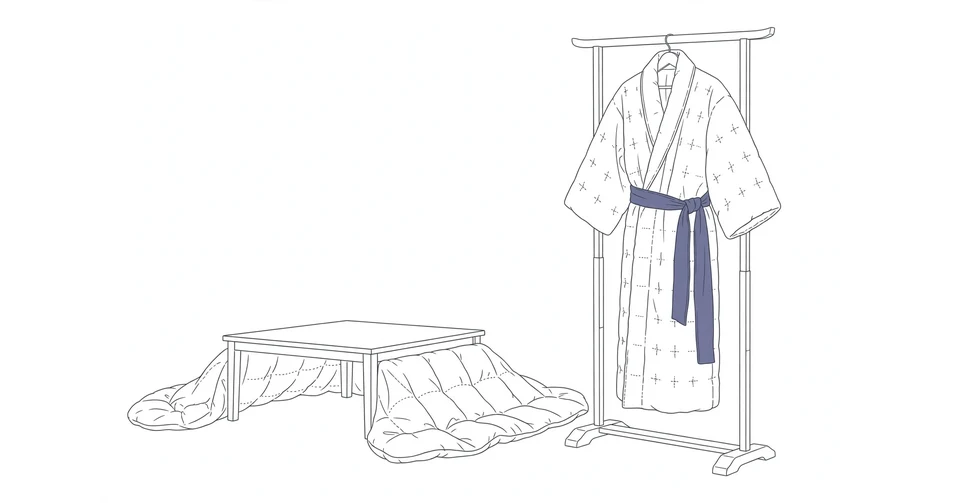
I find that distinction quietly wise. Much of modern winter clothing is designed to let you rush through the cold, and a tanzen is designed for the opposite. It lets you stop, sit down, and be warm while doing nothing at all. There is a kind of honesty in a garment that does not pretend to be anything else, and it does not pretend. It is a robe, it is padded, and it is warm, and that is the entire promise.
What a tanzen is
A tanzen is a thickly padded winter garment, a full-length outer robe that is worn left over right, just like a kimono or a yukata, and fastened with an obi sash. The padding is the point. Between the outer cloth and the lining sits a layer of cotton wadding, held in place by quilting stitches, and that layer traps still air against the body. Still air is a poor conductor of heat, so the robe slows the escape of warmth in the same way a quilt does. Put simply, a tanzen is a quilt you can walk in, cut in the shape of a robe.
The robe is worn over other clothes. It can go over a kimono, over pajamas, or over an ordinary sweater and trousers, and it asks nothing of the wearer beyond tying the sash. The cut is loose and straight, with wide sleeves and a long skirt, so it fits a wide range of bodies without tailoring. Most tanzen are made in a single loose size, in the same spirit as the hanten, because a fitted robe would defeat the purpose. It is meant to be thrown on in the evening and taken off in the morning, without ceremony.
Guides to Japanese clothing place the tanzen in the colder parts of the country. Japan Objects describes it as a padded garment worn during the colder months in the northern regions of Japan, such as Tohoku and Hokkaido, and Kamicrew's guide to the hanten lists the tanzen as cold-region indoor wear. That placement makes sense. In a house where the heating is a single stove or a low table with a heater under it, a robe that covers you from neck to ankle is not a luxury. It is the difference between a room you can sit in and a room you hurry through.
How a tanzen differs from a hanten
The easiest way to understand a tanzen is to hold it next to a hanten, because the two garments share a bloodline and differ in exactly the ways that matter. Both are padded, both are quilted, and both belong to the everyday wardrobe rather than the formal one. The differences are length, fastening, and purpose, and they are easy to see once you know them.
A hanten is a short winter coat, cut to the hip or mid-thigh, with three-quarter sleeves and a front that ties with strings or is simply left open. It is, as the hanten guide on this site explains, the winter jacket Japan wears to work. It keeps the arms free and the body warm while the wearer moves, cooks, cleans, or serves customers. A tanzen takes the same padding and runs it all the way down. It is a robe, not a jacket, and it closes with an obi sash rather than a tie. The sash matters more than it looks. A tie holds a jacket shut at the chest, while a sash wraps the whole robe snugly around the waist and keeps the long skirt from falling open when you sit cross-legged on the floor.
| Garment | Padding | Length | Fastening | Best for |
|---|---|---|---|---|
| Tanzen | Thick cotton padding | Full-length robe | Obi sash | Cold-region indoor wear |
| Hanten | Thick cotton padding | Mid-thigh | Front strings or open | Everyday winter wear |
| Haori | Thin or unpadded | Hip-length | Worn open over kimono | Dressier occasions |
| Happi | Unpadded plain cotton | Hip-length | Worn open | Festivals and uniforms |
The table above follows the comparison in Kamicrew's guide, and it shows why the tanzen sits apart from the rest of the family. The haori is thin and formal, the happi is unpadded and made for festivals and work uniforms, and the hanten is the padded jacket for active days. Only a tanzen covers the full body, and only a tanzen is closed with a sash. If you are choosing between the two, the question is not which one is warmer in the abstract. The question is what you will be doing while you wear it. Moving around calls for a hanten. Sitting still for a long evening calls for a tanzen.
Why the name of a tanzen changes with the region
One of the more confusing things about this robe is that its name is not stable across Japan. Japan Nakama, in its guide to the hanten, notes that tanzen is the Kansai name for what eastern Japan calls a dotera. The garment is the same kind of thickly padded robe, but the word for it changes as you travel from west to east, and that is worth knowing before you go looking for one. A shop in Osaka may label it a tanzen, while a shop in Tokyo may call the same shape a dotera, and neither label is wrong.
The same guide adds a second wrinkle. In Tohoku and Hokkaido, the word tanzen usually means a quilted bedcover instead of a robe. That sits oddly next to the other guides, which describe it as a robe worn in those very northern regions, and the two claims do not fully agree. The honest way to put it is that the word shifts meaning by region, and the garment itself is what matters. If you are buying one, look at the shape and the length rather than trusting the label alone. A full-length padded robe with an obi sash is a tanzen in the sense this article means, whatever the tag in the shop says.
I think there is a small lesson in that confusion. Traditional clothing was named by the people who wore it, in the dialect they spoke, long before anyone wrote a catalog. The names overlap and drift, and a tidy list of terms will always lag behind how people actually talk. The word is a useful one, but it is not a perfect one, and that imperfection is part of its history rather than a flaw in it.
What a tanzen is made of
A tanzen is built the way a hanten is built, with the same three layers and the same logic. The outer shell is a sturdy cotton cloth, often indigo dyed, the lining is a lighter cotton, and between them sits the wadding. The wadding is raw cotton fiber, and its hollow, twisted strands trap small pockets of air. The quilting stitches run through all three layers and do two jobs at once. They stop the wadding from bunching up at the hem, and they give the robe its familiar pattern of small diamonds or straight lines.
The craft behind that padding has a home. Production of padded hanten has centered on Kurume, a city in the Kyushu region, since the 1800s, using Kurume Kasuri, an indigo-dyed cotton weave developed through techniques introduced by Den Inoue. The Japanese government designated Kurume Kasuri an important intangible cultural property in 1957, and domestic production of padded garments remains concentrated in and around Kurume today. The robe shares this padded cotton tradition, and the same qualities matter when you judge one: clean stitching, even padding, and natural fiber against the skin.
Modern versions sometimes mix polyester into the padding. Japan Objects notes that a cotton and polyester blend can be lighter and longer lasting than pure cotton while still giving good warmth, and that is a fair trade for a robe that will be worn every evening. Pure cotton feels softer and breathes better, and it is the traditional choice, but a blend is easier to care for and less likely to clump after washing. Neither choice is wrong. The right one is the one that matches how often you plan to wash the robe and how much you are willing to spend on it.
How to wear a tanzen at home
Wearing a tanzen is simple, and the simplicity is part of its charm. Put it on left over right, the way a kimono or yukata is worn, and tie the obi sash at the waist. The sash does not need to be a formal silk obi. A soft cloth sash holds the robe shut just as well, and it is kinder to sit in for hours. Wear it over whatever you already have on, whether that is a kimono, pajamas, or a sweater and trousers. There is nothing to learn and nothing to fasten beyond the one knot.
The natural partner for this robe is the kotatsu, the low heated table that warms winter evenings in Japan. A kotatsu heats the legs under a heavy quilt while the upper body stays in the cold air of the room, and the robe fills that gap. The robe covers the shoulders and back that the table cannot reach, so the whole body is warm at once instead of half warm and half cold. Our guide to the kotatsu, Japan's heated table that warms winter, describes that low table and the evenings built around it, and this robe belongs in exactly those evenings.
A tanzen is an indoor garment first. It is made for the hours after work, for reading, for sitting with family, for the slow part of the day when there is nowhere else to be. It can be worn outside briefly, to step into the garden or to take out the rubbish, but its long skirt and loose sash are not made for walking far or for working with the hands. That is what the hanten is for. The robe is for the moment you come back inside, hang up your coat, and decide to stay warm in one place.
How to choose and care for a tanzen
Choosing one starts with the fit, and the fit is forgiving. The robe is meant to hang loose, with the hem near the ankles and the sleeves covering the wrists, so the main question is length rather than size. If it drags on the floor it is too long, and if it ends at the calf it is a different garment. Check the padding by pressing it between your fingers. It should feel even from shoulder to hem, without thin patches or hard lumps, and the quilting should hold it in place. Look at the collar and the seams, because those are the places that wear first, and a well made robe will have them finished cleanly.
Care for a padded cotton robe follows the same rules as care for a padded hanten, and those rules are gentle ones. Kamicrew's guide advises hand washing in warm water with a neutral detergent, skipping the tumble dryer, and drying in the shade so direct sunlight does not fade the fabric. Japan Objects gives the same advice and adds that the warmth of the sun helps the padding puff back to its shape, provided the cloth is covered so the light does not bleach it. Either way, the principle is the same: wash it softly, dry it slowly, and let the cotton recover on its own.
For storage, hang the robe on a sturdy hanger or fold it on its seams to keep its shape, and if space is short, a vacuum-sealed bag will do, since the padding puffs back up when the robe is aired. Keep it dry and away from damp, and it will last for years. The robe is not a delicate object, and it does not need delicate treatment. It needs the ordinary respect you would give any well made piece of clothing, and in return it gives you winter after winter of warmth.
Why a tanzen still makes sense today
A tanzen still makes sense because the problem it solves has not gone away. Many Japanese homes still do not have central heating, and warmth comes from a mix of heaters, electric carpets, and kotatsu tables rather than from a single system that warms every room. Japan Objects puts it plainly: in Japan, many homes do not have central heating, so a padded garment that is warming but not bulky is the practical answer to high electricity bills. A tanzen takes that logic one step further than a hanten. It warms the person instead of the room, and it warms the whole person rather than only the top half.
The same idea has found new life in recent years. Kamicrew's guide cites reporting by The Mainichi from 2022, which found demand for padded hanten rising as more people worked from home to save on heating costs, while younger buyers were drawn to the garment's distinctly Japanese feel. Production in Chikugo, part of Fukuoka's historic hanten-making area, had fallen from roughly 3 million jackets a year at its 1980s peak to about 20,000, yet one local manufacturer reported that its online hanten sales doubled in fiscal year 2020 alone. A tanzen rides the same wave. It is old clothing answering a new question, which is how to stay warm at home without heating rooms nobody is sitting in.
I like that about it. It does not ask you to buy a new system or to rebuild your house. It asks you to put on a robe, tie a sash, and sit down. There is something quietly radical in that, in a world that keeps selling bigger machines for smaller problems. The robe is small, it is simple, and it works, and the fact that it has worked for generations is not nostalgia. It is evidence.
A tanzen is the full-length robe Japan wears indoors in deep winter, and it earns that place by doing one thing well. It keeps a person warm from neck to ankle, in a cold room, for as long as the evening lasts. If you have ever sat in a drafty house in January and wished the warmth would stay with you instead of drifting up to the ceiling, you already understand what it is for. The rest is just tying the sash.
More in Life & Style
- A Hanten Is the Winter Jacket Japan Wears to Work
- A Hibachi Carries the Hearth Anywhere in the House
- A Kotatsu Turns a Cold Winter Evening Into the Warmest Room in the House
- The Jizaikagi Hangs Above the Fire and Sets the Pace of Dinner
- An Irori Hearth Warms the Room and the People Around It
- A Sudare Turns Harsh Sunlight Into a Cool Breeze
Latest posts
- Warosoku Burns Brighter Because Its Wick Is Hollow
- A Shichirin Turns a Handful of Charcoal Into a Full Meal
- Japanese Chopsticks and the Quiet Rules Behind Every Meal
- The Haze Tree Grows the Wax Behind Japan's Oldest Candles
- Haze Wax Keeps Japan's Oldest Candles Burning
- Furoshiki, the Japanese Cloth That Wraps Almost Anything
- Japanese Candles Are Still Rolled by Hand in Japan
- Ubame Oak Is the Tree That Turns Into White Charcoal
- Binchotan Is the Charcoal That Made the Hibachi Possible
- Igusa Is the Humble Grass Under Every Tatami Mat
- Japanese Incense and the Art of Listening to Smoke
- Kumiko Builds Beauty From Wood Without a Single Nail
- Japanese Paper Lanterns and the Light That Folds Flat
- A Zabuton Is the Cushion That Tells You Where You Sit in Sumo
- Tatami Still Sets the Measure of a Japanese Room