The Haze Tree Grows the Wax Behind Japan's Oldest Candles
· 13 min read
The haze tree is a Japanese sumac whose berries yield the plant wax behind warosoku candles, and its story runs from Edo era workshops to a small restoration movement in Kurume today.
Light a warosoku candle in a dark room and the flame looks different from any candle you have bought in a shop. It is larger, steadier, and oddly alive, and it smells faintly of plants rather than perfume. That flame exists because of the haze tree, a sumac most people in Japan walk past without noticing, which spends most of the year looking ordinary and then turns scarlet in autumn. The tree is called hazenoki in Japanese, and in English it is the haze tree.
The berries of the haze tree, a sumac relative that grows in the warm west of Japan, are the source of the pale plant wax known as Japan wax or haze wax. Crushed and pressed, those berries give up a fat that is not a true wax at all, yet it burns with a clean, bright flame that made it the fuel of temples, tea rooms, and ordinary homes for centuries. This article follows the haze tree from hillside to candle, and explains why a tree that can irritate the skin became one of the most trusted plants in Japanese craft.
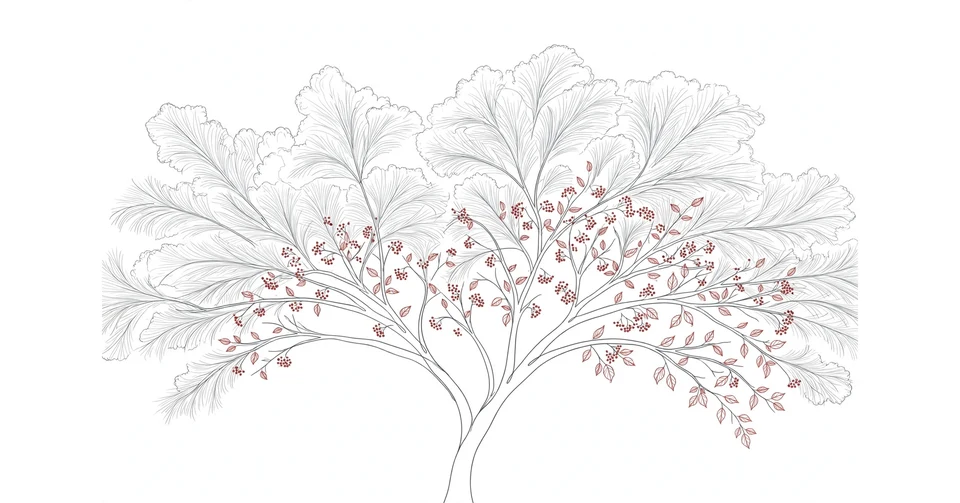
Before the candle, there is the haze tree, and before it became useful, it was simply part of the landscape of western Japan. The haze tree grows wild and cultivated across Kyushu and Shikoku, and its story is a reminder that some of the most useful things in a culture come from plants nobody planted for show.
What the haze tree actually is
The haze tree is Toxicodendron succedaneum, a species in the same family as poison ivy and the lacquer tree, and its Japanese name hazenoki means wax tree. The haze tree is deciduous and grows up to about eight metres tall, with leaves that turn a vivid scarlet and crimson in autumn. In the warm months it is easy to overlook, a green tree among many, but in autumn it announces itself. The wax tree is described in botanical records as a large shrub or tree, somewhat similar to a sumac, and that plain description hides a plant that has shaped a whole craft.
In autumn the haze tree earns its reputation. Its leaves turn scarlet and crimson, and the colour is strong enough that the tree has been planted as an ornamental far from Japan, in gardens whose owners sometimes had no idea what they were planting. Beauty was the invitation and the rash was the surprise, and that is a fair summary of how the tree treats strangers.
The same family that gives the haze tree its beauty also gives it a warning. Like its relatives, the tree contains urushiol, the compound that causes allergic skin reactions in many people, and all parts of the plant are considered toxic. The fruits are described in some sources as edible, though their consumption is not recommended, and that contradiction tells you most of what you need to know about the haze tree. It is generous and dangerous in the same breath, and it rewards people who handle it with knowledge rather than curiosity.
The haze tree is one of the city tree symbols of Kurume, a city in Fukuoka Prefecture that once grew the tree in large numbers for its wax. That civic honour is unusual for a plant that can raise a rash, and it says something about how deeply the tree is woven into the life of the place. Kurume did not choose the haze tree for its looks alone. It chose a tree that had fed a local industry and shaped the working year of farming families.
From berry to wax
The wax comes from the fruit. The haze tree bears small round fruits that hang in clusters from its branches, each one holding a single hard seed inside a waxy coating. The fruits ripen from September to November, turning pale brown as they mature, and they often stay on the branches through autumn and into winter. When the harvest comes, the fruits are gathered, dried, and pressed, and the wax is drawn out by expression, by heat, or with solvents.
Japan wax is not a true wax but a fat, made up mostly of palmitin, stearin, and olein, with about one percent japanic acid. The distinction matters to candle makers because a fat burns differently from a wax, and the haze tree gives a fuel that melts cleanly and feeds a wide wick without smoking heavily. Roughly a sixth of the fruit by weight is wax, according to plant records, which means a single harvest of berries yields a modest amount of a valuable material, and that scarcity is part of why the candles were once precious.
The wax of the haze tree is sold in flat squares or disks and has a rancid odor in its raw form, which is a useful reminder that this is an agricultural product before it is a luxury good. It is pressed, filtered, and refined until it is pale and clean, and only then does it become the smooth material that a candle maker can roll by hand around a wick. Nothing in that chain is fast, and nothing in it is automatic, which is why the craft survived in small workshops rather than factories. The story of the wax itself continues in haze wax keeps Japan's oldest candles burning, which follows the fuel from berry to flame.
The wax, the lacquer, and the second gift of the haze tree
The haze tree gives twice. Its sap is tapped and used as lacquer, the deep glossy coating that protects wood and gives Japanese lacquerware its shine, and Japan wax itself is described as a byproduct of lacquer manufacture. The same tree that lights a room also coats a bowl, and the two crafts grew up together, sharing trees, sharing workers, and sharing a patience that no machine has matched.
That double gift explains why the haze tree was planted so widely in the warm west. A farmer who grew the haze tree was not betting on a single product, and a craftsman who knew the tree knew both its sap and its fruit. When one market faded, the other could carry the tree for a while, and that is a sturdier way to live with a plant than depending on a single harvest.
There is something wise in the haze tree, which refuses to be only one thing. We tend to sort the world into single uses, a tree for timber, a plant for medicine, a flower for show, and the haze tree quietly refuses the sorting. It is a candle, a coating, and an autumn spectacle all at once, and it asks nothing in return except to be left in the warm ground where it grows best.
How haze wax became the candle of Edo Japan
Candles came to Japan with Buddhism in the Nara period, from 710 to 794, and the first ones were made of beeswax gathered from hives. Domestic production began around the year 1000 using pine resin wax, but those candles burned for a very short time, and they were poor light for a temple or a home. The candle Japan still makes today, the warosoku, began to take shape in the Muromachi period, from 1336 to 1573, when makers turned to plant waxes, and the wax of the haze tree became its heart.
In the Edo period, from 1603 to 1868, the cultivation of haze wax trees flourished in Kyushu and Shikoku, the warm islands of the southwest, and warosoku came into wide use among ordinary people. The haze tree was not a wild accident of the landscape any more. It was a crop, planted and tended, and its harvest set the rhythm of the year for the families who grew it. A tree that had once been gathered became a tree that was farmed, and that change is what carried the candle from temples into homes.
The trade that carried the wax was as patient as the craft. Nanao, a port city on the Sea of Japan in what is now Ishikawa Prefecture, thrived as a harbour for the cargo ships that sailed the coast in the Edo era, and those ships brought haze wax from Kyushu and washi paper from Iwami for the wicks. Candles were made in Nanao and then shipped onward to towns across Japan, and a candle makers cooperative called Rousoku-za was founded there around 1650 and kept working into the middle of the Meiji period. If you want to understand how a tree in Kyushu lit a room in the north, follow the ships, because the candle was never only a local product.
The wick is half the secret of the warosoku. It is made by wrapping dried rush weed around a core of cylindrically rolled washi paper, sometimes with silk fibre, and the hollow centre lets air rise through the candle and draws melted wax upward, so the flame burns large and steady with little soot. The wax of the haze tree and the paper wick were made for each other, and the result is a flame that is bigger and brighter than a Western candle flame, with a soft flicker that candle makers describe as relaxing. I find that description honest rather than sentimental, because a flame that moves slowly changes the pace of a room, and a room that moves slowly is a rarer thing than it used to be.
The candles are still rolled by hand in Japan today, and the makers who do the work learned it over decades. Takazawa Candle, a maker established in Nanao in 1892, describes itself as the sole guardian of the tradition in Ishikawa Prefecture, and its story is a good measure of how much has been lost. When electric light replaced candles as the main source of light, most workshops closed, and the few that remained kept a craft alive that a whole country had once depended on.
Kurume and the quiet work of keeping the haze tree alive
Electric light replaced candles as the main source of light in Japan, and the haze tree lost the industry that had kept it planted. Fields were cleared, knowledge thinned, and the haze tree, which had once been a crop, became a curiosity again. That is the ordinary fate of a useful plant when its use fades, and it is why the story of Kurume matters more than the story of the candle alone.
In Kurume, a citizens group called the Matsuyama-haze Restoration Committee has worked since 2007 to bring back a local variety of the tree known as Matsuyama-haze, which bears fruit of prime quality for mokuro, the tree wax that is the raw material of warosoku. The group was founded by Mayumi Yano, a resident of the city, and its work is slow and practical. It restores trees, runs workshops, and teaches people to make candles from the wax of their own town. There is no grand plan in that, only the patient belief that a place should keep what made it itself.
It is easy to admire restoration from a distance and harder to do it, because a tree takes years to bear fruit and a craft takes longer to relearn. The people of Kurume are not preserving a museum piece. They are keeping a living supply chain alive, one tree at a time, and the candle is the proof that the chain still works. I think that is the right way to think about heritage, not as something behind glass but as something you can still light.
A beautiful tree that asks for respect
The haze tree is one of those plants that rewards respect and punishes carelessness, and that is worth saying plainly. Its sap can cause severe dermatitis, and people who handle the tree, its berries, or its wood should know what they are touching. Gardeners in Australia and New Zealand learned this the hard way, and the tree is now officially classed as a noxious weed in both countries, planted as an ornamental by people who did not know its nature.
This is not a reason to fear the haze tree. It is a reason to meet it on its own terms, the way the candle makers of Kyushu and Shikoku always did, with gloves, with knowledge, and with no illusions. A plant that gives wax for light and sap for lacquer is not a decoration, and treating it as one is how people get hurt. The same care that makes a good candle also makes a safe harvest, and the craft has always contained both.
Why the haze tree still matters
Japan wax has not disappeared. It is still used in candles, and it also appears in cosmetics, polishes, and varnishes, because a plant fat that burns cleanly and feels smooth on the skin is useful in more than one trade. The haze tree still earns its place in the economy, just more quietly than it did when every home needed its light. A tree that once lit a country now lights a smaller number of rooms, and those rooms are chosen with more care.
There is a lesson in that, and it is not about nostalgia. The haze tree survived because it was useful to more than one craft, because it grew in the warm west where it belonged, and because a few people in Kurume refused to let the knowledge die with the market. Usefulness is not the same as popularity, and a plant that is useful in a small way for a long time is worth more than a fashion that burns brightly and disappears.
Keeping the haze tree alive is not only the work of committees and candle makers. It is also the work of anyone who chooses a slow light over a fast one, a plant wax over a petroleum one, and a craft that takes decades to learn over a product that takes seconds to buy. Those choices are small, and they are the whole story.
The haze tree at a glance
| Detail | Fact |
|---|---|
| Scientific name | Toxicodendron succedaneum |
| Japanese name | Hazenoki, meaning wax tree |
| Height | Up to about 8 metres |
| Fruit | Small round berries, ripening from September to November |
| Main product | Japan wax, also called haze wax |
| Home ground | Warm western Japan, especially Kyushu and Shikoku |
| Civic honour | A city tree symbol of Kurume, Fukuoka |
A table can only hold the facts, and the facts are the least interesting part of the story. What the table cannot show is the smell of the wax, the colour of the leaves, or the patience of a maker rolling a candle by hand, and those are the things that keep people coming back to a tree they could easily forget.
The next time you see a warosoku candle burning in a temple or a tea room, think of the tree behind it. The haze tree does not ask to be admired, and it does not need to be famous. It grows in the warm west of Japan, turns red in autumn, and gives its berries to a craft that has outlasted every fashion that tried to replace it. That is enough for a tree, and it is more than enough for a candle.
More in Culture & Society
- Warosoku Burns Brighter Because Its Wick Is Hollow
- Japanese Chopsticks and the Quiet Rules Behind Every Meal
- Haze Wax Keeps Japan's Oldest Candles Burning
- Furoshiki, the Japanese Cloth That Wraps Almost Anything
- Japanese Candles Are Still Rolled by Hand in Japan
- Ubame Oak Is the Tree That Turns Into White Charcoal
Latest posts
- A Shichirin Turns a Handful of Charcoal Into a Full Meal
- A Tanzen Is the Full Length Robe Japan Wears Indoors in Deep Winter
- A Hanten Is the Winter Jacket Japan Wears to Work
- Binchotan Is the Charcoal That Made the Hibachi Possible
- Igusa Is the Humble Grass Under Every Tatami Mat
- Japanese Incense and the Art of Listening to Smoke
- Kumiko Builds Beauty From Wood Without a Single Nail
- A Hibachi Carries the Hearth Anywhere in the House
- A Kotatsu Turns a Cold Winter Evening Into the Warmest Room in the House
- The Jizaikagi Hangs Above the Fire and Sets the Pace of Dinner
- Japanese Paper Lanterns and the Light That Folds Flat
- A Zabuton Is the Cushion That Tells You Where You Sit in Sumo
- An Irori Hearth Warms the Room and the People Around It
- Tatami Still Sets the Measure of a Japanese Room
- Chawanmushi Hides a Whole Meal Inside a Teacup