Haze Wax Keeps Japan's Oldest Candles Burning
· 18 min read
Haze wax is the pale, plant-based wax pressed from the berries of the haze tree, and it is the quiet reason Japan's oldest candles still burn the way they do.
Haze wax is the reason a Japanese candle burns the way it does. It comes from the berries of the haze tree, a sumac relative that grows in the warm west of Japan, and it has been pressed, steamed, and shaped into light for centuries. Without it, there would be no warosoku as we know them, and a whole chain of crafts, towns, and livelihoods would never have existed.
The companion article to this one put it neatly: "Haze wax is the classic material, but it was never the only one." That sentence is the starting point here, because the wax deserves its own story. The candle is the finished object, but the wax is the material that made the candle possible, and its history runs through forests, farming villages, merchant towns, and a slow decline that is only now being reversed.
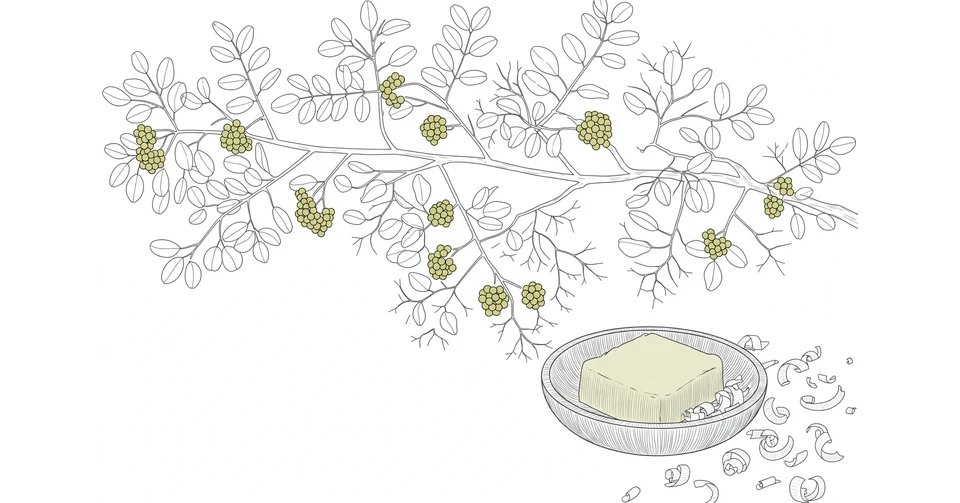
I find it easy to overlook a raw material. We admire the candle, the flame, and the craft, and we forget to ask where the wax came from and who grew it. Haze wax is worth that question, because its answer touches on botany, economics, religion, and the stubbornness of a few people who refused to let a tree disappear. This article follows the wax from the tree to the candle and beyond, and explains why it became scarce and what is happening with it now.
What haze wax actually is
Haze wax, known in Japanese as mokuro, is the pale, slightly gummy solid pressed from the fruit of the haze tree, Toxicodendron succedaneum. It is also sold under the wider name Japan wax, which covers wax from the haze tree and from its close relative the lacquer tree. The two names describe the same family of material, but haze wax is the specific product of the haze tree, and it is the one candle makers prize most.
One fact surprises most people who first meet haze wax. It is not a true wax at all, in the chemical sense. It is a fat, made up mostly of palmitin, and it behaves like a wax in the hand while melting at a modest temperature. The Japan wax entry gives its melting point as about 51 degrees Celsius, with a range of roughly 45 to 53 degrees depending on the sample. That low melting point is part of why a haze wax candle burns so gently, and why the wax feels soft and slightly tacky when you handle it.
The wax is pale yellow when fresh, with a faint earthy smell that some people describe as rancid. It is sold in flat squares or disks, and it hardens as it cools after pressing. In that form it looks unremarkable, like a dull block of soap, but it carries a long history in every gram. It is the material that lit temples, homes, and theatres in Japan for centuries before petroleum and electricity arrived, and it did so without a single animal product.
That last point matters more than it might seem. Japanese candles are ritual objects first, and Buddhism prohibits the intentional killing of animals, so a candle made from tallow or beeswax would be wrong for the altar. Haze wax solved that problem centuries ago, because it comes from a tree. The plant origin of haze wax is not a modern selling point. It is a religious requirement that shaped the whole craft from the beginning, and it is one reason the wax is still valued today by people who want a candle with no animal ingredients.
The tree behind the wax
The haze tree, called hazenoki in Japanese, is a deciduous tree in the Anacardiaceae family, the same family as cashews, mangoes, and poison ivy. It grows in the warm parts of western Japan, in Kyushu, Shikoku, and Wakayama Prefecture, and it was once cultivated across the southern islands specifically for its fruit. In autumn its leaves turn a striking red, and the sight of red haze foliage came to symbolize the late summer in the old wax growing regions.
The tree is not a casual garden plant. It belongs to a family whose sap can irritate the skin, and people who work with haze trees know to expect rashes. That is a small price the growers pay, and it is also one reason the trees were sometimes cut down when people forgot what they were for. A tree that stings is easy to remove and hard to defend, unless you know that its berries are worth more than its shade.
Haze trees bear fruit after the rice harvest, which made them an ideal second crop for farming families. The work of picking berries came in the slack season, when the rice was already in, and it gave farmers income in months that would otherwise have been idle. The trees were often planted along the edges of fields and on hillsides, in the gaps between other crops, so they did not compete with food. It was a clever use of land, and it meant that haze wax production was woven into the farming year rather than standing apart from it.
Over the centuries, growers bred the tree for better wax. Selective breeding and grafting produced dozens of named varieties, each suited to a particular region. Matsuyama Haze and Ikichi Haze came from Fukuoka Prefecture, Showafuku Haze from Nagasaki Prefecture, and Budo Haze from Wakayama Prefecture. Each variety gave wax with slightly different characteristics, tuned to the climate and soil where it grew. That diversity is a reminder that haze wax was never one uniform product. It was a family of local materials, each with its own character, and losing the trees meant losing that variety too.
From berry to wax
The journey from tree to wax begins in winter, when the berries are harvested by hand. The berries are small and nutlike, and the wax sits in the fibrous flesh around a hard kernel, not in the kernel itself. The fruit is steamed first, which softens the flesh and loosens the wax, and then it is pressed while still hot so the liquid wax runs out and hardens as it cools. It is slow, physical work, and it has changed remarkably little over the centuries.
The traditional method uses a press that squeezes the steamed berries in cloth bags, with wedges driven home by a mallet, and the wax that runs off is then purified and bleached by reboiling it with water and ash. A 19th century account of the process, written by a British resident of Nagasaki, describes berries being kept for a year or more before pressing, and the best wax coming from berries stored for six or seven years. That patience is part of the craft, and it is a world away from the way modern wax is made.
Today, the Honda Mokuro workshop in Shimabara, Nagasaki Prefecture, is one of the few places in Japan still producing traditional warosoku candles from the Japanese wax tree, and it is the only place in the country that uses mechanical presses rather than chemical extraction to produce its raw material. The workshop uses ball clamp presses built in the 1950s, a choice its owners made because chemical extraction leaves residues that are released when the candle burns. The older method is slower and more labour intensive, but the wax it produces is cleaner, and the workshop treats that as the whole point.
Candle making came to Shimabara at the end of the 18th century, after the earthquakes and tsunami of the Shimabara Catastrophe devastated the region in 1792. The local lord encouraged farmers whose lands had been destroyed to grow Japanese wax trees as a cash crop, and the trees became a way to rebuild a ruined farming economy. It is a good example of how haze wax has always been more than a candle ingredient. It has been a tool for recovery, a source of income, and a reason to replant a landscape.
How haze wax compares with beeswax and paraffin
To understand what makes haze wax special, it helps to place it beside the two waxes most people know. Beeswax comes from honeybees, and it smells of honey and melts at a higher temperature than haze wax. It is a wonderful material, and it was in fact the first wax used for candles in Japan, when candles arrived with Buddhism in the Nara period. But beeswax was rare and expensive, and only the nobility could afford it, and it is an animal product, which made it unsuitable for the Buddhist altar.
Paraffin is the opposite in almost every way. It comes from petroleum, it is cheap and abundant, and it arrived in Japan in the Meiji period along with Western style candles. Paraffin made candles affordable for ordinary households for the first time, and that is a genuine achievement. But it also changed what a candle was. A paraffin candle is a product of the oil industry, and its smoke and smell are the smoke and smell of petroleum, not of a plant.
Haze wax sits between the two, and it has qualities neither of them can match. It is plant based, like paraffin is not, and it is abundant in its own landscape, like beeswax is not. It burns cleanly, with very little smoke and a faint earthy scent, and it melts at a low temperature, which gives the candle its soft, generous flame. It is also, unlike paraffin, a material with a place and a season. You can point to the hillside where the tree grew and the winter when the berries were picked, and that connection to a specific landscape is part of what people are paying for when they buy a traditional candle.
I think this comparison is the fairest way to judge haze wax. It is not the cheapest wax, and it is not the easiest to produce, and it never will be. But it is the wax that fits the purpose it was made for, which is to burn quietly in a temple or a home without offending the religion, the room, or the people in it. Cheapness is a virtue in a commodity, but a ritual object is judged by different standards, and by those standards haze wax is hard to beat.
More than candles
Candles are the most famous use of haze wax, but they were never its only use, and the wax found its way into many corners of Japanese life. It went into furniture polishes and floor waxes, into soaps and cosmetics, into pastels and crayons, into wax matches and buffing compounds, and into metal lubricants and adhesives. The same properties that made it good for a candle, a clean melt, a soft finish, and a gentle smell, made it useful wherever a smooth, protective coating was needed.
One of the most distinctive uses was in hair. Japan wax went into bintsuke, the pomade used to shape and hold the topknots of sumo wrestlers and the traditional hairstyles of geisha. The wax gave the hair its shine and its hold, and the scent of bintsuke became so recognizable that it is still associated with the sumo world today. A material that starts as a berry on a hillside and ends up holding a wrestler's topknot in place has travelled a long way, and that range tells you how versatile haze wax really was.
The wax also mattered to the wider world. In the 19th century, Japanese wax was exported to Europe and America, where it was used in candles, polishes, and pharmaceuticals, and it was one of the products that introduced the outside world to Japanese craft. The export trade brought money into small towns that had little else to sell, and it gave those towns a reason to keep planting trees. When the export market faded, the towns that had depended on it faded too, which is a reminder that a raw material can carry a whole local economy on its back.
The connection to other traditional materials runs deep. Like binchotan, the charcoal that made the hibachi possible, haze wax is a material defined by its tree and its place, and both of them show how Japanese craft has always started with the landscape rather than the workshop. The tree comes first, the technique second, and the finished object last. That order is easy to forget when you buy a candle in a shop, but it is the order that matters, because without the tree there is nothing to make.
A town built on wax
No place shows the power of haze wax better than Uchiko, a small town in Ehime Prefecture on Shikoku. From the middle of the Edo period, Uchiko produced Japanese wax from the berries of sumac trees planted between the rice fields, and by the end of the Edo period the town had grown wealthy on it. The Haga family, the great wax merchants of Uchiko, built grand houses with white plaster walls and storehouses, and their wealth paid for a kabuki theatre, Uchiko-za, that still stands today.
At its peak, Uchiko was responsible for about 30 percent of Japan's total wax production, an extraordinary share for a single small town. The Kamihaga family developed a particularly fine white wax and exhibited it at the Paris Expo in 1900, and after that the town exported wax to Europe and America. The streets of the Yokaichi and Gokoku districts, lined with merchant houses and warehouses, are the physical record of that prosperity, and they are now preserved as a nationally designated historic district.
The decline came quickly. Demand for plant based wax fell as paraffin took over in the first decades of the 20th century, and by the end of the Taisho era the industry in Uchiko was in terminal decline. The grand houses remained, but the trade that built them was gone. Today the Kami-Haga residence houses a wax museum where visitors can learn how the wax was made, and the town survives as a place to visit rather than a place that makes things. I find that bittersweet. The buildings are beautiful, and it is good that they are preserved, but a museum is not the same as a living industry, and Uchiko is a warning about what happens when a raw material loses its market.
Why haze wax became scarce
The scarcity of haze wax did not happen all at once. It was the result of several slow changes that added up over a century, and each one took a little more of the supply away. The first was paraffin. When cheap Western style candles made from petroleum arrived in the Meiji period, they undercut haze wax on price, and most households switched without a second thought. Temples remained the main buyers of traditional candles, but temples alone could not support the old scale of production.
The second change was electric light. Once electric lighting became common, candles stopped being an essential item for daily life, and demand for haze wax fell again. The candle makers who survived did so by serving temples, altars, and a small number of devoted buyers, and the wax growers who supplied them found that fewer and fewer people wanted their berries. Trees that were no longer harvested were left to grow wild, and many were cut down or simply died where they stood.
The third blow was sudden. Nagasaki Prefecture was a prominent production area, but its haze trees were destroyed by the eruption of Mount Unzen in 1991, and that set off a full fledged material shortage for candle makers across the country. At the time, several wax makers, trading companies, and candle manufacturers tried to produce artificial haze wax, but the composition of haze wax is not entirely known, and they were unable to fully reproduce it even though they made similar materials. That failure was a turning point. It reminded the industry that a natural material cannot always be copied in a laboratory, and that protecting the tree matters more than finding a substitute.
The numbers tell the story plainly. There were roughly 80 traditional candle makers in Kyoto City during the last years of the Edo period, and that number has fallen to just five. The current domestic production of haze fruit is less than 1 percent of its height during the Meiji period, and wax makers in the old production areas are shutting down one by one. The haze wax initiative in Kyoto's Keihoku region describes the situation as precarious, and that word feels exactly right. The wax is not gone, but it is close enough to gone that every remaining tree matters.
What is happening with haze wax now
The good news is that people have started planting again, and the most hopeful project is in Keihoku, a mountainous region in Kyoto City's Ukyo Ward. In 2016, the Keihoku Agriculture and Forestry Promotion Center began producing haze wax there, growing mainly Budo Haze, a variety from Wakayama Prefecture. It planted over 1,000 seeds in the spring of 2016 and grafted 200 trees, and it has been tending them ever since, mending fences destroyed by deer, removing insects from the leaves, and watching the young trees survive winters that nobody was sure they could survive.
The project is called the Kyoto Eternal Light Project, and it is run by Japan Wax Kyoto Eternal Co., Ltd., a company founded with central roles played by the candle maker Nakamura Rousoku and people involved in traditional industries in Kyoto. Its aim is larger than simply growing trees. The plan is to make Keihoku an integrated production area for traditional candles, bringing together the growing of haze trees, the making of haze wax, and the rolling of candles in one place, instead of splitting those steps across distant regions as the industry has always done. The project also involves the last candle maker in Wakayama Prefecture, who has no successor, and the transfer of his equipment and expertise to Keihoku.
The work is slow, and the people doing it are honest about that. Haze trees bear fruit after around three years, and the first plantings in Keihoku were an experiment in a place with no record of growing haze at all. The trees reached only about 40 centimetres after a year, and they were damaged by deer, rabbits, and insects along the way. But they survived, and survival was the first victory. The project also gives the region something it badly needs, which is work for young people in a sparsely populated area where the population is falling. New industries bring new jobs, and the candle makers hope that Keihoku will become a raw material production area for candles and other traditional crafts.
Elsewhere, the picture is mixed. Makers now blend haze wax with other plant waxes, including rice bran wax, to stretch the scarce supply, and that blending is a practical answer to a real shortage. It keeps workshops working and candles affordable, even if the pure haze wax candle becomes rarer. The companion article about Japanese candles that are still rolled by hand explains how that blending works and why it matters, and it is worth reading alongside this one for the full picture of the craft today. I think the blending is a reasonable compromise, as long as makers are honest about it, because a craft that cannot adapt will die, and a craft that adapts badly will lose the thing that made it worth saving.
A wax worth keeping
Haze wax is a small thing in the world economy, and it would be easy to dismiss it as a curiosity. It comes from a tree that stings, it is harvested by hand in winter, it is pressed slowly, and it is used to make candles that cost far more than the paraffin ones in a supermarket. By every measure of efficiency, it should have disappeared a century ago.
But efficiency is not the only measure that matters. Haze wax kept temples lit, gave farming families winter income, built a town in Shikoku, held a sumo wrestler's topknot in place, and gave a candle a flame that no factory product has ever matched. It is a material with a history, a landscape, and a community attached to it, and those attachments are the reason it is still here. The trees in Keihoku are young, the workshops are few, and the supply is still fragile, but the wax is being planted again, and that is more than could be said a decade ago.
I think the lesson of haze wax is a simple one, and it applies well beyond candles. A material is never just a material. It is a relationship between people and a place, and when you lose the material, you lose the relationship too. Keeping haze wax alive means keeping that relationship alive, one tree, one harvest, and one candle at a time.
More in Culture & Society
- Warosoku Burns Brighter Because Its Wick Is Hollow
- Japanese Chopsticks and the Quiet Rules Behind Every Meal
- The Haze Tree Grows the Wax Behind Japan's Oldest Candles
- Furoshiki, the Japanese Cloth That Wraps Almost Anything
- Japanese Candles Are Still Rolled by Hand in Japan
- Ubame Oak Is the Tree That Turns Into White Charcoal
Latest posts
- A Shichirin Turns a Handful of Charcoal Into a Full Meal
- A Tanzen Is the Full Length Robe Japan Wears Indoors in Deep Winter
- A Hanten Is the Winter Jacket Japan Wears to Work
- Binchotan Is the Charcoal That Made the Hibachi Possible
- Igusa Is the Humble Grass Under Every Tatami Mat
- Japanese Incense and the Art of Listening to Smoke
- Kumiko Builds Beauty From Wood Without a Single Nail
- A Hibachi Carries the Hearth Anywhere in the House
- A Kotatsu Turns a Cold Winter Evening Into the Warmest Room in the House
- The Jizaikagi Hangs Above the Fire and Sets the Pace of Dinner
- Japanese Paper Lanterns and the Light That Folds Flat
- A Zabuton Is the Cushion That Tells You Where You Sit in Sumo
- An Irori Hearth Warms the Room and the People Around It
- Tatami Still Sets the Measure of a Japanese Room
- Chawanmushi Hides a Whole Meal Inside a Teacup