A Hanten Is the Winter Jacket Japan Wears to Work
· 16 min read
A hanten is a short padded jacket that kept Edo workers warm at the shop, at home, and at the fire station. This is how it was made, who wore it, and why it still works today.
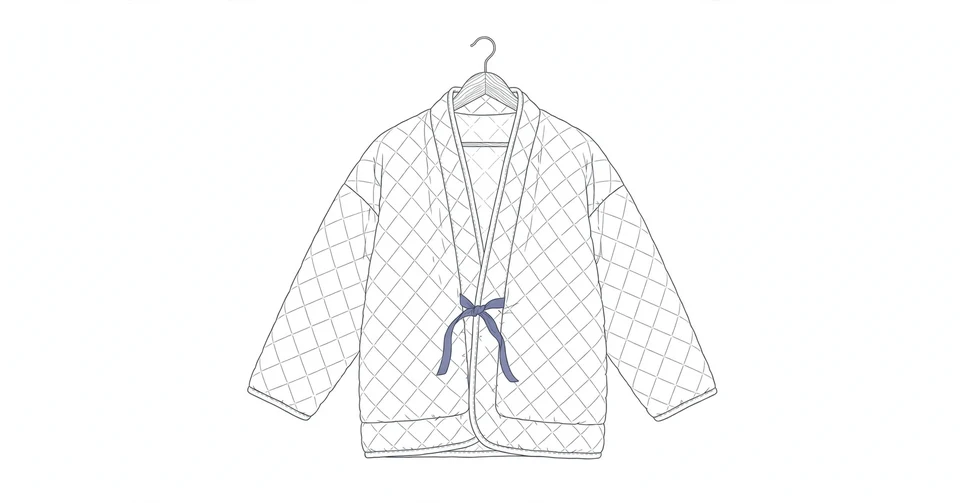
A hanten is the winter jacket Japan wears to work. It is short, padded, and loose, cut to the hip or mid-thigh, with three-quarter sleeves and a simple tie at the front. It slips on over a kimono or over a T-shirt, it keeps the arms free, and it holds warmth close to the body without asking the wearer to stop moving. That combination is the whole idea. A hanten is not formal dress, and it is not a fashion statement first. It is a tool for staying warm while getting things done.
The garment grew out of the same wardrobe as the haori, and the two are easy to confuse at a glance. Both are short jackets worn over a kimono, both have straight sleeves, and both share the same T-shaped silhouette. The difference is in the padding and in the purpose. As the haori article on this site puts it, "A hanten is a padded, quilted jacket built for warmth, closer to a winter coat." The haori is thin, light, and formal. A hanten is thick, warm, and practical, and it belonged to everyone who needed it, from the shopkeeper behind the counter to the artisan at the bench.
That democratic character is what makes a hanten worth a closer look. In Edo-period Japan, clothing was regulated by class and by sumptuary law, and the most formal garments were reserved for people of rank. A hanten ignored that hierarchy. Common people began wearing it in the 18th century, and it became the everyday jacket of merchants, artisans, and laborers. I like that about it. A garment that warms the person who wears it, whoever that person is, feels more honest than a garment whose first job is to announce rank.
What a hanten is
A hanten is a short winter coat made from cotton, padded with cotton wadding, and quilted to hold the padding in place. The outer shell is usually a sturdy cotton cloth, often indigo dyed, and the lining is a lighter cotton. Between them sits the wadding, a layer of raw cotton fiber that traps air and slows the loss of body heat. The quilting stitches run through all three layers, and they do two jobs at once. They stop the wadding from bunching up at the hem, and they give the jacket its familiar pattern of small diamonds or straight lines.
The cut is deliberately simple. The body is straight and roomy, the sleeves are shorter than a kimono sleeve so the hands stay free, and the front closes with a tie rather than buttons or a sash. There is no obi, and there is no need for one. The collar is often faced with a dark sateen cloth, usually black, which protects the edge from wear and gives the jacket its recognizable look. Most hanten are made in a single loose size, because a fitted jacket would defeat the purpose. It is meant to be thrown on over whatever you are already wearing, and taken off just as quickly.
That simplicity is also why a hanten can be worn by almost anyone. There is no real difference in cut between the versions made for men and the versions made for women. The difference mostly comes down to color and pattern, with darker and plainer designs traditionally aimed at men and brighter, more decorative patterns aimed at women. A child can wear one, an older person can wear one, and a worker can wear one over a uniform. The jacket does not ask the wearer to learn anything. It just asks to be put on.
How a hanten keeps you warm
The warmth of a hanten comes from the wadding, not from the cloth alone. The Japanese word for the padded version is wataire hanten, which means a hanten filled with cotton. The wadding is raw cotton fiber, and its hollow, twisted strands trap small pockets of air. Still air is a poor conductor of heat, so the layer of trapped air slows the escape of warmth from the body. The effect is modest on its own, but it is enough to take the edge off a cold room, and in a traditional Japanese house that edge was the whole problem.
Traditional Japanese houses were built to breathe. Sliding doors, paper screens, and wooden floors made them pleasant in summer and drafty in winter, and heating was often limited to a single hearth or a small brazier in the center of a room. There was no central heating to warm the whole house, and a person moving between rooms moved between pockets of cold. A hanten solved this by warming the person instead of the room. It was portable heat, worn on the body, and it traveled with the wearer from the shop to the kitchen to the street.
The quilting matters more than it looks. Without stitching, the loose wadding would slide downward with gravity and with wear, leaving the shoulders thin and the hem lumpy. Sashiko stitching, the small running stitches used across Japanese textiles, holds the layers together and spreads the warmth evenly. The pattern is decorative, but it is decoration that does a job. I find that satisfying. The prettiest part of the jacket is also the part that keeps it working.
Modern versions sometimes replace part of the cotton wadding with a cotton and polyester blend, which is lighter and easier to wash. The principle is unchanged. A hanten still works by holding a layer of air close to the body, and it still does that work without electricity, without fuel, and without a thermostat.
The hanten as Edo workwear
A hanten began as workwear, and its history is the history of the common people of Edo. The Edo period ran from 1603 to 1868, and during that time the castle towns filled with merchants, artisans, shopkeepers, and laborers. These were the people who kept the city running, and they needed clothing that was warm, cheap, durable, and easy to move in. The hanten answered all four needs at once. Cotton was affordable, the padding was simple to make, and the loose cut allowed a full range of movement.
Shop staff wore a hanten as a uniform. Artisans wore one at the bench. Delivery workers wore one on the street. The jacket identified the wearer as a working person, and often it identified the workplace too. Many employers provided a version called a shirushi banten, which carried the shop name, the guild mark, or the family crest on the collar or the back. The mark was printed or dyed in bold characters, and it worked like a name tag and a badge of belonging at the same time. A person wearing one was not just warm. They were visibly part of a shop, a trade, or a team.
That visible identity mattered in a society where clothing was regulated. Sumptuary edicts limited how loudly a townsman could dress, and the formal haori was restricted by class in ways a hanten never was. A hanten could be worn by anyone, and its decoration was the mark of the workplace rather than the rank of the wearer. For a merchant or an artisan, that was a small freedom. The jacket let working people express pride in their trade without breaking the rules that governed formal dress.
The hanten also had a domestic life. Padded winter versions were worn indoors as house jackets, and they were sometimes sewn at home or given as gifts at the New Year. A family might make one for an older relative, or for a child who felt the cold most. In that role the jacket was closer to a blanket with sleeves than to a uniform, and it was valued for comfort rather than for display. The same garment served two lives, one public and one private, and it served both well.
Fire brigades and the hikeshi banten
The most dramatic version of the hanten belonged to the firemen of Edo. Their jacket was called a hikeshi banten, and it was heavily quilted, often with bold white symbols on an indigo ground. The design was striking, but the construction was practical. A thickly padded cotton jacket, soaked in water before entering a burning building, gave the fireman a layer of protection against heat and falling embers. The water in the cotton absorbed heat as it evaporated, and the padding slowed the transfer of heat to the skin. It was not modern protective gear, and no one should mistake it for that, but in a city built largely of wood and paper it was a serious piece of equipment.
The firemen of Edo were organized into brigades, and each brigade had its own marks and colors. The hikeshi banten carried those marks on the back, often in large white characters that could be read across a smoky street. The jacket identified the brigade, and it also identified the courage of the wearer. Firefighting in Edo was dangerous work, and the men who did it were celebrated in prints and in popular stories. Their padded jackets became symbols of that bravery, and surviving examples are now prized by collectors and museums.
There is a detail here worth pausing on. The same quilting that kept a shopkeeper warm in winter also protected a fireman in a burning house. The technology did not change. The thickness, the water, and the purpose changed, but the jacket stayed the same. That is the mark of a good design. It does one thing well, and that one thing turns out to be useful in more places than its maker first imagined.
How a hanten differs from a haori and a happi
The Japanese wardrobe has several short jackets that look alike at first, and the hanten is often confused with two of them. The first is the haori, and the comparison is the one people ask about most. Both jackets are short and worn over a kimono, but a hanten is thickly padded for warmth while a haori is thin and lightly lined, and historically it was the haori, not the hanten, that carried class restrictions and formal meaning. A haori closes with two short cords and is worn open as a formal layer. A hanten closes with a simple tie and is worn as a working coat. If you want the full story of the formal jacket, the article on the haori explains its crests, its cords, and its ceremonies in detail.
The second lookalike is the happi, the light festival coat. A happi has a similar cut, but it is unpadded and made from plain cotton, and it is meant as a uniform rather than as a cold weather coat. Festival happi often carry large kanji characters or a company crest on the back, and they are worn by groups to show that they belong together. The terms hanten and happi are sometimes used interchangeably today, especially at festivals, but the distinction is real. A happi was never designed to keep anyone warm. A hanten was designed for exactly that.
There is a third relative worth knowing. The tanzen is a thickly padded garment too, but it is a full-length robe rather than a hip-length jacket, and it is closed with an obi sash the way a kimono is fastened. It belongs more to the colder northern regions, and to indoor wear in the depths of winter. The hanten sits between these relatives in a useful way. It is warmer than a haori and a happi, shorter and more practical than a tanzen, and easier to put on than any of them.
Kurume kasuri and where hanten are made
Not all cotton is the same, and the best known hanten cloth comes from Kurume, a city in Fukuoka prefecture on the island of Kyushu. Kurume kasuri is an indigo dyed cotton weave, and production of hanten has centered on Kurume since the 1800s. The weave was developed through techniques introduced by Den Inoue, and the Japanese government designated Kurume kasuri an important intangible cultural property in 1957. Domestic hanten manufacturing is still concentrated in and around Kurume today, and the indigo patterns of the cloth are part of what makes a traditional hanten recognizable.
The connection between place and product matters here. Kurume kasuri is not just a brand name. It is a weaving tradition that grew up alongside the garment it clothes, and the two supported each other for generations. A weaver in Kurume made cloth for a jacket that a shopkeeper in Edo would wear, and the demand for the jacket kept the looms busy. That kind of regional craft economy is easy to lose and hard to rebuild, which is why the survival of the tradition is worth noting.
A detailed guide to the garment traces this history from the 18th century to the present, and it notes that production in the Chikugo area, part of the historic hanten making region in Fukuoka, fell from roughly 3 million jackets a year at its 1980s peak to about 20,000, even as online sales revived in recent years. The guide is a useful starting point for anyone who wants the numbers behind the revival, and it is available in the hanten guide from Kamicrew.
Festivals, stalls, and the hanten today
A hanten never really left the festival. At a matsuri, the jacket is still the uniform of the group, worn by the people carrying the portable shrine, staffing the food stalls, and directing the crowd. Festival versions are often brightly colored and emblazoned with the team name or the shrine emblem, and they are designed to unify a group visually. The padding is less important on a summer festival night than the identity, but the jacket still does its old job. It says who belongs to the team, and it says it at a glance.
Away from the festival, the hanten has found a second life at home. Many Japanese homes still rely on space heaters, electric carpets, and kotatsu tables rather than central heating, so a padded jacket continues to earn its keep as a way to stay warm indoors during winter. It is worn over pajamas, layered on top of a kimono, or thrown over a T-shirt and jeans. The same loose, one-size construction that makes it easy to layer over a kimono also makes it easy to wear at home alongside a yukata on a cold night, when the light robe alone is not enough.
That home use picked up noticeably in recent years. Reporting by The Mainichi in 2022 found demand for padded hanten rising as more people worked from home to save on heating costs, while younger buyers were drawn to the distinctly Japanese feel of the garment. One local manufacturer reported that its online hanten sales doubled in a single fiscal year. The jacket had never disappeared, but the shift to working from home gave it a new audience, and a new reason to be worn.
The modern hanten is not only a reproduction of the old one. Designers have made versions in denim, in muted modern colors, and in reversible prints, and streetwear labels have borrowed the square silhouette and the padded construction. Collectors, meanwhile, seek out vintage examples, especially those with bold kanji characters, company logos, or intricate resist dyeing. An account of antique examples describes how late 19th century and early 20th century hanten were made with handspun, handwoven cotton and dyed with natural indigo, qualities that are now prized for their craftsmanship. That account, from Yorke Antique Textiles, is a good place to see how the working jacket became a collectible.
How to wear a hanten now
Wearing a hanten is easy, and that is the point. Put it on over whatever you are already wearing, tie the front loosely, and leave it open if you prefer. There is no sash to learn, no knot to master, and no rule about which side overlaps which. The jacket is meant to be comfortable, and comfort is the only test that matters. If it feels restrictive, it is too small, and a looser size is the answer.
For indoor wear, the hanten works best as a layer over a warm base. A long sleeved shirt underneath, a pair of warm socks, and the jacket on top will carry most people through a cold evening in a drafty room. For outdoor wear in mild cold, it works as a light coat over a sweater, though it is not a substitute for a heavy winter coat in freezing weather. The cotton padding is warm, but it is not waterproof, so it is best kept out of heavy rain.
Care is simple. Most modern hanten can be hand washed in warm water with a neutral detergent, then dried in the shade so direct sunlight does not fade the fabric. Skip the tumble dryer, which can damage the wadding and the quilting. A vintage or silk lined example should be treated more gently, and a specialist cleaner is the safer choice. The jacket was made to be used, not to be kept behind glass, and regular wear is the best way to keep it in good condition.
Why the hanten still matters
A hanten matters because it solves a real problem in a simple way, and it does so without asking for status, money, or ceremony. It warmed the shopkeeper, the artisan, and the fireman, and it still warms the person working from home on a cold morning. The materials are ordinary, cotton and air, and the construction is ordinary too, a few layers stitched together. The result is a garment that has lasted for centuries, not because it was protected by tradition, but because it was useful enough to be worn every day.
I think there is a lesson in that durability. Fashion changes quickly, and formal dress changes with it, but a garment that does its job well tends to survive. The hanten did not survive because anyone decreed that it should. It survived because people kept reaching for it on cold mornings, and because each generation found a new use for it, from the fire station to the festival stall to the home office. A jacket that warms the person who wears it, whoever that person is, is a small piece of practical wisdom, stitched in cotton and worn close to the body.
More in Life & Style
- A Tanzen Is the Full Length Robe Japan Wears Indoors in Deep Winter
- A Hibachi Carries the Hearth Anywhere in the House
- A Kotatsu Turns a Cold Winter Evening Into the Warmest Room in the House
- The Jizaikagi Hangs Above the Fire and Sets the Pace of Dinner
- An Irori Hearth Warms the Room and the People Around It
- A Sudare Turns Harsh Sunlight Into a Cool Breeze
Latest posts
- Warosoku Burns Brighter Because Its Wick Is Hollow
- A Shichirin Turns a Handful of Charcoal Into a Full Meal
- Japanese Chopsticks and the Quiet Rules Behind Every Meal
- The Haze Tree Grows the Wax Behind Japan's Oldest Candles
- Haze Wax Keeps Japan's Oldest Candles Burning
- Furoshiki, the Japanese Cloth That Wraps Almost Anything
- Japanese Candles Are Still Rolled by Hand in Japan
- Ubame Oak Is the Tree That Turns Into White Charcoal
- Binchotan Is the Charcoal That Made the Hibachi Possible
- Igusa Is the Humble Grass Under Every Tatami Mat
- Japanese Incense and the Art of Listening to Smoke
- Kumiko Builds Beauty From Wood Without a Single Nail
- Japanese Paper Lanterns and the Light That Folds Flat
- A Zabuton Is the Cushion That Tells You Where You Sit in Sumo
- Tatami Still Sets the Measure of a Japanese Room