Warosoku Burns Brighter Because Its Wick Is Hollow
· 19 min read
A warosoku burns brighter than a Western candle because its wick is a hollow tube of washi paper and rush pith that feeds air and wax into the flame at the same time.
A warosoku burns brighter than an ordinary candle for a simple reason. Its wick is hollow. The wick of a Western candle is a braided cotton string that sits in a pool of melted wax and burns with a small, steady flame. The wick of a warosoku is a thick, rigid tube made from washi paper and the pith of a rush plant, with an empty channel running down its middle. Air travels up through that channel while the candle burns, and the flame grows large and bright in response.
Light one beside a Western candle and the difference is hard to miss. The warosoku flame stands taller, glows a deeper orange, and sways from side to side even when the air in the room is still. It does not drip wax down its sides, and it leaves almost no soot behind. None of that is an accident of the wax alone. It is the wick doing its work, and the hollow centre is the part that matters most.
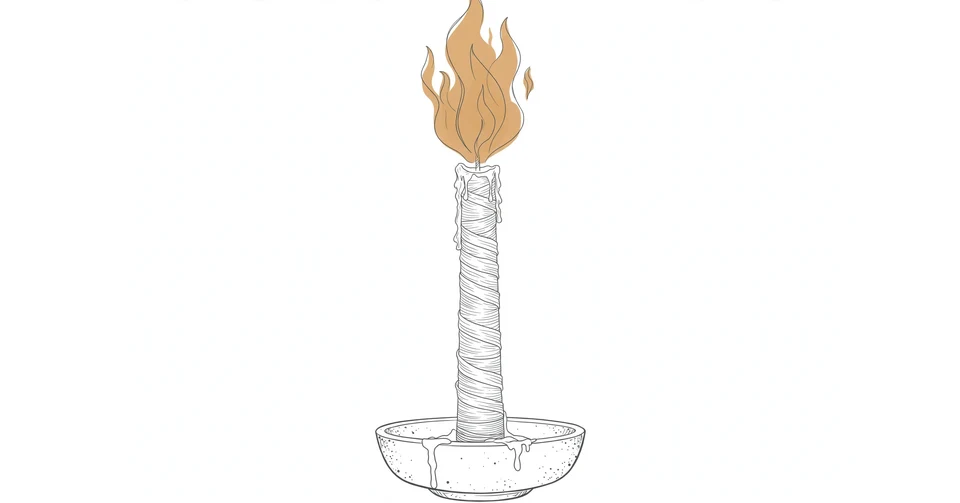
I find this a useful reminder that a small design choice can change everything. We tend to think of a candle as a stick of wax with a string in it, and we judge candles by scent or colour or price. A warosoku asks to be judged by its flame, and its flame is the product of a wick that was engineered, patiently and by hand, to breathe. Once you understand the wick, the bright flame stops looking like magic and starts looking like good design.
What a warosoku wick is actually made of
The wick of a warosoku starts as a sheet of washi, Japanese paper made from mulberry bark, rolled into a tight cylinder. Around that paper core the maker wraps toushin, the pale pith pulled from inside a rush plant called tohshinsou, a relative of igusa. The finished wick is thick, rigid, and slightly conical, and it is hollow down the middle. In some regions the maker binds the wick at intervals with silk or cotton thread to hold its shape while the wax is layered on.
That hollow centre is not a gap left by carelessness. It is the whole point of the construction, and it is made deliberately at the very start of the process. A visit to Nakamura Candle in Kyoto, described by Meguri Japan, shows how it is done. Long bamboo skewers are pushed through the centre of the wicks so that the candles can be hand worked, the wicks are placed upside down into a wooden mould, and a layer of melted wax is poured around each one to start forming the basic shape. After that the candles are hand coated with layers of wax until they reach the desired shape, and finally the bamboo skewer, which has served as a handle, is removed. The empty space it leaves behind is the hollow core of the wick.
Other makers build a warosoku without a mould at all, in a technique called tegake, or hand application. The maker holds a bowl of melted haze wax, kept at a carefully controlled temperature, and scoops the wax up with a bare hand or a spatula, spreading it in thin layers over a wick on a skewer and turning the skewer as the wax sets. The layers repeat until the candle has its shape, and then the maker planes and trims it by hand. Watching it is closer to watching a potter at a wheel than watching a factory line, and the rhythm of the work is part of the craft.
The materials of the wick connect the candle to the rest of the Japanese house. The same rush grass that is woven into tatami mats also supplies the pith for candle wicks, and the parts of the plant that are no good for mats are the parts that end up in candles. One plant, two household objects, nothing wasted. That kind of thrift is not an accident. It is the old Japanese habit of using a material completely, and it is built into the warosoku itself. A longer look at how Japanese candles are still rolled by hand in Japan covers the workshops that keep this craft alive, and the wick is where every one of those workshops begins.
Compare all of this with a cotton wick and the difference becomes clear. A cotton wick is a thin string. It is flexible, it burns away as the candle burns, and it can only carry a small amount of wax up to the flame. A warosoku wick is a rigid tube with a large surface area. It stands upright on its own, it holds its shape through the whole life of the candle, and it can draw up far more wax than a string ever could. The brightness of the flame is decided here, in the wick, before the candle is ever lit.
How the hollow core feeds the flame
A flame needs two things to grow: fuel and air. A normal candle supplies both from the outside, with wax melting into a pool and air drifting in from the room. A warosoku supplies both through its wick, and that is why its flame is so much larger.
Air passes up through the hollow centre of the wick while the candle burns, feeding the flame from below. At the same time the thick wick draws up a large amount of melted wax, far more than a cotton string could carry. Fuel and air arrive together, in the same place, at the same time, and the flame responds by burning large and bright. The hollow wick is not just a tube that happens to be empty. It is a small chimney built into the heart of the candle.
The second thing the hollow core does is just as important. Because the thick wick draws up so much wax and the flame burns so hot, the wax is consumed almost as fast as it melts. That is why a warosoku almost never drips. In a Western candle the melted wax pools, cools, and runs down the side. In a warosoku the wax is burned where it melts, and the sides of the candle stay clean. The same mechanism that makes the flame bright also makes the candle tidy, which is one reason temples prize it. A candle that drips wax onto a lacquered altar or a painted screen is a candle that causes work, and a warosoku causes almost none.
The size of the flame can surprise anyone who sees it for the first time. As a warosoku burns, the flame can grow to roughly half the length of the body of the candle, which is startling when the candle is short and the flame is tall. Small warosoku candles, about 7 cm long, burn for roughly 25 to 30 minutes, a little faster than a Western candle of the same length because the thick wick burns hotter. Larger candles burn far longer, and the range runs from about 30 minutes to more than nine hours, so a household can choose a candle to match the occasion, a short prayer or a long ceremony.
I think there is something quietly honest about this design. Nothing is hidden and nothing is wasted. The wax goes up the wick and becomes light, the air goes up the hollow core and feeds the flame, and the candle disappears at exactly the rate it is used. A factory candle can be cheap and bright, but it cannot be this direct. The warosoku flame is bright because the whole candle is built around the idea that a flame should be fed well, and the hollow wick is how that idea is made real.
Why the flame dances instead of standing still
The brightness of a warosoku flame is only half the story. The other half is its movement. Light a warosoku in a room with no draught at all, close the windows, close the door, and the flame will still sway from side to side in a slow, irregular rhythm. It never stands still, and it never repeats the same movement twice.
The hollow wick is the reason. The air inside the wick is what causes the flame to dance, as the makers at Nakamura Candle explain, and the movement is not random. The hollow core draws air down into the heart of the flame along with the molten wax, so the flame is fed in pulses rather than in a steady stream, and each pulse moves it a little. Japan Documented calls the warosoku the breathing candle, and the name fits. The flame sways, yurari yurari, as if it is breathing, and watching it feels less like watching a fire and more like watching something alive.
Researchers have compared the flicker of a warosoku flame to the pattern of waves and of a resting heartbeat, which may be why sitting beside one feels calming rather than merely decorative. Our bodies recognise that rhythm. We are used to steady light from bulbs and screens, light that never changes and asks nothing of us. A flame that moves in the same rhythm as a heartbeat asks for a little attention, and it gives a little calm in return. I have sat beside electric light for most of my life, and it has never once made me slow down. A warosoku does it within a minute.
The colour of the light adds to the effect. The flame of a traditional warosoku emits a gentle orange light, and the softness comes from the low melting point of the plant wax. It is a warm, low light, and it suits the rooms it was made for. In a tea room it throws deep, shifting shadows across the tatami. In a temple hall it lights the altar without washing out the gold. On a stage it suits Noh, Kyogen, and Kabuki, where a hard white light would look wrong. The flame dances, the light is warm, and the room feels different because of it.
A wick built for draughty old houses
The hollow wick was not designed for beauty alone. It was designed for the houses it had to burn in, and those houses were full of moving air. The old Japanese house, with its sliding screens and open corridors, was never sealed against the wind, and a candle that went out every time a door slid open would have been useless.
The substantial wicks of Japanese candles were devised so the flame would not be blown out by the draughts prevalent in old Japanese houses. That is not a guess. It is what the makers themselves say, and it is written on the workshop wall at Nakamura Candle in plain terms. A thick wick with a hollow core holds a large flame, and a large flame fed from below is much harder to kill than a small flame fed from the side. The same air that makes the flame dance also keeps it alive, because the flame is always being fed from its own centre rather than depending on the still air around it.
That toughness mattered most in temples, where a warosoku is still, first and foremost, a ritual object. Candles are lit before sunrise as part of the day's first prayers, and they burn on the butsudan, the cabinet like home altar where families remember their dead. During a ceremony it is important that the candles keep burning without going out, because a candle that dies in the middle of a rite interrupts the offering. The hollow wick was built for exactly that moment, a flame that refuses to quit in a cold hall at dawn.
Temples also value the warosoku because it burns so cleanly. It does not drip wax as it burns, and it emits only a very small amount of smoke compared with an ordinary candle. Any soot that the tiny amount of smoke does deposit is non oily and easily removed, which matters when the candle is burning beneath priceless religious objects. In fact the tradition of susu harai, the deep cleaning that takes place in Buddhist temples at the end of each year, began as the annual job of removing candle soot from religious fixtures and fittings. A candle that leaves almost no soot is a kindness to the people who have to clean the temple, and the hollow wick is part of that kindness too.
The wax matters too, but the wick decides the flame
None of this means the wax does not matter. It matters a great deal, and a warosoku made with the wrong wax would not burn the way it should. But the wax and the wick do different jobs, and it is worth being clear about which is which.
The most prized wax for a warosoku is mokuro, written with the characters for tree and wax. It is pressed from the nutlike fruit of the haze tree, Toxicodendron succedaneum, a relative of sumac that grows in the warm parts of western Japan, in Kyushu, Shikoku, and Wakayama Prefecture. The berries are harvested in winter, steamed, and pressed, and the pale wax that comes out of them burns cleanly with very little smoke and a faint, earthy scent. The story of haze wax keeps Japan's oldest candles burning follows that wax from the tree to the workshop, and it is the wax that gives the warosoku its clean burn and its low melting point.
Haze wax is the classic material, but it was never the only one. Rice bran wax, palm wax, rapeseed wax, and lacquer wax have all been used over the centuries, and they matter more today than ever because haze trees have become scarce. The makers at Nakamura Candle use two blends for their candles, using wax from the berries of the haze tree as well as rice bran oil and palm oil. Aging farmers and a shortage of successors have left the haze supply in a critical state, and makers now blend in other plant waxes to keep working. There are efforts across Japan to restore overgrown haze forests and plant new ones, which tells you how seriously the craft takes its raw material.
There is also a warning worth hearing. Many candles sold nowadays as warosoku are actually mass produced candles made from petroleum derived paraffin wax, and a paraffin candle with a cotton wick is not a warosoku no matter what the label says. Genuine warosoku are made entirely from plant based materials, and that rule has never changed. One reason the rule matters is religious. The candles are used in Buddhist temples and on home altars, and Buddhism prohibits the intentional killing of animals, so a candle that contained tallow or beeswax would be wrong for the altar in a way that has nothing to do with how it burns. The plant wax is not a marketing choice. It is a religious one, and it has shaped the craft from the beginning.
So the wax sets the fuel, and the wick sets the flame. Put the same haze wax around a cotton string and you would get a small, steady flame that drips and smokes. Put a hollow wick of washi and rush pith into that wax and you get a tall, bright, dancing flame that burns its own wax cleanly. The wax makes the candle possible. The wick makes it a warosoku.
How to keep a warosoku burning well
A warosoku asks a little more of its owner than a factory candle does, and that is part of its character. The wick does not burn away completely as the candle burns. Instead it leaves behind a stub of carbon, and if that stub is left alone the flame can grow too large or start to sputter. Makers supply a small wick trimmer with their candles so the owner can snip the carbon back and keep the flame clean, and trimming the wick is a small act of care that belongs to the ritual of lighting the candle.
A few practical habits help. Set the warosoku in a proper holder that fits its thick base, on a stable surface where it cannot be knocked over. Keep it away from strong draughts, not because the flame is fragile but because a gust can still push hot wax where it should not go. Choose the size to match the occasion, a short candle for a short prayer and a long one for a long ceremony, since the range runs from about 30 minutes to more than nine hours. And remember that painted warosoku, the e-rousoku decorated with flowers and seasonal designs, are usually offered rather than burned. Some candles are too pretty to light, and that is a compliment, not a waste.
I like that the candle asks for this attention. A light bulb asks for nothing, and it gives nothing back but light. A warosoku asks you to trim its wick, to choose its size, to watch its flame, and in return it gives you an hour that feels different from the hours around it. The maintenance is not a flaw in the design. It is the design, a reminder that some things are worth tending.
Why the hollow wick nearly disappeared
The hollow wick is more than six hundred years old, and it nearly did not survive to the present day. Candles are believed to have arrived in Japan during the Nara period, from 710 to 794, along with Buddhism from China, and the use of haze seeds for candle wax is said to have begun in the Muromachi period, from 1336 to 1573. The peak of the craft came late in the Edo period and into the Meiji period, from the mid 1700s to 1912, when the domestic cultivation of the haze tree finally made candles accessible beyond the court and the great temples. During the Edo period, from 1603 to 1868, people read books and did needlework by the glow of a warosoku, families gathered around it to share a meal and a conversation, and tea masters would light a single warosoku for a night ceremony, cherishing the deep, shifting shadows it cast.
The decline came quickly. Cheap paraffin candles arrived from the West in the late 19th century, and the handmade warosoku was quickly pushed aside. The spread of electric light accelerated the fall, and a craft that had once lit the whole country was left to temples, home altars, and a small number of devoted buyers. It takes years to learn to make a warosoku properly, and by the time a young person had mastered the work, the market for it had shrunk to almost nothing. Workshops closed, and the apprenticeship system that had carried the craft from one generation to the next began to thin out.
The makers who still do this work are few, and their names are worth knowing. Tanji Renshodo in Kyoto is a family business that has made traditional candles for about 500 years, and its current head has said there were once more than 80 traditional candle makers in Kyoto and now there are only four. Takazawa Candle was established in 1892 in Nanao, in Ishikawa Prefecture, and is the last traditional warosoku maker in that prefecture. Daiyo, founded in 1914 in Shiga Prefecture on the shores of Lake Biwa, has passed its knowledge across four generations. These are not large companies. They are family workshops, and the hollow wick survives because the families have refused to let it go.
There is a quiet warning in that survival. Even today it has become rare to find a warosoku made of pure, 100 percent haze wax, even when the label claims it. The haze trees are scarce, the makers are few, and the knowledge lives in a small number of hands. A craft that depends on a hollow tube of paper and grass is easy to lose, because it looks simple enough to replace and it is not simple at all. The wick is the part that takes years to learn, and it is the part that would be hardest to bring back if it were lost.
What the bright flame is for
So a warosoku burns brighter because its wick is hollow, and its wick is hollow because a hollow wick feeds a flame better than a solid string ever could. Air rises through the empty core, wax rises through the thick wall of paper and rush pith, and the two meet in a flame that is larger, brighter, and more alive than anything a cotton wick can make. The brightness is not a trick of the wax or a quirk of the shape. It is the direct result of a wick that was designed, centuries ago, to breathe.
I think that is a good reason to light one, not as a decoration and not as a novelty, but as a small lesson in how good design works. The hollow wick does not add anything to the candle. It takes something away, a narrow channel of empty space, and the empty space does the work. There is a restraint in that which feels very Japanese to me, the idea that the most important part of an object can be the part that is not there.
In a world that has made light cheap and instant, a warosoku is a reminder that light can also be deliberate. It takes a moment to strike a match, a moment to watch the flame catch and grow steady, and then a long, quiet stretch of sitting with a flame that dances in the rhythm of waves and a resting heartbeat. That is what the bright flame is for. Not to push back the dark as fast as possible, but to give the dark a little company, and to give the person sitting beside it a reason to stay a while longer.
More in Culture & Society
- Japanese Chopsticks and the Quiet Rules Behind Every Meal
- The Haze Tree Grows the Wax Behind Japan's Oldest Candles
- Haze Wax Keeps Japan's Oldest Candles Burning
- Furoshiki, the Japanese Cloth That Wraps Almost Anything
- Japanese Candles Are Still Rolled by Hand in Japan
- Ubame Oak Is the Tree That Turns Into White Charcoal
Latest posts
- A Shichirin Turns a Handful of Charcoal Into a Full Meal
- A Tanzen Is the Full Length Robe Japan Wears Indoors in Deep Winter
- A Hanten Is the Winter Jacket Japan Wears to Work
- Binchotan Is the Charcoal That Made the Hibachi Possible
- Igusa Is the Humble Grass Under Every Tatami Mat
- Japanese Incense and the Art of Listening to Smoke
- Kumiko Builds Beauty From Wood Without a Single Nail
- A Hibachi Carries the Hearth Anywhere in the House
- A Kotatsu Turns a Cold Winter Evening Into the Warmest Room in the House
- The Jizaikagi Hangs Above the Fire and Sets the Pace of Dinner
- Japanese Paper Lanterns and the Light That Folds Flat
- A Zabuton Is the Cushion That Tells You Where You Sit in Sumo
- An Irori Hearth Warms the Room and the People Around It
- Tatami Still Sets the Measure of a Japanese Room
- Chawanmushi Hides a Whole Meal Inside a Teacup