Furoshiki, the Japanese Cloth That Wraps Almost Anything
· 11 min read
Furoshiki is a single square of cloth that has wrapped temple treasures, bathhouse clothes, lunch boxes, and gifts for more than 1,200 years, and it is quietly becoming Japan's answer to plastic bags.
A furoshiki is nothing more than a square of cloth. No zip, no handle, no pocket, no stitching that does anything clever. Yet for more than 1,200 years, Japanese people have used this plain square to carry almost everything they own, from sacred temple objects to a bottle of wine, from a lunch box to a wedding gift. Fold it one way and it is a bag. Fold it another and it is wrapping paper you never throw away.
The trick is not in the cloth. It is in the knots. The cloth asks almost nothing of its material and everything of the hands using it, and generation after generation of Japanese people have risen to that challenge. What looks like a humble piece of fabric is really a small lesson in how little you need when you know what you are doing.
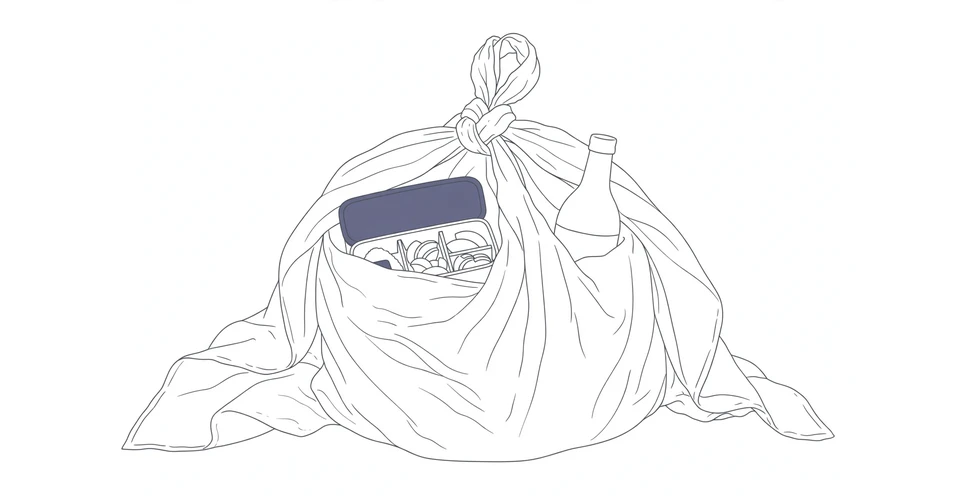
That lesson is worth learning today, because the furoshiki has quietly come back. In 2006, Japan's environment minister held one up on television as an answer to plastic waste. Shops in Kyoto and Tokyo now sell them next to the souvenirs. Travellers buy one, learn two knots, and never carry a plastic bag again. It survived paper bags, plastic bags, and a century of convenience culture without changing at all, which may be the strongest argument for it.
From Temple Treasure to Bathhouse Mat
The furoshiki began in the Nara period, from 710 to 794, when it was not called furoshiki at all. It was called tsutsumi, which simply means wrapping. Buddhist temples used these cloths to protect precious objects: sacred texts, lacquerware, and ceremonial instruments. To be wrapped in one was to be considered worth protecting. The oldest surviving wrapping cloth in Japan is kept in the Shosoin, the treasure house of Todai-ji Temple in Nara, a reminder that the cloth started its life guarding things people considered holy. The full history of the cloth, from temple wrapping to bathhouse mat, is laid out in the furoshiki entry on Wikipedia.
Its role widened in the Heian period, from 794 to 1185, when it became a cloth for wrapping expensive clothes. But the moment that gave the furoshiki its name came later, in the Muromachi period, and it came from a bathhouse. Shogun Ashikaga Yoshimitsu built a grand bathhouse in Kyoto and invited the high-ranking lords of the region to join him. The problem was one any communal changing room still has today: how do you keep your kimono from getting mixed up with someone else's? The solution was elegant. Visitors packed their belongings in cloth decorated with their family crest, so ownership was visible at a glance. When they stepped out of the bath, that same cloth became a mat beneath their feet.
From that moment, the name stuck. Furo means bath, and shiki means to spread. A furoshiki is literally a bath spread, a cloth you stand on after bathing. It is a strangely humble name for something that began as a guardian of temple treasure, and that is part of its charm. It has never pretended to be grand. It simply does the job in front of it.
The cloth spread beyond the aristocracy in the Edo period, from 1603 to 1868, when public bathhouses became part of everyday urban life. Ordinary people carried their clothes and bath items in furoshiki, wrapped their shopping in them, and used them to carry gifts. Merchants used them to bundle goods. Families wrapped presents in them. By then the cloth was no longer a temple object or a lord's accessory. It was something everyone owned, like a good knife or a sturdy pair of sandals. The shared bathhouse culture that gave the cloth its name is still alive in Japan today, and the public baths called sento carry the same spirit of communal bathing that first made the furoshiki necessary.
How One Square of Cloth Becomes Almost Anything
What one cloth can carry depends mostly on its size and on your imagination. The standard sizes tell the story. A small cloth of about 45 centimetres wraps a bento box or a single book. A medium cloth of about 70 centimetres, the most common size, carries groceries, clothes, or a bottle or two of wine. A large cloth of 90 to 105 centimetres can bundle a stack of books, a change of clothes for a weekend trip, or a watermelon. The cloth does not change. The knot does.
The cloth becomes a shopping bag when you tie two opposite corners together for handles and knot the other two at the base. It becomes a gift wrap when you place the present in the centre, fold the corners over it, and tie a neat bow on top. The Japanese art of wrapping, which treats the wrapping as part of the gift itself, finds its purest form here: the wrapping is not torn open and thrown away, it is untied, folded, and used again tomorrow. It becomes a bottle carrier with two knots, a book bag with one, and a picnic blanket when you simply spread it flat on the ground.
The same flexibility made the cloth a traveller's friend long before packing cubes existed. A folded furoshiki weighs almost nothing and takes up no space in a suitcase, yet it can separate dirty laundry from clean clothes, bundle souvenirs on the way home, or turn into an emergency bag when shopping gets out of hand. I have started keeping one in my day bag the way other people keep a reusable tote, and the difference is that the furoshiki disappears when I do not need it. A tote is always a tote. A furoshiki is whatever the next five minutes require.
That adaptability is the same quality that runs through much of Japanese craft. The paper makers behind washi paper turned a single plant fibre into everything from sliding doors to banknotes, and the cloth does the same trick with a square of cotton. Neither object tries to do one thing perfectly. Both do many things well enough, and that is the point.
The Knots That Do the Work
If the cloth has a technology, it is the knot. Two knots do most of the work, and both are easy to learn in a few minutes. The first is the ma-musubi, the true knot, the same square knot used to tie shoelaces securely: right over left, then left over right. It holds firm under weight and comes undone with a single pull on one end. The second is the hitotsu-musubi, a single loop knot used to make handles and to close the top of a bundle. Everything else is a variation on these two.
The Ministry of the Environment in Japan has published a guide to 14 different folding patterns for the furoshiki, from the basic carry to elaborate gift wraps that make a bottle look like a flower. A good visual introduction to those patterns and the history behind them is the guide to furoshiki on Japan Objects. Fourteen sounds like a lot until you try them. Most people settle on three or four patterns they actually use and forget the rest, which is fine. A furoshiki does not grade you. A slightly crooked knot still carries the groceries home.
There is a small pleasure in learning to tie one well, the same quiet satisfaction that comes from folding a paper crane or repairing a chipped bowl with gold. The repair art of kintsugi treats a broken object as something to honour rather than hide, and the furoshiki shares that attitude toward ordinary things. It does not hide the fact that it is a piece of cloth doing the work of a bag. It shows the knot. The knot is the design.
Sizes, Fabrics, and Choosing Your First Furoshiki
Not all cloths are the same, and the differences matter more than they first appear. Cotton is the everyday choice: sturdy, washable, and cheap enough to own several. Chirimen, a crepe-textured silk, is the traditional choice for formal gifts, with a soft grip that holds knots well. Modern furoshiki come in polyester blends that shrug off rain, and in heavy canvas for carrying real weight. The pattern is often the point of the purchase. Traditional designs include seigaiha waves, asanoha hemp leaves, and karakusa scrolling vines, each with its own history, while contemporary makers print everything from city maps to cartoon cats.
If you are buying your first cloth, start with a 70-centimetre cotton cloth in a pattern you actually like. That size handles a bento box, a paperback and a bottle of water at once, which covers most days. A 50-centimetre cloth is better for lunch boxes alone, and a 90-centimetre cloth is the one for travel, when you need to bundle a whole change of clothes. Buy from a shop that sells them as furoshiki, not as scarves: the difference is the weight of the fabric and the finished edges, which keep the cloth from fraying after years of knotting. A good furoshiki should last decades. My own first one, bought in Kyoto years ago, has carried more lunches than I can count and still looks new after a wash.
Price is no barrier. A plain cotton one costs about the same as a sandwich, and even a silk one costs less than a decent tote bag. The expensive part was never the cloth. It was always the habit.
Furoshiki and the Fight Against Plastic
The cloth might have faded into a museum piece if not for a minister with a television camera. In 2006, Yuriko Koike, then Japan's Minister of the Environment, held up a specially designed furoshiki and presented it as a living answer to plastic waste, under the name Mottainai Furoshiki. Mottainai is a word with no neat English equivalent, but it means something close to what a waste: a regret for squandering what still has value. The campaign gave the old cloth a new job, and it stuck.
The timing was good. Japan charges for plastic bags in shops now, and the small daily decision of how to carry things home has become a visible one. A furoshiki fits in a pocket, weighs less than a phone, and replaces a bag that would have been used once and thrown away. The maths is simple enough that it barely needs stating: one cloth, used for years, against hundreds of plastic bags. But the environmental argument alone would not have saved the furoshiki. What saved it is that it is genuinely pleasant to use. It feels good in the hand, it looks better than a plastic bag, and the small ritual of tying a knot turns a chore into something with a little ceremony in it.
There is a lesson in that for anyone who cares about waste. The objects that survive are rarely the ones with the best argument. They are the ones people enjoy using. It survived because it is useful first and virtuous second, and that order matters. Nobody keeps using something out of guilt alone. They keep using it because it works, and the furoshiki works.
Why a 1,300-Year-Old Cloth Still Matters
It is tempting to treat the cloth as a curiosity, a quaint survival from a slower Japan. That misses what it actually is. It is a design that refused to become obsolete because it never tried to be modern. It has no moving parts, no battery, no app, and no planned obsolescence. It cannot break in a way that matters, because there is nothing in it to break. A torn furoshiki can be mended, and a mended one works just as well as a new one.
That durability is worth thinking about in a world where most of what we buy is designed to be replaced. It asks a different question from the one most products ask. Most products ask how much they can do for you. The furoshiki asks how little you need, and then shows you that the answer is one square of cloth and two knots. It is a small, daily reminder that sufficiency can be elegant, and that the oldest solutions are sometimes the ones still waiting to be used.
The next time you are handed a plastic bag for a single item, imagine the alternative: a square of cloth from your pocket, a quick knot, and a small moment of craft in the middle of an ordinary errand. It does not demand that you change your life. It only asks you to carry a little less, and to tie a knot instead of tearing paper. After 1,300 years, that still seems like a fair trade.
More in Culture & Society
- Warosoku Burns Brighter Because Its Wick Is Hollow
- Japanese Chopsticks and the Quiet Rules Behind Every Meal
- The Haze Tree Grows the Wax Behind Japan's Oldest Candles
- Haze Wax Keeps Japan's Oldest Candles Burning
- Japanese Candles Are Still Rolled by Hand in Japan
- Ubame Oak Is the Tree That Turns Into White Charcoal
Latest posts
- A Shichirin Turns a Handful of Charcoal Into a Full Meal
- A Tanzen Is the Full Length Robe Japan Wears Indoors in Deep Winter
- A Hanten Is the Winter Jacket Japan Wears to Work
- Binchotan Is the Charcoal That Made the Hibachi Possible
- Igusa Is the Humble Grass Under Every Tatami Mat
- Japanese Incense and the Art of Listening to Smoke
- Kumiko Builds Beauty From Wood Without a Single Nail
- A Hibachi Carries the Hearth Anywhere in the House
- A Kotatsu Turns a Cold Winter Evening Into the Warmest Room in the House
- The Jizaikagi Hangs Above the Fire and Sets the Pace of Dinner
- Japanese Paper Lanterns and the Light That Folds Flat
- A Zabuton Is the Cushion That Tells You Where You Sit in Sumo
- An Irori Hearth Warms the Room and the People Around It
- Tatami Still Sets the Measure of a Japanese Room
- Chawanmushi Hides a Whole Meal Inside a Teacup