A Yubatake Cools a Spring With Nothing but Wood and Gravity
· 9 min read
A yubatake is a field of tiered wooden channels that cools scalding onsen water in the open air, without diluting it. This is how the yubatake at Kusatsu works, and why other hot spring towns built their own.
In the middle of Kusatsu Onsen there is a field where nobody grows anything you can eat. The yubatake, literally a hot water field, is a raised square of stone and timber in the centre of town, and through it runs some of the hottest spring water in Japan, steaming in the open air on its way to the baths.
The water arrives far too hot to touch. Kusatsu's sources are recorded between about 45 and 95 degrees Celsius depending on the vent, which means the strongest of them come out of the ground close to boiling. The town's answer is not a cooling machine, and it is not a tap of cold water. The water is sent on a slow walk through long wooden channels, shedding heat to the mountain air as it goes, until it reaches a temperature a person can actually sit in.
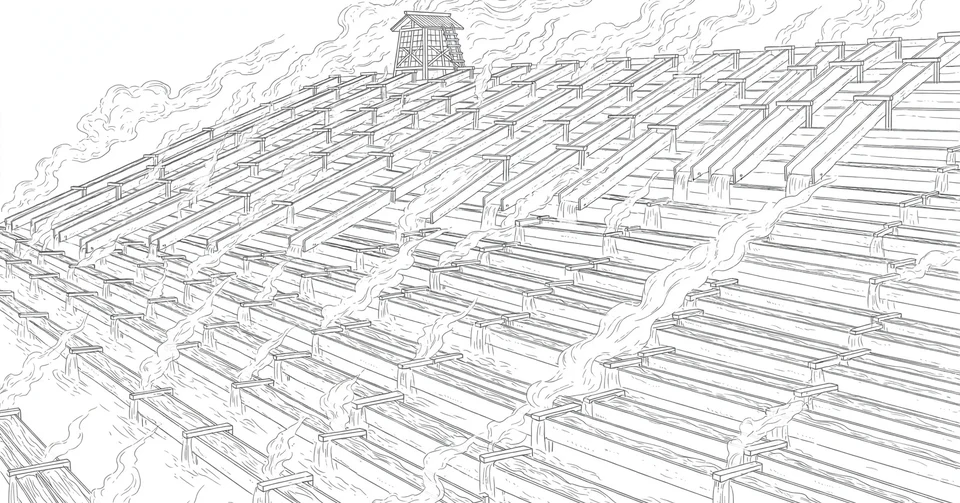
It is an old and patient piece of engineering, and once you understand what a yubatake does, you start to see how much of the town is arranged around it. The inns, the public baths, the free foot baths at the corners and the evening crowds in yukata all take their water, and their rhythm, from this one steaming field.
What a yubatake actually does
The name is a farmer's metaphor. Yu means hot water, and hatake is a field or plot, and a yubatake is laid out the way a field is laid out, in long parallel rows. At Kusatsu, the source water pours into seven long wooden channels set into the raised square, and then it simply travels. The run is long, the water is shallow and spread wide, and every metre of the journey puts more of its surface in contact with the air. Heat leaves a thin sheet of moving water far faster than it leaves a deep tank, and the slope does the rest, because gravity is the only pump the system has ever needed.
At the end of the channels the water drops over a small waterfall, known as the yudaki, which sheds a little more heat in the fall and makes the great clouds of steam that drift over the square. From there the cooled water is divided up and sent out to the inns and public bathhouses around the town centre. The Kusatsu Onsen Yubatake guide describes the arrangement plainly: the water moves slowly through the channels, loses heat to the outside air, and is then distributed through the town with little or no dilution on the way.
The choice of wood is practical, not nostalgic. Kusatsu's water is fiercely acidic, with a pH around 2, not far from lemon juice, and as one detailed guide to Kusatsu puts it, everything at the yubatake is built of wood because acid water eats through metal pipes. Timber survives where steel would corrode, it can be replaced channel by channel as the acid and the mineral crust slowly wear it down, and it asks for nothing more sophisticated than a carpenter when a section finally gives up.
Scale is the part that stays with me. The same guide counts the combined flow of Kusatsu's sources at about 32,300 litres a minute, the largest natural flow of any hot spring resort in Japan, and all of the share that passes through the yubatake has to be cooled by nothing more than distance, air and a gentle slope. No fans, no chillers, no moving parts at all. The mountain air at 1,200 metres does the work for free, in winter most of all, when the steam over the field turns thick enough to hide the far side of the square.
Why the water is never diluted
The obvious shortcut exists, and everyone in the business knows it. If your source is too hot, you add cold water until it is not. Kusatsu has always refused to do this, because diluting the water weakens it, and local custom treats that as spoiling the very thing people travel hours to bathe in. The yubatake exists precisely so that the shortcut never has to be taken. The water that reaches the baths is the water that came out of the ground, at full strength, only cooler.
That refusal belongs to a wider ethic in Japanese hot spring culture, the same one behind gensen kakenagashi, the ideal of source water flowing straight from the ground to the bath and away, used once, never pumped around in a loop and never reheated. A yubatake is what that ethic looks like when it is built in timber in the middle of a town. It is a promise, made visible, that nothing has been added and nothing has been taken away except heat.
I find the honesty of it appealing. Plenty of resorts solve the temperature problem quietly, behind a plant room door, and the bather never knows. At Kusatsu the whole process is left out in the street, where anyone can watch the water arrive scalding at one end of the field and leave bathable at the other. The yubatake is not hidden infrastructure. It is the town square.
The field also grows a crop
A yubatake does a second job while it cools. As the hot water travels the channels and gives up its heat, its dissolved minerals grow concentrated and begin to settle out as pale crystalline deposits along the wood. These are yu no hana, literally hot spring flowers, the soft sulphur rich crust that gives the water of Kusatsu part of its milky colour and much of its reputation.
The deposits are gathered from the channels several times a year, dried and sold as a natural bath additive, so that visitors can take a little of the spring home in a paper packet. The collection is believed to have begun around 1790, in the late Edo period, which makes yu no hana one of the older souvenirs in Japanese travel. There is a pleasing suggestion, too, that the crust is where the name came from in the first place: the minerals accumulated in a field-like area, raked and harvested like a crop, and so the cooling works became a field in fact as well as in shape.
Harvesting doubles as maintenance. A channel left to crust over would narrow and slow, and the same scraping that fills the souvenir packets keeps the water moving at the pace the cooling depends on. Work, product and upkeep are the same gesture, repeated a few times a year, which is the kind of arrangement that tends to survive for centuries.
Yumomi, the last few degrees by hand
The yubatake brings the water down to a usable temperature for the town, but an individual bath can still sit hotter than its bathers want. For that final adjustment Kusatsu developed yumomi, the practice of stirring the bath itself with long wooden boards, worked in unison and in rhythm, often to a traditional song. Stirring exposes the water to the air and knocks the temperature down degree by degree, again without a single drop of cold water being added.
Yumomi is performed today at the Netsu-no-Yu hall right beside the yubatake, several times a day, with the boards moving to the Kusatsu-bushi folk song, and at some performances visitors are handed a board and allowed to try. It is easy to file it under tourist show, and the hall does sell tickets, but it began as ordinary work done by the women who tended the baths, and the rhythm that looks like choreography is simply what a row of people stirring together naturally falls into. The yubatake and yumomi are two halves of one idea: cool the water by moving it through air, never by watering it down.
Beyond Kusatsu
Kusatsu's yubatake is the famous one, and the square visitors see today owes its finished form to a redesign in 1975, supervised by the artist Taro Okamoto, who turned a working cooling plant into a landscaped public space of stone terraces, channels and open ground. It worked so well that the installation became the symbol of the whole resort, lit up after dark and printed on every piece of town publicity, which is a strange and satisfying fate for a piece of plumbing.
But the idea is older than Kusatsu's fame and wider than one town. Any resort whose source runs too hot, and whose water is valued too highly to dilute, needs some version of the same answer. Across the same volcano, the much quieter resort of Manza Onsen keeps a working yubatake of its own above its baths, cooling its milky sulphur water on the mountainside and sharing it out among the inns. Stand at either one and the principle is identical, only the scale and the crowds differ. Wherever you find a yubatake, you have found a town that decided its water was worth cooling slowly.
That, in the end, is what I like most about the thing. A yubatake is technology reduced to almost nothing: a slope, some timber, moving water and cold air, arranged with enough patience that the water arrives ready. It has no fuel bill and no off switch, it grows a small harvest while it works, and at night, lit through its own steam, it is the prettiest spot in town. Towns built around hot water have invented many clever devices over the centuries. Few of them are as honest as a field that cools a spring by letting it walk downhill in the open air.
More in Life & Style
Latest posts
- Edo's Hikeshi Wore Their Dragons Into the Fire
- Kagawa Puts the Sweet Part Inside the Mochi
- Sodoran Treats an Heirloom Like an Honoured Guest
- You Can Read a Pecalang From Across the Street
- A Donko Never Got the Chance to Open
- The Milpa Is a Garden That Thinks Like a Forest
- The Kitamaebune Came Home Loaded With Kelp
- When the Gara-Gara Starts, the Puppets Drop the Plot
- Forty Pounds of Cowbells, and the Mamuthones Say Nothing
- The Oarfish Still Answers to a Name From the Dragon Palace
- Ponzu Began With a Fruit Too Bitter to Eat
- Kombu Is the Quiet Half of Dashi
- Irezumi Was an Art Before It Was a Warning
- The Oshi Kept Fuji's Pilgrims Fed, Housed, and Devout
- Every Prefecture Argues About What Goes in Ozoni