Toji Meant Moving to a Hot Spring Until You Got Better
· 9 min read
Toji, Japan's old hot spring cure, meant leaving home for a week or more: a plain room, a shared kitchen, your own cooking, and daily baths until the body recovered. A few inns still run on toji time.
For most of Japan's history, a trip to the hot springs was not a treat. It was closer to moving house. Under the custom called toji, people left home for a week or more, settled into a plain room beside one spring, and stayed there, bathing day after day, until whatever ailed them felt better.
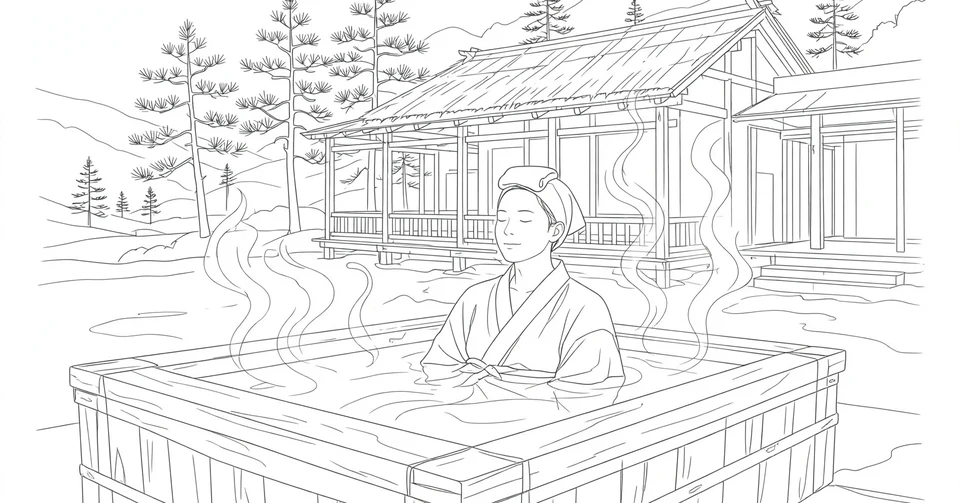
There was no dinner service, and nobody turned down a futon for you. A guest on toji rented a bare room, shared a kitchen with strangers, cooked the rice and miso they had brought from home, and organised the whole day around the bath. It was less a holiday than a temporary life, repeated for as long as the cure took.
Almost everything about modern onsen travel, the single night, the elaborate dinner, checkout by ten, runs opposite to toji. Yet the old system never quite disappeared, and the inns that still operate on its terms show what hot springs were for before they became a luxury.
What a toji stay actually looked like
The classic toji guest was a farmer or a fisherman, someone whose living was made with the back, the knees and the hands. The Japan National Tourism Organization's account of the hot spring culture of Towada-Hachimantai National Park describes how such people travelled long distances with bedding and food carried on their backs, then bathed several times a day in mineral waters believed to ease fatigue, injuries and chronic illness. Toji was not considered a luxury pastime. It was essential maintenance for a body that worked for a living.
The unit of toji was never the night. It was the week, and often several of them. A stay had a rhythm rather than an itinerary: bathe, rest, cook, eat, bathe again. The inn itself, the tojiba, worked as a temporary community, where guests shared kitchens and bathhouse small talk and fell into step with one another's recovery. Strangers from different villages ended up on the same schedule, and the company was understood to be part of the treatment.
The bathing itself was communal in a way that has mostly faded from Japanese life. At the old cure inns everyone soaked together in big shared halls, a world that survives in the mixed bathing culture of konyoku, and the bathhouse doubled as the village square of the place. You did not book privacy. You joined in.
One roof, two kinds of guest
Walk into an old toji inn today and the building often tells the story by itself. Many are split into two operations under one roof: a ryokan wing with meals served in the room, and a toji wing of plainer rooms with a shared kitchen and a coin laundry, where guests look after themselves. Sukayu Onsen in Aomori, one of the most famous cure inns in the country, divides its 139 rooms along exactly this line.
At Osawa Onsen in Iwate, the self-catering side occupies a wooden lodge more than 200 years old, a short walk from the modern ryokan on the same grounds. Guests cook on coin-operated gas stoves in the communal kitchen, and room-only stays start at 4,650 yen, with even the yukata robe billed as an extra. That kind of itemised, no-frills pricing is itself a fossil of toji economics. At Namegawa Onsen in Yamagata, a self-catering room in the therapeutic wing starts at 3,200 yen a night.
Cooking for yourself, jisui in Japanese, was not a budget compromise. It was the mechanism that made the whole system possible. A farming family could never have afforded three weeks of served dinners, but three weeks of rice, pickles and soup cooked in a shared kitchen was within reach. There is a dignity in the arrangement that I find quietly persuasive: nobody performed hospitality at you. For the length of the cure, you were a resident, not a customer.
The waters were the whole point of toji
People did not travel for weeks for a pleasant soak. They came for specific waters, and the most demanding of them all is Tamagawa Onsen in Akita, opened as a toji ground in 1885 and still drawing long-stay guests from across Japan. Its source runs at about pH 1.2, close to the most acidic spring water in the country, and the great vent called the Obuki discharges around 9,000 litres a minute at 98 degrees, the largest single source of any hot spring in Japan. The bathhouse offers pools at full strength, at half strength and milder, so that a guest builds tolerance gradually over the days. There is also bedrock bathing, lying on geothermally heated rock, for those who want the heat without the acid.
Sukayu, in the Hakkoda mountains of Aomori, pairs similarly strong water with a famous bath hall, the Sennin-buro or bath of a thousand, a vast room of cypress fed by four different sources. It also keeps a consultation room where staff advise guests on bathing schedules, a small sign that the cure here was always treated as a regimen rather than a pastime.
Not every cure water is fierce. At Nishiyama Onsen in Yamanashi, the spring at Motoyu Horaikan rises at only 34 to 38 degrees, barely above body temperature, and the inn keeps self-catering rooms reserved for toji guests who soak for an hour at a time. The principle is the same as at Tamagawa, only inverted: instead of short dips in violent water, long immersion in gentle water, day after day.
It is worth being precise about what was being claimed for all this. Japanese regulations list indications for each type of spring water, conditions the water is traditionally associated with, typically neuralgia, muscle and joint pain, and poor circulation. An indication is not a cure. As one careful guide to Japan's surviving toji inns puts it flatly, hot springs are not medicine. People believed in these waters, organised their year around them, and many no doubt felt genuinely better for the warmth, the rest and the routine. Anyone with a real medical condition should still start with a doctor, not with a bath.
A cure written into the calendar, and later into law
Toji had to fit around work, so it belonged to the slack part of the farming year, when the fields could spare their people. In the Edo period, when ordinary folk rarely travelled far without a sanctioned reason, the cure was one of the reasons that made sense of a long absence. It was health, not wandering. The infrastructure was formal, too. Namegawa Onsen was opened as a toji ground in 1763 under a permit from the Uesugi lords of the Yonezawa domain, and the Fukushimaya family has kept the spring ever since, fourteen generations of them. The Wakamatsuya inn at Hijiori Onsen in Yamagata has been taking in bathers since the late Edo period.
Every cure region kept its folklore of recovery. Goshogake Onsen in Akita is summed up in a local saying that translates roughly as come by horse, leave on wooden clogs: arrive too weak to walk properly, depart on your own feet. It is a saying, not a statistic, but it captures what guests hoped a fortnight of bathing would do.
The state eventually wrote the custom down. In 1954 the government designated its first three National Health Resort Hot Springs, and one of them was Sukayu, alongside Shima in Gunma and Nikko Yumoto in Tochigi. Today only about 80 of Japan's roughly 3,000 hot spring resorts hold that designation, and a striking share of them sit in the snowy northeast, where toji culture ran deepest.
What is left of toji now
Across Japan, the traditional toji inn has been in long decline. Most springs now sell the single night, and many old cure houses have closed or rebuilt themselves into conventional ryokan. The stronghold that remains is the region the habit came from: the mountains of Aomori, Akita and Iwate, around Towada-Hachimantai National Park, where inns still offer long-stay plans, shared kitchens and weekly rates, and where the cure is a living practice rather than a museum piece.
Hijiori Onsen in Yamagata still looks the part entirely: a dozen or so inns packed onto the floor of a deep gorge, steam drifting between the buildings, an early morning market setting up on the street outside from spring to autumn, and inns like Wakamatsuya where two shared kitchens and a coin laundry still support the old style of toji stay.
The modern form is smaller and quieter, but it is not dead. Geto Onsen Kanko Hotel in Iwate reopened in October 2025 serving no meals at all, a room-only, self-catering inn built entirely around long therapeutic stays. Others, like Namegawa and Nishiyama, keep a handful of cheap self-catering rooms alongside the meal plans, hedging between two centuries. Many of these places also sit on springs generous enough to run straight from the source, free-flowing and never recirculated, which is exactly what a cure measured in weeks requires: water that does not run out before the guest does.
What has changed most is the assumption underneath. Modern wellness sells recovery as something that can be scheduled into a weekend, purchased by the night and photographed. Toji assumed the opposite, that a worn-out body heals on its own calendar, and that the sensible response is to move in next to the water and wait. There is something in that patience that feels less like nostalgia and more like a correction.
The springs are still there, and so are a few of the kitchens, the coin-operated stoves and the plain rooms priced by the week. Toji asked a lot of its guests: their time, their cooking and their faith in slow processes. In return it offered something the one-night stay rarely manages, the feeling of actually living somewhere until you are well enough to leave.
More in Life & Style
Latest posts
- Edo's Hikeshi Wore Their Dragons Into the Fire
- Kagawa Puts the Sweet Part Inside the Mochi
- Sodoran Treats an Heirloom Like an Honoured Guest
- You Can Read a Pecalang From Across the Street
- A Donko Never Got the Chance to Open
- The Milpa Is a Garden That Thinks Like a Forest
- The Kitamaebune Came Home Loaded With Kelp
- When the Gara-Gara Starts, the Puppets Drop the Plot
- Forty Pounds of Cowbells, and the Mamuthones Say Nothing
- The Oarfish Still Answers to a Name From the Dragon Palace
- Ponzu Began With a Fruit Too Bitter to Eat
- Kombu Is the Quiet Half of Dashi
- Irezumi Was an Art Before It Was a Warning
- The Oshi Kept Fuji's Pilgrims Fed, Housed, and Devout
- Every Prefecture Argues About What Goes in Ozoni