The Milpa Is a Garden That Thinks Like a Forest
· 9 min read
The milpa is the Mesoamerican field system that grows maize, beans and squash together at farm scale, then hands the land back to the forest. It fed Maya cities and still feeds villages from Mexico to Costa Rica.
From the road, a milpa can look like a corn field that has given up on tidiness. Maize stands in loose order, bean vines climb the stalks, squash leaves spill across the ground between them, and somewhere in the middle there are chilis, tomatoes and herbs that follow no visible plan. The disorder is the design. A milpa is not a single crop but a whole company of crops planted together on purpose, each one doing a job the others cannot, and when the arrangement has run its course the field is handed back to the forest to rest.
The word gives away how completely the idea mixes place and practice. Milpa comes from the Nahuatl words milli and pan, and in Mesoamerica it names the field itself and the system of farming that happens on it at the same time. Gardeners further north grow the same famous trio, maize, beans and squash, in a single mound and call it the three sisters. The milpa is that partnership scaled up from a mound to a landscape, and given a calendar measured in decades.
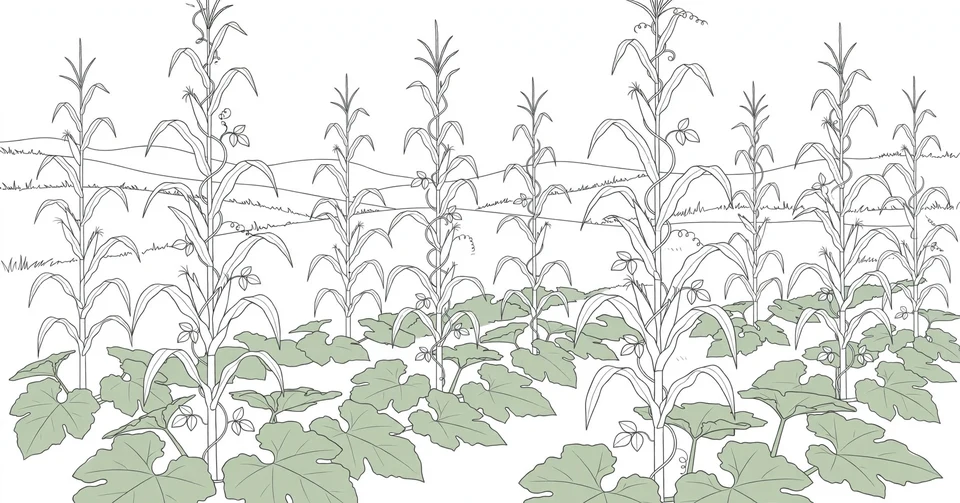
Farmers have worked this way in Mexico and Central America for thousands of years, and a great many still do. The milpa fed Maya cities when they were among the largest settlements on earth, and today it still feeds villages across the region, which makes it less a survival from the past than a living system that industrial farming never quite managed to replace.
A milpa is a field and a system at once
The encyclopedia overview of the milpa describes it as a field for growing food crops and a crop growing system used throughout Mesoamerica, described most fully in the Yucatan Peninsula of Mexico. That double meaning is the first thing to understand. A wheat field is a place. A milpa is a place plus a set of relationships, between plants, between the field and the forest around it, and between the farmer and both.
A single field might hold a dozen crops at once. Charles C. Mann, in his book 1491, listed maize, avocados, several varieties of squash and bean, melon, tomatoes, chilis, sweet potato, jicama, amaranth and mucuna growing together in one milpa, and quoted the maize researcher H. Garrison Wilkes calling the system "one of the most successful human inventions ever created." That is a large compliment for a field with no straight rows, but the variety is the point. Where a monoculture bets everything on one plant, this system spreads its bets across a dozen.
Three crops doing three jobs
At the centre of the planting stand the same three partners as in the northern garden version. Maize grows tall and lends its stalk as a living pole. Beans climb it, and pay for the ride by hosting bacteria in their roots that pull nitrogen out of the air and leave it in the soil, feeding a famously hungry crop. Squash takes the ground floor, spreading wide leaves that shade the earth, slow the weeds and hold moisture in the soil through dry spells. I worked through the mechanics of that partnership in my article on the three sisters, where the trio shares a single mound.
What changes at milpa scale is the size and the supporting cast. The plants stand further apart, in fields rather than mounds, and the gaps are filled with whatever else the household grows and eats. The three sisters remain the engine, but the field around them behaves less like a garden bed and more like a small managed ecosystem, which is exactly how the farmers who work it tend to describe it.
The forest gets its turn
The classic milpa is not a permanent plot, and this is where it surprises people raised on the idea of a field as a fixed piece of property. In the traditional cycle, a patch of forest is cut, the fallen growth is left to dry and then burned, and the ash goes into the soil as a first feeding. Crops are planted for a short run of seasons, commonly given as two years of cultivation, and then the land is left alone for a long fallow, commonly eight years, while the forest grows back over it.
Seen from above, a landscape farmed this way is a patchwork. One plot is in its first green year, another is heavy with maize, a third is resting under young trees, and the oldest fallows are nearly forest again. The farmer is not really farming one field. He is farming time itself, rotating a small herd of plots through growth and rest so that fertility comes from the returning forest rather than from a bag.
It is the fallow I keep coming back to. Modern farming tends to treat rest as waste, an acre earning nothing. This system treats rest as the main event, the long quiet stretch in which the soil rebuilds itself for free. A way of farming that plans for the forest to return is not primitive. In some ways it is more patient, and more honest about where fertility actually comes from, than the methods that replaced it.
A pantry planted in one field
The cooperation does not end at the harvest. Maize on its own is a poor protein, short on the amino acids lysine and tryptophan, and beans carry both, while squashes add vitamins and avocados add fats, so the field assembles a nearly complete diet before anyone reaches a kitchen.
On the table this becomes the oldest menu in the region: tortillas and beans, squash in season, chilis for heat, herbs for freshness. Dried maize and dried beans also keep for months without refrigeration, so a good harvest is a pantry as well as a meal. Diversity in the field becomes diversity on the plate, and security in the storehouse.
From Maya cities to a Nicoya kitchen
The milpa is built on the agronomy of the Maya and their neighbours, and it scaled. A system of family plots, multiplied across a region and tended for centuries, carried the food supply of Maya cities, and its three core crops then travelled north over generations until the partnership was being planted across much of North America as well.
It also travelled south, and never left. In Central America this remains ordinary working agriculture, and at the southern end of the old Mesoamerican world, on the Nicoya Peninsula of Costa Rica, maize, beans and squash still form the core of the local plate, with the maize cooked in lime in the process I described in my article on why Nicoya cooks its corn in lime. Nicoya is now famous as a blue zone of long lives, and researchers there keep returning to that same plain plate of food. The milpa is one of the threads that ties the peninsula's longevity back to a field system thousands of years old.
The milpa under pressure
None of this is guaranteed to continue. An FAO feature story on Mexico's traditional agrifood systems describes walk after walk through milpa country, maize spaced wide with beans climbing and squash leaves covering the soil, and calls the system the opposite of monoculture. The same story names the squeeze plainly. The steady expansion of large scale, intensive production and monoculture, and the simple abandonment of traditional farming, leave households more exposed to shocks and leave diets narrower.
Research in Calakmul, in southeastern Mexico, found the pattern is untidier than simple disappearance. Families there planted less milpa as droughts, hurricanes and money sent home by relatives working elsewhere changed the household maths, yet the system did not collapse. Income from outside the farm, which pulls young people away from the fields, also let some families keep a plot for their own food and culture rather than depending on it for cash. The milpa shrinks, adapts and persists, often all in the same village.
There is also organized rescue under way. The FAO, working with Mexico's biodiversity commission CONABIO and the Global Environment Facility, has spent years helping farmers revive the milpa and market its produce, building 77 community and family seed banks with more than 1,400 farmers taking part, and reaching nearly 10,000 producers over five years. Part of the bet is on city appetites. Shoppers who remember the taste of tortillas and beans from a grandparent's kitchen are a market that monoculture cannot serve.
Why the milpa endures
Part of the answer is that it was never only agriculture. Researchers describe the milpa as a social and cultural construct as much as a technique, and one scholar of Maya farming described the making of milpa as the central, most sacred act of village life, the thing that binds together the family, the community and the universe. That sounds grand until you remember that this one decision, what to plant and where, decides what a family eats, what it celebrates with, and what it hands to its children in the form of seed. Of course it is sacred. It is dinner, identity and inheritance sharing a single field.
What stays with me is how the milpa answers a question modern farming mostly stopped asking. Instead of asking how much one field can be made to produce this year, it asks how a field, a forest and a family can keep feeding each other indefinitely. The maize still stands, the beans still climb, the squash still cools the ground, and behind them the forest is always on its way back. A garden that thinks like a forest is in no hurry, and that may be exactly why it has lasted.
More in Food & Travel
Latest posts
- Edo's Hikeshi Wore Their Dragons Into the Fire
- A Yubatake Cools a Spring With Nothing but Wood and Gravity
- Toji Meant Moving to a Hot Spring Until You Got Better
- Sodoran Treats an Heirloom Like an Honoured Guest
- You Can Read a Pecalang From Across the Street
- Nyuto Onsen Hides Seven Inns at the End of a Snow Road
- Nobody Just Watches a Panigyria, Everybody Dances
- When the Gara-Gara Starts, the Puppets Drop the Plot
- Forty Pounds of Cowbells, and the Mamuthones Say Nothing
- The Oarfish Still Answers to a Name From the Dragon Palace
- Manza Onsen Bathes at 1,800 Metres
- Irezumi Was an Art Before It Was a Warning
- The Oshi Kept Fuji's Pilgrims Fed, Housed, and Devout
- Japan's Population Decline and the Villages It Leaves Behind
- KRL Commuterline and the Trains That Move Jakarta