When the Gara-Gara Starts, the Puppets Drop the Plot
· 8 min read
Around midnight in an all-night wayang kulit performance, the epic pauses for the gara-gara, an unscripted hour in which four clown servants set the story aside to joke, sing, and talk about the audience's own life.
A Javanese wayang kulit performance lasts all night, from roughly nine in the evening until just before dawn. Kings quarrel, heroes set out on long journeys, armies gather on distant fields. Then, somewhere around midnight, the story simply stops. The hero sits down in a forest, the battle is postponed, and four clown servants wander onto the screen to talk about something else entirely. This halt in the middle of the epic is the gara-gara, and plenty of people in the audience have been waiting for it since the first gong.
The name suits it. In Javanese, gara-gara carries the sense of a commotion or an uproar, a disturbance in the way things ought to be, and the gara-gara is traditionally played as exactly that, a small crack in the order of the world. The puppeteer, called the dalang, has spent the evening voicing gods and demons in formal court language. Now, for a while, he can put the formality down.
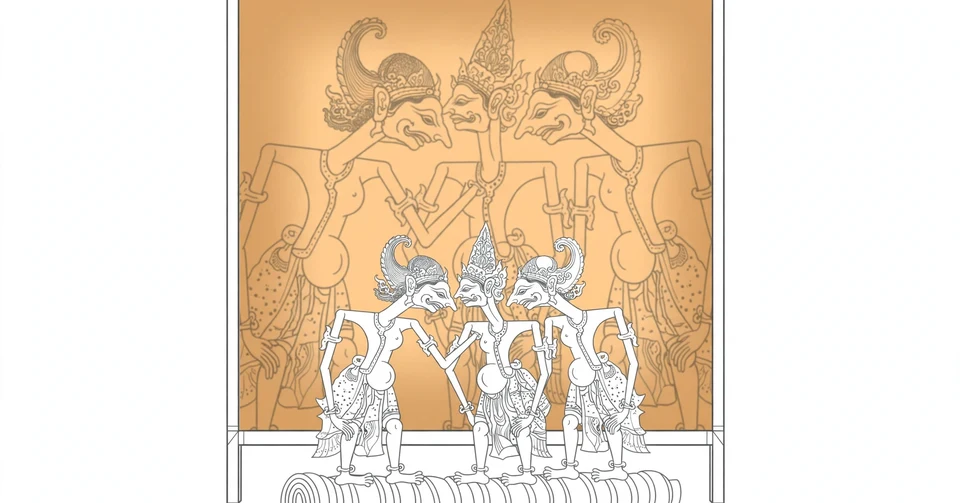
What follows is close to an hour that nobody wrote down. The gara-gara is the one long stretch of the night that the dalang is expected to invent on the spot, out of the week's news, the price of rice, local gossip, and whatever else the village has on its mind. Every dalang dreads it a little and loves it a little, because there is nowhere in it to hide.
Where the gara-gara sits in the night
A full performance is built in three broad movements, named for the musical modes, called pathet, that govern them. The evening begins in pathet nem, with courts and councils and a young hero still at home. The middle of the night moves into pathet sanga, when the hero is on the road, in exile or on a quest, and the world around him grows stranger. The last movement, pathet manyura, carries the story through its climaxes to a resolution before the light comes back.
The gara-gara belongs to the hinge between the second movement and the third. The clown servants, the punakawan, make their main entrance during pathet sanga, and their big scene arrives around midnight. A study of a recorded performance by the celebrated dalang Ki Manteb Sudarsono, published in the journal Panggung, notes that the gara-gara scene is usually presented at midnight, in the deep part of pathet sanga, and one practical reason is disarmingly simple. By then, parts of the audience have drifted off to sleep, and the scene is built to wake them again with laughter.
Four servants walk in, and the epic steps aside
The newcomers are Semar and his three sons, Gareng, Petruk, and Bagong, a family of servants who attach themselves to whichever hero the night's story happens to follow. They are, as this site's earlier piece on the punakawan explored, the most loved figures in Javanese theatre, and among the strangest. Semar, round bellied and heavy eyed, is in the mythology a god who chose to live as a servant, a guardian spirit of Java content to do his master's errands. His sons are jokes in silhouette. Gareng is short and limping, Petruk tall and gangling with his famous long nose, and Bagong a plump echo of his father.
Where the kings and knights of the epic speak an elevated, archaic register of Javanese and move with courtly restraint, the servants dress like ordinary villagers and talk like them too. That contrast is the engine of the gara-gara. Dressed as common people, the punakawan free the dalang to address the audience directly, in the language of the market and the rice field, without the etiquette of the palace standing in the way. Long before the jokes begin, the costume change alone announces that different rules now apply.
The gara-gara hour has no script
Ask what actually happens in a gara-gara and the honest answer is that it depends on the night, the village, and the dalang. One scholarly description puts it plainly: the scene can run for more or less than an hour, depending on the dalang's need and his ability to improvise. The four servants introduce themselves, bicker among themselves, trade riddles and wordplay, and take stock of the world. A wandering student or a hermit's disciple may drift into the scene and be cross examined about his life, and through him the dalang can talk, at a safe comic distance, about poverty, debt, grasping officials, failed harvests, or the new road that everyone in the village is complaining about.
Nothing in the scene is protected by the distance of myth, because the servants refuse to stay inside the myth. Their humour runs on deliberate anachronism. Petruk may cheerfully claim to own a car or a mobile phone, objects that obviously never existed in the age of the epics, and the audience laughs precisely because the pretence has been dropped. In the gara-gara, last week's events receive the same treatment as the deeds of ancient kings, and usually a sharper one.
All of this rests on one person's shoulders. The dalang performs every voice, works every puppet, cues the gamelan orchestra, and keeps a field full of tired people awake past midnight. A beginner can lean on stock routines inherited from his teacher. A master treats the gara-gara as the night's proving ground, the stretch where his reputation is genuinely made or lost, because there is no story to carry him. There is only him, four leather clowns, and a village waiting to be recognised in the jokes.
Why the gara-gara is the part people wait for
It would be easy to file the gara-gara as comic relief, a rest stop built into a very long performance, but audiences have never treated it that way. The entrance of the punakawan is traditionally greeted with laughter and anticipation, and researchers who recorded village performances noticed that the crowd's enthusiasm peaked when the dalang stayed close to home, shaping the scene around the audience's own situation. People called out their agreement. He is right, Petruk is right, one listener said, while another remarked that the dalang seemed to be one of them.
There is practical wisdom in the placement, since an audience that has laughed itself awake at midnight will stay for the battles and revelations of the final movement. But I suspect the gara-gara does something more than manage the crowd's energy. For one hour, the lowest figures on the screen become the highest authority in the room, and a village hears its own concerns, its prices and officials and small humiliations, spoken aloud from the place of honour in its most prestigious art form. That is not relief from the performance. In a real sense, it is what the performance is for.
A free hour attracts powerful listeners
Freedom that reliable is never left entirely alone. During the New Order decades, when wayang performances were broadcast on radio across Java and sponsored at every level of official life, the gara-gara was watched as carefully as it was enjoyed. The same improvisation that let a dalang tease a vain official also let governments pour their own messages into the scene, and researchers of the period describe stories bent to carry the vocabulary of development campaigns and ruling party praise. The clowns could speak truth upward, or be borrowed to speak power downward, and everyone in the audience understood both possibilities perfectly well.
That double use, in the end, tells you how much the scene mattered. Nobody bothers to capture a channel that nobody listens to. The gara-gara remained the most trusted hour of the night precisely because audiences believed it was where the dalang spoke in his own voice, and trust of that kind is always worth competing for.
Then the story takes its stage back
When the laughter settles, the epic does not simply restart from where it froze. It restarts changed. The punakawan do not leave the stage after the gara-gara. They stay beside their master through the final movement, advising him, scouting ahead of him, and sometimes saving him outright. Semar's counsel can carry real weight in the plot, as when he quietly tells the hero Bima the single weakness of the enemy he is about to face. The servants who spent an hour cheerfully ignoring the story turn out to be the ones who carry it safely home.
There is a generosity in that design that I keep coming back to. A tradition confident enough to interrupt its own sacred epic, near its most solemn hour, and hand the stage to four servants with nothing prepared, is a tradition that trusts its artists and its audience in equal measure. The story will still be there after midnight, patient as ever. The gara-gara exists to make sure the people watching are still there too, awake and laughing, and feeling that for at least one hour of the long night, the performance was about them.
More in Culture & Society
- Edo's Hikeshi Wore Their Dragons Into the Fire
- Sodoran Treats an Heirloom Like an Honoured Guest
- You Can Read a Pecalang From Across the Street
- Forty Pounds of Cowbells, and the Mamuthones Say Nothing
- The Oarfish Still Answers to a Name From the Dragon Palace
- Irezumi Was an Art Before It Was a Warning
Latest posts
- Kagawa Puts the Sweet Part Inside the Mochi
- A Yubatake Cools a Spring With Nothing but Wood and Gravity
- Toji Meant Moving to a Hot Spring Until You Got Better
- Nyuto Onsen Hides Seven Inns at the End of a Snow Road
- A Donko Never Got the Chance to Open
- The Milpa Is a Garden That Thinks Like a Forest
- The Kitamaebune Came Home Loaded With Kelp
- Nobody Just Watches a Panigyria, Everybody Dances
- Ponzu Began With a Fruit Too Bitter to Eat
- Kombu Is the Quiet Half of Dashi
- Manza Onsen Bathes at 1,800 Metres
- The Oshi Kept Fuji's Pilgrims Fed, Housed, and Devout
- Every Prefecture Argues About What Goes in Ozoni
- Japan's Population Decline and the Villages It Leaves Behind
- KRL Commuterline and the Trains That Move Jakarta