Kagawa Puts the Sweet Part Inside the Mochi
· 9 min read
Anmochi zoni is Kagawa's New Year soup, a white miso broth built on dried sardines in which the round mochi hides a core of sweet red bean paste. It sounds like a mistake until the sweet and salty parts meet in the same spoonful.
Every prefecture in Japan greets the New Year with its own bowl of ozoni, the soup that carries mochi into January. Most versions stay firmly savoury. Kagawa, the small prefecture on Shikoku that the rest of Japan knows for udon, does something else entirely, and its anmochi zoni has been startling first time visitors for generations.
The surprise is hidden inside the mochi itself. An anmochi is a round, plain looking rice cake with a secret: its centre is filled with an, sweetened red bean paste, the same filling that goes into everyday Japanese sweets. Dropped into a hot white miso soup, the anmochi turns dessert into breakfast without asking anyone's permission.
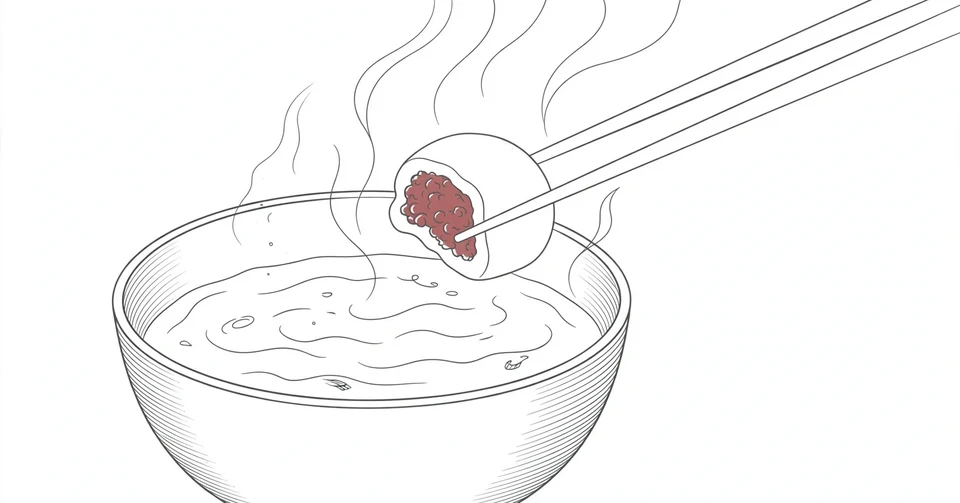
I have written before about how every prefecture argues about what goes in ozoni, from clear broths in the east to white miso in the west. Kagawa's anmochi zoni sits at the far end of that map, the version people describe to friends with a pause, because they know how it sounds. Sweet bean paste, in miso soup, on New Year's morning. Kagawa insists it works, and Kagawa has had a very long time to be sure.
What goes into anmochi zoni
Strip away the shock value and anmochi zoni is a disciplined, ordinary piece of cooking. The stock comes from iriko, small dried sardines, the same base that flavours much of Kagawa's everyday food, udon broth included. Into that stock go daikon radish and carrot, cut into round slices, and in some homes a little tofu. The recipe recorded by Japan's agriculture ministry, provided by Kagawa Prefecture itself, uses the deep red Kintoki carrot and finishes the bowl with a sprinkle of aonori, green laver, once the soup is served.
The mochi follows the western, Kansai pattern. It is round rather than square, and it is not toasted over a flame. The anmochi goes into the pot and boils in the soup until it softens, so the rice cake arrives at the table tender all the way through, its sweet centre warmed to the temperature of the broth around it. Only then is the white miso stirred in, loosened with a ladle of the hot stock so it dissolves without lumps.
White miso matters here. The Sanuki style of white miso is pale, mild and noticeably sweet for a fermented seasoning, low in salt compared with the darker misos of the north. That gentleness is part of why anmochi zoni can exist at all. A fierce, salty broth would fight the bean paste. This one makes room for it, the way a frame makes room for a picture that should not, by rights, hang in that room.
There is even a piece of table engineering in the ministry's recipe that I have come to admire. Before the soup is ladled in, a slice of the cooked daikon is placed at the bottom of the bowl and the mochi is set on top of it, so the soft rice cake never touches the bowl directly and cannot glue itself there as it cools. Generations of Kagawa cooks solved a small, sticky problem without comment, and the solution simply became part of how anmochi zoni is served.
The iriko base deserves a word of its own, because it ties anmochi zoni to the prefecture's louder fame. Kagawa has more than six hundred udon shops and leads Japan in both udon production and consumption, and the dried sardine is a backbone of that world too, the quiet fish behind the noodle broth. So the two bowls that define Sanuki eating, the everyday udon and the once a year anmochi zoni, begin in the same place. The prefecture's New Year soup is not an import or a stunt. It is the home dialect of a flavour Kagawa already speaks fluently.
Why the filling is sweet
The explanation Kagawa gives for anmochi zoni is a story about sugar, and about who was allowed to taste it. During the Edo period, the Takamatsu Domain promoted sugar production as a way to enrich itself, and the fine white sugar known as wasanbon became one of the region's prized products. Sugar, though, was an upper class food. Ordinary households in Sanuki almost never tasted anything sweetened, even though the ingredient was made in their own province.
Anmochi zoni is said to have been created as the one licensed exception. If sweetness could only be afforded on a special occasion, then the most special meal of the year, the New Year soup, was where it belonged. The filling turned the first bowl of January into a small celebration in itself, a taste of the luxury that the rest of the year kept out of reach. The Kagawa tourism association tells the story the same way, and it is worth noticing how neatly it fits the dish: nothing in anmochi zoni is sweet except the hidden centre, as if the sugar had to be rationed even in the telling.
Even the vegetables carry a wish. The daikon and carrot are cut into rounds, and the roundness is deliberate, a hope for a complete and fulfilling year, the circle unbroken from the first meal of January to the last of December. It is a gentle detail, easy to miss under the louder question of whether bean paste belongs in soup, but it tells you that anmochi zoni was never a joke dish. It was built, carefully, by people who meant it.
Sweet and salty in the same spoonful
The honest first reaction to anmochi zoni, for most people raised outside Kagawa, is suspicion. Miso soup is savoury. Bean paste is dessert. The categories feel settled, and anmochi zoni ignores them with the calm of a dish that predates the argument. Locals, by most accounts, find the confusion more puzzling than the soup. To them the combination is simply what New Year tastes like, learned at a family table long before they had opinions about categories.
Taste it slowly and the logic appears. The white miso broth is mild and rounded, the iriko stock underneath gives it depth, and then the mochi breaks open and the an spreads its slower, darker sweetness through the spoonful. It is less like dessert in soup than like the balance in salted caramel, or in a peanut sauce, where sweetness only works because the salt is there to hold it up. Anmochi zoni does not taste like two foods colliding. It tastes like one food that happens to stand with a foot in each camp.
My own view is that anmochi zoni gets judged unfairly because people hear about it before they taste it, and the description is genuinely hard to defend at a distance. In the bowl, warm, on a cold January morning, the defence becomes unnecessary. I would not want it every week. As a once a year bowl with a story inside it, I find it hard to argue with, and I suspect that is exactly the relationship Kagawa has always had with it.
Every household keeps its own version
For a dish with such a famous fixed point, anmochi zoni is surprisingly flexible around the edges. The filling, the white miso and the iriko stock are not negotiable. Almost everything else is. Depending on the district and the family, the pot might also hold taro, burdock root or aburaage, the thin fried tofu that drinks up broth. Toppings drift too, from green onion to nori, which is the dried form of the same seaweed family as the aonori in the official recipe, to a snowfall of dried bonito flakes.
The mochi itself separates anmochi zoni from the other famous mochi of the season. January is also the month of the stacked kagami mochi, the hard ornamental pair that sits on household altars until it is broken open, never cut, in the kagami biraki ceremony. Nobody would put that in soup. The anmochi is a different creature entirely, fresh, soft and made to be eaten, closer to a filled dumpling than to a decoration. Kagawa simply gave it a savoury place to swim.
That flexibility explains how anmochi zoni survives. A dish that only tolerates one exact form tends to become a museum piece. One that lets every grandmother adjust the vegetables, argue about the tofu and defend her own miso ratio stays alive, because the argument itself is part of the tradition. The centre holds, literally, while everything around it stays negotiable.
Finding anmochi zoni outside New Year
Anmochi zoni remains, first of all, a home dish for the New Year holidays, and the surest way to meet it is still an invitation to a Kagawa family table in early January. But a visitor no longer has to wait for the calendar or for an invitation. In Takamatsu, the prefectural capital, teahouses including the ones inside Ritsurin Garden serve anmochi zoni to travellers, and sweet shops in the city keep it on the menu beyond the holiday season, because a dish this famous eventually escapes its own dates.
The tourism association's own list of places to try it reads like a small map of Takamatsu: Hanazono-tei and Fukiage-tei, the teahouses inside Ritsurin Garden, where the bowl arrives with a view of one of Japan's celebrated landscapes, the sweet shop Budou-no-ki in Hyakken-machi, and Momotaro chaya over in Yashima. None of these are New Year pop ups. They are ordinary addresses where anmochi zoni has settled into the regular menu, there to be ordered by anyone curious enough, in whatever month curiosity strikes.
That escape says something kind about the prefecture. Kagawa is the smallest prefecture in Japan, a place that built its national reputation on a single noodle, and it would have been easy for anmochi zoni to remain a local in-joke, mentioned every January and forgotten by February. Instead the prefecture put it in front of strangers, in garden teahouses and official recipe collections, trusting that the bowl could speak for itself.
There is a lesson in anmochi zoni that goes beyond one prefecture's soup. Regional food survives not by being the easiest to explain, but by being the most itself. Kagawa took the humblest ingredients it had, sardines, radish, miso, a little of the sugar its own people were once barely allowed to taste, and folded them into a bowl that no other prefecture would dare to copy. The sweet part is hidden inside the mochi. The confidence, I think, is not hidden at all.
More in Food & Travel
Latest posts
- Edo's Hikeshi Wore Their Dragons Into the Fire
- A Yubatake Cools a Spring With Nothing but Wood and Gravity
- Toji Meant Moving to a Hot Spring Until You Got Better
- Sodoran Treats an Heirloom Like an Honoured Guest
- You Can Read a Pecalang From Across the Street
- Nyuto Onsen Hides Seven Inns at the End of a Snow Road
- Nobody Just Watches a Panigyria, Everybody Dances
- When the Gara-Gara Starts, the Puppets Drop the Plot
- Forty Pounds of Cowbells, and the Mamuthones Say Nothing
- The Oarfish Still Answers to a Name From the Dragon Palace
- Manza Onsen Bathes at 1,800 Metres
- Irezumi Was an Art Before It Was a Warning
- The Oshi Kept Fuji's Pilgrims Fed, Housed, and Devout
- Japan's Population Decline and the Villages It Leaves Behind
- KRL Commuterline and the Trains That Move Jakarta