The Oarfish Still Answers to a Name From the Dragon Palace
· 8 min read
In Japan the oarfish is called ryugu no tsukai, the messenger from the Sea God's Palace, and its rare appearances on beaches are still read as warnings of earthquakes. The fish is real, and stranger than the legend, but the warning has never held up.
Every few years an oarfish turns up where it does not belong, filmed paddling in water shallow enough to stand in, or lying in long silver loops on a beach while a crowd gathers. In Japan the fish already has a job title waiting for it. It is called ryugu no tsukai, the messenger from the Sea God's Palace, and a messenger, everyone understands, never arrives without news.
The news it is supposed to carry is bad. In Japanese folklore the appearance of an oarfish warns of earthquakes to come, and the nickname it has collected abroad, the doomsday fish, shows how far that reading has travelled. The fish itself, though, is stranger and more interesting than the omen pinned to it.
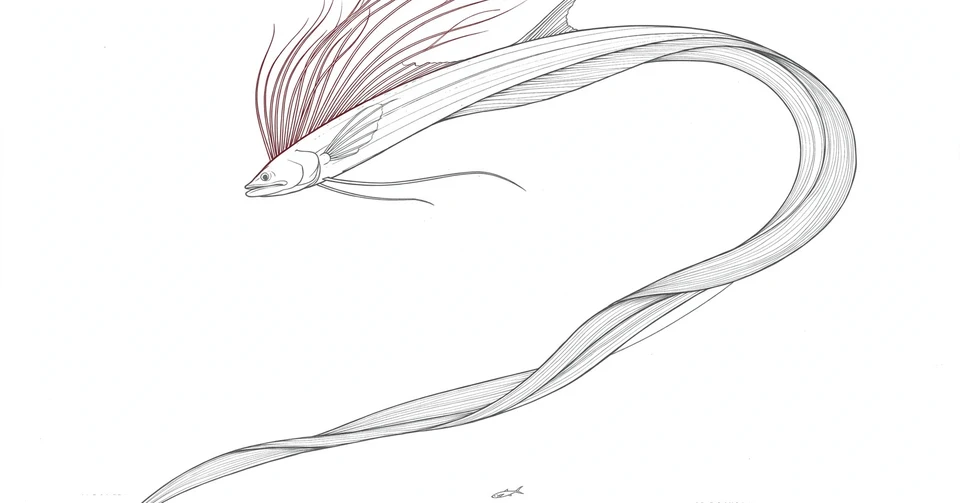
It helps to remember that the name came first and the fear came later. Ryugu is the undersea palace of Ryujin, the dragon king of the sea, the same palace that the fisherman Urashima Taro visited in Japan's most famous story about lost time. I have told that tale elsewhere on this site, in the story of Urashima Taro and the dragon palace, and the palace has its own afterlife in the article about Ryugu, the palace under the sea. A ribbon of silver rising out of deep water, wearing a red crest like a court ornament, looks exactly like something a dragon king would send. The oarfish was cast in its role centuries before anyone thought to blame it for earthquakes.
What an oarfish actually is
The name oarfish covers a small family of three species. The giant oarfish, Regalecus glesne, is the famous one. Its smaller relative Regalecus russelii, the slender oarfish, is the species that washes up on Japanese coasts and the one the ryugu no tsukai name properly belongs to. A third species, the streamer fish, completes the family.
The giant oarfish holds a genuine record. It is the longest bony fish alive, and the most careful modern measurements put the confirmed maximum at about eight metres. Reports of eleven metres, even seventeen, circulate in old accounts and headlines, but they are reports rather than measurements, and most oarfish anyone actually encounters are closer to three metres long. Even at that size, the animal is mostly ribbon. The body is flattened side to side, covered in silver skin with no scales, and the dorsal fin runs the whole length of it, its first rays drawn out into a trailing red crest. There is no swim bladder, almost no tail to speak of, and a small toothless mouth. The English name is thought to come from the long body or from an old, wrong belief that the fish rowed itself along with its fins. The family name comes from the Latin regalis, meaning royal, which suits an animal that folklore had already promoted to court staff.
Nobody eats one, incidentally. The flesh is gelatinous and widely considered inedible, so the oarfish has never been worth a fishery. It owes its fame entirely to being seen at the wrong moments.
A life spent hanging in the dark
An oarfish spends its life in the mesopelagic zone, the dim middle layer of the ocean, roughly between 200 and 1,000 metres down. There is little or no current at that depth and almost no light, and the fish is built accordingly, with so little muscle mass that it could not fight turbulent shallow water even if it wanted to.
The posture that surprises people most is the vertical one. A healthy oarfish often hangs upright in the water column, head up, body straight, rippling its long dorsal fin to hold position. Researchers believe this is a feeding posture, because prey above the fish is silhouetted against the faint light filtering down, which makes it easier to spot. The diet itself is modest for so large an animal. The oarfish is a filter feeder that strains krill, tiny shrimp and other small crustaceans from the water with the gill rakers in its mouth, and it will also take small fish, jellyfish and squid. One specimen caught off California was found to hold around ten thousand individual krill. The Florida Museum's profile of the giant oarfish describes that toothless, straining mouth in detail, and it reads less like the mouth of a monster than the mouth of a very large plankton sieve.
Almost everything known about the living fish has arrived in the last few decades. A live oarfish was filmed for the first time only in 2001, by United States Navy personnel inspecting a buoy in the Bahamas, and the first footage of one swimming in its natural deep habitat came in 2008, in the Gulf of Mexico. Remotely operated vehicles have since recorded healthy fish down to nearly 500 metres. For most of human history, though, the species was known almost entirely from corpses.
Why an oarfish washes ashore
The oarfish that people meet are the unlucky ones. The fish that reach the surface are usually sick, injured or dying, and a body built for still, pressurised darkness copes badly with the bright shallows. Once at the surface an oarfish typically dies, and storms then cast the body onto beaches, where its size and strangeness do the rest. Many stranded specimens are also missing part of the tail, which sounds like an attack but is usually self inflicted. Oarfish practise autotomy, deliberately shedding the end of the tail as a defence, and the wound heals even though the tail never grows back.
A dead giant the length of a bus, silver, crested and unlike anything else in the sea, is the raw material of sea serpent stories, and historians of the subject take the connection seriously. In 1860 a specimen of about five metres washed up on a beach in Bermuda and was written up at the time as a sea serpent. The oarfish did not need folklore to invent it. It only needed to keep arriving dead in front of people with no other category for it.
The winter the messengers kept coming
The modern earthquake story has a specific beginning. From December 2009 to March 2010, unusual numbers of slender oarfish appeared in the waters and on the beaches of Japan, and across 2009 and 2010 around twenty of them washed ashore. Then, in March 2011, the Tohoku earthquake and tsunami struck and killed more than twenty thousand people. Afterwards, many people looked back at those strandings and read them in a new way, as a warning that had been delivered and missed.
I find it hard to mock that reading, however shaky its logic. A coast that lives with earthquakes will scan the sea and sky for any pattern at all, because the alternative is admitting that the worst days arrive unannounced. A strange silver fish is at least a sign you can point to. Much of the folklore around the oarfish, I suspect, is not really about the fish. It is about the human wish that disaster would be polite enough to send a messenger first.
What the numbers say about oarfish and earthquakes
The folklore has been tested properly, which deserves credit on both sides. In 2019, researchers led by Yoshiaki Orihara of Tokai University published a study in the Bulletin of the Seismological Society of America that went looking for the pattern in the records. They gathered 336 reports of deep sea fish appearances in Japan, oarfish among them, from November 1928 to March 2011, and compared them against 221 earthquakes of magnitude 6.0 or stronger. The test was simple: did a qualifying earthquake follow an appearance within thirty days and within one hundred kilometres? Out of 336 appearances, exactly one case plausibly fit, a magnitude 6.8 earthquake off Niigata in 2007. No appearance at all preceded the largest earthquakes on the list. The authors concluded that the spatiotemporal relationship was hardly present, and the summary of the oarfish in folklore quotes their verdict on the belief itself, an illusory correlation.
The illusion is an easy one to fall into, because the ingredients guarantee it. Japan has strong earthquakes regularly, and oarfish strand somewhere on its long coasts in most years, so the two will sometimes land close together by pure chance. Those occasions are remembered and retold. The strandings followed by quiet months, which are nearly all of them, are forgotten. A simpler explanation covers the fish themselves: the ones we see are weak, sick or storm tossed animals that drifted up from the deep and could not get back down. Their arrival says something about the individual fish, and nothing reliable about the ground under the sea.
None of this retires the name, and I am not sure it should. Ryugu no tsukai was never really a forecasting tool. It is a piece of respect, a way of saying that a creature from a world we cannot visit deserves a title drawn from the best story available. When the next oarfish rises into the shallows, the honest news it carries is not that an earthquake is coming. It is that the deep ocean is full of large, quiet lives that we glimpse only when they are already ending, and that for a few hours on a crowded beach, one of them gets to be treated as an emissary from a palace, which is not a bad last thing for a fish to be.
More in Culture & Society
Latest posts
- Kagawa Puts the Sweet Part Inside the Mochi
- A Yubatake Cools a Spring With Nothing but Wood and Gravity
- Toji Meant Moving to a Hot Spring Until You Got Better
- Nyuto Onsen Hides Seven Inns at the End of a Snow Road
- A Donko Never Got the Chance to Open
- The Milpa Is a Garden That Thinks Like a Forest
- The Kitamaebune Came Home Loaded With Kelp
- Nobody Just Watches a Panigyria, Everybody Dances
- Ponzu Began With a Fruit Too Bitter to Eat
- Kombu Is the Quiet Half of Dashi
- Manza Onsen Bathes at 1,800 Metres
- The Oshi Kept Fuji's Pilgrims Fed, Housed, and Devout
- Every Prefecture Argues About What Goes in Ozoni
- Japan's Population Decline and the Villages It Leaves Behind
- KRL Commuterline and the Trains That Move Jakarta