Gensen Kakenagashi, the Onsen Water That Never Circles Back
· 8 min read
Gensen kakenagashi is the phrase onsen fans in Japan look for, spring water that flows into the bath fresh, spills over the rim, and is never recirculated, filtered or reheated. Here is what the term really promises, and how the posted notice lets you check it.
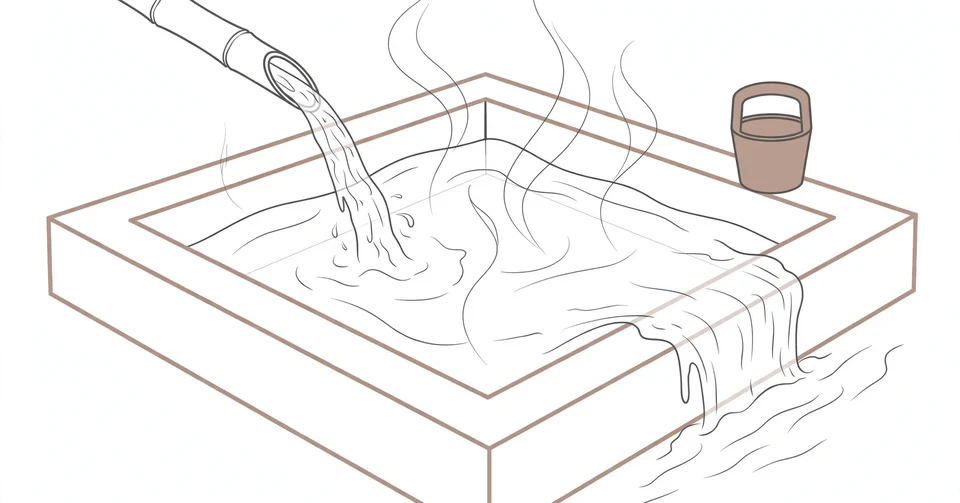
Stand at the edge of a small wooden bath in a mountain inn and you may notice something extravagant. The water never stops. It pours in from a bamboo spout, rises to the rim, and spills quietly over the side, all day and all night, whether anyone is bathing or not. That bath runs on gensen kakenagashi, and every litre of water in it is on a one way trip.
The words are simpler than they look. Gensen means the spring source itself, and kakenagashi means to pour and let flow. Put them together and they describe the oldest plumbing arrangement in Japan. Fresh water comes up from the ground, fills the tub once, and leaves for good. Nothing is filtered back into a gensen kakenagashi bath, nothing is pumped around in a loop, and nothing is reheated for the next bather.
Most bath water in Japan does not live this way, and for sensible reasons. So why do onsen fans treat gensen kakenagashi as the mark of a serious bath, and how can you tell whether a place claiming gensen kakenagashi deserves the claim? The answers sit in the plumbing, in the law, and on a framed notice that almost nobody stops to read.
What follows is a small education in reading water. Learn a handful of Japanese terms and one government form, and you will never look at a steaming tub in quite the same way again.
What gensen kakenagashi actually promises
The phrase is a report about plumbing, not a certificate of purity. Strictly speaking, gensen kakenagashi promises one thing only, that the water in the bath is not recirculated. It does not promise that the water is untouched, and this is where many visitors misread it.
A spring can come out of the ground far too hot to touch, and the inn may add cold water to bring it down to bathing temperature. A cool source may need heating before anyone can sit in it. Both steps are legal, both are common, and a bath can do either one and still honestly call itself gensen kakenagashi, as long as the treated water flows through once and is thrown away. As Japan Culture Navi puts it in its explainer of the term, kakenagashi only means the water is not recirculated, and it may still be diluted or reheated.
The term itself has no legal definition. It is a trade expression, which is exactly why the paper notice matters more than the painted sign. Japan's Fair Trade Commission warned as long ago as 2003 that advertising water as 100 percent source water while adding water, heating it or recirculating it could mislead consumers. The honest version of the claim is the modest one. A gensen kakenagashi bath is not swearing that nothing was done to its water. It is swearing that whatever was done, the water passed through once and was let go.
Some inns go further and cool their water without diluting it, running it through long pipes or wooden channels so the mineral balance reaches the bath intact. They usually advertise the fact, and it is a fair thing to boast about. But it is a refinement, not the definition.
The water that goes around in circles
The opposite of gensen kakenagashi is a recirculating system, called junkan-shiki. In a bath like this, the water you soak in has soaked other people before you. It drains away, passes through a hair catcher and a filter, is disinfected, warmed back up, and returned to the tub to begin another round.
Health ministry guidance for these systems is precise. The water is disinfected, usually with chlorine, and operators are asked to keep free chlorine at about 0.4 milligrams per litre, and no higher than 1.0. None of this makes a recirculated bath a fake one. The water still began its life as genuine spring water, and in a large hotel or city facility, recirculation is often the only workable arrangement. A grand communal bath can hold an enormous volume of water, and many springs simply do not produce enough to fill it fresh and keep it filled.
Recirculation also holds a bath at an even temperature and stretches a limited resource across hundreds of guests a day. There is a quiet honesty in that, too. A gensen kakenagashi bath avoids the whole loop by refusing to store water at all, but it can only refuse because its spring gives it more water than it needs.
Why only a generous spring can throw water away
The arithmetic is unforgiving. A gensen kakenagashi bath discards every litre after a single use, hour after hour, so the spring underneath it has to produce more water than the bath can hold, continuously, in the coldest week of the year as well as the warmest.
Japan is rich in springs, at least on paper. The Environment Ministry counted 27,899 spring sources across the country at the end of March 2025. But they vary enormously. Around 46 percent of them emerge at 42 degrees Celsius or hotter, and many come out of the ground above 50 degrees, hot enough to scald. At the other end, roughly 15 percent are cooler than 25 degrees and count as onsen only because of what is dissolved in them. Flow varies just as wildly as temperature. Some sources roar. Others seep.
This is why gensen kakenagashi tends to belong to small inns and old bathhouses in spring rich towns, where one strong source feeds a handful of tubs, rather than to large resorts with a dozen baths to fill. You can usually see the truth of it at the rim. In a real gensen kakenagashi bath, water is genuinely running over the edge and away. I have come to listen for that small, wasteful sound. It is the sound of a spring with something to spare.
The notice by the changing room door tells the truth
Japanese law gives bathers a way to check all of this, and it hangs on the wall. Under Article 18 of the Hot Springs Act, every facility that offers spring water for public bathing has to post the water's contents, the conditions that make bathing unwise, and the precautions to follow, somewhere guests can actually see them. Since May 2005, the rules have gone further. If a facility adds water, heats the water, recirculates it, puts in bath additives or disinfects the water, it must say so on the notice, and give its reason.
The result is a framed sheet, usually waiting beside the changing room door, that quietly settles every argument about what is in the tub. Alongside the treatment lines it lists the source name, the spring type, the temperature at the source and what the last analysis found in the water. The Sumimasen Guide walks through the sign in detail, including the Japanese words for each treatment, and it is worth a look before your next trip. If none of the treatments are listed, the bath in front of you is the real thing.
One catch is worth knowing. The notice is written for each bath, not for the whole building, and a facility with several baths may run them differently. The grand bath might recirculate while the small one outside flows free. The same applies when you book a kashikiri private bath for your own group. It is worth asking which water it uses, because the answer is not always the same as the main bath down the hall.
Fresh is not the same as perfect
It would be tidy to declare gensen kakenagashi simply better, but the water refuses to cooperate with tidy stories. Recirculated baths are filtered and disinfected for a reason. Warm, still, reused water is where Legionella bacteria thrive, above all inside filters and pipes, and Japan tightened its expectations for disinfection after a Legionella outbreak in Miyazaki in 2002. A free flowing bath sidesteps much of that risk by never storing water, but it is not automatically safe either. Guidance for these baths still stresses scrubbing slime from tubs and pipes, and some gensen kakenagashi baths are disinfected with chlorine as well, which is why the purest sounding bath can carry a faint smell of the swimming pool.
Spring water also starts changing the moment it meets the air, as dissolved gases escape and minerals react with oxygen. That is the real argument for gensen kakenagashi, I think. Not purity, but freshness. The water in an overflowing tub left the ground minutes ago, and it reaches your skin before the air has finished altering it.
Reading the notice is a habit worth building for other reasons, too. A bath that is honest about its water tends to be honest about its other rules, and anyone travelling with tattoos will want to check those before undressing, as our guide to onsen tattoo rules in Japan explains. The small print is where Japanese bathing keeps its manners.
In the end, gensen kakenagashi is a small luxury granted by geology. A spring either produces more than its baths can use, or it does not, and no advertising can argue with that. When you find water running over the rim of a quiet tub, you are looking at the surplus of a generous piece of ground, spent once and let go. As definitions of abundance go, it is a hard one to beat.
More in Life & Style
Latest posts
- Japan's Population Decline and the Villages It Leaves Behind
- Kecap Manis and the Sweet Soy Sauce of Indonesia
- In Mamoiada, Two Hundred Families Still Make Wine at Home
- Shochu and the Quiet Spirit of Japan
- A Dried Shiitake Is Louder Than a Fresh One
- Maruten Numazu and the Towering Kakiage Bowl of the Port
- The Three Sisters Grow Better Together
- Half the Old Springs in Japan Thank Kobo Daishi
- Tatamiishi Terraces Filter a River Through Stone
- Wasabi-Zuke Puts the Whole Plant in Sake Lees
- Karo Is the Tengger's Other Great Gathering
- Urashima's Dragon Palace Had a Name, Ryugu
- Petruk's Nose Arrives Before He Does
- Why Nicoya Cooks Its Corn in Lime
- A Ngaben Can Take a Village Years to Prepare